



















Opening
Some games are built to test your reflexes. This one is built to hand you back your childhood, frame by frame.
Most people boot up Dragon Ball Z: Kakarot to settle a single question they have carried since they were ten years old — what does it actually feel like to be Goku? CyberConnect2 answers with something close to obsession. They did not retell the story; they rebuilt the whole of Dragon Ball Z, from the Saiyan invasion all the way to Majin Buu, matching the anime's storyboards, camera pushes and the exact beat where a character holds a pose. Then they put the controller in your hands. So Goku's first transformation into a Super Saiyan stops being a thing you watch from the couch — it becomes the moment your own thumb holds down a button, the screen blanches white, and the hair stands up.
Because the game stakes everything on letting you be Goku one more time, its reception splits cleanly in two: the critics landed it around 73, while 93% of Steam players gave it a thumbs up across more than 43,000 reviews. That gap is not a fight about quality. It is the weight of nostalgia, measured. The 10 million copies it has now sold, and the six straight years of DLC that pushed it there, only widen the distance between how the press graded it and how the audience voted with their wallets.
What follows takes this nostalgia machine apart — where it sings, and where it shows the honest ceiling of a 2020 anime-licensed action RPG. The verdict up front: if you grew up on this show, it will almost never let you down. If you did not, the gameplay flaws that nostalgia papers over will surface fast.
Story | 9.0/10
Story: 9/10From Raditz at the door to a wish on Shenron — 30 hours that give you back all of Dragon Ball Z
Turning a sprawling, decade-spanning anime into a playable campaign is not a technical problem first. It is a problem of what you leave out. Kakarot refuses to leave out anything.
The Saiyan arc has Piccolo and Goku teaming up to take down Raditz before Nappa and Vegeta arrive; the Frieza arc flies you to Namek to gather the Dragon Balls and delivers Goku's first Super Saiyan transformation; then come the Androids and Cell, Gohan's awakening, and finally the fusion-fueled chaos of the Buu saga. The main path runs roughly 30 hours, which is exactly long enough to lay the entire remembered spine of the show back in front of you, one beat at a time — not a greatest-hits montage, but the full arc, including the connective tissue most adaptations cut.

The upside of refusing to cut is obvious: you are not watching someone else's highlight reel, you are throwing every signature punch yourself. The cost is that the narrative ambition stops at faithful reproduction. There is almost no original reinterpretation here — you already know every turn, and the suspense was spoiled by your own memory two decades ago. For the faithful, that is the whole point. For anyone who never watched the source, this is a very long drama you have no emotional account in.
The storyboards line up with the anime — CyberConnect2's recreation craft is the real thing
If replaying the plot is an attitude, recreating it shot for shot is a skill. CyberConnect2 made the Naruto: Ultimate Ninja Storm series, and turning anime cutscenes into something cinematic is the studio's signature, built over years. All of that craft cashes out on Dragon Ball here. The opening leans on the series' iconic music, and several shots transition almost seamlessly into and out of the original animation; in the fights, the pause before a character settles into a pose and the rhythm of the camera's pull all answer to the TV anime.
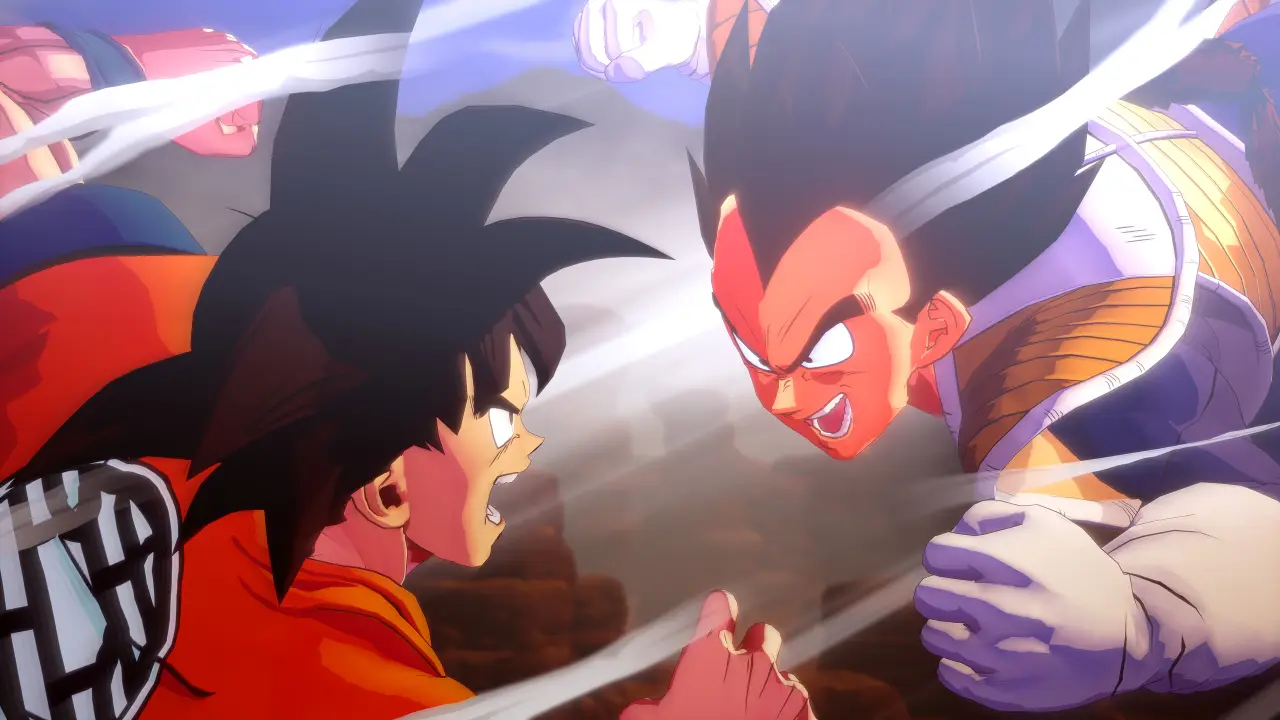
The voice work matters even more. The game keeps the original Japanese cast, including Masako Nozawa, and the instant that unmistakable Goku voice opens its mouth, a memory you forgot you had lights up. When Goku shouts his line at Frieza, when the golden flash of Super Saiyan first detonates, performance, voice and music lock together into something that is not a "game cutscene" but the actual episode you watched as a kid, except now the scene answers to you. No fighting game in this IP can manufacture that feeling.
Filling the gaps the anime skipped — Goku's appetite, Vegeta's stubbornness, Gohan's burden
Lining up the famous moments is not enough. What actually lets this narrative RPG stand on its own is the way it uses a flood of everyday dialogue and side stories to turn corners the anime brushed past into specific people. Goku's bottomless appetite becomes a running thread of cooking and fishing; Vegeta's slow walk from prideful rival to reluctant ally gets fed one conversation at a time; Gohan's weight as the son everyone pins their hopes on, and the unexpected warmth of Piccolo becoming his mentor, are all made concrete through playable beats.

This is the single biggest thing separating it from a pure Dragon Ball fighting game. A fighter gives you the punch and nothing around it; this gives you the life between the punches, and that life fills the seams between the major battles while propping up the emotional foundation of a 30-hour run. You watch the domestic comedy of a man who eats too much, you sit with Krillin and Tien — the human fighters — in their helplessness and stubborn courage against beings who outclass them. Characters the anime would dismiss in a single line are handed a real, occupied presence. The trade-off is dilution of pace: between one big fight and the next you are expected to fish, run errands, and gather Dragon Balls, and for someone who only wants to brawl, the downtime drags. Story earns its 9.0 not on original surprises but on the sincerity and execution of turning an entire memory into something you can play.
Audio | 8.5/10
Audio: 8.5/10The moment Masako Nozawa opens her mouth — the audio alone is worth the ticket
For a nostalgia piece, sound lands closer to the nerve than visuals ever do. Kakarot leaves almost nothing on the table here: it brings back the original Japanese cast, Masako Nozawa among them, and that Goku voice — the one that raised a couple of generations — flips a switch the instant it speaks. This is not "find a soundalike and call it close." It is the voice from the show, lifted into the game intact.

For longtime fans, that recreation of sound is the single most emotionally loaded stroke in the package. When the Goku you are steering shouts a line you know by heart, when Vegeta speaks in that stubborn register, you are not hearing voice acting — you are hearing the era itself. A lot of those Steam thumbs-up exist partly because of it; the cast is impossible to leave out of the equation.
The battle score detonates on cue — how the music hands the fight a knife
If the voices wake the memory, the music drags the feeling to its peak. The opening reaches for the series' signature track and snaps you back onto a familiar frequency immediately, but the real craft is in how the battle score interlocks with the story's pivot points. At Goku's first Super Saiyan transformation, at the showdown with Frieza, the music cuts to a soaring arrangement that rises in step with the camera and the character's outburst, and the back of your neck prickles.

The sound design pulls its weight too. The rising hum as ki charges, the roar of a Kamehameha leaving the hands, the crackle of two beams locking in a Beam Clash — these give heft to fights that could otherwise feel weightless. Plenty of contemporary Japanese action RPGs build their identity on an original orchestral score — Tales of Arise and its fresh soundtrack, say — but this game takes the opposite road: it mobilizes the memory you already carry. On originality it loses; on nostalgic recognition it is near untouchable. The new-gen update left the audio core untouched, which means the music and voice work — its real strength — stay identical no matter which platform or version you buy in on. Audio takes an 8.5 on the strength of sounding right from the first syllable.
Worth flagging: the music here does more than sit in the background — it actively conducts the narrative's pacing. The everyday exploration stretches run on light, gentle melodies that pull you out of combat tension and back into the lived-in warmth of the Dragon Ball world.
The moment the plot pushes toward a decisive clash, the score holds a beat of silence or low rumble to gather force, then floods to full volume as the character erupts. That hold-then-release mirrors the calm before the storm in the original animation almost exactly. For anyone who cares about staging, this marriage of music and story is its genuine bonus on top of the nostalgia points.
One practical note for the import-minded: the dual-track approach matters here. The English dub is competent and uses the cast Western fans grew up with, but the Japanese track with Nozawa is where the recreation truly closes the loop — the cadence of every grunt and battle cry was tuned to lines first recorded decades ago, and switching languages noticeably changes how "authentic" a given scene reads. If the nostalgia is the reason you are buying, the language toggle is not a cosmetic setting; it is part of how faithfully the game hits.
Visuals | 7.0/10
Graphics: 7/10Cel-shading drawn tight against the anime — golden hair flares, ki beams split the sky
On visuals, Kakarot's goal was never in doubt: not to chase top-tier technical specs, but to make you feel like you are looking at the right thing. Built on Unreal Engine 4, the art commits to a cel-shaded style loyal to the source, keeping model work, color and outlines as close to the TV anime's texture as it can. The instant Goku's hair flares up gold, it reads like a freeze-frame from the show dropped into a 3D space.

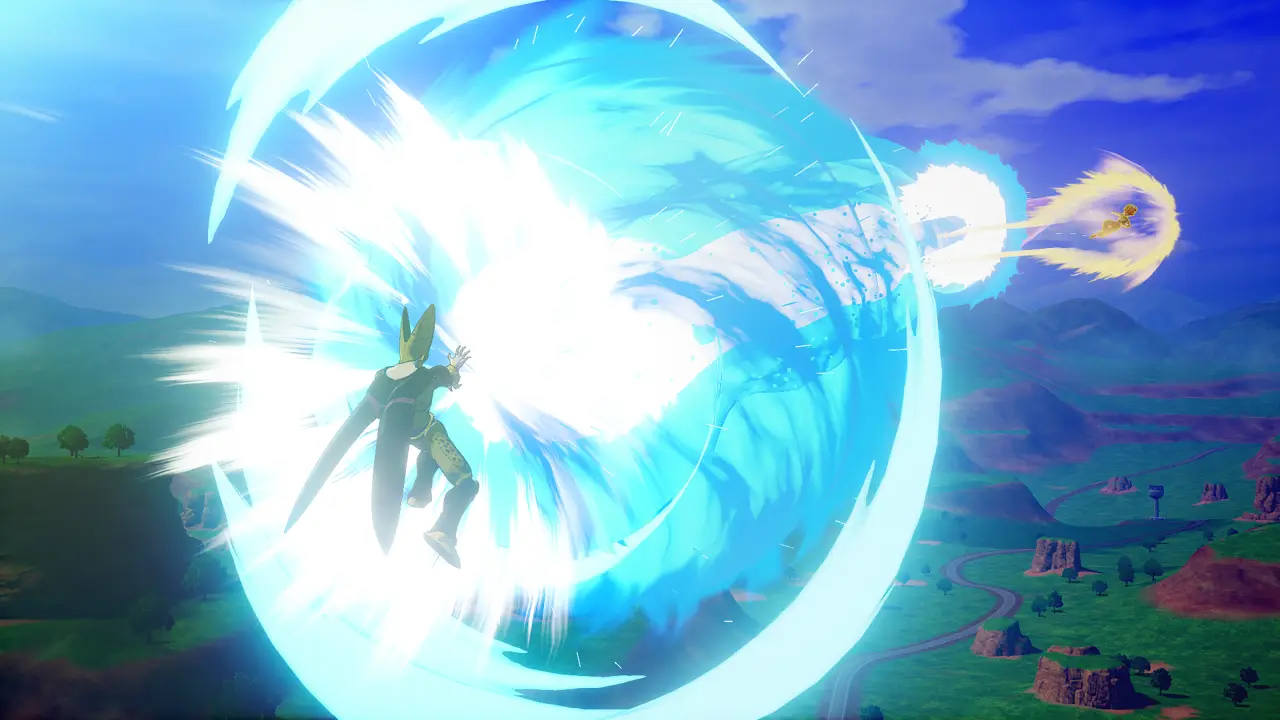
What actually gives the visuals their punch is the combat staging. The aura crackling around a charging character, the way a Kamehameha's beam tears a line across the sky, the terrain caved in by high-speed melee — all of it captures the original's sense of raw power overwhelming everything. The fidelity of those signature moments is the real metric this dimension is scored on, and on the question of "does it look like that episode," it delivers. Namek's reddened sky, the cracks Cell shakes out of the earth — the palette and framing of the landmark scenes precisely match what your memory kept, and that flicker of instant recognition is the most valuable thing the visuals own.
Empty middle distance, long load times — the 2020 tech foundation can't hide
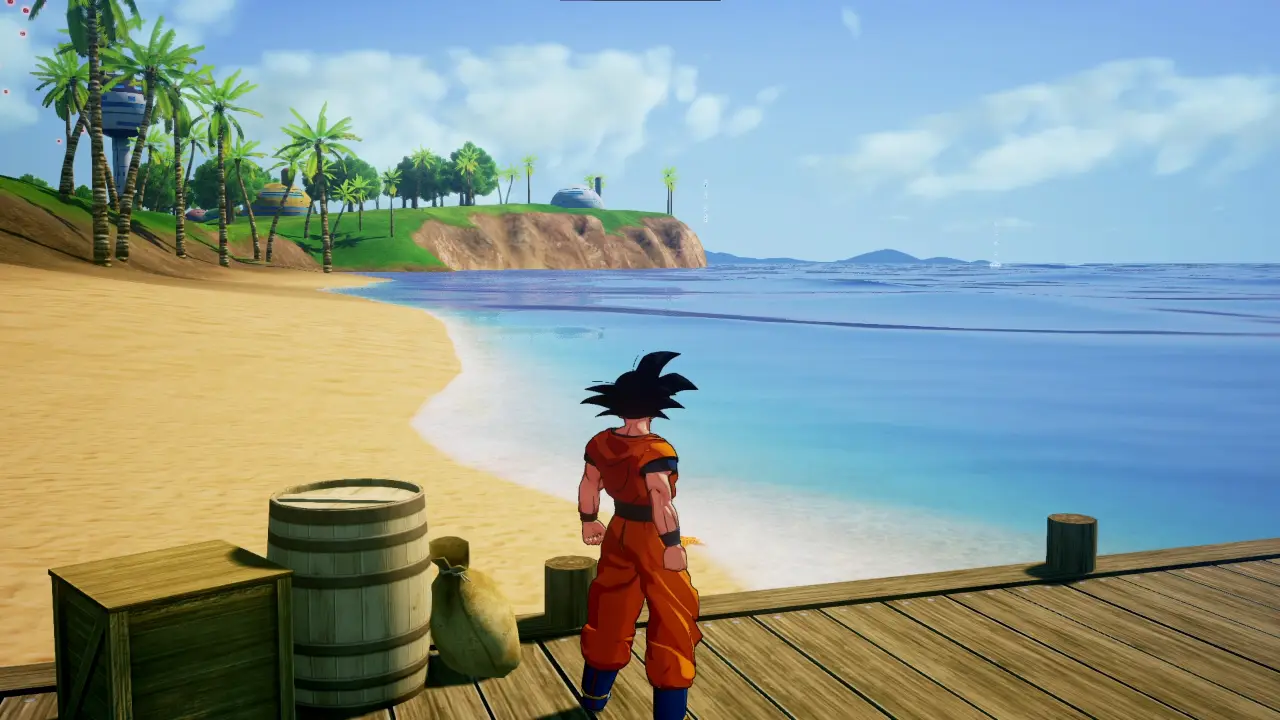
Pull the camera back from the combat close-ups, though, and the technical shortfall stops hiding. Texture and model detail across the open zones is merely passable, the middle distance runs sparse, and the everyday exploration spaces look a clear notch rougher than the lovingly polished fights. Put plainly, the art budget got dumped onto the staging; the day-to-day visuals are good enough and no more.
The more concrete problem is loading. On last-gen consoles — PS4, Xbox One — load times stretch long enough to break the rhythm; every entry into a fight, every zone change, makes you wait, and the constant black-screen loading bars saw the connected thrill of combat into pieces. Critics and players alike flagged it as the era's clear flaw, and it dominated the early word of mouth more than any single visual complaint did.
The 2023 new-gen update made it a priority fix: PS5 and Xbox Series get a free upgrade, with separate "cinematic" and "quality" modes for higher fidelity versus up to 60 frames, and an SSD slashing the load times until the campaign finally flows. In other words, the gap between platforms is less about the image itself than about whether you are willing to tolerate the old machines' loading — the cel-shaded look barely changes across hardware, but the feel of moving through it transforms.
The version spread is worth knowing before you buy. PC, with a fast drive, sidesteps the loading complaint that haunts the base consoles outright; the Nintendo Switch port, by contrast, makes the heaviest concessions — softer textures, a trimmed-down draw distance — to fit the cel-shaded fights onto handheld silicon, and it is the one platform where the "scenery is plain" critique bites hardest. For comparison, CyberConnect2's own Naruto: Ultimate Ninja Storm series shares the cutscene craft and counts as studio signature, yet on open-world polish this game — boxed in by the scope it reaches for and its release year — lands at "staging dazzles, scenery is plain." Graphics scores 7.0, the exact compromise of a ceiling that shines and a foundation that does not quite hold under it.
Combat | 6.0/10
Gameplay: 6/10Fly up and fire a Kamehameha — aerial combat and Beam Clash make the set pieces playable
Start with what the combat gets right. Kakarot runs a third-person 3D aerial brawl: you fly freely, dash to dodge, lock onto an enemy for melee strings, then spend ki to fire energy blasts. Charge ki to the brim and you unleash the series' signature finishers — Goku's Kamehameha, Vegeta's Final Flash, Gohan's father-son Kamehameha, and the planet-fueled Genki-Dama. The single most central Dragon Ball fantasy — you can fly, you can throw ki — is turned into something that sits comfortably in your hands. That much, it nails.

The cleverest touch is the Beam Clash: two energy waves collide mid-air and you mash to push your side past the other, which is the original's "power versus power" set piece made playable.
Stack on the Super Saiyan 1, 2, 3 and Super Saiyan Blue transformation systems — each shift rewrites your moveset and your numbers — and the anime's sensation of climbing one more rung gets reproduced. Judged purely on Dragon Ball flavor, the combat is full.
One combo string all the way down — sameness across characters and weak AI are the real ceiling
Play deeper, though, and the cracks rise. The biggest one is a lack of differentiation between characters — Goku, Gohan, Vegeta, Trunks share combo structures and feel so closely that swapping a character is mostly swapping a skin, the tactics barely move, and the novelty hits its floor fast. One familiar string carries you from the Saiyan arc to the Buu saga.

The enemies can't hold up the difficulty either. The AI poses little threat and most ordinary fights fall to stat-stacking and a transformation; the occasional balance lurch swings the other way, with foes dropping into heavy super-armor where your hits land for nothing while you get staggered, and that "can't-hurt-them-but-they-hurt-you" friction sours the experience.
The systems that should add texture mostly skim the surface. Support characters can be slotted in to chip damage or heal, a tension gauge lets you spike into a burst window, and ki management nominally gates how often you can fire — but none of it ever demands real decision-making once your numbers outpace the encounter. Set it next to the IP's hardcore competitive fighter, Dragon Ball FighterZ, and it gets clearer: that game is an arena for experts to study frames and combos, while this one takes a low-barrier, relive-it road — fun, sure, but not in the same depth bracket. Gameplay takes a 6.0, docked for being quick to learn and just as quick to bottom out.
Community Boards and Soul Emblems — the deepest-designed layer in the whole game
The progression layer is one of the game's rare design highlights. It uses "Z Orbs" training tables as a skill tree, spending experience to unlock and strengthen moves; characters level for raw stat growth; cooking grants temporary buffs, and a maxed-out dish noticeably lifts your stats; D-Medals slot in for passive bonuses. That framework is by-the-numbers on its own, but its "Community Board" system paired with "Soul Emblems" was singled out by multiple outlets as the most thoughtfully designed part of the game.
It works like this: collect each character's Soul Emblem, slot them into the seven boards — Z Fighters, Master and Pupil, Cooking, Development, Adventure and so on — and different arrangements feed bonuses into combat power, cooking, fishing or machine development, while adjacent emblems trigger exclusive story dialogue. For series fans, the system is both a min-maxing minigame and a hotbed of Easter eggs — you will deliberately chase a particular character pairing just to hear one specific exchange. It doesn't rescue the thin combat, but it is genuinely the layer most worth your time. Put another way, the pleasure here is not in getting stronger — the difficulty is too low for that to matter — but in collecting: to complete a board, to unlock a line, you go hunting through the story for the character bonds scattered across it. That motivation comes straight out of your familiarity with the source, and it proves once more where the center of gravity sits: every system bends toward serving the fan.
Content | 8.0/10
Content: 8/1030 hours for the main story, 53 to clear it all — Intermissions stuffed between the arcs
Start with the bulk. Kakarot's main story runs about 30 hours, and chasing the side quests, collectibles and Community Boards to completion stretches it to roughly 53. It advances by arc, mirroring the source — Saiyan, Frieza, Androids and Cell, Buu — and between each arc's marquee battles it drops in free-roaming stretches called Intermissions, letting you taste the everyday life of the Dragon Ball world in the gaps between two hard fights.
The structure's upside is a give-and-take pace: after a high-intensity story fight, you get a breather to fish, cook, spar with the Z Fighters, race in the Z Encyclopedia trials, or gather the seven Dragon Balls to summon Shenron for a wish (cashable for experience, Zeni or rare items).
For fans who want to soak in the world, that downtime is a plus; it is also where the pace gets watered down, a point the next section gets into.
Z-orbs blanketing the map and fetch-quest side jobs — plenty of content, but the padding shows
Bulk does not equal density, and that is this dimension's most honest shortfall. The open world hands you weak reasons to explore: gathering materials like herbs and ore mostly sit in place waiting to be scooped up, with none of the joy of searching or solving; the most-criticized piece is the Z-orb collectibles, scattered so thickly across the map that picking them up carries no sense of accomplishment.
The side quests run thin on variety too, cycling between "go fight someone" and "help gather supplies," and the repetition piles up fast. The map's dense thicket of markers is a drive for the completionist and visual clutter that pushes everyone else away. This filler stretches the run without stretching the fun alongside it, the clearest deduction against the content's quality.
Be honest about what the extra 23 hours between the 30-hour main story and the 53-hour completion actually buy you: mostly more of the same loops, not new ideas. The padding is wide rather than deep, and a player who treats the campaign as the product — rather than a checklist to 100% — loses very little by skipping most of it.
10 million copies sold, updates running to 2026 — top-tier long-tail for a licensed game
Pull back to the operations level and the game's stamina is genuinely striking. In January 2026, Bandai Namco announced cumulative sales across all platforms had broken 10 million — a standout commercial result for an anime-licensed RPG. Propping up that longevity is a sprawling DLC roadmap.
From "A New Power Awakens" Parts 1 and 2 filling in Dragon Ball Super's Beerus, Whis and Golden Frieza, to "Trunks — The Warrior of Hope" covering the parallel-world Androids arc, to "Bardock — Alone Against Fate" launched alongside the new-gen version, then "Goku's Next Journey," all the way to "Adventure Through the Demon Realm (DAIMA)" rolled out in two parts across 2025 into 2026 (a $34.99 bundle on the Switch store) — it was still drawing fresh blood six years after release. That kind of long-tail support is top-tier among licensed games and the key to its run from 2020 to ten million copies. The long DLC road also means beating the base game is nowhere near the end. If you are willing to keep investing, Super's new power tiers, the parallel world's tragic side arc, even the new chapter reaching into DAIMA can keep you in this world for dozens more hours. Most of it is paid, of course, and whether it is worth it depends on how much love for Dragon Ball you have left — for the true believer it is an extension line with almost no end; for someone who just wants one run through the story, the base game is already complete on its own. Content scores 8.0, the result of weighing two ends against each other: maximal bulk and long-term service, watery density per stretch.



Comments 0
Share your game review
Join the discussion and share your review of this game.
No comments yet. Share your thoughts on this review.