



















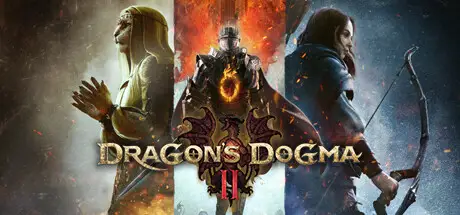
Opening
The griffin came out of the cloud line while I was still crouched on a cliff path, fussing over my Pawns' formation. A second later my Arisen was dangling from a pair of talons, hauled into the sky. No loading screen, no cutscene cutaway — just a rush of panicked wind and the party screaming in confusion below. That was the moment it clicked: the best thing about Dragon's Dogma 2 was never "how big the map is." It is how reliably the game tears a hole in your plan the instant you think you have everything handled, then dares you to make a decision inside the chaos.
Critics handed it an 88 on Metacritic, an 87 on OpenCritic, a 91% recommendation rate. At the same time, Steam players were drowning it in negative reviews. The split is not an accident. Reviewers were grading the craft of the combat-Pawn-exploration loop; players were venting about paying full price and hitting frame drops and a surprise drawer of microtransactions. The two camps were holding different rulers.
So let me say this up front: it is rough, and it is captivating, both at once. You do not play this for a smooth experience curve. You play it for the moments that nearly went off the rails and somehow held together. From here we walk from its strongest hand — the gameplay — all the way down to the performance and the controversy that hurt most.
Story | 6.8/10
Story: 6.8/10The old Arisen-and-dragon frame: it lands, but it does not linger
The main plot keeps the series' signature setup. You are the Arisen, your heart torn out by a dragon, bound to a fated road of reclaiming it and slaying the beast — this time with a layer of royal succession and palace intrigue laid on top. The idea is fine; the execution plays it safe. It tells a complete story and gives you reasons to push forward, but it never generates that "I have to know what happens next" pull. You'll see it through. You won't remember it long.

The few narrative beats that genuinely hold up are the Sphinx's riddle trials and the racial-conflict thread out in the beastren nation of Battahl. The Sphinx breaks the usual march with brain-teaser challenges that force you to stop and think instead of swinging mindlessly; Battahl lends the world a sliver of political depth and a perspective beyond the human kingdom.
But these are point sources, scattered across the run, never strung into a throughline you carry with you. The framework around them — the prophecy, the false sovran, the climb toward a confrontation with the dragon — is competently arranged but emotionally muted, the kind of plot you nod along to rather than lean into. By the time the credits roll, what stays with you isn't the storyline at all; it's a handful of isolated moments you stitched together yourself.
The adventure outshines the script — and that gap stings
The real narrative weight sits not in the linear screenplay but in the event-driven feel of the road. Which creates a delicate tension: the things that happen to you on the way are routinely more alive, more memorable, than the scripted chapters.

Getting chased across a mountainside by a monster at midnight; bailing out a stranded NPC at the roadside; stumbling onto a hidden ruin because you got greedy and detoured — none of these were written into the main script, yet they are the first images you reach for after the credits. They are not authored climaxes; they are stories improvised by systems, terrain, Pawns and the time of day colliding. The upshot is a split: the adventure is gripping, the main quest is merely okay.

Come at it expecting a story-driven RPG and you'll likely walk away disappointed. Treat it as an adventure tale assembled out of systemic events, and your tolerance climbs sharply. Shift the lens and the verdict flips entirely, from a thin story to a generous engine for stories you author yourself simply by choosing where to walk and when.
The old flaws survive untouched, and small choices pile on the friction
Set it against the storytelling ceiling of something like The Witcher 3 — which writes its side quests with main-quest weight — and Dragon's Dogma 2's characterization and dialogue fall short by more than one rung. Its people mostly stay functional: they hand you a task, a clue, a direction, and rarely earn the kind of lasting hook a Bloody Baron leaves behind, let alone make you ache over a supporting character's fate.
More to the point, many have called this game one that "inherits the predecessor's strengths and faults wholesale, more a high-spec remake than a sequel." The strengths worth amplifying got amplified, but the thin writing and clumsy guidance — old complaints from the original — survive intact. Add a single save slot that punishes experimentation and certain key story triggers obscure enough to miss outright, and the narrative experience sinks a notch further. Some players stumbled into a rushed ending simply because they didn't talk to the right person at the right time, only realizing afterward that they'd skipped a whole stretch of content. A 6.8 here is no catastrophe — the story does reach its end — but in an open world this ambitious, the writing is the leg that drags. It hands you a stage worth exploring, then fails to tell a tale equally worth revisiting on it. That is the thing fans love it despite, and grieve over most — a great script could have stretched the afterglow of this journey several times over, and it never quite delivers that gift.
Audio | 5.5/10
Audio: 5.5/10The score does its job, but rarely makes you stop and listen
Audio is the least distinctive of the six dimensions. The soundtrack isn't broken — it lifts the tension right on cue when a behemoth appears, the battle percussion keeps step with the action, and the epic mood arrives when it's supposed to — but you'd struggle to hum a single one of its themes afterward. It's diligently fulfilling a baseline duty rather than actively bending your emotional arc upward.

That's a real shame in a game leaning this hard on roadside encounters and split-second danger. Music here ought to be the lever for tension and grandeur: a well-placed string swell could make the griffin's dive hurt more, a stretch of silence could sharpen the loneliness of a midnight march, a triumphant motif could turn a hard-won kill into a memory. The original game had a famously over-the-top vocal battle anthem that fans still bring up years later; this sequel has nothing that sticks in the same way. Had this score carried a touch more personality, a bit more nerve at the emotional beats, it could have pushed the whole experience up a level. As it stands it is merely adequate — it won't grate on you, and it almost never makes you stop to hear a piece out.
Voice work feels stiff, and ambient sound is just competent backing
The dialogue and voice acting come across stiff in places, occasionally out of sync with the visual mood and the combat tension. You can parse the information and follow the thread, but the sound itself rarely grips you — it never became a talking point in the community, which tells you plenty about how thin its presence is.

Ambient sound sits at the same level: footsteps, weapon swings, the wind and rain and insect hum of the natural world are all competent functional feedback, telling you exactly "what just happened" without forming any memory hook. The upside is it never hogs the stage; the downside is precisely that — its presence is so low you barely register it. Set against fellow Capcom title Monster Hunter: World, where a hunting theme kicks in and instantly fires you up and wakes your muscle memory, Dragon's Dogma 2's audio identity is markedly weaker, missing that signature auditory anchor welded to the gameplay. A 5.5 captures that state: it doesn't drag the experience down, but it barely adds to it either — a quiet corner piece that offends no one and that no one remembers. In a game where every other dimension has sharp, defined edges, the blandness of the audio stands out as oddly conspicuous, like the one flavorless dish on an otherwise excellent table that nobody reaches for twice. It is the rare part of this game with no strong opinion attached to it at all — and for a title this opinionated everywhere else, that flat absence is its own quiet kind of disappointment.
Visuals | 7.2/10
Graphics: 7.2/10Dark fantasy held up by RE ENGINE: the mood is genuinely there
The visual character is what the game can comfortably show off. RE ENGINE plants the dark-fantasy register firmly, and when a vast scene collides with a giant monster the impact is the real thing — you feel the world pressing down on your character rather than a backdrop posing politely behind. The bulk of the creatures, the sheer vertical drop of the terrain, the shifting daylight all conspire to make you feel small and exposed.

The close-quarters dread of meeting a giant griffin on a summit, the clash of firelight against cold mist at a cave mouth — these are concentrated proof of its atmospheric staging, the kind of frame where danger spikes in an instant. It doesn't chase the last strand of hair or the finest grain of rock the way the top-tier graphics benchmarks do. It plays more like a fantasy film with a killer eye for shot composition, using framing, light and scale to burn a single moment into memory. It understands mood over spec sheets, conjuring scenery that leans on you rather than merely dazzles you. That "atmosphere first, parameters second" instinct shows up most on the road: morning fog, dusk clouds bearing down, a circle of torchlight as the only thing carving sight out of the dark. You instinctively race to beat nightfall, hold your breath when a behemoth surfaces — reactions earned by art direction, not resolution.
Performance is the real problem: pegged CPU, town frame drops
But the technical trouble cannot be dodged, and it is exactly one of the fuses that blew up the launch reception. CPU usage on PC runs sky-high, and frame rate craters whenever you hit a town or a quest crowded with NPCs. Plenty of people paid full price only to drop into the thirties and forties the moment they entered a settlement — CPU maxed, GPU half-asleep, and no graphics setting that claws it back.

What makes it worse is that even on a high-end PC the image quality underwhelms, with a completion level that visibly oscillates between sharp and shabby. This is not one isolated blemish but a stability problem that runs through the whole experience, and it lands hardest precisely where the game wants to impress — the bustling capital, the crowded plaza, the set-piece moments built to show the world off. To its credit Capcom didn't shrug it off — it kept shipping patches, gradually shaving down the CPU load and improving town frame rates, so performance genuinely improved over the months that followed. But the lousy first impression from those launch days, when the game was at its most visible, has proven very hard to scrub off.
Stack it side by side and the gap shows — yet mood claws a point back
Put it next to its open-world contemporaries and the gap is visible. Against the world-level precision and detail stability of Elden Ring, Dragon's Dogma 2 trails by a clear tier — its world has plenty of menace but isn't "clean," with rough edges around the margins popping up to break your immersion.

Still, graphics aren't a thing you read off a parameter sheet. If you're willing to put the weight on the adventure rather than a pure pixel-peeping tour, it serves up no shortage of high points: a behemoth silhouetted in the dusk, a winding mountain road swallowed by fog, an encounter lit by a fork of lightning in a downpour, an ancient bridge half-swallowed by creeping mist — memory-makers that hold their own against far "cleaner" rivals. So 7.2 lands as a precise score: atmosphere adds, technical stability subtracts, and together they form a report card with both genuine bright spots and real, lingering wounds. It won't be remembered for how polished it looks, nor written off for not topping the charts — atmosphere is its true trump card, and on that front it punches well above its technical weight. In other words, the instant you start resenting how rough it is, it pulls you back with one gorgeous silhouette against a bruised sky and you forgive the jank all over again, ready for the next ridge.
Combat | 8.7/10
Gameplay: 8.7/10The big-monster fights are the real headline — and you have to climb
Combat here cannot be summed up by "it feels good." What grabs you is that fighting something huge becomes a physical act of climbing. A cyclops, a griffin, a chimera — swinging at its ankles is not enough. You grab a leg, scramble up the back, dig your fingers into the neck, find the weak point and start hacking, and if it shakes you loose you have to find your way back up all over again.

The tension this produces is best in class. A griffin beats its wings to throw you off; a cyclops drops and rolls to crush the rider on its shoulders. You and your Pawns juggle balance, target priority and the question of when to let go and drop clear. None of it is stat-check brute force. It is a chain of small calls you make in the moment, under pressure, with the clock against you.
That is also why no two giant encounters land the same way. Take the same beast, change the terrain, swap your Pawn loadout, switch your own vocation, and the rhythm of the fight is reborn from scratch. The game treats every monster as a fresh puzzle rather than a wall of HP, and that keeps the spectacle from going stale across a hundred-hour run.
A four-Pawn party that guides you, reads enemies, and climbs alongside you
If the kaiju fights are the headline, the Pawn system is the series' soul. You sculpt a main Pawn at the start — its vocation, its temperament, the way it talks — then borrow two more from other real players through the otherworldly Rift to round out a party of four.

These are not silent stat sticks. They remember and they learn. "I've walked this road, follow me," one calls out on familiar ground; another flags a fire-weak enemy before you've even drawn a weapon; a third tugs you toward a chest or a hidden path it spotted in someone else's world. In a fight they sort their own roles — the mage enchants your blade and circles back to heal, the fighter plants himself up front to hold aggro, the thief slips behind for damage and scrambles up the monster with you when it counts. The loneliness of a long march gets diluted by their constant chatter.
The borrowing loop is the clever part. The two Pawns in your party arrived carrying knowledge shaped by someone else's playthrough, and when you send them back through the Rift they take what they learned with you. Every party you assemble carries a trace of another player's world — a form of asynchronous connection that no other open-world RPG quite copies.
Vocations in three tiers, with hybrids that blow the build space wide open
The depth lives in the vocation system. It runs three tiers: basic classes (Fighter, Archer, Thief, Mage), advanced ones (the hard-hitting Warrior, the long-range Sorcerer), and the hybrid vocations only the Arisen can touch.
The hybrids are where late-game play gets its real flavor. The Mystic Spearhand wields the Duospear and stays balanced at every range, sliding between front-line slashing and back-line magick without missing a beat. The Trickster is the strangest of the lot — it deals almost no damage itself, instead conjuring illusions out of its censer smoke to bait enemies into killing each other, and temporarily pushing your Pawns past their normal ceiling. The Trickster, in other words, turns "directing the party" into the core loop, casting you as a backstage conductor of the whole fight. That is a bold, rarely-seen idea for an action RPG.
Better still, you can swap and re-spec a vocation back at a settlement any time, no lockouts, no penalties, which nudges you to keep tinkering with new builds and party shapes. The same monster, brute-forced as a Warrior or out-thought as a Trickster, becomes two entirely different problems — and that is exactly where the combat earns its replay value.
Exploration is on foot, not by teleport — a thesis, and a turn-off
The game deliberately strips away modern open-world convenience. No map littered with question marks, no teleport on demand. Fast travel is squeezed down to fixed-route oxcarts — which can be ambushed mid-journey — and a scarce supply of Portcrystals. The point is to make travel itself the content again.
So walking from one town to the next becomes a sequence of real events. Goblins set an ambush in daylight; dusk falls and stronger nocturnal monsters start to prowl; your stock of supplies and lantern oil turns into a variable you actually weigh. To one kind of player this is the wellspring of immersion. To another it is a grind.
It also offers no true real-time co-op — the two extra Pawns in your party are all borrowed asynchronously, so you cannot adventure side by side with a friend, a point plenty of reviews singled out as a letdown. Love it and you cannot put it down; bounce off it and you quit. The fork in the road of its polarized reception starts right here.
Content | 8.3/10
Content: 8.3/10Thirty hours of main story, but you'll probably log a hundred
Fixated on the main quest alone, Dragon's Dogma 2 wraps in roughly 30 hours — about the same length as the original. But almost every player's real playtime will balloon far past that: dabble in a few side quests and you hit 40 to 50 hours, and a completionist run chasing every achievement won't stop short of 80 to 120.
The thing stretching the clock is that same "anti-convenience" movement design. The team pointedly refuses you teleport-on-tap, leaning instead on fixed-route oxcarts and a supply of Portcrystals so scarce you ration them like rare currency, so the bulk of your time goes into walking across the wilds on foot, retracing roads you've already crossed. Some take this as the true source of immersion, every step grounded and weighted and earned; others read it as dead time, padding the runtime with legwork that adds hours without adding much else. That fundamental rift in how the travel feels is one of the technical roots of the game's polarized scores, and it's worth flagging plainly before you buy in.
Two regions, quadruple the size, and a first run that can't see it all
The map splits into the human kingdom of Vermund and the beastren nation of Battahl, the whole thing scaled roughly four times larger than the original. But its stickiness doesn't come from padding out a quest checklist — it comes from "what might happen on the way."
You often just mean to reach the next objective and get yanked aside, again and again, by branching quests, random encounters, timed events. Spot a clifftop city or a ruined arch on the horizon and the instinct to detour and see it kicks in; an oxcart leg meant to be downtime can suddenly become the prologue to your next skirmish. Reviewers widely noted you'll "still miss a mountain of content on a first run," and that tracks: the game rewards snap decisions and calmly accepts that you'll let things slip.
You're never punished for failing to scrub the map clean; instead, knowing you didn't see it all is what seeds the urge for a New Game Plus.
The microtransaction row: 21 paid items dropped on a full-price single-player game
Unavoidable is the reputation disaster at launch. The day the PC version went live, a suite of microtransactions that had been hidden until then suddenly became purchasable — 21 separate DLC items on day one, priced around one to five dollars, covering the Portcrystal fast-travel point, the Rift Crystals you spend hiring Pawns, appearance changes, the revival item, and more.
What players couldn't stomach wasn't the existence of paid items so much as the way and the timing they showed up: the pre-launch marketing never breathed a word, so the first time anyone saw these entries was on the store page, producing an instant sense of ambush. This is a single-player RPG at a roughly 70-dollar list price; it had no business bolting on this kind of mobile-style monetization. Capcom apologized soon after, insisting repeatedly that the bulk of the paid items can be earned in-game through normal play and that buying them is just a shortcut. The defense isn't baseless, but needing to firefight on day one is itself proof of a misjudged pricing call.
Acclaimed and a hit: cumulative sales already past four million
The funny part is the reputation storm never really dented sales. The game moved 2.5 million copies in its first week and has since pushed past 4 million cumulative, while collecting a Best RPG nomination at The Game Awards 2024 and a Console Game of the Year nod at the Golden Joysticks.
Getting roasted and selling gangbusters happened simultaneously here, and that seeming contradiction is exactly what vindicates the truth of its content density. A game that makes people happily sink a hundred hours and dive straight into a second run has content heft that earns this commercial showing, and no pile of negative reviews shakes that. There are problems, sure — the microtransaction row, the performance wobble, the walking that drives some away, all real and all worth weighing — but no amount of them stops the players it clicks with from burrowing into this continent and refusing to leave, hour after hour. The 8.3 goes to that stickiness: the willingness to keep walking forward, one more ridge, one more ruin, even knowing the pits are there.



Comments 0
Share your game review
Join the discussion and share your review of this game.
No comments yet. Share your thoughts on this review.