






















Opening

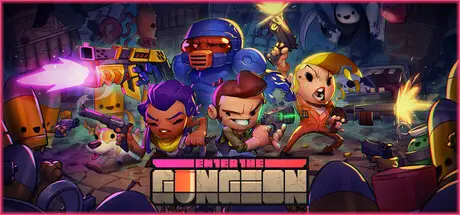
A four-person studio had no business making a game this confident. I understood what Enter the Gungeon wanted from me about ninety seconds in, mid-roll, with a flipped table soaking a wall of pink and blue rounds and the whole screen turning into confetti. This is not a twin-stick shooter that happens to have a dungeon. It is a dungeon exam, and the subject is small decisions made very fast.
Then a bullet — an actual anthropomorphic bullet, helmet and all, wearing the dumbest expression in the building — kicked the door open, and I laughed, and it shot me to ribbons before the laugh finished. That gap between how silly it looks and how tense it plays is the whole personality. The guns, the time paradoxes, the giant ammunition cults: it all reads as a joke until you realize the joke is load-bearing. Every descent is framed as one last negotiation with your own past.
The studio is called Dodge Roll, the publisher is Devolver, the year was 2016, and three-million-plus copies later the Steam page still glows at 95 percent. None of that came from a standout face.
It came from doing the boring, fiddly stuff — the micro-choices nobody else bothers to sweat — until those choices grew into something nobody else could copy. Plenty of indies hit one good idea and ride it for a launch window. The rarer thing, the thing this game actually pulled off, was guarding that idea for three straight years and patching it for free until even the skeptics came around. What you are looking at, a decade later, is not a clever prototype that got lucky. It is a small team's single conviction, sharpened past the point where anyone else could match it.
Story | 6.0/10
Story: 6/10A gun that kills the past — a premise that lands, an epic that never takes off

The hook is one sentence long. Somewhere at the bottom of the Gungeon sits a gun that can kill the past, and whoever claims it gets to reach back and erase one mistake from their life. Four playable misfits — Marine, Convict, Hunter, Pilot — descend not to save a world but to unwrite themselves. The cleanliness of that setup is its strength: two seconds in, you know exactly why you are going down. The trouble is that the game never wanted to tell you a story you would carry for years, and it doesn't pretend otherwise.
What the main plot delivers is a competent B-movie script. You follow each character's motive, you grasp that someone wants their regret undone, and then the motive just sits there, functional, never blooming into a real emotional arc. Finish a run and you will probably land in that specific state: by tomorrow the plot beats are gone, but the mood lingers — absurd, faintly mournful, a little ridiculous. That is exactly why the story dimension settles at a 6.0. The melancholy 3DM flagged is genuinely there, but it stays a tint rather than a thread.
The clever move is binding the narrative to the boss fights instead of to text dumps. Every character has a personal Past waiting as a boss; only by gunning it down does that character's absolution actually pay off. The story isn't fed to you in cutscenes — you earn it one trigger-pull at a time, and that delivery is smarter than the script it carries.
It also forces a small thematic point that the writing never spells out: in this dungeon, the only way to rewrite your past is to face the monster your past has become and put it down yourself. Narrative and mechanic collapse into the same act. That is a tidier idea than anything in the dialogue, and it does more emotional work than the dialogue ever attempts. You don't read about regret here so much as shoot it.
A comedy built out of guns — the worldbuilding outclasses the plot

The real narrative charm lives in the worldbuilding, not the main line. Everything here is a derivative of the gun: enemies are anthropomorphic bullets, helmeted and rifle-toting and occasionally exploding; the dungeon houses cults that worship ammunition, rituals tied to firearms, causal tangles spat out by time paradoxes. Stitched together, it plays less like a fantasy saga and more like a short film that abstracts gun culture into deadpan farce. It wants the gag, not the gravitas.
That tone is what separates it from its grim peers. Put it next to The Binding of Isaac and the split is obvious: Isaac mines religious dread and fragmented darkness, asking you to assemble a suffocating family tragedy out of blood and symbols, while the Gungeon throws the weight overboard and runs a string of bits about regret and second chances — gags that make you snort right before they make you bleed. Both are technically about trauma. One pulls you under; the other gets you laughing.
The cost is that the story cannot carry the job of keeping you playing. If you are the kind of player who needs a plot tugging you forward, you will find no rope here — the systems and the challenge push you, and the narrative is seasoning that never steals the dish. It tastes fine, it genuinely adds flavour, and it will never be the reason you ordered. This is a meal about feel and systems; the plot is the garnish on the rim of the plate, and the kitchen knew it.
Which is why opinions on the narrative naturally split into two camps. One side reads the restraint as wisdom — nobody buys a bullet-hell shooter to chase a plot, so handing the stage to the gunplay is the smart call. The other side sees plain laziness in the characterization: four protagonists, four regrets, all of them sketched and none of them written deeply enough to make you genuinely ache. Both readings are correct, because the game never treated "tell a great story" as a KPI in the first place. What it wanted was a worldbuilding vessel that holds together and stays out of the gunplay's way, and that vessel it carries steadily — just don't expect it to hold anything heavy.
Audio | 8.0/10
Audio: 8/10A synth score that rides the bullets

This is the kind of music you catch yourself nodding to while dodging fire. Doseone handles the score, laying down a relentlessly rhythmic electronic bed where the drums and synth lines clamp directly onto the beat of combat. The best trick is the timing: at the exact moment a wave floods the screen and your shoulders tense, the track tends to surge upward, so a fight ends up sounding like a pre-choreographed electro set. You aren't listening to a song — you're brawling inside one.
There's a particular class of cue worth singling out: the kind still ringing in your skull after a run ends. You might not retain the melody's details, but the next time you drop in, the opening bars hit and your hands reflexively reset their grip on the pad.
A quiet rapport forms between the music and your inputs, like a running song you know so well it drags your cadence faster without asking. Plenty of game scores never manage that hold over how you actually play. Here the track isn't background — it's a metronome you fight inside, nudging your dodges onto the beat whether you mean to sync up or not. By the time you've cleared a few floors, the soundtrack and your thumbs have negotiated a tempo, and breaking it feels almost physically wrong.
Punchy gunfeel feedback and an honest limit

The gunshots and hit feedback are crisp, which is non-negotiable for a game holding 200-plus weapons. A big slice of how each gun feels lives in that split-second of sound: some crack, some thud, some go off like a string of firecrackers. Stack the enemy-death cues and the environmental-destruction noise on top, and clearing a room earns a very specific, very satisfying release — you don't just see the room empty, you hear it get emptied one body at a time. With the occasional hush of a transition room and light ambient texture, your ears even get to breathe inside a high-intensity bout.
In fairness, the audio has a ceiling, and that's why it lands at 8.0 rather than higher. The overall register is functional — the music serves the combat, not the sort of standalone soundtrack you'd loop on its own. It does its job in-game, and then does a little extra (that grip on your play state), but strip away the bullets and triggers and its independent listening value thins out compared to the genre's true OST showpieces. One practical heads-up: if you tend to mute games and pipe in a podcast, this is one where you'll leave a real chunk of the intended experience on the table, and that's genuinely a shame. The sound design isn't decoration you can switch off without consequence — it's half of how the game communicates danger to you, and muting it quietly makes an already hard game noticeably harder than it needs to be.
Visuals | 8.2/10
Graphics: 8.2/10Pixel craft that files chaos into clean lanes

The pixel look here isn't merely retro-cute. What actually grabs you is the discipline of using a limited palette to organize a storm of bullets into something legible. When the screen fills with pink, blue, and red trajectories at once, you can still parse the source, the type, and the timing of each wave instead of drowning in undifferentiated mush. For a bullet-hell game that legibility is the real craft — worth more than any effects budget, because your first prerequisite for surviving is your ability to see.
The enemy designs then crank the invention all the way up. Anthropomorphic bullets, gun-toting birds, ambling giant bombs — every one carries a streak of mischief that snaps tightly onto the "everything is guns" worldbuilding while still finding time to make you grin as it kills you. This is the opposite lane from the dour, grimdark dungeon crawler. It plays like a slightly malicious fireworks show, except you are the one standing in the middle of the sparks. And crucially, that mischief never muddies the read: a joke enemy is still instantly distinguishable from the bullet it just fired, so the comedy and the clarity coexist instead of fighting each other.
Animation and tech: crisp not for looks but for reading

The animation is fluid, and the rolls, flips, and scattering shell casings all land cleanly. But there's an easily missed intent in that crispness: it isn't only serving "pretty," it's serving "readable." In a single glance you clock how high a table stands, how wide a piece of cover reaches, where an enemy is about to shuffle — and from that you decide which side is safe. Like an action film cut clean enough that you follow every punch, here the editing lets you follow the logic of every bullet wave.
On the technical side it runs on Unity, the 2D pixel rendering load is light, and so it ships across PC, PS4, Xbox One, and Switch with effectively no frame-stability worries and no port that drops the ball. That's a different race from the ray-traced, upscaler-chasing blockbusters, and rightly so: for a game whose mantra is "see it to survive it," a stable, fluid image matters far more than spectacle. A single dropped frame in a screen-filling pattern can cost you a run, so the consistency is not a footnote — it is part of the fairness contract the game makes with you, and it keeps that contract on every platform it touches.
The one real knock: a palette that wears thin

If you must fault the visuals, it's the thin aesthetic variety. The dungeon themes and overall colour scheme circle a similar register most of the time, several floors feel like the same paint in a new frame, and over long back-to-back runs a mild fatigue creeps in. It isn't fatal — more the game nudging you to take a break — but next to peers that reinvent their art language every floor, it does give up ground on sheer visual novelty.
Set beside its contemporaries the positioning is clear: it doesn't chase the gasp, it chases clarity. Nuclear Throne's coarse, violent pixels hit harder and rougher; the Gungeon sands its pixels rounder and more readable. Both have their fans, but if what you value is staying cool inside the chaos, the Gungeon's readability-first art is simply the more comfortable place to live. The 8.2 docks that sliver of sameness and rewards a clarity that almost nobody else nails. Put differently: this art will never headline a "most beautiful game of the year" list, but it shows up in every veteran's answer to "why is this thing so endlessly playable." Beauty fades after the first hour; legibility pays you back on hour two hundred, and the Gungeon bet everything on the second kind of value — a bet that, judging by how long this game has stayed in active rotation across a decade of newer, flashier releases, paid off in full and then some, with a kind of compound interest that no spectacle-first game has ever managed to earn over the same span.
Combat | 9.0/10
Gameplay: 9/10Roll, flip, kick: the micro-decision as main course

Ask what makes this game fun and the honest answer isn't how many bullets you fire — it's how much thinking you'll do to avoid eating one. Twin-stick fire is only the floor. The addiction lives in a stream of tiny, almost-muscle-memory choices: which wave of fire gets your dodge-roll's invulnerability frames, whether that table in the corner is worth flipping right now, whether to boot the oil barrel into the crowd early and gamble on a chain explosion taking out half the room. These decisions pack into every second, and together they form the one skeleton nobody else has reproduced.
The dodge-roll is the core verb — the studio literally named itself after it. It carries i-frames and it is your last line of survival, but it has recovery, and panic-rolling just rolls you into the next wave. For the first few hours you flail: mashing, rolling blind, dying and deserving it. Then you learn the enemies' rhythms, and a switch flips toward "every shot means something." Each round now suppresses fire and clears space rather than just emptying a clip; each roll is a planned route, not a reflex. That pivot from being schooled by the dungeon to schooling it is rare in the genre for how cleanly it arrives.
Table-flips: a tactical layer the rivals simply lack

If the roll is the genre's standard kit, the table-flip is the Gungeon's house special. Tables scattered around a room can be kicked upright into temporary cover that eats a wave or two for you. But tables break, so when to flip, which one to flip, and where to bolt afterward all become live, on-the-spot reads. Cover here isn't passive terrain — it's a resource you actively manage, and managing it badly ends your run as surely as bad aim.
Layer in the Blank — a screen-clearing panic button — and the barrel-kick gamble, and the game stacks several tiers of contingency and risk on top of plain shooting. Hoard your Blanks for the worst full-screen pattern, or spend one early; bait an enemy cluster into a barrel for a chunk of free area damage.
These options are why the same room resolves completely differently in different hands: one player is a patient sniper kiting from range, another is a melee lunatic eating hits behind rolls and flipped furniture. The variety comes from the structure of the systems, not from inflated numbers. Nothing here is a stat upgrade pretending to be depth — it is genuine decision space, and the depth is something you generate yourself out of how you choose to combine these verbs under pressure.
A curve that teaches you through repeated defeat

The difficulty runs high for the genre, the bosses spew dense patterns, and PC Gamer flatly called them the hardest things they'd ever faced. More to the point, the teaching is almost entirely implicit — no tutorial walls of text, just death after death until you intuit the rules yourself. That "death as instructor" design clearly inherits from Dark Souls and from Ikaruga, the other named source for the roll, and it reads as a feature to the patient and a brick wall to the impatient.
Line it up against its most direct rival, Nuclear Throne, and the gap shows. Nuclear Throne is pure high-velocity bullet thrill, more feral, more stripped-down; the Gungeon adds an entire tactical layer in the table-flip plus the build depth of 200-plus guns, so there is simply more to mine on the replay. Game Informer went so far as to say it surpassed both The Binding of Isaac and Nuclear Throne — generous, sure, but the fact underneath is true: when it comes to how much decision space the systems hand you, the Gungeon walks further than its peers. The price of that depth is the steepness, and the two are the same coin: a game that demands this much thought has to be willing to punish the absence of it, and the Gungeon is unapologetically willing. That's the trade, and for the right player it's the best trade in the genre.
Content | 8.5/10
Content: 8.5/10200-plus guns and a collect-em-all engine: the clear is just the prologue

This is one of those games where beating the main line is the opening remark. The content core is a pool of more than 200 guns, plus multiple characters, a mountain of items, and the synergies between them. Most of it hides behind unlock goals, so the game quietly swaps your objective from "finish a run" to "roll that one gun I've been dreaming about, assemble that fabled synergy, unlock that character I haven't touched yet." It behaves like a board game: the rules sit out in the open, but every session deals a different hand, and so your story shifts with it.
Underpinning that loop is the procedurally generated dungeon and permadeath. Every run forces a fresh risk read: detour left into the chest room, or push the main route? Sometimes you stumble into a "barren Gungeon" with almost no decent drops, and that run is doomed; sometimes you ride a streak of god-tier guns and steamroll.
The luck swing produces not raw joy or misery but a sustained itch for "one more" — you always suspect the next run breaks your way. That is the spine of the 8.5 in content: the loop reproduces itself. The randomness isn't there to pad the runtime; it's there to make sure no two sessions tell the same story, so the act of restarting feels like reshuffling rather than repeating, and the difference between those two sensations is the whole reason roguelites work at all.
Three updates, all free: generosity past the price tag

What truly nailed this game's reputation to the word "evergreen" is that its three major updates all shipped free. The 2017 supply-drop update added guns, enemies, and room layouts; the 2018 advanced-dungeon update piled on more weapons and balance passes plus a hidden boss — a resourceful rat that steals your items; and the 2019 send-off, the farewell update, dumped in 22 new guns, 14 new items, a pile of synergies, a fresh secret floor with its own boss, and two brand-new characters, the Paradox and the Gunslinger.
The keyword is free. None of this was paid DLC — it was the developer, Dodge Roll, handing extra content to everyone who already owned the game. An already-cheap indie that ran three sizeable content drops across three years without charging a cent: that goodwill is a big reason the Steam page holds 95 percent positive across seventy-eight-thousand-odd reviews. You didn't buy a 2016 snapshot — you bought a work that kept getting fed until it formally signed off in 2019. In an era of season passes and trickle microtransactions, the "sell once, nourish three years, charge nothing" approach looks more generous in hindsight, and it's no mystery why veterans speak of it with a soft spot.
Length and fit: twenty-minute runs, hundred-hour sinks

Its time structure fits the roguelite appetite exactly: a single run is fifteen to twenty minutes, tight and cheap to restart; clearing the main path takes dozens of hours; and maxing every weapon, every synergy, every high-difficulty challenge runs easily past a hundred. That "short loop, long tail" shape lets it slot into spare minutes while still swallowing hundreds of a player's hours whole. Hidden content like the resourceful rat exists precisely as an extra target for the hardcore, so the moment you think you're near done, it produces something new.
Drop it into the genre's coordinate system and the differentiation is sharp. The Binding of Isaac wins on the sheer count of item synergies; Nuclear Throne wins on pure high-speed thrill. The Gungeon's edge is taking the "gun" motif to its limit — 200-plus weapons each with its own feel, sound, and joke — then stacking table-flip tactics and three free updates on top, which makes "playtime far past the price" a hard fact rather than a boast. If the act of grinding holds any appeal for you, the hours this game squeezes out of you will dwarf what its sticker price suggests, and that ratio of value to cost remains one of the most lopsided bargains anywhere in the entire genre, as true now as it was on launch day.



Comments 0
We'd love to hear from you
Welcome! Share your take on this game — being first might come with a surprise.
No comments yet — share your thoughts on this review!