

























Opening
Here is a game where the entire premise is moving cargo from point A to point B on a fake European road network, and it has held a spot on the Steam weekly sales charts for thirteen years.
Euro Truck Simulator 2 launched in October 2012 and was still charting in May 2026. Thirteen million base copies, eighty million DLC sales — an average of six expansions per owner — and a 97% positive Steam rating across a sample large enough that the number should be impossible. The average player has logged 121.6 hours, which places it among the hundred highest-playtime games on all of Steam, ahead of many sprawling role-playing games. SCS Software, a small studio out of the Czech Republic, has spent thirteen years doing exactly one thing: letting players haul freight across a scale-model Europe, and refining it until the act of driving a truck through rain at night became one of gaming's most reliable forms of decompression.
It never asks you to be the best trucker. There is no finish line, no boss, no villain, no story in the traditional sense. You accept a contract, you drive, you deliver, you bank the euros, you buy a better truck or hire a driver or unlock a new country, and you do it again. Described on paper it sounds boring enough to be a joke. In practice it is the genre's clearest example of a game that gets more valuable with age — every map expansion widens the world, every physics pass deepens the feel, and the community has spent over a decade treating the cab of a Scania as a place to think.
This review covers the game as it stands in 2026 on PC, the only platform it has ever had, with the 1.42 force-feedback rework and the full run of map DLC through Greece in mind. The scoring leans on immersion, longevity, and feel rather than spectacle. That is the game SCS built. Buckle in, set the cruise, and let the kilometers roll.
Story | 7.0/10
Story: 7/10Euro Truck Simulator 2 has no plot, and that is a deliberate design choice rather than an omission. In place of a narrative, SCS built a three-phase career-growth curve that gives the long haul a shape, and the 7.0 story score is the honest accounting of a structure that works without ever telling a story.
Phase one: the apprenticeship that loses the impatient
The opening five to ten hours put you in someone else's truck. You take Quick Jobs from SCS's fictional logistics companies — given a truck, given a cargo, given a route — and you drive them for a flat fee that slowly accumulates into seed capital. There is no ownership decision, no route choice, no customization; the apprenticeship deliberately strips the game down to its single verb, driving, so the player learns the road before they learn the economy. This is the driving-license apprenticeship, and it is the phase that sheds impatient players. There is no ownership, no choice of contract, no economic stakes beyond the slowly filling wallet. A player expecting immediate freedom will read this as tedium, and a meaningful fraction quit here before the game opens up. SCS accepts that filter on purpose: the apprenticeship teaches the road, the gearbox, and the rhythm before handing over any responsibility, and the players who stay are the ones the rest of the game is built for.
Phase two: the owner-operator pivot where the game opens

Around hour ten you buy your first truck — somewhere between 120,000 and 200,000 euros, usually financed — and the game changes character entirely. Now you choose your own contracts, plan your own routes, manage your own fuel and fatigue, and decide whether to chase high-value fragile cargo or steady bulk freight. You also start customizing: the first paintjob, the first chrome accessory, the first engine upgrade, the slow personalization of a machine that becomes recognizably yours. The ownership pivot is the moment the game becomes self-directed, and it is where the 121-hour average playtime starts to make sense. The psychological shift is real — a borrowed truck is a job, but an owned truck is a project, and the moment the loan paperwork clears, the player's relationship to every subsequent kilometer changes. The truck is yours, the schedule is yours, and the open road map of Europe becomes a space you traverse on your own terms rather than the game's. This is the core loop that the apprenticeship was quietly preparing you for, and it is genuinely difficult to put down once it clicks.
Phase three: the logistics empire and the community layer
The endgame is management. You hire drivers, buy garages across multiple countries, assign AI haulers to routes, and watch a logistics company grow into a multi-national operation that runs partly without you. This meta-layer is what sustains the 350-hour completionist saves — the game stops being about any single delivery and becomes about an empire of them. World of Trucks, the online event system, adds a light community narrative on top: time-limited shared cargo campaigns where the entire playerbase hauls toward a collective goal, the closest the game comes to a story beat. None of it is dramatic. All of it is quietly compelling in the way a well-run spreadsheet is compelling, and for the right player that is exactly the appeal.
The genius of replacing plot with progression is that the player writes their own narrative. The story of an ETS2 save is the story of decisions: the first nerve-wracking loan, the route you learned by heart, the driver you hired who keeps crashing, the garage in a city you visited in real life. SCS understood that a simulator's drama is emergent and personal rather than authored, and they built a progression spine strong enough to hold a hundred hours of self-directed play without ever scripting a single line of dramatic dialogue. It is the anti-narrative position taken to its logical and successful conclusion — proof that a game can be deeply engaging with no story at all, provided the systems underneath give the player reasons to keep choosing the next haul. The 7.0 reflects the absence of authored storytelling; it does not reflect a lack of meaning, because the meaning is the one the player builds.
Audio | 9.2/10
Audio: 9.2/10The audio in Euro Truck Simulator 2 is where SCS spent money in a way that borders on obsessive, and it is the single pillar that most justifies the immersion the game is famous for.
Every engine is recorded from a real truck

SCS records every truck's engine individually, in a studio, from the actual vehicle — not synthesized, not sample-library approximations. The Volvo FH's sixth-generation 16-liter D16 engine has an audibly different growl at 1000 rpm than at 1800; the Scania flagship line carries its signature low-end roar that a player can identify with eyes closed. Each truck has, in effect, an audio fingerprint, an acoustic identity card that distinguishes it from every other model in the roster. Players who own the real trucks have repeatedly confirmed in forums that the in-game engines sound correct to their ear, which is the highest possible validation for this kind of work — the people most qualified to hear a fake are the ones vouching for the authenticity. It is a level of fidelity that costs real money and studio time, and SCS has paid it for every truck in the roster. For a game whose central activity is sitting in a cab listening to an engine for hours, this is not a nicety — it is the foundational layer of the whole experience, and no competitor in the genre has matched the per-vehicle recording budget.
Sampled to a paranoid degree, recombined per configuration
The sampling depth goes well past the engine note. Idle, acceleration, deceleration, the exhaust brake, the turbo blow-off valve — each is separately recorded across the rev range, and the game recombines them in real time according to the exhaust configuration the player has bolted onto their truck. A short stack sounds different from a tall one; a straight pipe barks where a muffled setup grumbles. Change the stack and the acoustic signature changes with it. The result is that two players driving the same base truck with different tuning hear genuinely different vehicles. This is the kind of system that is invisible in a trailer and unmistakable after fifty hours, the depth that turns a driving game into a driving simulator. The recombination happens seamlessly as engine load changes — pulling a heavy trailer up a grade produces a strained, lower note that lightens as the road levels, and engine braking on a long descent has its own distinct character. None of it is scripted per-route; it is all emergent from the simulated engine state, which is why no two hauls sound exactly alike even on a road you have driven a dozen times.
Ambient road audio and the radio-as-soundtrack choice

The ambient layer carries the meditative loop the game is loved for: rain drumming on the cab roof, tire hum changing pitch across asphalt versus concrete versus wet road, the metronome of the wipers, the distant doppler of passing traffic. SCS made a deliberate decision not to score the game with original music — instead the in-game radio streams real internet stations, so the soundtrack is whatever the player brings. It is a confident non-score choice that respects the relaxation use-case: the player who wants silence and engine note gets it, the player who wants a late-night talk-radio station gets that, and the game never imposes an emotional track over a fundamentally personal, meditative activity. The absence of a composed score is itself the audio design.
The detail extends to the world outside the cab. Tunnels change the acoustic profile — the engine note tightens and reverberates, then releases as you exit. Crossing a bridge alters the tire sound; a downpour muffles the high frequencies; the rumble strip at a highway edge buzzes through the cab if you drift. Air-brake hiss, the chunk of the gear engaging, the click of indicators, the warning chime when fatigue sets in — every functional sound is recorded and placed with care. The cumulative effect is a cabin that sounds like a real working environment, and it is the reason players describe long ETS2 sessions as genuinely calming rather than merely passive. The audio is doing the heavy lifting of immersion that the modest visuals cannot, and the 9.2 score reflects a craft area operating well above the rest of the package.
Visuals | 8.6/10
Graphics: 8.6/10Euro Truck Simulator 2 does not chase graphical spectacle, and judging it on raw fidelity misses the point entirely. The 8.6 score is for authenticity at scale, not for polygon counts.
Real European roads, rebuilt at 1:20

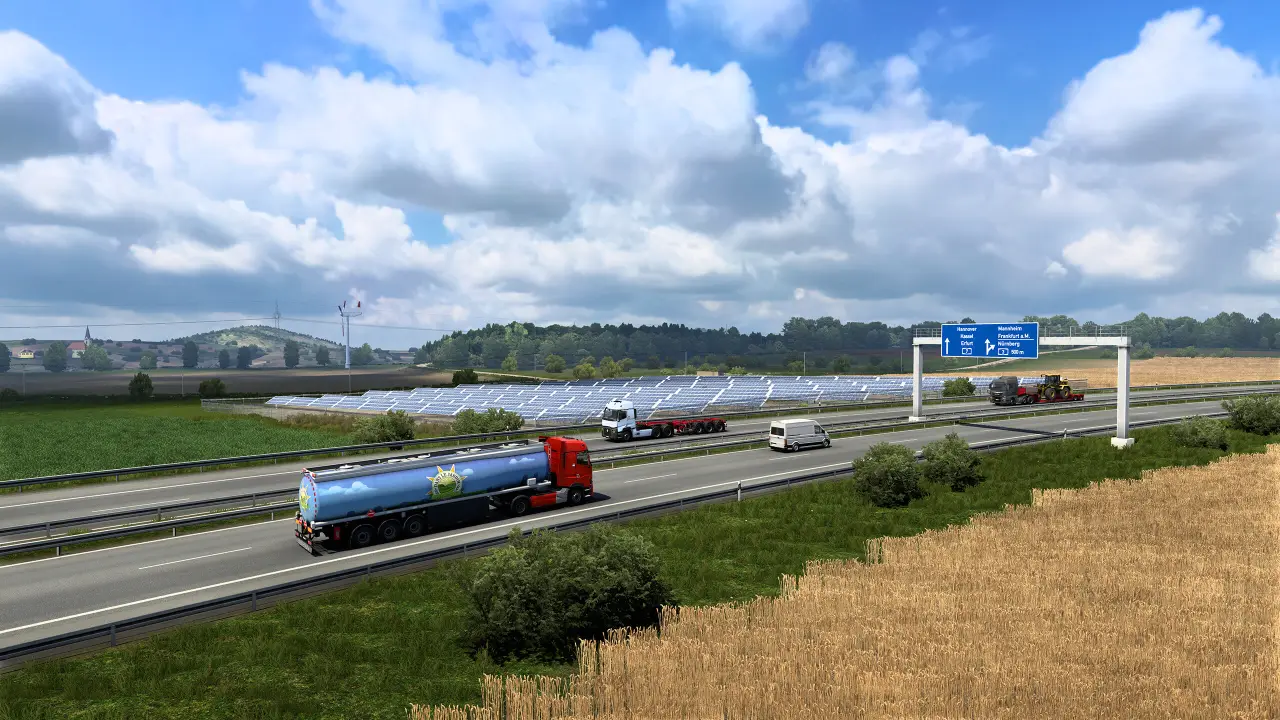
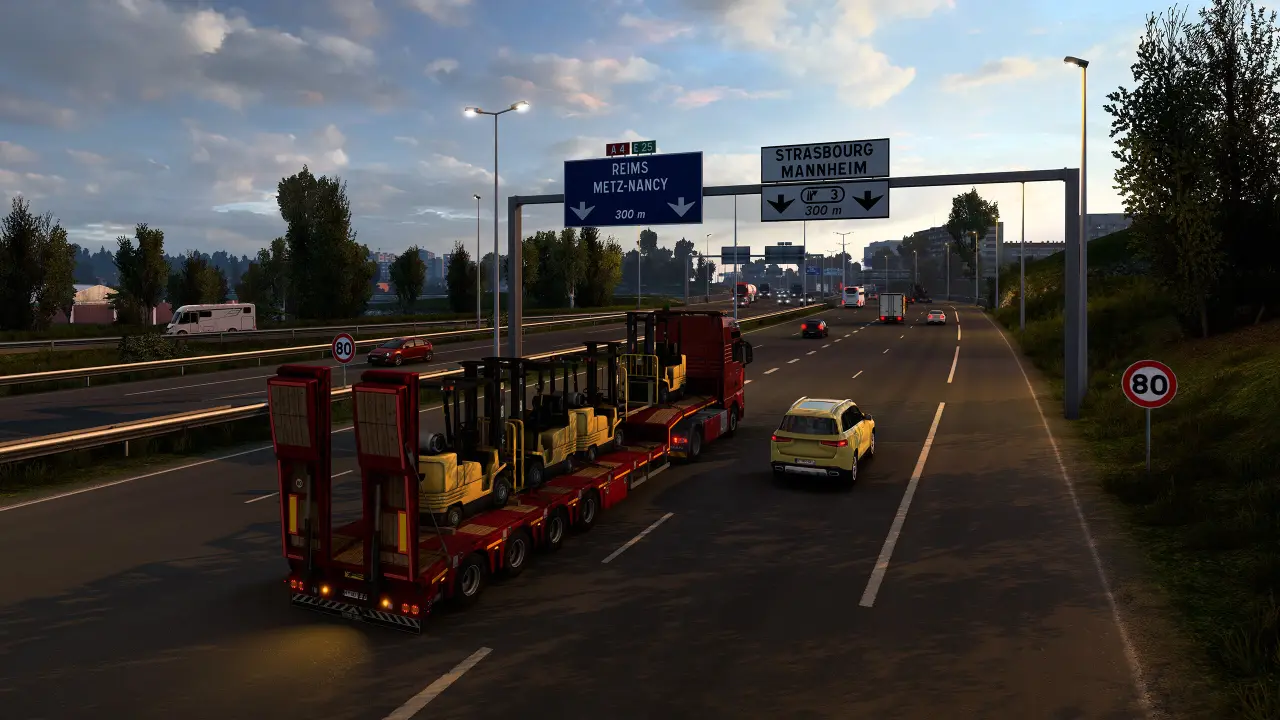
SCS's art direction chases the sensory recreation of real European roads rather than technical showmanship. Over thirteen years the studio has sent production teams on field trips to country after country — Irish country lanes, the switchback fjord roads of northern Norway, the volcanic terrain of Cappadocia in Turkey, the suburbs below the Athenian Acropolis — and rebuilt each at a 1:20 scale on return. The result is a Europe that feels like Europe: not a photoreal copy, but a faithful compression that captures the character of each region's roads, signage, architecture, and landscape. A driver who has actually driven the A2 in Germany will recognize it. That recognition is the entire visual ambition, and it is one SCS hits with remarkable consistency across an enormous map. The signage is correct, the road markings follow each country's real conventions, the rest stops and fuel stations carry plausible regional branding, and the toll booths match how each nation actually collects tolls. These are the details a tourist would never notice but a local immediately would, and SCS chases them because the entire promise of the game is that you are driving through a recognizable Europe rather than a generic one.
Thirty-plus countries and the landmarks that prove the field trips

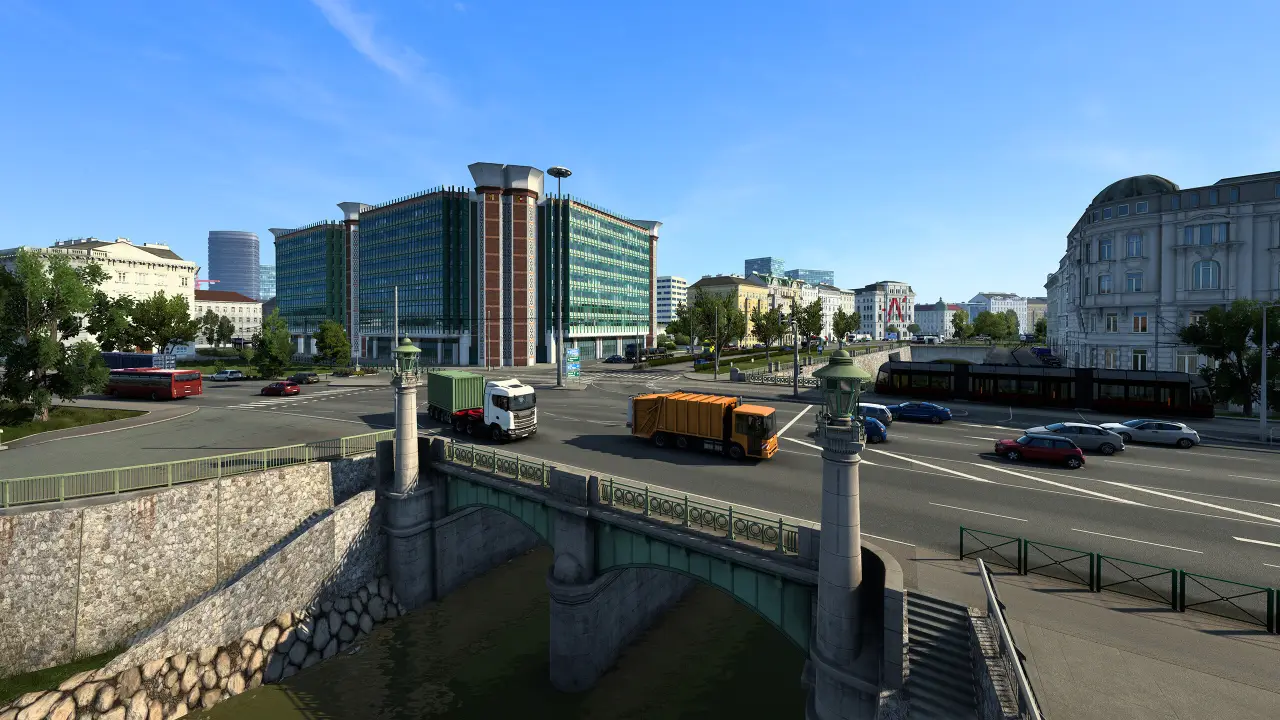
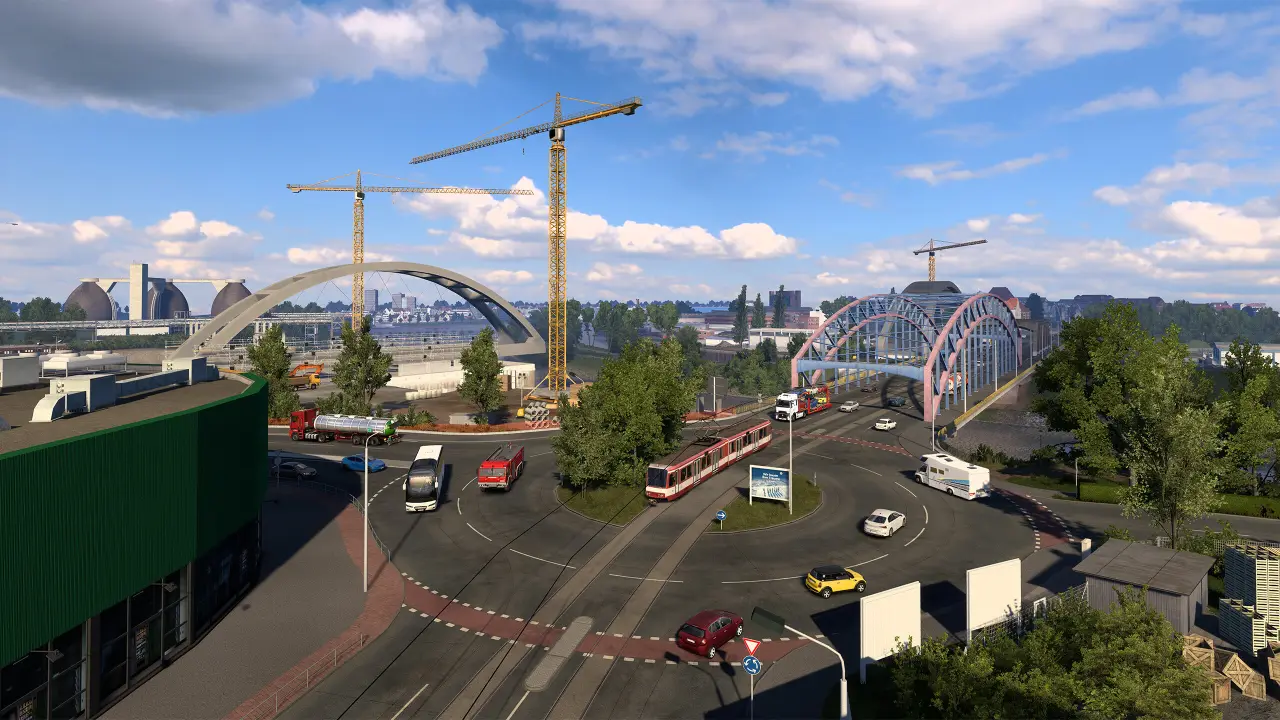
By early 2026 the released maps cover more than thirty countries: the eight-nation Western base (UK, France, Germany, Netherlands, Belgium, Luxembourg, Switzerland, Austria), Eastern expansions (Czech Republic, Poland, Slovakia, Hungary), the Nordic Scandinavia pack, Vive la France, Italia, Beyond the Baltic Sea, Road to the Black Sea, Iberia, West Balkans, and Greece. Each expansion is not a reskin — it carries region-specific landmarks, road furniture, vegetation, and architecture that demonstrably came from those field trips. The scale is the achievement no competitor has approached: thirteen years of map DLC has produced a continent-sized road network with genuine regional identity, and the seams between expansions are nearly invisible because each was built to the same authenticity standard. The quality has also risen over time — the later expansions like Iberia and Greece are visibly richer in detail than the 2013 Going East content, and SCS has gone back to remaster older regions to keep the standard consistent. That commitment to bringing the early maps up to the current bar, rather than leaving them as dated artifacts, is part of why the world feels coherent despite being assembled across thirteen years of evolving technology. A new player driving from Greece to the original German base today would struggle to tell which regions shipped first.
Lighting, weather, and the honest tech ceiling
Lighting and weather give the same stretch of road four distinct moods across day, night, and seasons — a dawn haul through Bavarian fog reads completely differently from the same road at midnight in rain. The atmospheric variety is what keeps a repeated route from going stale over a hundred hours. SCS has also layered in incremental visual upgrades over the years that compound: improved road textures, better skyboxes, a 2019 lighting pass, seasonal mod support, and a steady stream of model updates to the truck interiors that are, after all, the thing the player stares at most. The cab interiors in particular are rendered with real care — every dashboard, every gauge, every switch on a licensed truck is modeled accurately, because that is the frame the player lives inside for a hundred hours.
The honest caveat is the tech ceiling: the engine dates to 2012 and has been modernized incrementally rather than rebuilt, so up close the textures and distant models show their age against a 2026 AAA benchmark, and the draw distance on dense foliage can pop. That trade-off is deliberate and correct — the modest engine runs smoothly on low-end hardware, which is exactly the broad accessibility a thirteen-year evergreen needs, and it keeps the game playable on the laptops and older PCs much of its audience owns. SCS chose scale, reach, and accessibility over bleeding-edge fidelity, and for a game whose appeal is calm immersion rather than visual shock, that was unambiguously the right call. The 8.6 rewards the authenticity and atmosphere while honestly marking the dated underlying technology.
Combat | 9.0/10
Gameplay: 9/10The gameplay earns a 9.0 on the strength of one rare design achievement: a stepless slider from arcade to hardcore simulation that lets two completely different players love the same game.
Full-spectrum difficulty, from scenery cruise to truck-sim ritual

Most simulators force a choice between approachable and authentic. Euro Truck Simulator 2 refuses the choice and offers a continuous slider between them. That full-spectrum design is genuinely uncommon, and it is why the game can hold both a player who wants to decompress after work and a player who wants to row a sixteen-speed gearbox through an Alpine pass in a snowstorm. The settings are not a difficulty toggle with three presets; they are a dozen independent dials — transmission, parking, inertia assist, traffic density, fatigue, fines, route advisor detail, damage modeling — that the player tunes to taste. The same software is a relaxation toy and a hardcore rig depending entirely on where those dials sit, and that flexibility is the design decision that underwrites the 121-hour average. Crucially, the dials can be changed at any time, so a player can start at the arcade end and ratchet up the realism one setting at a time as their confidence grows — the game teaches itself to you at whatever pace you choose, which is a far gentler on-ramp than the hard-mode-or-bust structure most simulators impose.
The arcade floor and the simulation ceiling
The arcade default opens with automatic transmission, auto-park, inertia compensation on, low traffic density, and lenient police tolerance. In that configuration the player can focus on the scenery rolling past and never worry about missing a gear or rear-ending a car or getting fined for a missed sign. It is a genuinely relaxing way to spend an evening, and for a large share of the audience it is the only configuration they ever touch. The simulation ceiling is a different game entirely: full manual including the 16-speed I-Shift that is the signature of the Volvo and Scania flagships, auto-park off, inertia compensation off, dense traffic, strict enforcement, and driver fatigue forcing real rest stops. At the top of the slider, reversing a full trailer into a tight loading bay, or carrying fragile high-value cargo across a mountain route in bad weather without a scratch, is a genuine skill accomplishment that takes dozens of hours to master. Both ends are fully supported, neither is treated as the "correct" way to play, and most players settle somewhere in the middle and slowly climb the realism dials as their confidence grows — which means the same purchase keeps offering new challenge long after the scenery has become familiar.
Force feedback and the company-management loop

The 1.42 update reworked the force-feedback physics, and the result pushed the wheel-peripheral feel to the front of the entire genre — drivers with a proper force-feedback wheel describe it as the best truck-handling feel available anywhere. The trailer's weight transfers through the wheel; a heavy load shifts the truck's balance on a fast corner; the road surface texture comes up through the rim. The caveat is that the depth is hardware-gated: a keyboard or basic gamepad player feels none of this, and cannot access the best of what 1.42 delivers. This is the honest tension in the gameplay score — the ceiling is genre-leading, but reaching it costs a real-money wheel investment, and the game cannot be fairly judged as if every player owns one.
Beneath the driving sits the company-management loop — contracts, fuel costs, road tolls, driver fatigue, delivery deadlines — a quiet strategy layer that gives the act of driving an economic spine. You are not just steering; you are running a business one haul at a time, weighing whether a high-value fragile cargo's payout justifies the slower, more careful drive it demands. Fuel prices vary by country; tolls eat margin; a fatigued driver risks fines or accidents. The two layers reinforce each other into a loop that is far stickier than the simple premise suggests: the driving makes the management tangible, and the management gives every drive a reason and a stake. That mutual reinforcement is the real engine behind the 121-hour average, and it is why "boring truck game" is a description that only survives until about hour three.
Content | 9.5/10
Content: 9.5/10A hundred and twenty-one hours. That is the average Steam playtime for Euro Truck Simulator 2, and it places a thirteen-year-old trucking game among the hundred highest-playtime titles on the entire platform.
Fifty hours to learn, three hundred and fifty to explore

HowLongToBeat gives the reference points: roughly 50 hours to unlock all player skills and establish a company, and around 350 hours to fully explore — every map expansion driven, every truck model unlocked, the late-game CEO operation built out. The Steam average of 121.6 hours sits comfortably between, higher than many large role-playing games, and the figure keeps the game in the platform's top-100 by playtime. To put that in perspective, the average ETS2 owner has spent more time in the cab of a virtual truck than the average player spends finishing a story-driven AAA epic, and many spend far more — multi-thousand-hour saves are common enough in the community that they barely draw comment. That depth of engagement on a game with no narrative and no competitive ladder is the strongest single piece of evidence for how durable the core loop is. The pacing is deliberately relaxed: there is no spike of excitement, no dramatic arc, just a slowly widening world and a slowly growing operation. For the player wired for it, that steady accumulation is more durable than any scripted high, which is precisely why the playtime numbers run so far above genre norms.
Thirteen years of map DLC, and an attach rate that tells the story
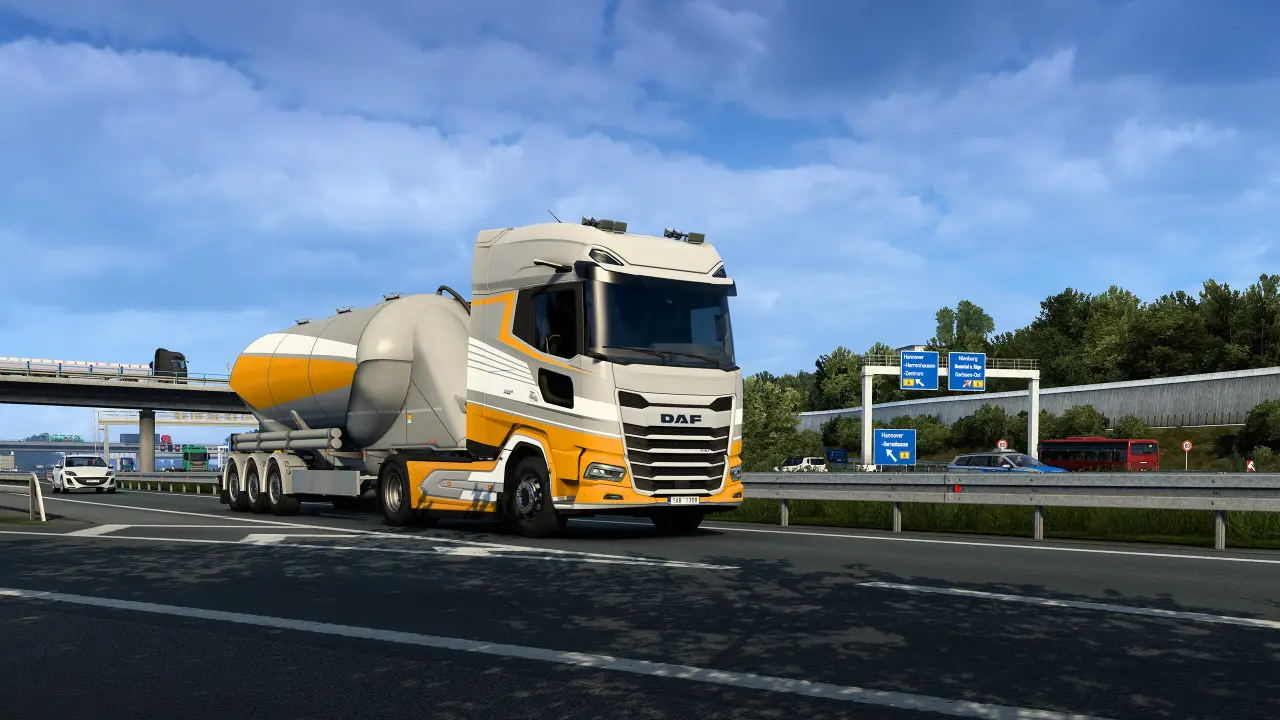
The content model is the headline. Nine regional map expansions have shipped from Going East in 2013 through Greece in 2024, each adding countries, landmarks, and road network at the same authenticity standard as the base game. The commercial result is striking: 13 million base sales against 80 million DLC sales, an attach rate of roughly six expansions per player. That number does not happen unless players genuinely value the content — nobody buys six DLC packs for a game they bounced off. It is the inverse of the live-service pattern where a minority of whales subsidize a free majority; here a broad base of committed players each buys most of the catalog because each expansion adds a genuinely new region they want to drive. The attach rate is, in effect, a satisfaction metric in disguise, and at six-per-player it is one of the highest sustained DLC attach rates in PC gaming. The sustained-update cadence is the engine of the evergreen status, and the fact that SCS is still shipping country expansions thirteen years post-launch is the clearest signal that the game is treated as a living platform rather than a finished product.
Mods, pricing, and the cheapest hours-per-dollar in the genre
The third content leg is the mod ecosystem. ProMods, the flagship fan map project, rivals official content in scale and quality and stitches into the official maps to produce a Europe larger than SCS alone has shipped, and Steam Workshop carries thousands of truck skins, tuning parts, physics tweaks, and map extensions that push coverage and customization well beyond the official ceiling. For a PC-only game, the mod scene is a major multiplier on the base content, and SCS actively supports it with official modding tools rather than tolerating it grudgingly — the studio understands that the modding community is part of why the game has stayed alive for thirteen years. A dedicated player can extend ETS2 almost indefinitely without paying SCS another cent.
The pricing seals the value argument: the base game frequently drops below five dollars in Steam seasonal sales, and DLC bundles are routinely discounted deep enough that the entire thirteen-year catalog of map expansions can be bought for less than the price of a single new AAA release. At those prices, against a 121-hour average playtime — and a 350-hour completionist ceiling — Euro Truck Simulator 2 offers one of the cheapest hours-per-dollar ratios in all of PC gaming. It is a genuinely absurd value proposition for anyone the game's rhythm suits, and because the base game is so cheap, it is also a near-zero-risk purchase to test whether that rhythm suits you before committing to the DLC catalog. Buy the base, drive for an evening, and you will know within three hours whether this is your kind of game.




Comments 0
Share your game review
Join the discussion and share your review of this game.
No comments yet. Share your thoughts on this review.