

























Opening
You came here to party. Skydiving, speedboats, an island bender with your brothers — and then the screen cuts to black and you wake up in a cage, somewhere lawless, with a wiry man in a red singlet leaning into your face to ask whether you know what the definition of insanity is.
That is where Far Cry 3 grabs you, and it does not let go for the next sixteen hours. Ubisoft Montreal's 2012 standout does something most open-world games still flinch from: it makes you the prey before it ever lets you play the predator.
The Rook Islands are gorgeous and the freedom is enormous, but the real subject here is how easily a frightened tourist learns to enjoy the hunt. There are no rules out here, only who is willing to go further — and you will be unsettled by how fast you learn. A decade later it remains the entry the whole series is measured against, and the one veterans still hand to newcomers without hesitation. This review walks the island again across six lenses: story, sound, visuals, play, content, and the final verdict.
Story | 9.0/10
Story: 9/10A focused descent, drawn straight onto the hero's skin
Most open worlds hand you a sandbox and a to-do list. Far Cry 3 hands you a question instead: how long before the scared kid becomes the monster? Jason Brody parachutes onto the Rook Islands, watches his brother die in the opening escape, and survives by accident. His stated goal is simple — find his scattered friends, get everyone off the island. Writer Jeffrey Yohalem is not actually writing a rescue, though. He is writing a conversion.

Every infiltrated camp, every quiet takedown, leaves Jason a little more capable and a little more comfortable. He starts with shaking hands; he ends clearing whole outposts without blinking. The game feeds you the high of getting better while the characters around you keep asking, with growing unease, whether you actually want to go home anymore — or whether you have started to love this. That tug between the thrill of mastery and the horror of who you are becoming was a rare ambition for a 2012 shooter, and the campaign earns it by staying short and pointed. HowLongToBeat clocks the main story near sixteen hours, and the focus pays off: years later you may forget which hills you climbed, but you will remember what Jason turned into.
The smartest stroke is mechanical. Jason's skill unlocks are mapped onto a tribal tattoo crawling up his arm, the ink spreading with every new ability. Watching that pattern bloom across his skin is watching the island's violence claim him, one upgrade at a time. A cold progression menu suddenly carries the weight of a character arc, and it does so without a single cutscene having to explain the point — you simply glance at your own forearm and understand.
The ending hands the choice back to you — leave with your surviving friends, or stay and give yourself fully to Citra's tribe — and that binary forces the whole "what have you become" question onto the player's own thumb, while quietly justifying a second run. Neither ending is the comfortable one, and that is the design working as intended. The game has spent sixteen hours making you complicit, and then, at the last possible moment, it asks you to own it.
Vaas, and the hole he leaves behind
It helps that the supporting cast is written with the same restraint. Dr. Earnhardt is a ruined man clinging to one last shred of decency, Citra is seductive and terrifying in equal measure, and Jason's rescued friends drift further from him the more he changes — so that by the end they are looking at a stranger wearing their friend's face. The script trusts you to notice all of this without spelling it out, and that confidence is a large part of why the descent reads as tragedy rather than power fantasy.
The Rook Islands are the stage; Vaas Montenegro is the man under the spotlight. Played through performance capture by Michael Mando, he is a pirate lord who never sits still — every line balanced on the edge of going off. The infamous beat is his "definition of insanity" monologue, delivered inches from a bound, helpless Jason, all menace and zero action. It rides entirely on rhythm and Mando's face, and it became one of the most quoted villain moments the medium has produced. Critics on OpenCritic flatly call Vaas one of the best antagonists in gaming history, and they are not wrong.

Here is the catch that keeps the story honest. Vaas is not the final boss. The game retires him at the midpoint and hands the back half to slaver Hoyt Volker, who has the menace but none of the layers. The charisma simply does not transfer, and the late campaign feels it — every scene after the handover quietly misses the man who left.
Jason's pivot from frightened brother to eager killer can read rushed, too, and the binary ending arrives before some of that turn is fully earned; the script wants you further down the rabbit hole than it has always shown its work for. None of it sinks the ship. On the strength of one believable archipelago, one immortal villain, and a progression system fused to its own theme, Far Cry 3 still writes its way into the front rank of its era's open-world shooters, and it does so while asking harder questions of the player than almost anything else released that year.
Audio | 8.0/10
Audio: 8/10A score and a voice that keep the island on edge
Brian Tyler scores the Rook Islands without reaching for a big orchestra. He works in tribal percussion, sparse strings and electronic textures, and the result is a sound that lounges in the heat one minute and snaps taut the next. By day the drums idle. The instant you slip into a camp and trip an alarm, the tempo cinches and the air gets heavy. The music is not wallpaper here; it is a thermometer for how much danger you are standing in.

The real high point is the voice work, and most of that credit lands on Vaas. Michael Mando's delivery swings between a soft, almost gentle cadence and a sudden eruption, and that unpredictability — the sense that he might detonate mid-sentence — is carried almost entirely by sound. Strip the vocal track and Vaas is a well-built model of a villain; keep it and he is the franchise's calling card.
The supporting cast holds the line too. Dr. Earnhardt's frayed warmth and Citra's cold conviction give the island's dialogue scenes real dramatic pull instead of leaving them as quest-dispensing filler. Even the radio chatter from the men you are about to ambush is performed with enough personality that picking a camp apart never feels like clearing faceless targets — you hear them joke, complain and panic, which makes the whole thing land a little heavier than it has any right to.
Environmental detail and combat feedback do the quiet work
Half of an open world's immersion is the picture; the other half is the soundscape, and Far Cry 3's environmental design is the kind you never stop to praise yet could never do without. The jungle layers insect chatter over distant surf, rustling underbrush over the sudden roar of something large in the dark. More than once you hear the tiger before you see it, and that one beat of warning is the difference between turning to face it and becoming its lunch. The island sounds alive and hostile, which is exactly the point, and it is the soundtrack to your own slow change as much as anything you can see.

There is craft in the smaller cues too. A change in the bird calls warns you that something has spooked the local wildlife; the particular grind of an outpost alarm tells you, without a glance at the screen, that your quiet plan just collapsed into a loud one. The audio is constantly feeding you information you can act on, which is exactly what good immersive sound design is supposed to do.
Combat feedback is just as solid. 3DM handed the audio an 8.5 and singled out the firefights, noting that the most important sound in a shooter — the report of the weapons, the concussion of an explosion, the way rounds slap against different surfaces — lands with real weight. Every exchange has heft to it. When the story tips into its hallucinogenic, drug-induced sequences, the music drifts into woozy, surreal variation, serving the emotional whiplash rather than the action. Set beside a same-era jungle shooter like Crysis, which leaned its audio toward technical flex, Far Cry 3 aims its sound squarely at mood and story — and that is a large part of why the place feels so lived-in.
Visuals | 8.5/10
Graphics: 8.5/10The Rook Islands are, by consensus, the real lead
You cannot talk about how Far Cry 3 looks without talking about the islands themselves, because nearly every review reached the same verdict: this archipelago is the actual protagonist. It runs on Ubisoft's in-house Dunia 2 engine — a heavily rebuilt evolution of the tech behind Far Cry 2 — and what it puts on screen is a believable, overgrown, genuinely dangerous slice of the South Pacific. From the beach where your plane went down to the deep interior, you keep walking into views that make you stop and stare.

The art direction is distinct. Stacked rainforest, blinding white sand, vine-choked World War II bunkers, pirate-held villages, temple ruins buried in the green — several wildly different landscapes are stitched into one chain of islands without the seams showing. What sells it is the sheer density of incidental detail: shafts of light cutting through the canopy, the colour of the water shifting as you wade out past the reef, the way a clearing you have never visited still feels like it has a history. The island rewards looking, and that is a rarer quality than raw polygon counts. The day-night cycle and weather sell it: morning mist, a punishing noon sun, a sea gone red at dusk, and a darkness where the only light is a campfire and the muzzle flash on a distant ridge. Foliage sways, light dapples through the canopy, water reflects with real body. 3DM scored the visuals a 9 and said outright that even the fussiest graphics snob would struggle to find fault with a maxed-out PC build.
Fire propagation was the era's technical calling card
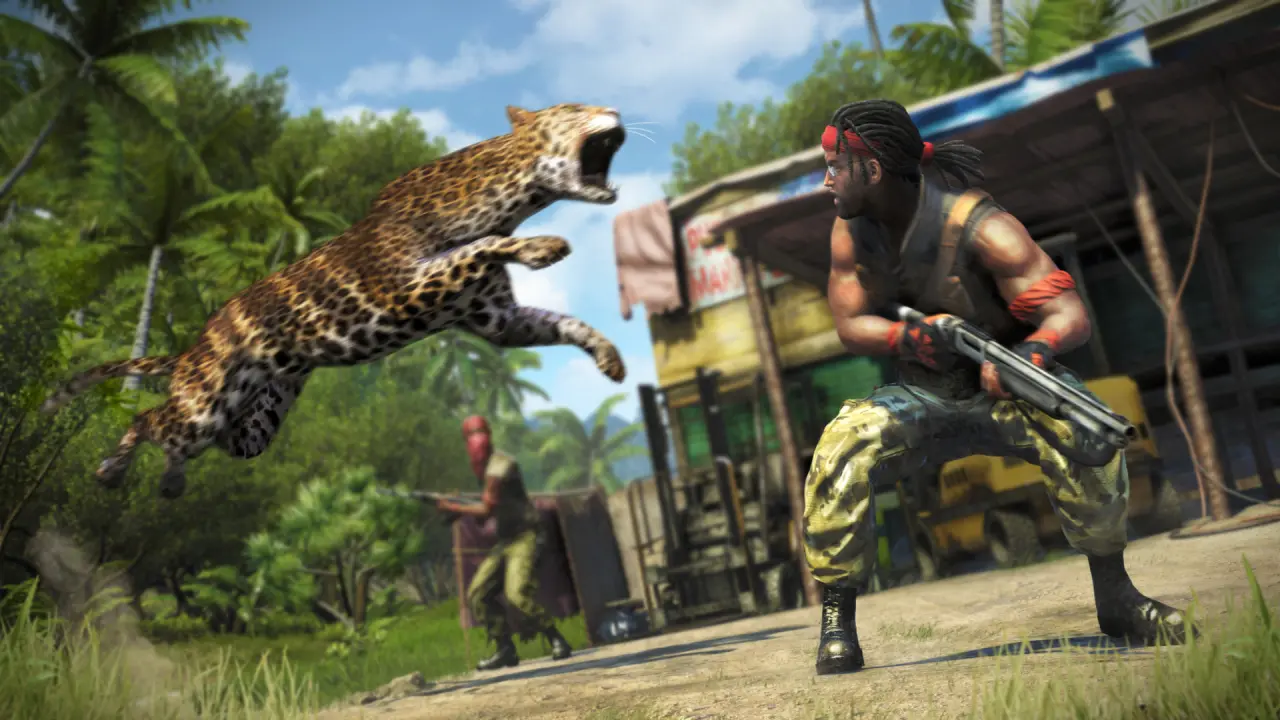
If one detail captures the ambition, it is the fire. In 2012 this was a genuine showpiece. Flame here is not a decal pinned to an object; it is a physical event that spreads. Light a patch of grass and the blaze travels with the wind, hunting along flammable brush, swallowing a whole camp, smoking out the defenders huddled inside. Watching the fire run the work for you — driving guards out of cover on its own — is a thrill most of its contemporaries simply could not offer.

And it is not just spectacle; it rewrites your decisions. Assaulting an outpost backed up against dry grass, a single match is often smarter than a frontal push, and suddenly wind, terrain and the spread of flammable cover are all part of your plan.
Welding the visual tech directly into the play loop like that is what makes it stick. It is the difference between a pretty effect and a tool, and Far Cry 3 always lands on the tool side of that line. Against same-year stablemate Assassin's Creed III, the third game carries the denser, more interactive natural ecosystem — wind, fire and prowling wildlife make this island feel like a living thing rather than a painted backdrop. You are never quite alone out here, and the engine is the reason it reads that way.
Platform versions: PC at full tilt, the port as a backstop
The visuals come with a platform footnote worth spelling out. The best form of this game is the maxed PC build, where resolution and effects let the islands' lighting and foliage density fully breathe — distant ridgelines under mist, individual leaves up close. The original PlayStation 3 and Xbox 360 versions trade some fidelity and frame rate to the hardware of the day, yet they still sat in the front rank of 2012 consoles, with none of the island's atmosphere lost.

The thing to flag is the 2018 Classic Edition, which moved the game to PlayStation 4 and Xbox One but barely touched the visuals — a straight port of the main game rather than a real remaster, with only marginal gains in resolution and texture work. The "Classic" label oversells it; this is the same island in a slightly sharper frame, not a reimagining.
So if you have a PC that can run it, the original PC build remains the best way to see this place. The Classic Edition is mainly a backstop for players who only own the newer consoles and want a way in; just do not expect it to dazzle you on looks the way a true generational remaster would.
Combat | 9.5/10
Gameplay: 9.5/10Every outpost is an open question, not a kill list
The play loop lives in the thirty-four enemy outposts scattered across the two islands, marked by black smoke and a red flag. None of them is a simple "rush in and clear the room." Each one is an open problem with several legitimate answers, and that freedom is the single thing critics agreed on most — 3DM handed the systems a 9.5 precisely because of it.

Start by lying on a ridge and tagging the garrison through your camera, learning the patrol routes, then pick your approach. Go dark with bow and knife and drop them one by one without raising a single alarm. Or blow a fuel drum, take up a weapon and push the front in a loud, ugly brawl. Or — the island's favourite trick — shoot open a cage and let a caged tiger scatter the defenders while you mop up the survivors. The game even hands you a bonus of fifteen hundred experience for clearing an outpost completely undetected, openly rewarding you for thinking. One objective, several genuinely different solutions: that is what keeps retaking outposts from ever going stale.
The same freedom runs through the three tattoo skill trees, which sort players into three kinds of hunter. The Spider line specialises in stealth — drag takedowns from the grass, death-from-above, chained silent kills — and anchors the sneaking build. The Shark line favours the loud approach, raising your health ceiling, your regeneration and your assault takedowns so the brawlers have more room to make mistakes. The Heron line goes long, sharpening marksmanship and distance kills along with mobility tools like the wingsuit and the rope descent.
You can mix all three, but most players drift toward a favourite over a single playthrough — some hug the grass and leave nobody standing and savour the clean, undetected run; some sit on high ground and pick targets off from afar like a shooting range. The game never forces a lane. It lays out the tools and lets you grow into whatever you want to be, and because the outposts respect every one of those styles, the same encounter can read like a different game depending on who is holding the controller. That is where the real depth lives — not in any single system, but in how cleanly they stack on top of one another.
Hunting and crafting bolt exploration to power
If the skill trees decide how you fight, the hunting and crafting system decides how much you can carry into the fight. You begin with a laughably small supply pouch, wallet and equipment holster, and the only way to carry more gear or more cash is to hunt specific animals and craft bigger kit from their hides. That is the clever part: it bolts "explore the world" directly onto "get stronger."

It is a deceptively elegant bit of design. Because the upgrades you actually want are gated behind animals rather than shops, the economy keeps pushing you out of the safe loop and back into the dangerous wilds, where the systems are at their best. You rarely grind on purpose; you go looking for a particular hide and stumble into an outpost, a tower and three side jobs on the way.
Want a bigger pack? Then walk into the jungle and trade blows with sharks, Komodo dragons and man-eating crocodiles. Liberating an outpost unlocks the Path of the Hunter missions, and the top tiers of gear demand the hides of rare animals that only surface in those quests — sometimes with a restriction that they be taken with the bow alone, which gives the late game a clear set of targets. Layer on climbing radio towers to strip their jammers and light up the map, plus jeeps, jet skis and the wingsuit for getting around, and the full circuit of liberating outposts, lighting the map and hunting to upgrade becomes the blueprint people would later call the Ubisoft open world. Set beside its own sequel, Far Cry 4, or a sandbox peer like Just Cause 2, the third game wins on the freshness the formula had back then and on the sheer tactical reach of its outposts — and a decade on, that combination is still hard to beat.
Content | 6.5/10
Content: 6.5/10A tight, deliberate length rather than a bottomless one
Far Cry 3 is built for density, not bulk. HowLongToBeat puts the main story around sixteen hours, and going after everything on the map — full clear, all the collectibles — pushes the total toward the forty-hour mark. That was not the biggest open world of 2012, but it is paced sensibly and it never bloats.

The side content fans out generously: thirty-four outposts to liberate, radio towers dotting the islands, the Path of the Hunter quests, lost letters and memory cards to track down, plus assorted side jobs and assassination contracts. They are laid across the map organically, and paired with the fog that retreats as you climb each tower, they make up the original template for filling a Ubisoft open world.
You are forever en route to a story beat when an outpost, a tower or a rare animal wandering into view tugs you off course — and that "pulled aside on the way" rhythm is exactly what makes the genre so easy to fall into. Crucially, the distractions here are short and self-contained, so detours feel like rewards rather than chores. A radio tower is a two-minute climbing puzzle; an outpost is a five-minute tactical set piece; a hunt is a quick, tense errand. The map never asks for more patience than the moment can repay, which is part of why the islands stay moreish long after the novelty of any single activity has faded.
Blood Dragon proves how far the framework stretches
Beyond the base game, the extra content is worth a word. High Tides is an added chapter aimed at the co-op mode, handing online partners a fresh set of missions. The real highlight, though, is the standalone expansion Far Cry 3: Blood Dragon.

Released on its own in 2013, Blood Dragon swaps the tropics for a neon-soaked 1980s cyberpunk dystopia — laser weaponry, cybernetic dinosaurs, a synth score — and runs the exact same liberate-hunt-light-the-map machinery under a wildly different B-movie aesthetic. It turns the cheap romance of a video-store sci-fi flick into deliberate comedy, right down to the gleefully absurd tutorial.
Blood Dragon sold well on its own and pulled the base game's sales up behind it, and that is the clearest proof that the framework the third game laid down is enormously malleable. Reskin it, restyle it, drop it into another decade, and the skeleton still stands up and still plays well. Few games of this size can survive that kind of transplant with their fun intact; the fact that this one does, and arguably comes out the other side even sharper, says a great deal about how solid the underlying loop really is and how much room it left for reinvention.
The soft spots: faceless multiplayer, late-game fatigue
In fairness, content is also where this game scores the lowest, and the drag comes from the multiplayer and the back-end repetition. The bundled competitive multiplayer and four-player co-op campaign are faceless next to that exemplary single-player run.

The co-op offers a prequel thread unrelated to the campaign, four players online, but the level design is linear and missing the open exploration that makes the solo game sing — more a chopped-up shooting gallery than an adventure. The competitive side vanished into a crowded shooter market and left no mark; its community drained away fast. The consensus is blunt: you buy Far Cry 3 for the single-player open world and treat the rest as a freebie.
On top of that, once all thirty-four outposts and every radio tower are cleared and the map is fully lit, the pull to explore drops off sharply — strip away the unknown and you are just re-running known points. That repetition is the ceiling on this much content, and it arrives a little sooner than you would like. Set against the near-bottomless thickness of a Skyrim, which can swallow hundreds of hours, Far Cry 3 clearly chose quality over quantity, keeping the experience to a length that never wears out its welcome. That is a clear-eyed trade-off, and it is also the honest edge of what this dimension has to offer. You will not be playing this one for a thousand hours, but the forty it asks for are unusually well spent, and very little of that time is padding.





Comments 0
Share your game review
Join the discussion and share your review of this game.
No comments yet. Share your thoughts on this review.