

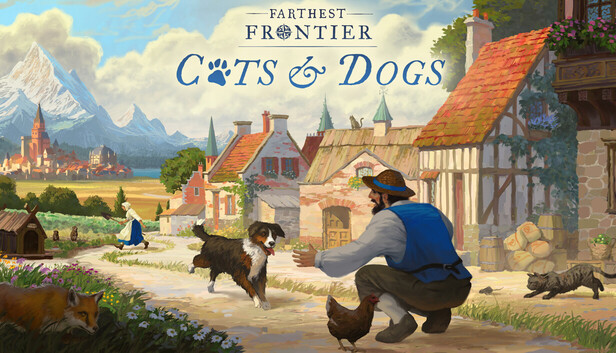

Farthest Frontier
Price History
Past 36 months · Updated dailyPrices cover Steam and 39 authorized stores; only legitimate offers are counted. The chart shows weekly market-wide lows and Steam's official price across the past 36 months.

01About Farthest Frontier
Farthest Frontier is a town-building game about guiding a small group of settlers through wilderness. Gather resources, hunt, fish and farm as you construct buildings and organize supplies for a growing settlement. Production chains and trade help provide needed goods, while disease, weather and possible attacks add challenges. Randomly generated maps and customizable difficulty options shape each run. Steam players: 86% positive from 24,583 reviews. Release date: October 23, 2025. Supported interface languages: Simplified Chinese, Traditional Chinese, English, French, Italian, German, Spanish, Czech, Korean, Polish, Portuguese-Brazil, Russian, Swedish, Japanese, and Ukrainian.
Credits
Lowest recorded in 36 months
$17.492026-04-20 · SteamBase game · same records as the chart above; USD history, not a regional Steam low.Language support
| Language | Interface | Subtitles | Audio |
|---|---|---|---|
| Simplified Chinese | Yes | — | — |
| Traditional Chinese | Yes | — | — |
| English | Yes | — | Yes |
Show 12 more languages
| Language | Interface | Subtitles | Audio |
|---|---|---|---|
| French | Yes | — | — |
| Italian | Yes | — | — |
| German | Yes | — | — |
| Spanish | Yes | — | — |
| Czech | Yes | — | — |
| Korean | Yes | — | — |
| Polish | Yes | — | — |
| Portuguese-Brazil | Yes | — | — |
| Russian | Yes | — | — |
| Swedish | Yes | — | — |
| Japanese | Yes | — | — |
| Ukrainian | Yes | — | — |
Steam PC edition data · 2026-10-16
02Before you buy
A settlement-building focus
Build a settlement through gathering, farming, production and trade. Pacifist play and options to disable invaders are described.
Steam PC features
Steam PC lists single-player and full controller support.
Language
English full audio is listed, alongside interface support in several languages. Confirmed interface languages: {supportedLanguages}.
03Frequently asked questions
Are maps randomized?
Yes. Maps randomize terrain and resources, and options let you set water, mountains and which resources can appear.
Can I avoid combat?
Yes. Pacifist mode avoids combat, and custom options can turn off invaders and disease.
Does it support mods?
Yes. The description specifies modding through Steam Workshop and Unity development tools.
“Food spoilage mechanics and historical disaster events challenge players in this grounded city builder, which ultimately stalls without compelling narrative stakes or long-term progression goals.”
Our Verdict
This is a game that knows what it wants to be. It doesn't aim to tell an epic story, create a visual spectacle, or introduce revolutionary gameplay. It simply wants you to experience the authenticity of medieval colony management—including the tedious, repetitive, and frustrating parts.
Is it worth dozens of hours? That depends on your patience for "management" as a concept. If you enjoy the process of careful calculation, methodical planning, and watching numbers slowly grow, this game can provide enough satisfaction. If you expect more narrative, more variety, more climactic moments, you'll find it monotonous.
Its Early Access status is both an advantage and a limitation. On one hand, the core gameplay is already formed, bugs are minimal, and it's fully playable. On the other hand, the content depth isn't yet sufficient to sustain long-term engagement, and repetitiveness will emerge after twenty or thirty hours. You can have fun with it now, but it might not reach that "can't stop playing" level.
It's not the kind of game that keeps you up all night, but rather one you play for an hour or two each day over several weeks. The pace is slow, but solid.
Popular Steam reviews
Native-language selection · 10 reviewsSelected helpful reviews in this language show both recommendations and criticisms. This selection does not represent the overall positive rating; opinions reflect the version reviewed.
Okay- after almost 46 hours in Early Access, I am going to give this an initial review. (I will update my review as the game evolves and gets to full release.) First- I own a number of settlement/city-builder games. None ever felt good to me, I generally played for a very short time (a few hours at most), quit playing and never felt the call to go back and try the game again. This game is different, somehow. Yes, it is made by Crate- which is why I bought it and decided to see if this was the one that got me into the genre. If it sucked, I would say so. I like and trust Crate, but I ain't their cheerleader. That said- the game is gorgeous to look at- the art style is good, and very much has that "Grim Dawn" Crate look to it. But it is a much more vibrant and "realistic" world. The music is fantastic- it suits the game, isn't overdone or intrusive. Skew Sound did a bang-up job with the music. The audio is good- the sounds of chopping trees, casting fishing lines, sawing planks- it all sounds "right"- not overwhelming and noisy for the sake of being noisy, and you can turn the sound down and music down in the main settings if it suits you. The gameplay is complex for someone not used to this type of game- it is a lot to learn and keep track of. I am finding the UI to be a bit overwhelming and a bit unintuitive for a newbie like me to try to look at and work with all at once, but the more I play, the more it starts to make sense to me. Some optimization issues, with some hitching and fps spiking once my towns hit about 60-70 villagers, and things get busy. It is Early Access, and they have said more optimization passes will come as they move forward- which is what I expected. The opening screen contains a disclaimer telling you to expect bugs and future changes- so if you can't deal with that- don't buy Early Access games. Wait for full release. Other than the microhitching and fps spiking- I haven't has any major issues with the game running well enough to play. No crashes, nothing gamebreaking. I am playing on a desktop with an i9 9900k/ NVIDIA 2070 RTX Super/ 16 GB DDR4 @2400 MHz/ Windows 10 Home. 60-144 fps (usually closer to 144, but the spiking will drop it to 60, with an occasional hitch/stutter that drops it to much lower- autosaves will cause the game to hitch pretty significantly. It is a Unity game, it is CPU bound more than GPU bound. No thermal throttling on my machine, temps peak at around 70-75 ° C, which is well within safe limits for my system. (5 fans and liquid cooled, though- so YMMV). So- not the best perf right now, hopefully that will improve with future optimization passes. I like it. I am really enjoying the game, and the process of learning the game and how things work. I've already gotten my money's worth, though I did pay less than full price because I bought (completed) the Crate Entertainment Complete Collection Bundle. I have no problem with the price, but I also am not struggling financially- so again, YMMV. Again, I will update this as things go along and change for better or worse. But the fact that I have not rage-quit after a half hour, like I did with Banished- that should say something. Not sure why this game has really grabbed me, when so many other games in the same or similar genres have not- but it has. Check back in at a later date to see if I still feel the same. :) (Quick edit: 22 August, 2022- to fix a few typos. More may exist- dyslexia makes me miss them quite frequently.) (Another quick edit: 25 September, 2022- v. 0.7.6. New update, some bugs fixed, other bugs still exist. But perf is better on my rig (YMMV), and several major bugs seem to have been addressed, while new ones have popped up. More people playing means more machine builds are running the game, and exposing some HW-specific issues, and those if us who enjoy trying to break games just to see if we can are having some success, lol. AI is still a bit janky- mainly prioritization of jobs and needs fulfillment (dude, why are you dropping raw meat in the middle of the road to run home because you are hungry- you are literally carrying food...). But I am quite happy with how Crate is addressing these things. If you want instant gratification- this may not be the game for you. It is evident that a good bit of planning ad long-term strategy is needed to make your town go from surviving to thriving- and thee is no "one-way-only" to get there. The game allows for a plethora of different playstyles to work well, while rushing things seems to lead to a death spiral at some point- mistakes made 50 years ago may come back to kill your children and grandchildren.) 11/24/2025: Coming back after a long time away, finally full release. Lots of changes to the game, most notably the Knowledge (skill) tree. Takes some getting to know, minor gripe that the layout is a bit odd and that makes it difficult to find a building or buff you want to unlock. I am sure after playing a bit more I will be able to find what I want without thinking- but it will take some time for returning players or new players to get the hang of the Knowledge tree. Other than that, it still scratches an itch and is still quite enjoyable to play for me.Show moreShow less
I thought this game was pretty good until they added raider camps. Completely pointless addition that added nothing more than a new way for your village to go into a death spiral early to mid-game. Hunter AI will try to attack them on sight for some horrible reason, and sprint into their towers range and die. A new hunter will be assigned, and laborers will try to recover the previous hunters corpse. They enter the towers range, and die too. More corpses means more laborers try to recover more bodies. You cannot stop them from doing so, only temporarily interrupt them by giving them orders to stand around and do nothing, and when that order expires they will continue to try and recover corpses. This has happened to me twice on different seeds, with my only solution being to completely restart. There is no way to turn these camps off besides Pacifist Mode, which turns all threats off entirely. On my third restart, I had the misfortune of having ANOTHER ♥♥♥♥♥♥♥ camp spawning outside my range of vision, only discovering it when a hunter wandered into its radius again. This time however, I didn't make a graveyard, so my villagers wouldn't try to recover bodies. This meant though that any time a villager died in my village, it would cause plague to spread due to the corpses being kept in houses. It's incredible how a single ♥♥♥♥♥♥ addition manages to completely brick the game. Everything else about the game I love, but why in god's name would you ever add a feature that amounts to "Villagers die if they enter this area", and provide no means of keeping them out of the ♥♥♥♥♥♥♥ area? There isn't even any reward for killing raider camps besides "delaying" future raids. It's made it genuinely unplayable. Either remove these stupid ♥♥♥♥♥♥♥ camps, give us a way to tell villagers to avoid them, or make it so Hunters dont try to 1vX the entire camp. Or just give us a way to turn them off.Show moreShow less
TLDR: Enormous potential to be a huge time-sink, but still needs work. The good: - It's a clone of Banished+Colonial Charter mod, in the best of ways. - The graphics, music, and ambience are generally very good. - The gameplay loop is addictive. - The additions of combat, soil composition, crop selection, all extra dimensions to the Banished formula and force you to consider your town's layout. - The UI is pretty good, though not perfect. - Road building is really easy/practical! The bad (keep in mind it's still in Early Access) - The "tech tree" doesn't make much sense as it is right now. As other posters pointed out, you often need building A so you can have building B, but building A will be useless for a while. Then you get attacked, and need weapons, but you need iron, but have no means to make it. - It's hard to tell buildings apart in the UI. I rely on hovering over them, because they look too similar, and it disrupts the flow. - Really needs a tutorial. I've played a lot of Banished so I immediately knew what to do, but other users won't. - The terrain-flatten tool is a must but it's not working. I expect that to be fixed soonish.Show moreShow less
Sadly, after nearly 20 hours in this game I'm probably first to write negative review and soon I will describe this game in form of video (in my language). Let's start with the fact that this is a game similar to Banished, but with slightly more combat and defense mechanics, plus cool idea about farming and leveling up buildings. That's good. In addition, it has a brilliant graphic design, which very quickly begins to drop to a barely playable number of frames, despite strong and modern PC. We quickly discover that everything is mechanically and economically designed in an incredibly idiotic way. For example, we do not have a stone mine (there's no such thing in game yet), so we only need to bring the stone over time, even though our city lies under the mountains. So are the advanced tools. We cannot make them, because to be able to do them we must have a blacksmith. To have a blacksmith, we must have these tools. Dumb circle. We have to import such things. The city wears out too - buildings, tools, everything. So over time we become incredibly dependent on imports. Eating practically does nothing. We are making huge amount of fields, hunting, gathering, we process this food in a critically great way, in a book-like, perfect manner, but so what, it rots after a year, no matter how we try. So the entire food mechanics of the game is based fulfilling the needs for a maximum of one year (12 months). It's incredibly difficult to make food chain better during 80% of the content. Children are born, but where do they live? Are they eating? When are they growing up? How long? We do not know. The game in a lot of places is made by authors for authors. Not for the players. I also noticed that the game's calculation system works extremely weird. We put a well near the lake, but there is no water in it, it is empty for a long time. The fisherman is sad and he has a poor feelings because he has no water, living... by the water. All the inhabitants of the city rush to the fire, even those who will go to the place of the fire for a month. Someone was attacked by a bear? The townspeople give a ♥♥♥♥ about him. The guards are also not very good at helping him or reacting to attack. A merchant arrives in the village? He wants to sell us something he doesn't own. That's a great feature! :) It is possible to play it, but really, it is a game that has not been tested at all. It is made badly, unpleasantly in every possible way, where we are fighting game mechanics, not trying to survive. We are trying to "cheat" or "avoid" game mechanics. At some point we come to a situation where our people have nothing to chop for firewood, no stone, and the merchant arrives and sells us something that he does not have. I forgot, we can't burn coal and wood in houses, we need firewood. Lol. We lose after 20 hours, not because the bandits beat us or our decisions are bad, but because the map is running out of resources and everything collapses under its own weight. This game is a race against time, which is not the point of such games. I wouldn't put this game in a negative review if the authors had played their own game and noticed that they had done a lot of things wrong. And so, with full premeditation, they give us a game based on a race to get as far as possible mixing it with poorly working "survival".Show moreShow less
My reviews are never seen. Just know that this game is positive from me and move alongShow moreShow less
EDIT Aug 15, 2022 I want to add that I find this developer response condescending and rude. First, the dev appears to have purposely left out the M in my name to call me CptSchidt like some kind of immature bully. ReAlLy EdGy. Second, the dev completely dismisses everything I said by accusing me of saying I've reached the endgame in 4.1 hours—which I never said and never would. Finite resources really are a problem, no matter how they try to spin it. I don't care if the devs have built a tier 4 city with more than a thousand people in their echo chamber studios. They say I'm the dumb one because they haven't exhausted the entire map of resources and do just fine. The problem is that the stone deposits often only have maybe a dozen or so units in any given spot (and that's a good deposit) and in order to get more, you have to go farther and farther from town. Sure, you can walk to the other side of the map and find some stone and ore and whatever else, but it takes forever and people get attacked by animals and enemies and die. They get sick. They need more food. They get tired. The computer decides to make them do any number of things besides what you want them to do or have prioritised. In any practical sense you run out of resources and fast. The dev says they don't know what I'm talking about when I say you have to build buildings that have no immediate use. Well, the pub is a great example. You need a pub (tier 2) for entertainment and taxes for gold. But the pub needs beer or it can't serve its purpose. You can't get beer until you're tier 3. Don't even get me started on defense towers. Another great example is the healer's house. It takes forever to get one, and you need it to stop people from dying from their wounds inflicted by animals and enemies, and from disease. Once the house is built, it's useless until you can actually get a healer to work there. The healer requires a constant upkeep of gold (among other things), which you can't get until.... And all buildings seems to go on and on like this. What I especially don't like is that the devs feel entitled to my money, especially with a response like this. I spent $40 on this the day it came out because I was hotly anticipating it. I post a negative review after 4 hours of playtime and the devs come back and call me a swearword, accuse me of saying something I didn't, and then condescend to me about being too stupid to play on normal maps currently available and, if only I stick around, they'll make it easier for idiots like me in the future by adding an "idyllic" map. Screw off. They accept zero responsibility for anything. Nothing in the game is explained. They offer nothing in terms of how the mechanics work. No charts or graphs or consumption rates or anything. Traders show up with essential goods at random and their visits are seldom. You also have to manually watch for them because there is no indication of when they're coming or when they're trading. Literally RNG determines the fate of your city. 99% of the negative reviews I've read are fair, honest, and all say they didn't want to be negative because they like the studio's past work. This is my first experience with these people, and I have to say that based on their response to me and others, I will never purchase from them again. --- ORIGINAL REVIEW: I've been excitedly waiting for this game for a long time. Period city builders that are any good are far and few these days and this looked like something I could get into. Boy was I wrong. Essential resources like stone, iron, and clay are finite. This means that you must constantly expand farther and farther from your city. There is no buildable drop-off point like in RTSs or warehouses like in Anno. The only way for you to get resources is for citizens to physically bring them to your town, and the farther away the resources are, the longer it takes. Not only does it start to take forever, but it requires more and more upkeep as your people walk farther and farther, so as resources become sparser, you waste what you do manage to find on the upkeep needed to get them. Diminishing returns (although by how much exactly is anyone's guess, because the game doesn't give you any information). You also have no control over your citizens. You can move them around, but for what purpose eludes me. The game decides who does what and when they do it. What's worse is you can prioritize the construction of a particular building, but it doesn't matter. You might think this will solve your problems of nothing ever getting done, but it won't. Even when you prioritize a build, it can take forever for it to finish (or even get started) because the game will make your citizens go do something else (often multiple times) before they'll get around to starting or finishing it. The lack of control means the game, not you, decides whether trees or stone are harvested. If you want trees, you better hope the game agrees with you. The building tiers make no sense and serve to needlessly waste time and complicate. Many buildings, for example, serve as prerequisites for higher tiers but serve no purpose until that tier is reached. This means you have to spend time and money and manpower on things you can't even use in order to get to a tier that will unlock further things you can't use. It's a lot of sitting around and waiting. It feels like RNG rather than planning. The worst part for me, even if they fixed all these problems, is that each game isn't about city building, it's just a race against time determined by how many resources you find. Once they're gone, there's literally nothing you can do. If you ever played StarCraft, you know what I mean. Once the crystal is gone, the game is done. That's fine for an RTS, but in a city builder? Come on.Show moreShow less
Early Access Review after 50+ Hours Disclaimer: I received a free copy of Farthest Frontier from the game's PR team. But I've not been paid to talk about the game, stream or create content for it, nor say anything positive about it at all. It's just that good. TL;DR: Farthest Frontier might just be the best colony builder I've played since Banished released 8 years ago. From the game's gorgeous soundtrack and sound design, to the challenge of balancing a sprawling, expansive city, Farthest Frontier surprised me in so many good ways. The game isn't perfect, of course, but it will keep you buys for tens of hours *at least*, and for many of you - many, many more. View some unsponsored gameplay https://youtu.be/bfLt_hs_r0s FAQ What games does Farthest Frontier feel like? It feels most like Banished and Anno - gather resources with your population, use them to place new buildings and appease the townspeople. Happy townspeople upgrade their homes and require new goods to remain happy. There have been some comparisons to Settlement Survival and Foundation as well. Are there enemy attacks? Can you play in peaceful mode? Yes, you'll be attacked by raiders periodically. You can enable peaceful mode when you start the game if you'd like, or adjust the game's settings so that raider attacks don't ramp up in difficulty. This makes raiders very weak and basically negligible. But you will still face some small attacks from them. You can also challenge yourself with heavy raider attacks if you'd like to, or set the game right in the middle with a balanced mode. Death is a part of life in Farthest Frontier. How do you "win"? So far the game doesn't have a strict "win" condition. You can play infinitely, with no hard population cap. Your PC hardware will determine how long you can play the game. I currently have 400 population in my city, and the game performance is starting to slow down a bit. That's because each villager has their own life, jobs, pathing, and is individually animated. Is it multiplayer? No, and I wouldn't hold your breath for it. Is it moddable? Not as of writing this review, but I'd be surprised if the game wasn't made moddable in the future. If I like X, will I like Farthest Frontier? Banished - Yes Settlement Survival - Yes Foundation - Probably (there *is* a grid in this one) Anno - Maybe (The game is simpler than Anno, but many of the same principles are here) RimWorld - Maybe (The game's challenging, but characters don't have stats or "individuality" in the same way) The Sims - Lol I have no idea Long Form Review It's been many many years since I've played a game that has excited me the same way that Farthest Frontier did when I first loaded it up. The moment the soundtrack hits you, you realize the care and attention to detail that the game has toward the atmosphere and sound design - something often neglected in simulation games. But it makes all the difference here. Each time a villager chops a tree, you hear a chop sound. Each time the season turns from summer to autumn to winter, the yellow leaves fall and the sound of creaking dead trees can be heard. The game's atmosphere is encompassing, immersive, and delicately made. For that alone, the game was worth it. Gameplay is what you would expect from the trailer. You start on a procedurally-generated world with a few settlers and a town center. You give orders to your settlers to chop trees, mine stone, gather food, and build new buildings like storage yards and homes. Villagers have a happiness meter determined by the goods and services they have access to - they need clothes, shoes, tools, a variety of food, sanitation services, and clean drinking water. Failing to provide these things and your villagers may die from a variety of diseases, or from frost exposure, or from a work accident. Villagers that catch Small Pox need to be quarantined from the others, or they'll spread the disease to one another. In one game, I accidentally gathered a militia to fight off a roaving group of bandits, but because one militia member was sick with Small Pox, I suddenly had an outbreak of 50-70 small pox victims. That one...didn't turn out too well. Each villager is independently nameable and controllable unlike in games like Banished. There's no generalized abstraction of the game mechanics here. Bob wakes up at home, goes to work, mines some rock, and takes that rock back to the storage. If Bob dies along the way, he drops the rocks he had in his inventory on the ground and someone else needs to pick them up (and also bury Bob in the graveyard). It makes the game feel alive in that way as too do the decorative elements of the game. While each of the buildings are hand-crafted and unique, many of them - like houses - are cookie-cutter designs that can end up looking repetitive next to one another. You can mix up your town by adding parks, wood and fruit trees, farmland, and roads to design a pretty aesthetically-pleasing city. And almost every building in the game is upgradable through at least one or two steps upward as your technology increases, so there always feels like there's more to do. I've generated about 20-30 different worlds and each one feels different. One was a barren hellscape with little more than gravel and ice to build on. The ground was infertile and there were few animals or bushes for foraging, but the land was rich in valuable minerals, so we would have needed to rely on crafting and trade in order to feed ourselves. On another, most of the area was made up of lakes and ponds. Deer and boar were plentiful and the land was mostly flat for building. I've spoken with the developers who say it's even possible to roll an island seed, where you're stuck completely surrounded by water without any help (or harm) from the outside world. The typical pressures in the game are around running out of resources. As your population grows, you'll need to build new farms on fertile land that will eventually run out. Your supply of deer may dwindle if you expand over their home territory, so you'll need to reconsider where to place your hunters huts to continue the supply of hides and meat. In fields, you'll need to rotate crops to keep the land fertile enough for growing. Your wells will begin to evaporate if the ground isn't covered in shade from trees. Wild animals will break into your fences, damage buildings, and steal your food if you don't protect your city. And of course, raiders will attack and attempt to steal your gold bars - the game's defacto currency - if you haven't built a suitable defense of walls, towers, and barracks to defend against them. One playthrough took me about 20-30 hours to reach the end-game final technology levels. Though I was focused more on creating a massive town than I was to reach the absolute end of the available content. Once I reached about 250 population I noticed some slowdown and chugging in the game. Panning the camera around began to get choppy, which was the first time the game brought me out of immersion. To test it though, I've challenged myself to reach 500 population in our game on-stream: twitch.tv/maxthecatfish 400 pops in, the game still runs - though with some chop - and we might even work toward 1000 population to see if we can really push its limits. Outside of performance, for an early access game, I'm super pleased with the game, and I mean it when I say that Farthest Frontier is likely the best colony builder I've played in the past 10 years. The game's sound design is thoughtfully crafted, the gameplay brings me back to the joy I had playing Banished for the first time, and it's full of new challenges and puzzles that I thoroughly enjoy. I highly recommend it.Show moreShow less
The biggest problem with Farthest Frontier isn't balance, difficulty, or complexity. It's that the game constantly wastes the player's time. This is one of the most beautiful and immersive city builders on the market, which makes its quality-of-life problems even more frustrating because they're not hidden behind a bad game. There is an excellent city builder underneath all of this, but interacting with it often feels like fighting the interface instead of managing a settlement. Take building site management. If I place twenty construction sites to test a neighborhood layout and later decide it doesn't work for what I'm trying to build, I can't simply drag-select them and press Delete. I can't bulk-cancel them. I can't use the so-called "Manage Buildings" tool. Instead, I have to click each individual build site, move my mouse across the screen to the delete button, click it, move my mouse back across the screen to confirm, and repeat that process for every single structure. Twenty build sites means roughly sixty clicks for something that should take seconds. What's even more baffling is that the "Manage Buildings" tool doesn't actually manage buildings. It manages roads, plazas, decorations, walls, towers, and shelters while excluding one of the most common things players actually need to manage: building sites. That design philosophy shows up everywhere. The game constantly pushes the player through extra menus and unnecessary steps for routine actions. Want to remove construction plans? Open a window. Want to review or manage large groups of structures efficiently? Good luck. Many systems feel designed around repetitive manual interaction rather than giving the player practical tools to manage a growing settlement. The larger your town becomes, the more obvious these shortcomings become. This lack of clarity extends into one of the most frustrating parts of the entire experience: logistics and system transparency. The game often provides minimal feedback about why production chains are failing or stalling. You’ll see messages like “production halted” or notice critical shortages without clear explanations of what caused them or how to resolve them efficiently. Resources appear to exist in the settlement, yet aren’t being delivered where they are needed. Workers behave in ways that are difficult to predict or diagnose, and instead of clear diagnostic tools, the player is left to manually trace problems across multiple buildings and storage points. In a city builder where logistics are the backbone of progression, this lack of visibility turns problem-solving into guesswork far more often than it should. This leads into one of the game's biggest recurring issues: many systems don't behave the way players would reasonably expect them to. The flattening tool frequently behaves more like a smoothing tool than a flattening tool. The Manage Buildings tool doesn't actually manage many of the structures players most commonly need to manage. Expensive hedge fences and iron-wrought fences provide no desirability despite being some of the most visually appealing structures players can build. Time and time again, the game teaches players that the obvious solution is not the correct one. Instead of feeling intuitive, many systems feel like they require players to discover workarounds for problems that should not exist in the first place. The desirability system is perhaps the clearest example of this disconnect. Hedge fences and iron-wrought fences are some of the nicest-looking structures in the game. They're expensive, visually appealing, and exactly the kind of thing players naturally want to use when creating attractive residential districts. Yet they provide absolutely no desirability. Their practical purpose is largely limited to controlling animal access, while a handful of cheap gardens provide significantly more value for improving residential areas. The issue goes beyond fences. Many structures that clearly exist to improve the appearance of a settlement contribute nothing to desirability at all. Every aesthetic investment should provide at least some benefit to desirability, even if it's small. The amount can scale based on cost, prestige, or upgrade level, but when players spend resources making their city look better only to discover the game doesn't recognize that effort, the system feels arbitrary rather than intuitive. A small garden should not outperform nearly every other beautification option simply because it happens to be one of the few objects the system rewards. The game should encourage creative city design, not funnel players toward a handful of mathematically optimal decorations. Ironically, the desirability system also exposes another problem with the terrain system. The flattening tool frequently requires multiple passes and often struggles to create suitable construction space without creating awkward-looking terrain. In practice, I've found that decorations and gardens do a better job preparing building areas than the dedicated terrain tools. By placing inexpensive decorative objects across an area, I can preserve the natural rolling hills, create flatter building footprints, and prevent structures from clipping into terrain more effectively than if I had used the actual flattening tool. When decorative objects perform the job better than the system specifically designed for that purpose, something has gone wrong at a fundamental level. One recurring theme throughout Farthest Frontier is that players are often rewarded for finding workarounds rather than engaging with the systems as intended. The most effective solution frequently isn't the tool designed for the job, but some unrelated mechanic that happens to produce a better result. Gardens become superior desirability generators compared to more expensive beautification projects. Decorative objects become better terrain preparation tools than the flattening system itself. Rather than reinforcing the game's mechanics, these situations encourage players to bypass them. What makes these issues especially frustrating is that they all point toward the same underlying problem: a lack of focus on player interaction and quality-of-life in a genre built around managing things at scale. Many actions still require repetitive one-by-one interaction long after the settlement has grown beyond the point where that makes sense. What makes all of this so frustrating is that none of these complaints are about wanting the game to be easier. Good quality-of-life features don't remove challenge; they remove unnecessary friction. They respect the player's time and allow the player to focus on meaningful decisions. Farthest Frontier often does the opposite. Too many systems feel like they were designed around workarounds rather than convenience, forcing players to spend time wrestling with interfaces instead of building cities. The tragedy is that beneath all of these issues is arguably one of the best city builders in the genre. The atmosphere is fantastic, the visuals are fantastic, and the core simulation is genuinely compelling. But after years of development, it is difficult to understand why so many basic quality-of-life problems remain unaddressed when they affect some of the most common actions players perform. Farthest Frontier doesn't need more content nearly as much as it needs the developers to modernize the experience, embrace intuitive design, and start respecting the player's time.Show moreShow less
The list of settler/Anno-like games has grown really REALLY long in the past decade, and I have been disappointed more times than I can count, with each of them being just as boring and unfulfilling as the last. I almost cant believe it, but this one is actually good.. like.. really good. The economic simulation is fully phyiscalized and works at a huge scale. No teleporting goods or people. Everything is tracked and flows seamlessly. When your hunter kills a deer, they go and actually pick that deer up and bring it home in their inventory. They then turn the deer into meat, hides, and tallow, and each unit is then physically represented as its carried off to the smokehouse or storage. The smoked meat is then picked up by the grocers and sold throughout the city. The meat eventually ends up in the inventories of various households throughout the town and when people go to work in the morning they will pick up the smoked meat and carry it around in their inventory until they are hungry and eat it. This all happens in the context of a city with hundreds of people juggling dozens and dozens of goods and materials. All this is happening under the hood, and it never lags or breaks. If you like city builders or econ sims, this is the one to get.Show moreShow less
Edit: A few years on, I got the craving to give this another try and see if it had improved and long story short, it just hasnt. It still suffers from the same pacing issues it always did. Traders will make or break you year after year. *tinfoil hat* Im almost certain the engine reads your stockpiles behind the scenes and adjusts a "false challenge" by making the merchant who sells the things you need suddenly not show up for a year, or the merchant who buys your stock suddenly not want it when youve got a full stock ready to go. At least half of your town isnt unemployed? Your laborer numbers are critically low. Get used to that message, you'll see it a lot. Most of the challenge in the game comes not from the mechanics themselves, but from wrangling a chaotic AI that still wants to run halfway across the map for no reason. They won't ever implement most of the QOL upgrades most people want because if they did, it would totally break the illusion of challenge. The building grid system still sucks. And now to top it all off theyre throwing a useless tech tree on top of everything to make it even more obtuse. Shame. At least the villagers are less prone to leaving random items strewn about the streets. This is tough... I really wish there was something you could give between a yes or a no here. Theres a fun game here, but nothing really sets it apart from any other city builder and the minor nuisances really drag it down. Pros -Its a well paced settlement sim, getting your settlement to thrive especially in adverse conditions is a joy. -the notion of a market mechanic is novel, youre not going to have everything your people need and youll probably have more of something than your people need. -the aesthetics are great. towns look lived in, the screen dims during the winter making you feel properly anxious for the survival of your townspeople. -a wolf gave one of my townspeople rabies day 1. that was hilarious. -the crop rotation mechanic is pretty damn cool. getting your fields to be fertile and disease free is a neat little minigame in itself. Cons -the AI is garbage. the people will drop whatever theyre doing literally in the middle of the road to run off for a random unnecessary task. Tier 3 and 4 towns are littered with half accomplished tasks, streets full of shoes and fish. They'll sit in their houses refusing to do whatever job you've set for seemingly arbitrary reasons. Theyll run headlong into danger then realizing theyre in danger turn tail and die fleeing. Ive watched one of my hunters waste 4 months carting a supply of water to their shack only to realize they had too much water and cart it back while the settlement starved because they werent hunting. -the tower defense mechanic is tired. Why does every settlement sim out there have to have raiders. do you not trust that your management/building/expansion gameplay is enough? NPCs have to randomly zerg the town every once in a while? Need us to have a gold sink in random defense for the unnecessary zerg mechanic? raiders do nothing but beeline for the center of town. its muddy and unnecessary. -Speaking of which, the guard AI is garbage, theyre borderline useless. just build too many defense towers and HOPE they actually fire when a baddie gets near. -Grid system or freeform. pick one. or integrate them better. buildings all want to be built on a strict grid but roads are going everywhere with arbitrary rules that keep them from being placed occasionally. The terrain often doesnt work with the grid. -The mercantile system is either broken op or useless. Either you make 2000 gold every time they show up or they never show with what you need. -Food spoilage is obnoxiously oppressive. You have to keep over 3 months of spoiling food on hand at all times or else your villagers will panic and think theyre starving. Theres no way to stockpile a 4 month supply of food without over half of it spoiling until the end game and you get the warning noise every time it dips below that. I WANT to like this game. I DO like this game, but the petty frustrations build up. Its fun to start settlements and see if they thrive. Its not fun to defend against the raiders because the mechanics suck. The end game is dull because youve either got your town set or you dont by that point. all there is to do is watch your town thrive, wait for raiders, and listen to the low food warning donk off every spring because theres *gasp* only 3 months of food left while the farmers are planting more. I hope it gets better, I really do.Show moreShow less
Source: original Steam user reviews. Helpful votes are an archived snapshot, not live data. Last collected: 08/15/2026.