

























Opening
Five Nights at Freddy's: Security Breach is the first game in the series to unlock the door and let you run. Steel Wool Studios traded the locked office and the dwindling power meter for a sprawling, neon-soaked Freddy Fazbear's Mega Pizzaplex, and handed you a flashlight instead of a security feed. The dread no longer comes from a thing you cannot see creeping toward a camera; it comes from being exposed in a space far too large to hide in.
You play Gregory, a boy locked inside the Pizzaplex overnight, who survives until 6 AM with help from Glamrock Freddy himself. Built in Unreal Engine 4, the 1980s glam-rock mall is instantly recognizable, and the game has sold more than 1.4 million copies worldwide. That commercial weight alone proves a once-tiny indie jumpscare IP can stand on the bigger stage of large-scale exploration horror.
It is also a game whose ambition and whose flaws are equally loud. Critics parked it in the middle of the road at OpenCritic 72 and Metacritic 73, while Steam's long-tail rating climbed back to 86% Very Positive across 64,000-plus reviews. That arc, a rough launch followed by a slow recovery, is the real story this review needs to tell.
Story | 6.5/10
Story: 6.5/10Glamrock Freddy is the one thread that holds the cold Pizzaplex together

The single most effective storytelling decision in Security Breach is making Glamrock Freddy your ally rather than your hunter. For its entire history this franchise has cast its animatronics as pure threats, blank-eyed killers waiting behind a camera. Here, for the first time, one of them protects you, even letting you climb inside its chest cavity to slip past patrols. A seven-foot machine standing on your side gives an otherwise frigid steel theme park a pulse, and it hands the player one concrete thing to hold onto in a story that is otherwise scattered to the wind.
Freddy is not a hollow escort, either. He weakens when his battery runs low, he frets over Gregory's safety, and a handful of plain lines of dialogue make the trust between a child and a machine land with surprising weight. Kellen Goff's voice work does the heavy lifting; that mix of showbiz swagger and genuine tenderness is the most human sound in the whole production. Take this relationship away and the narrative collapses into loose fragments. With it, the scattered clues finally have a spine, and you have a reason to keep walking deeper into the building when nothing else is explaining itself.
Fragmented lore: a feast for veterans, a maze for newcomers

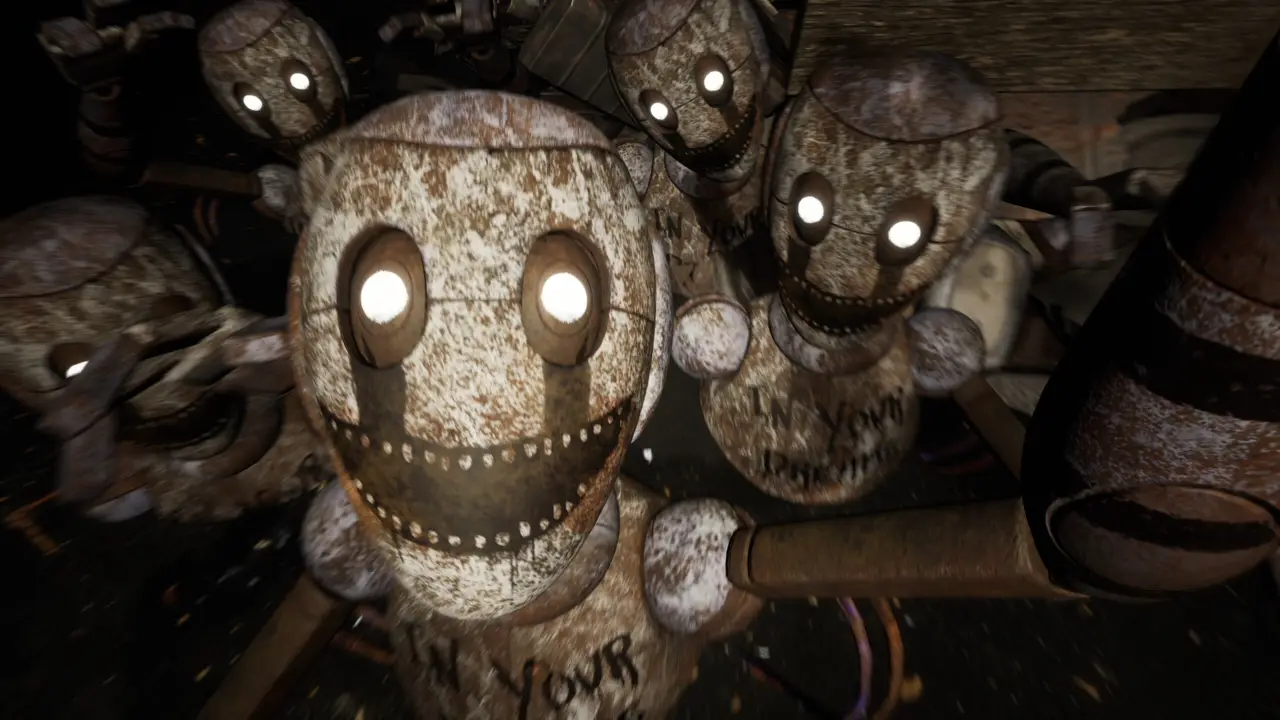
Everything outside the Freddy thread, though, is assembled from shards. Security Breach keeps the series' long-running habit of hiding its malice inside collectibles, recorded tapes, locked rooms, and cutscenes that flash past before you can parse them. The signature beat is the broken rabbit figure leaning out of a crack in the dark, refusing to explain who it is or what it wants, leaning entirely on silhouette and timing to remind you how hostile this world really is. The game trusts you to feel the threat rather than read about it.
For veterans who have chewed on series lore for years and watched every theory video, this is a banquet. Every callback and buried Easter egg earns a knowing smile, and the rewards for paying attention are real. For a first-timer, the same material is a maze with no map. You cannot tell which detail is load-bearing and which is mere atmosphere, and the open layout scatters cause and effect even further apart, so emotional continuity frays. That split is exactly why the story divides players so sharply: it is generous to its own and nearly indifferent to outsiders, and there is no difficulty slider for narrative comprehension. Players who shrug off the cryptic delivery in older entries had a single locked room to interpret; here the same cryptic instinct is sprayed across a building the size of a real mall, and the signal gets lost in the square footage.
Multiple endings: turning "I don't get it" into "let me try again"
The multiple endings are the game's attempt to patch all of this, and they half succeed. Different choices and exploration depths route you toward different conclusions, which hands the hardcore a reason to keep digging and softens the deflation of finishing a first run feeling like the story never landed. Compared with the fragmented but emotionally continuous storytelling of something like Alan Wake, Security Breach is markedly less coherent and leans far harder on the player to assemble meaning unprompted. It rewards the obsessive and abandons the casual in the same breath.
But the endings cut both ways. Their triggers are obscure enough that plenty of players never reach the so-called good ending without consulting a guide, which only reinforces the criticism that the narrative intent is unclear.
The deeper contradiction surfaces here: the game wants the open space to grant you total freedom of discovery, yet it never lays down enough legible story signposts inside that freedom, so the thrill of exploring and the frustration of not understanding keep pulling against each other. The ceiling rises; the barrier to entry does not fall. A more confident edit would have trimmed the dead-end mysteries and let the strong central thread breathe. Story lands at 6.5, a faithful portrait of ambition that is real and execution that is fractured.
Audio | 8.5/10
Audio: 8.5/10Your ears reach the danger before your eyes do
Audio is the steadiest, least contested craft in Security Breach, and it is what earns the 8.5. Inside a Pizzaplex this enormous, you usually detect a threat with your ears first and confirm it with your eyes second. Footsteps ringing through an empty atrium, the electrical hum of a charging station, the dense electronic chirp of the arcade floor, all of it stacks the unease of a bright space that is somehow crawling with menace. The brightness should feel safe, and the soundscape spends the entire game proving it is not. Where the visuals try to disarm you with color and light, the sound mix keeps a hand on your shoulder, never quite letting the cheer settle into comfort. A distant clank can stop you mid-step long before anything appears around the corner, and that gap between hearing and seeing is precisely where the dread lives. For a game that hands you so little to fight back with, the audio layer ends up carrying a surprising share of the actual horror.
Dynamic scoring that works like a combat cue

What pushes the sound past mere ambience is how the music behaves under pressure. The moment an animatronic locks onto you and gives chase, the score snaps into a tight, high-strung passage that practically shouts run, find cover, and once the danger clears it sinks back into low ambient drift. That state-switching trick imports the "you are now in combat" signal from action games and drops it into a stealth game with almost no combat, replacing health bars and alert icons with pure sound. Because the game so rarely tells you outright that you are in trouble, this audio cue becomes the closest thing to a UI for danger, and your body learns to read it faster than any on-screen prompt. The dynamic arrangement by Allen Simpson and A Shell in the Pit means your heart is racing before the enemy is even on screen, and the transitions are smooth enough that the shift never feels like a switch being flipped. Sound is a genuine early-warning system here, not decorative filler, and it is one of the few systems in the game that fires reliably every single time.
Voice work and spatial design that make the world believable
Voice acting is the other badly underrated asset. Kellen Goff gives Glamrock Freddy that blend of star presence and warmth, and the villains, Roxanne Wolf and Montgomery Gator among them, each carry a distinct electronic timbre that lets every machine stand on its own. A series long known for its puzzles and its scares has historically ignored its voice work, yet here the casting never misfires, quietly anchoring the world's credibility. The spatial audio is just as deliberate: reverb shifts from zone to zone, directional echo lets you guess where a machine is and how close it stands by sound alone. In a park this large and this easy to get lost in, your ears are often more reliable than your eyes, a portable radar you carry everywhere. The one soft spot is melodic memorability; the glam-rock stage tracks fit the theme but never birth a signature franchise anthem. Even so, ambience, voice, and dynamic scoring pull together into the most polished, least troublesome layer of the whole game.
Visuals | 7.5/10
Graphics: 7.5/10Neon horror staged in broad daylight
The most valuable thing about Security Breach's visuals is the sheer nerve of its art direction. Steel Wool built a vast 1980s glam-rock Pizzaplex in Unreal Engine 4: neon tubing, mirror-polished floors, stage spotlights, wide and brightly lit mall concourses, a world apart from the series' old vocabulary of dim, abandoned pizzerias. This is not a reskin. It is an inversion of horror aesthetics, swapping "fear lives in the dark and the unknown" for "fear lives in plain sight, where there is still nowhere to hide."
The inversion works better than it has any right to. Glamrock Freddy, Glamrock Chica, Montgomery Gator, and Roxanne Wolf all sit on a knife's edge between cute and uncanny, and the brighter their finish, the more wrong they feel. The radiant central stage, the kaleidoscopic arcade, and the gloomy underground maintenance levels form sharp light-and-dark contrasts that effectively color-code the map into "relatively safe" and "danger." That kind of recognizability is the single hardest thing for any rival to copy, and it is what makes a screenshot from this game unmistakable.
Space as a pressure tool, not just a pretty backdrop
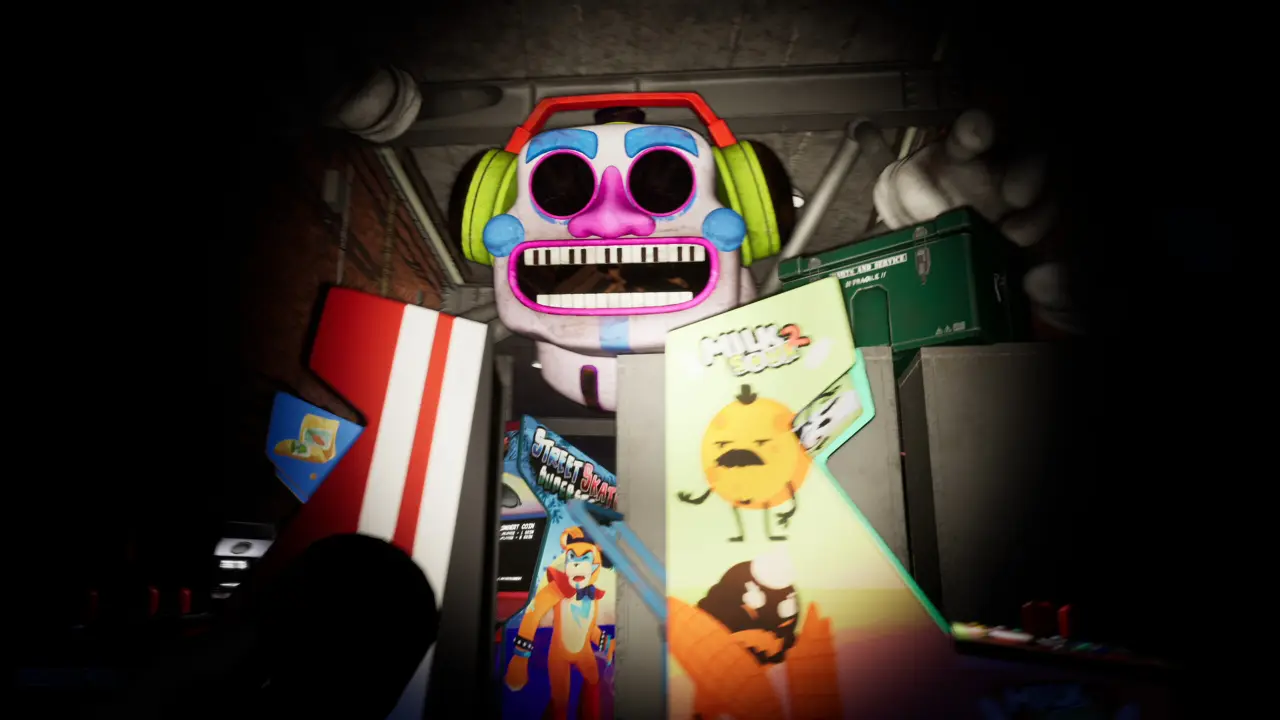
The spaces do more than look good. The 3D environment stops being a backdrop and becomes a stage that actively shapes how you feel. Stand alone in that cavernous atrium and the scale itself unsettles you; step into a dim warehouse where a giant colored animatronic head hangs motionless above an arcade cabinet, and its bulk pins you down without a single animation. Position, volume, and light are choreographed into the horror. The broken rabbit figure peering from a crack in the dark is iconic precisely because the image makes malice concrete with restraint, a single silhouette and a beam of light doing the work that lesser horror reaches for gore to achieve.
That restraint is the whole point. Against survival-horror peers that lean on photoreal viscera to disturb, Security Breach takes the opposite road, building unease from exaggerated silhouettes, the sheer mass of its rooms, and the clash of saturated color.
A character can be standing perfectly still in a brightly lit hall and still read as a threat, because the design language has trained you to distrust anything that smiles too widely under neon. It is an art direction with an actual aesthetic argument behind it rather than a pile of rendering features, and that "wrongness inside the brightness" is the exact quality no rival can lift wholesale. You could mute every other system in the game and the look alone would still tell you where you are, which is more than most big-budget horror can claim about its own face. Years on, that confident, instantly legible identity is the thing players still cite first when they defend the game at all.
Technical debt: imagination can't outrun the frame drops
The execution, unfortunately, lands nowhere near as cleanly as the imagination. Security Breach supports ray tracing, and on high-end machines the mirror reflections and neon bloom genuinely impress, but the cost is a heavy performance overhead. Launch-window optimization was the single biggest target for critic deductions: frame-rate swings, high VRAM usage, long load times, texture pop-in in certain zones, animatronics clipping through walls, all of it especially visible on PC and only gradually eased by later patches and community mods. The Metacritic user score dipped to roughly 6 at one point, and technical instability was the main culprit.
Guidance and accessibility drag on the visuals too. The map is enormous and the objective prompts are vague, so a newcomer spins in circles across that giant floor with no clear navigation to lean on. The most striking set piece loses its grip the moment a frame-rate stutter or a wrong turn interrupts it, and horror that cannot sustain a continuous output of tension bleeds out fast. That is why graphics settles at 7.5: the artistic vision and the sense of scale deserve a higher number, but the twin weaknesses of technical stability and navigation design pull the experience back down. It is the cleanest snapshot of this game's central problem, ambition maxed out, completion underfunded.
Combat | 5.5/10
Gameplay: 5.5/10From watching screens to running the floor: the franchise's boldest rebuild
Mechanically, Security Breach attempts the boldest rebuild in series history: it rips out the fixed-camera, surveillance-and-stare loop and replaces it with free-roaming stealth, rerouting, and flight. The old games chained you to a monitor room, rationing power and watching for monsters to close in. This one drops you into a colossal after-hours Pizzaplex and tells you to move, to find your own route, to hide on your own terms. The core loop shifts from waiting to passing through, and that direction is fundamentally correct. It is the most valuable idea the game owns.
Holding it up is a combat-free threat system. You have almost no power to fight back, just hiding, rerouting, and a few limited gadgets, so every ounce of tension comes from animatronic sightlines, their positions, and your own uncertainty about the path ahead. An animatronic standing upright in a narrow corridor never actually blocks the way, yet you instinctively slow your steps anyway; that sweaty-palmed pressure built from spatial relationships and psychological squeeze genuinely grips you when the system behaves. It is also what separates the game from pure run-and-hide horror: you are not simply fleeing, you are constantly weighing the safe long way around against the risky shortcut. Stealth, evasion, puzzle-solving, and objective progress interlock, and on paper they should add up to an experience that really sinks its hooks in.
When the rules wobble, so does the horror
The trouble is reliability. Animatronic sightlines and stealth detection fire inconsistently: sometimes they stand inches from your face and fail to see you, sometimes they lock on through a solid wall. Once the source of tension becomes unstable, you can no longer form a dependable read on risk, never sure whether the next moment calls for held breath or a casual stroll past. Random-feeling rules are the cardinal sin of stealth horror, and they drain immersion on contact.
Launch-window bugs made it worse. Several game-breaking glitches left certain tasks nearly impossible or trivially exploitable thanks to scrambled AI behavior; exiting an upgrade console could disable save stations, entering a charger too quickly could trigger a hard lock, problems the community logged repeatedly and patches eventually fixed. A core loop, however clever, shatters when unreliable detection and crashes keep interrupting it. That is why gameplay scores only 5.5: the direction earns respect, but its real-world reliability falls badly short, and a launch player and a fully patched player are almost reviewing two different games.
The cost of an open map: freedom that doubles as confusion
The open-world freedom carries its own cost, too. The big map and its many branches genuinely hand you a sense of choice and discovery, the room to scout a detour and then pick a safer moment to push forward. But the objective guidance is so weak that a large share of your time goes to hunting for the way forward rather than dodging machines, and inexperienced players end up circling the same plaza, forced to check a guide and breaking their own rhythm again and again.
The comparison sharpens the point. Resident Evil's remake builds tension from fixed routes and resource management as well, but its guidance is clean and its pacing is firm; you always know where you should be heading and exactly why you should be afraid.
Security Breach treats uncertainty as the source of horror without separating uncertainty about danger from uncertainty about the route. The first is design. The second is just getting lost, and when the player spends more minutes searching for a door than evading a hunter, the clever evasion loop gets diluted into busywork. The collectibles and multiple endings raise the replay ceiling, but reaching that ceiling means grinding through a heavy tax of frustration from the guidance and the detection first, which is a steep ask for anyone who came purely for the scares. The frustrating part is that the idea underneath all of it is good enough to deserve a far more disciplined execution than the one it shipped with, and you feel that potential most keenly in the stretches where everything briefly clicks.
Content | 7.0/10
Content: 7/10From one dark room to an entire theme park
On raw volume, Security Breach is not even in the same weight class as its predecessors. The old games pinned you in a single monitor room for five nights, with essentially no map, no stages, nowhere to go. This one swaps in a multi-level, clearly zoned mega Pizzaplex: the main stage atrium, the arcade, the underground maintenance levels, and the warehouse collection area each form their own district, and simply learning to navigate them eats several hours. That expansion from single-point defense to whole-area exploration is the most immediate upgrade to how the game feels.
The Pizzaplex is packed with things to do. Beyond pushing the main story, you can hunt collectibles scattered across the floor, solve small mechanisms, and trip hidden rooms; the warehouse collection-and-detour side path is the archetype, forcing you to rummage and double back under the looming bulk of a motionless giant animatronic head, fusing exploration and evasion into one act. Crucially, the zones are not isolated from each other. You routinely grab something in the arcade only to loop back to the atrium to open another door, and the map is built as an interconnected web rather than a string of linear levels, which turns exploration itself into content. Tying most of this side activity to the stealth loop means the collectibles are not a checklist of empty ticks; they give you a reason to return to different corners of the map again and again.
Endings and free DLC raise the replay ceiling, even if the floor stays shaky
What truly props up the content depth is the combination of multiple endings and the free post-launch expansion. The enlarged map paired with several ending paths gives the hardcore a reason to keep grinding: different exploration depths and choices steer you toward different conclusions, so a single clear is nowhere near the finish line. With collectibles and side-style exploration spread across the whole building, replay value sits clearly above any prior entry in the series. Steel Wool later added a free story expansion called Ruin, continuing the base world and filling in narrative, effectively bolting an unpaid extra chapter onto the package, which for a game with such a turbulent launch reputation doubles as both compensation for early adopters and a real bump to overall value. Free post-launch content of that size is rare enough at any price point that it reframes the whole purchase, turning a once-shaky proposition into something that comfortably justifies its asking price on a sale. Between the base endings and Ruin, the package you buy today is meaningfully fuller than the one critics first reviewed.
Built wide, but the foundation never sets
The problem is that the content sprawls wide without firming up its foundation. The map is huge and the stuff is plentiful, but the structural scaffolding is visibly thin: ending triggers are obscure enough that many players never reach the good ending without a guide, quest routes meander, objective prompts are weak, and a large share of the content is something you stumble into rather than are clearly guided toward. That gap between ambition and solidity is the recurring deduction in critic scores, and it is the difference between a park that has plenty of attractions and a park that knows how to walk you between them.
Resident Evil's remake is not necessarily bigger, but every stretch of its content carries clear rhythm and purpose, its resource management and route planning sanded down until they interlock; you always know where to go next and why. Security Breach feels more like a great pile of good material dumped into the plaza and left for you to sort, find, and trial-and-error your way through. The good stuff is not missing; what is missing is the order that would deliver it to your door. Breadth is there; density and order are not, which lands content at 7.0. There genuinely is a lot to do, and the free expansion helps, but actually digesting it all means powering through plenty of friction from guidance and organization first, a threshold that will quietly chase off the impatient.






Comments 0
Share your game review
Join the discussion and share your review of this game.
No comments yet. Share your thoughts on this review.