























Opening
That moment rushing through the maintenance area on a rainy night, the headlights split the wet ground in two, and the instant the front wheels hit the puddle, the steering wheel feedback changed immediately. It wasn't that kind of "thrill" created through exaggerated performance. More like suddenly rolling over an invisible seam on the highway—subtle, solid, and something you actually feel in your palms. The best part of Forza Motorsport this time isn't the number of cars or the completeness of tracks, but that it finally brings depth to the act of "driving a car." Media outlets have widely mentioned this might be the best driving feel in the series so far, and after playing it, I largely agree. There are issues too. The upgrade system has been criticized as a step backward, and this isn't a minor flaw—it gradually wears down your long-term enthusiasm. Fortunately, the core is solid enough. Even if you're not that into sim racing, after a few laps you'll probably understand: this time it's not just repeating the previous game, but actually pushing forward where it matters most.

Driving Feel | 8.5/10
In the first few laps, you'll be nervous. After that, you start to trust the car.
This is where Forza Motorsport earns its value. Current media opinions almost unanimously give high scores to the driving itself, and the reason is clear: the tire model, grip feedback, and the vehicle's state changes when approaching the limit are all more natural and progressive than Forza Motorsport 7. Simply put, the car is no longer like a "sudden loss of control" switch, but like a steel plate being slowly bent—you can feel when it can still hold and when it's about to break. This sense of progression is important. It makes mistakes more than just "penalizing you off the track," and also makes corrective actions meaningful. A side-by-side entry into a corner, with a red Porsche and blue Corvette fighting to the exit point—that scene looks like a movie edit, but in actual operation it's quite straightforward: you know how much to hold back and how much to leave. This is also why multiplayer spec racing is considered an enhanced feature: when the rules are more unified, the quality of driving is more easily amplified.
The downsides must be mentioned too. The regression in the upgrade system means this excellent handling can't be caught by an equally smooth progression structure. The problem is systemic, affecting long-term retention—not fatal, but it will make you hesitate a few extra seconds between "one more race" and "maybe later."


Content and Long-term Playability | 7.0/10
Content: 7/10It's not the kind of game that looks impressive at first glance. It's more like pre-prepared ingredients in the fridge—neatly arranged, plenty of ways to use them, but the seasoning hasn't quite caught up.
What can be confirmed at this point is that the multiplayer mode additions do have substance, and they're the main selling point in terms of content. Spec races have strengthened the competitive aspect and elevated the value of replay. If you have an average run today, you'll want to come back tomorrow for another couple of laps—not necessarily for novelty, but to chase down that half-second you lost last time. This "one more session" stickiness is different from open-world collectathons; it's narrower, but purer. Unfortunately, the progression system holds it back. Media reviews have focused their criticism on this point, and I agree it directly affects the pace of content consumption. The long-term drive in racing games comes half from driving, half from building; the former is strong this time, but the latter hasn't kept up. You'll repeatedly use the vehicles, events, and the loop itself, but you won't easily get sustained fresh stimulation from the system level. That comparison chart of versions and additional content shows it wants to build a large framework, but a large framework doesn't mean every piece fits together smoothly. Frustrating. Also addictive.


Visual Performance | 6.5/10
Graphics: 6.5/10Night tracks are the easiest to deceive. Once the reflections light up, the atmosphere is there.
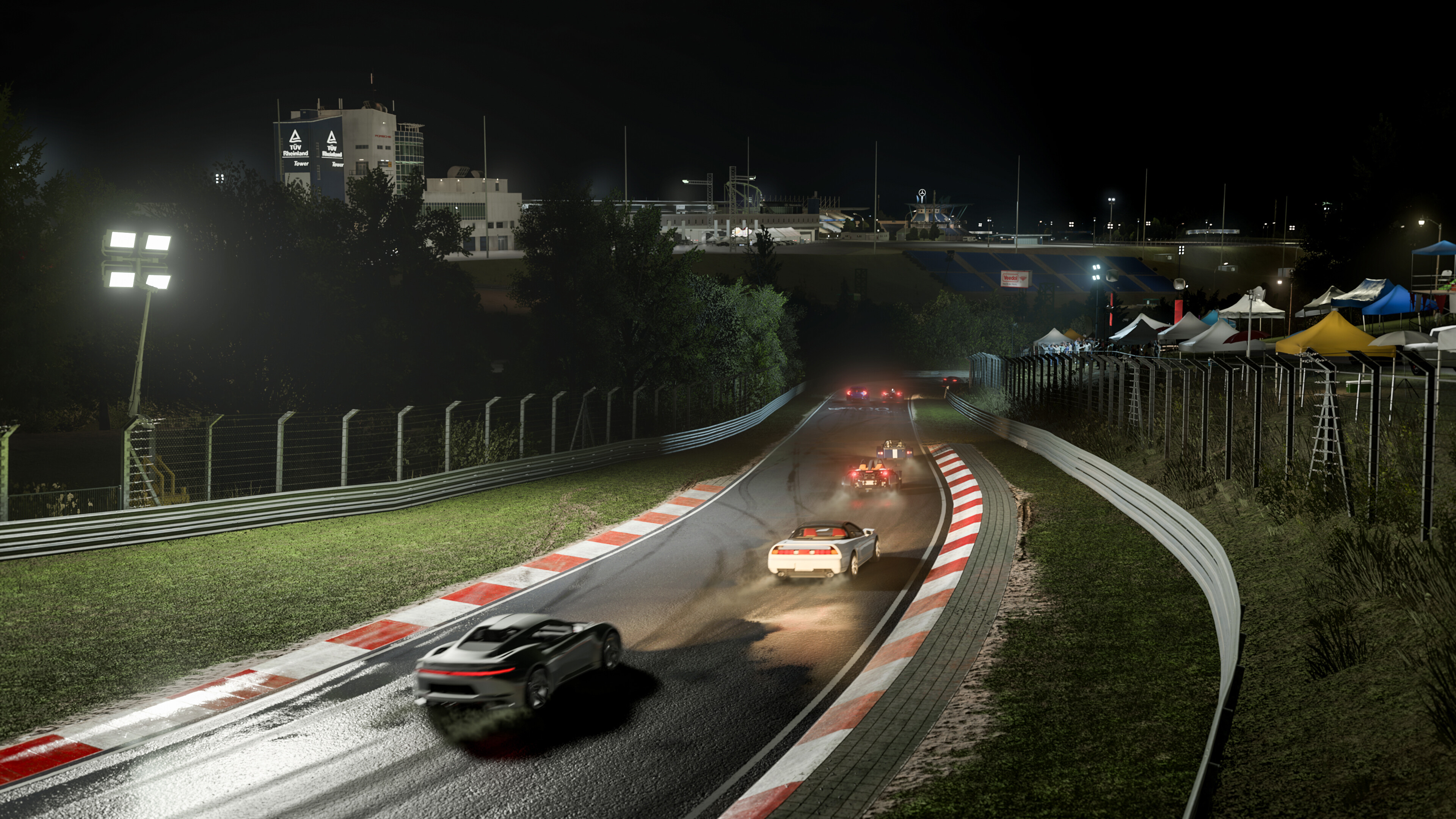
The overall presentation of Forza Motorsport has been categorized by quite a bit of credible information as part of a "comprehensive series upgrade," and this assessment isn't an exaggeration. During multi-car battles, the reflections on wet surfaces and the moments when lights sweep across car bodies do genuinely elevate the sense of speed. Those scenes where a line of race cars on night corners are connected into a single streak by road reflections have real texture. The close-up mechanical details of the Mercedes engine bay also show that the development team put effort into the "close inspection" aspect. The problem is that the available information lacks sufficient cross-validation between lighting, modeling, and performance, so I can't oversell this part. In terms of experience, it feels more like a racing documentary with stable cinematography and mature composition, rather than a commercial that shows off technical prowess in every frame. Good-looking. Adequate. But once you want to dig deeper—like whether certain scenes truly reach industry-leading standards—it lacks solid enough evidence to support a high score.
So I'm giving this part an above-average rating, not higher. It's not that it's bad, but there's inherently a gap between "comprehensive upgrade" and "absolute benchmark."

Sound Effects and Music | 6.0/10
Audio: 6/10This part is the hardest to discuss. Not because it's necessarily bad, but because there's too little existing information.
Regarding engine sounds, environmental audio, collision feedback, and even the specific quality of menu and race music, there's currently insufficient stable evaluation support. What can be said with relative confidence is that the audio is most likely serving the driving feel, and it shouldn't drag things down too much. After all, much of the "car feel" in racing games isn't achieved solely through the steering wheel and visuals—sound is the other half of the road information.
But the problem lies here: without enough details, I'm unwilling to turn this section into empty talk. On the experiential level, it gives the impression of being more like a competent metronome, helping you judge speed, grip, and environmental changes, but without much of that "I still remember this sound after the race" memorability. At least from the available information, there's no repeatedly mentioned audio highlight, nor any music explicitly praised as carrying the atmosphere.
It doesn't drag things down. But it doesn't stand out either. This isn't fatal for a racing game, because what really determines whether you'll keep playing is often those few millimeters of correction in front of the steering wheel; but if the audio could take one more step forward, the entire experience could have been more complete.
Plot and Expression | 3.5/10
Story: 3.5/10This game barely intends to tell a story.
Media opinions are quite consistent on this point: the core of this title doesn't emphasize narrative at all, with the main experience focused on racing and driving, and the story having an extremely low presence. Valid sources also haven't provided content regarding character development, main plot progression, or narrative structure, which basically says it all. You can certainly understand it as a trade-off—putting all resources into the track—but a trade-off doesn't mean it doesn't exist. Absent is absent.
The impact is also very direct. You won't continue pushing forward because of a certain character, some grudge, or the motivation behind a key race, but simply because "I want to drive a few more laps." This isn't necessarily bad for pure racing players, and might even be a relief; but for a broader audience, lacking narrative glue makes the emotional variance between races smaller, turning the entire experience into a set of high-quality practice sessions rather than a complete journey.
Is it fatal? Depends on the person. For hardcore racing audiences, not fatal. For those hoping the game provides more emotional hooks, this is an obvious shortcoming.



Comments 0
We'd love to hear from you
Welcome! Share your take on this game — being first might come with a surprise.
No comments yet — share your thoughts on this review!