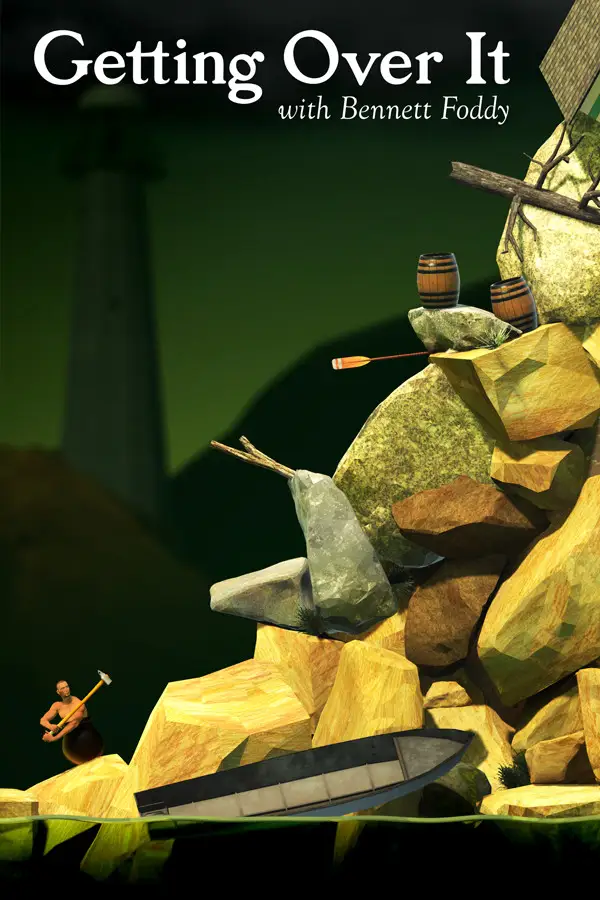
Getting Over It with Bennett Foddy
Price History
Past 36 months · Updated dailyPrices cover Steam and 39 authorized stores; only legitimate offers are counted. The chart shows weekly market-wide lows and Steam's official price across the past 36 months.
01About Getting Over It with Bennett Foddy
In Getting Over It with Bennett Foddy, climb an enormous mountain with a hammer and a pot. Move the hammer with the mouse to jump, swing, and work your way upward. A misstep can erase progress and send you back over ground you already covered, while philosophical observations accompany the ascent. The Steam PC version supports single-player. The interface is available in Simplified Chinese, English, Japanese, Russian, and Korean. The positive rating is 82% across 75,453 player reviews. Released December 6, 2017.
Credits
Lowest recorded in 36 months
$1.592025-06-27 · SteamBase game · same records as the chart above; USD history, not a regional Steam low.Language support
| Language | Interface | Subtitles | Audio |
|---|---|---|---|
| Simplified Chinese | Yes | Yes | — |
| English | Yes | Yes | Yes |
| Japanese | Yes | Yes | — |
Show 2 more languages
| Language | Interface | Subtitles | Audio |
|---|---|---|---|
| Russian | Yes | Yes | — |
| Korean | Yes | Yes | — |
Steam PC edition data · 2026-10-19
02Before you buy
Controls and languages
The Steam PC version has single-player mode. The mouse moves the hammer; interface languages include English, Simplified Chinese, Traditional Chinese, Japanese, and Korean.
Audio and warning
English narration includes philosophical observations. The description carries an epilepsy warning for surprising elements.
03Frequently asked questions
How does climbing work?
Move the hammer with the mouse to jump, swing, and climb.
Can progress be lost?
A mistake can cost you progress, forcing you to climb sections again.
What is at the top?
The game describes a reward awaiting those who reach the summit.
Popular Steam reviews
Native-language selection · 10 reviewsSelected helpful reviews in this language show both recommendations and criticisms. This selection does not represent the overall positive rating; opinions reflect the version reviewed.
A good Game. but, It's way too overpriced for what you get.Show moreShow less
The only game on Steam that's worthy of being tagged "Psychological Horror"Show moreShow less
I respect the idea of what Foddy's attempting here. Working through punishingly difficult-to-master gameplay has been a throughline in all of his most notable work, from QWOP to GIRP. In those games, the challenge usually came from the interface giving you such literal, direct, deliberate control over what the player character did, and your struggle to negotiate with it, that the failure felt entirely your own, for you to iterate on and do better next time. In "Getting Over It," however, there's no consistency of player control over themselves. The hammer you use to climb the mountain will clip through objects randomly, gain and lose friction seemingly at random, and most damning of all, control over it seems entirely arbitrary. Gamepad controls don't move it fast enough to be usable, mouse controls never map 1-to-1 with the position of the hammer's maul. And because there's no option to, say, loosely swing the hammer into a new position at speed, you'll find that with nearly every errant two-pixel flick of the mouse, you'll launch yourself at full force, uncontrolled, 20 feet in a direction you would never have intended. And when nothing about moving around the screen feels deliberate, the failures and victories can never truly feel your own, so the "lesson" of the game breaks down. The end result is that, as you climb an impossible mountain, with an interface that isn't just counter-intuitive but outright broken, with a narrator (Foddy himself) who spends as much time reading beat poetry about his elevated view of the state of gaming today as he does skimming an "inspirational quotes for utter twerps" book he presumably found in a friend's bathroom, the image becomes less of a creator trying to craft a meticulously cultivated, yet deliberately brutal challenge, and more of a self-righteous elitist, high on the smell of his own pretension to the point that he fails to tell the difference between a game that's difficult, and one that's broken.Show moreShow less
When I was 17, I decided I wanted to be a game designer. I had previously toyed with the idea due to loving video games since I was a small small kid, but the pressures of highschool and having to decide what to do with your life finally made me solidify my decision and head towards the path of game development. The years went by. I went to university for computer programming. It felt soulless and more concerned with teaching me how to manage databases for google rather than something fun and artistic with the skill. I decided to then go to art school, but realized I couldn't draw and that most of the classes were for people who knew what they were doing and just wanted to burn money practicing. And all the while, every time I tried to do something to advance myself personally aside from institutions, I would get shot down. Every year when I would finally muster up enough energy to attempt something creative to get better at the things I love, I would fail to meet my own high expectations and fail miserably. The failures hit me so hard I would never get back up until months and months would pass. My friends felt like they were taunting me by trying to help me out. "All you have to do is just keep doing things, and you'll get better at it". The hardest part to swallow is that I knew it was true. But I didn't know how to explain the invisible force of failure to them. For some reason when they got back up from failing, they barely gave it any attention and just moved on to the next thing. Every time I attempted an ambitious project or failed to change something I wanted to do with my life, I would feel hopeless and like I could never come back from it. Even after the bitterness of defeat and depression wore off a few days later, a wave of long term procrastination would swathe over me for months and I would do nothing but waste my time living day to day and playing video games. It isn't that I suddenly didn't want to partake in these creative endeavours, but rather they just didn't get done- I would avoid them on a subconscious level by doing literally anything else just so I didnt have to feel the pang of self defeat and absolute misery. Then I played "Getting Over It". I bought it without any hesitation mainly because I am a huge fan of Sexy Hiking and wanted to play the spiritual sequel. The game drew me in immediately, there was that familiar damned tree at the very beginning, the way your hammer moved was exactly the same, and there were even some devious parts that I remembered coming exactly from the game itself. I moved my way up the mountain, and the commentary soothed me and provided me more information on Foddy's inspiration from sexy hiking and how he felt media was changing in recent years. But the interesting thing was that I got back up. I would lose almost hours of progress, falling down the cliff in a way that was 100% crafted by Foddy to be devious and "hateful". But I took a deep breath, checked my phone, then got back to climbing the mountain. I would realize that once you fell down and regressed to a previous state of the game, due to your previous practice and new tactics you could get back up to where you were in half the time and frustration. I learned that recklessness is actually helpful in some situations, you can't hesitate and have to just "do it" rather than inch your way up slowly to get over some obstacles. At one point the commentary quoted Mary Pickford, saying "Failure is not falling down, it is not getting up again". that then made me realize what I was doing. Why was I approaching my life with fear and self hatred due to my failures and this stupid game with a dude in a bath pot was the one exception? I know that video games are fun and an escape from reality, but is climbing a virtual mountain designed to put stress and fatigue on the player really that less painful than having to fail on things in real life? I was learning recklessness, perserverance, self preservation, and self esteem- and immediately applying them to a sequel of a game called "Sexy Hiking" for gods sake. Would I get to the top of the mountain? Maybe not. Maybe one failure would finally drive me over the edge, some terrible puzzle where you could easily hit the very bottom by making a simple mistake. But it was the fact that I gave it more of an honest and long term shot than most of my attempts at being creative that disturbed me. And I knew that after playing "Getting Over It", I would go back to my regular life, letting failures keep me down for months and retreating to my hundreds of video games instead of dealing with my anxiety and low self esteem. But while this realization may make me want to scream out for help in fear and panic, it also gives me hope that maybe this journey is not as hard as it seems. Maybe all it takes is a new perspective and new way of challenging yourself to make the oppressive force of falling down not so hard on yourself. Oh, and the game is good too.Show moreShow less
I see people posting negative reviews after 0.2 hours with this game. That's to be expected. Likely story is they are salty and gave up in face of the sheer frustration this game brings. It's also amusing, sort of like the game was for the first 30 minutes. The best thing about this game: schadenfreude. Watching streamers play this game was hilarious. After beating it in 10 hours however, I just feel... kinda salty... Like I just trudged through ♥♥♥♥ for 10 hours and no ♥♥♥♥♥♥♥ reason. After 9 hours, I decided to try toggling the little "trackpad tuning" option in the menu. It then took me some 5 tries to get over the obstacle I'd been stuck on for hours, and only 30 more minutes or so to complete the rest of the game. It kinda felt like I had just turned down the "♥♥♥♥♥♥♥♥♥♥" slider on the controls page, and everything became just a little bit more consistent. That's the thing that got me with this game: the controls "feel" inconsistent. They aren't, obviously. I got better at it over time, and people are posting speedruns. But it feels like the whole way through, I was just fighting a contrived control scheme rather than the level design. Which of course, is the point. You probably already knew this. I guess I actually expected the level design to be the main obstacle or at least half the obstacle. Instead, just like in QWOP, it's pretty much just the controls that are in your way. After getting over that one part, everything beyond was just kinda... lame. Poorly paced, in a way. The difficulty spike placed smack dab in the middle of the game. There are lots of little things in the level designed to mess you up. Lips to get caught the wrong way on etc. but more often than not, even when rekt by the level, it just felt like the man in the pot was the one who launched himself down the mountain to spite you. "Screw you for playing this game." I envy the quitters for moving on with their lives. I wish I enjoyed the schadenfreude from watching Twitch and left it at that, even though Bennet taunted us about 1/3 through the game. "That's culture too." Uh huh. This is not for me. Never again. You got me Bennet. You made me want to swear at you. I'm giving this a salty "no". If you absolutely must buy it, gift it to a friend you don't like. Trust me, you'll enjoy it way more that way.Show moreShow less
if you prefer playing videogames over killing yourself, but want the same result; this is the game for youShow moreShow less
AhhhhhhhhhhhhhhhhhhhhhhhhhhhhhhhhhhhhhhhhhhhhhhhhhhhhhhhhhhhhhhhhhhhhhhhhhhhhhhhhhhhhhhhhhhhhhhhhhhhhhhhhhhhhhhhhhhhhhhhhhhhhhhhhhhhhhhhhhhhhhhhhhhhhhhhhhhhhhhhhhhhhhhhhhhhhhhhhhhhhhhhhhhhhhhhhhhhhhhhhhhhhhhhhhhhhhhhhhhhhhhhhhhhhhhhhhhhhhhhhhhhhhhhhhhhhhhhhhhhhhhhI have played this game for 1941 hours and still havent beat it onceShow moreShow less
Thanks! I hate it!Show moreShow less
I want to kill myselfShow moreShow less
Source: original Steam user reviews. Helpful votes are an archived snapshot, not live data. Last collected: 08/15/2026.