
























Opening
Go-Go Town! opens by kidnapping you, and it is the best career decision anyone will make on your behalf all year. One minute you are an anonymous drone; the next, a conglomerate called TownCo has dropped you on a neglected patch of grass, handed you a garbage bag, and informed you that this is now a tourist destination and you are its mayor. There is no contract. There is only work — and somehow, you will love it.
What Prideful Sloth — a five-person studio out of Brisbane, with credits scattered across Batman: Arkham, Rome: Total War, and Guitar Hero — has built here is a management sim that refuses to sit still. You do not draw districts from a mayor's-eye view. You haul the boxes yourself, stack the shelves yourself, chase the runaway shopping cart down the street yourself, and only later, once the town rank climbs and the logistics company unlocks, do you get to lean back and watch the machine you built carry its own weight. Animal Crossing lets you potter. Cities: Skylines lets you watch. Go-Go Town insists you live both lives in the same afternoon, and it bills you hourly.
After two years in Early Access, version 1.0 lands July 17, 2026 on Steam, Switch, and Switch 2 at $27.99 — and it earns most of that price. The first act is glorious, exhausting manual labor; the second is a genuinely satisfying automation sandbox. The catch is that the tank runs dry somewhere around hour thirty, and the story beneath it all is scaffolding, not a house. Score it 7.8: a town worth building, a job worth taking, a postcard you will stop sending sooner than you hoped. Bring gloves for the first ten hours and a spreadsheet for the next twenty.
Story | 6.5/10
Story: 6.5/10Hired Is a Strong Word for It
The premise is a joke the game tells completely straight: TownCo, a faceless conglomerate run by an unseen Boss, has acquired you. Not hired — acquired. You are deposited on a failing plot of land and instructed, with corporate cheer, to turn it into a thriving tourist economy. The satire is the load-bearing wall of everything that follows. It explains why money arrives as Coin from sales and as EGO from tourist happiness — a company town minting two currencies for its one employee. It explains why the workday never ends. It even explains why you, the mayor, are personally hauling trash at midnight: TownCo does not pay for staff until you have earned the right to staff.
Creative director Cheryl Vance has described the pitch as the joy of being a hands-on mayor — building, optimizing, decorating, managing tourists, "and occasionally eating garbage for reasons that could only be explained at a town meeting." That line is the whole register. Checkpoint Gaming called the writing "hilarious," packed with pop-media references, and the tourists carry it: robots, aliens, dinosaurs, clowns, cameos from Dinkum, and one visitor the game itself describes as "just here to sightsee." Nobody at TownCo is evil, exactly. They are something worse and funnier: pleased with your quarterly numbers. The unseen Boss hovers over all of it like a performance review that never ends, pushing expansion for expansion's sake, and the joke stays fresh because the game commits — every menu, memo, and milestone speaks fluent corporate euphemism while asking you to do something faintly absurd.

A Narrative That Clocks Out Early
Here is the honest problem, and it is why the story scores 6.5: the satire is a frame, not an arc. The Boss pushes expansion; you expand; the frame holds. But nothing escalates, nobody changes, and the town you fill with personality never develops one of its own. A 26-hour player on Steam put the finger on it precisely — charming and healing, but thin, with a wish that residents could talk and had stories of their own. Your locals are beautifully dressed furniture. They want things, they rate things, they never say things.
The sequencing does the story no favors either. Nintendo Life flagged an early Story mode quest that asks you to catch 25 fish at a point when you have nowhere to sell, cook, or even store them — their verdict was that "the game presents problems but locks solutions behind a long grind." For a narrative whose entire job is to pace the unlocks, that is a structural stumble, not a nitpick. The story's real function is to be a conveyor belt toward rank 5, and the belt occasionally jams under its own fish.

The Good Ending Is the One You Build
And yet — there is a thread worth pulling. Nintendo Life noted something hidden beyond the town borders tied to TownCo, and reported that digging deeper "is worth it." That is the story working as it should: the conglomerate as mystery, not just management. Combined with hidden pockets like the slime-block sewer and the chess-themed garden, the world keeps hinting it has a secret life beyond the balance sheet.
It is just a hint, though. Go-Go Town's story is a delivery mechanism for a management loop, dressed in sharp satire and genuinely funny dialogue, and it performs that job with more wit than the genre usually bothers with — which, given what the genre usually bothers with, is a low bar cleared with style. Judge it as a narrative and it is scaffolding. Judge it as the reason the chores feel like a career instead of a checklist, and it quietly earns its keep. The 6.5 reflects both truths: best jokes in the genre wrapped around a plot that resolves into a balance sheet. The Boss never shows up to say thank you. Of course he doesn't.
Audio | 7.5/10
Audio: 7.5/10Dance Music for a Garbage Emergency
The soundtrack has one job and one mood: keep your heart rate slightly above the task at hand. Nintendo Life described the music as upbeat dance tracks seemingly selected "to suit the panic of cleaning up after your tourists," and that is exactly the sensation — you are knee-deep in other people's litter, the bins overflowed ninety seconds ago, and the speakers are throwing a pool party about it. It is scored like a game show that knows you are losing. The choice is bolder than it sounds, because cozy games live or die on their audio blanket, and Go-Go Town refuses to knit you one — it hands you a jumpsuit and a shift whistle instead.
What makes it work is that the panic is real. The early hours are a sprint between deliveries, and a mellow Animal Crossing strum would have lied to you about what kind of afternoon you were having. The dance tracks tell the truth: this is a job, the whistle already blew, and the tempo is the foreman. Cozy games usually score themselves for a hammock; this one scores itself for a shift change, and that single decision does more world-building than a page of TownCo memos. Even the garbage run has a backbeat.

It Clicks When the Town Does
The more interesting judgment comes from Nerdy Bird Games, who played on Steam Deck during Early Access: the soundtrack felt wrong at first, and right once the town got busy. That arc is the whole audio review in miniature. In the silent, empty first hour the music can feel like it is performing for an empty room. Then the tourists arrive, the shops start chiming, the streets fill with bobbleheaded foot traffic, and suddenly the tracks have an audience. The mix stops being a playlist and starts being a soundscape. Few soundtracks are that honest about their own pacing — this one effectively scores your progression, flat when the town is flat, buoyant once your supply chain starts singing.
That is also where the score's ceiling shows. At 7.5, this is a soundtrack that serves the simulation superbly without ever threatening to outlive it — nothing here will follow you out of the town the way a great theme does, and once the late game goes quiet, the upbeat loop can feel like it is celebrating a party that ended an hour ago. The weather deserves a mention on the way out: rain changes how the whole town behaves, and the presentation shifts with it, the busy street noise thinning as the locals scatter for cover. It fits the machine it scores, note for note. It just never asks to be more than the machine. Punchy, functional, and gone from your head by breakfast the next morning.
Visuals | 8.5/10
Graphics: 8.5/10Bobbleheads With Better Tailoring
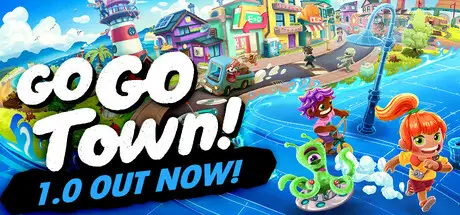
The first thing Go-Go Town gets right is proportion. Every local is a big-headed cartoon citizen with a waddle that reads as personality before it reads as animation, and every building on your street is styled individually enough that you can navigate by landmark instead of by minimap. This is the difference between a cozy game that looks handmade and one that looks assembled: the diner does not look like the bait shop, the bait shop does not look like the arcade, and none of them look like they shipped from the same flat-pack warehouse. By hour ten you will know your own town the way you know a real neighborhood — by its silhouettes.
The craft extends to the mayor. The Change-O-Tron restyles your character whenever the mood strikes, houses accept 360-degree placement with a full color picker, and the vehicle roster — skateboard, go-kart, flying broom, horse, and a unicorn tricycle — is animated with exactly the seriousness a unicorn tricycle deserves, which is to say none, gloriously. Score it 8.5 on the strength of a simple test: you can tell what a building sells from across the street, at a glance, while riding past it on a broom.

Weather as a Lighting Department
Weather here is not a texture swap; it is a mood director. Nerdy Bird Games noted that weather affects both the environment and the residents, and you see it — rain empties the sidewalks, changes the shine on every roof, and makes your neon signage work twice as hard. A sunny main street and a stormy one are two different postcards of the same town, and the game knows it. Most cozy games treat weather as a screen filter; here it is a behavioral system with a lighting budget, and it quietly doubles the visual variety of every district you build.
For a five-person team, the sheer density of styled objects is the quiet flex. Large landmarks, cliff faces you can terraform, transit hubs, Town Hall display cases for rare and legendary collectibles — each arrives with its own silhouette instead of a recolored box. So Many Games scored the 1.0 release 4.5 out of 5, and you do not have to squint at a single screenshot to see why the presentation carried that argument. Featured at Wholesome Direct 2026 as one of the 53 cozy games in the showcase, it still managed to look like the most expensive thing in the room. It was not. It just has better tailoring.

Where the Camera Pushes Back
The art's one enemy is the toolset you view it with. A 132-hour Steam veteran's complaints land hardest here: the camera is restricted outside build mode, buildings rotate in only four directions on art that was clearly drawn for one facing, and the strict grid forbids diagonal roads outright. Rotate a hand-painted storefront ninety degrees and you can feel the perspective quietly object. The artists built a town meant to be admired from the curb; the engine keeps insisting you look at it from a surveyor's tripod. For a game that gives you 360-degree freedom over your own sofa, the leash on the skyline feels personal.
Handheld players get a second, smaller gripe — the on-screen text is tiny and cannot be enlarged, with no touchscreen or Switch 2 mouse support to soften it, which stings precisely because there is so much worth reading on signs and shopfronts. None of this dents the beauty; it dents your access to it. The town is gorgeous. The window you view it through could use a better frame.
Combat | 8.5/10
Gameplay: 8.5/10Act One: Your Legs Are the Supply Chain
Before rank 5, Go-Go Town is a game about carrying things. Every box of produce moves from truck to shelf on your shoulders, every overflowing bin is your problem, and the town's entire economy runs on one pair of legs: yours. A 20-hour Steam player who scored it 8 out of 10 called this stretch "top-tier torment" — bins overflow in two minutes, and they eventually stopped restocking food shops altogether just to control the garbage. That is not a player failing the game. That is the game working exactly as designed, and the design is brutal on purpose.
Nerdy Bird Games felt the same wall in Early Access: overwhelming manual labor before the staff unlocks arrive. The brilliance is that the suffering is load-bearing. Because you personally hauled every fish and swept every sidewalk, you understand the logistics network you are about to build — not abstractly, but in your calves. So Many Games, scoring 1.0 a 4.5 out of 5, praised precisely this loop synergy and the considered pacing of the unlocks. Their critic's favorite pastime, incidentally, was plowing through pedestrians on a skateboard, which tells you the moment-to-moment movement stays fun even when the chores pile up. And pile up they do: the pre-rank-5 hours are a triage exercise where every decision — restock the grocer or empty the bins, chase EGO or chase Coin — has an opportunity cost you can feel ticking. A weaker design would have made the manual phase a tutorial to skip. This one makes it the thesis.

Rank 5 and the Great Handover
Then the logistics and cleaning companies unlock around town rank 5, and the game you were playing retires. Workers appear. Trucks route themselves. The same 20-hour player described the flip perfectly: it becomes an idle game, and "the delivery AI is excellent." The dual economy drives the climb — Coin from sales buys expansion, EGO from tourist happiness feeds the tech tree, and town rank gates everything, so there is always one more unlock glowing on the horizon. The pacing of that horizon is the quiet achievement: every session ends with a concrete next goal, and none of them feel like filler.
The phone is the second half of the genius. It shows every worker's job and whereabouts, tracks stock flow across the town, lets you lock storage bins to a single item, pin courier priority per store, even close the train station when you need a quieter day. Nintendo Life singled out these oversight tools for praise, and they are why the automation feels like management instead of abandonment: you are not watching the town run itself, you are conducting it. The difference matters more than it might seem. Plenty of idle-adjacent games hand you automation as a nap; Go-Go Town hands it to you as a control room, and the phone's readouts give you reasons to keep tinkering — a bottleneck at the bait shop, a courier idling across town, a bin filling faster than its route can clear. Add the new 1.0 toys — cliff terraforming, large landmarks, transit hubs, fast travel — and the back half becomes a genuine city-builder played from inside the city, where the skyline you are optimizing is one you can also walk down to and admire at street level. Score the loop 8.5. Two acts, both earned.

Four Mayors Walk Into a Town
Multiplayer is the genre rarity: real co-op, not a photo mode with guests. Steam supports up to four players online, Switch up to two, with split-screen local play and mixed local-online lobbies across platforms. In a category where "multiplayer" usually means visiting someone's island and leaving a fruit, building and running an entire town together is a small miracle. Split the labor and the design reveals a third act: one mayor on deliveries, one on sanitation, one on construction, one on décor, and the pre-rank-5 grind turns from torment into a very efficient friendship test.
The miracle needs patching, though. A 37-hour negative Steam review reports that co-op was stable in Early Access but regressed at 1.0 — teleporting tourists, items stuck in players' hands, interactions freezing hard enough to force an alt-F4, plus litter AI problems and display-case freezes. Multiple reviews also report saves wiped by updates, which is the kind of bug that costs a cozy game its congregation overnight. Prideful Sloth has a free roadmap on the way — "Cooperative Chaos" lands late 2026 with new multiplayer interactions and playable instruments — so the fix is presumably coming, and the studio's two-year Early Access record says it tends its towns. Until the patches arrive, co-op is the best way to play and the riskiest way to save — a sentence no launch review should have to write about a game this good with friends.
Content | 5.5/10
Content: 5.5/10Thirty Hours and the Tank Reads Empty
Here is the number the whole review pivots on: thirty. A 20-hour player who enjoyed the game enough to score it 8 out of 10 reports Story mode runs 16 to 20 hours total. A 26-hour player went further — about 20 hours to max out the upgrades, with exploration refusing to stretch past 30. For a management sim, a genre whose entire social contract is "see you in 200 hours," that is not a length. That is a visit. Stardew Valley players measure their saves in seasons; Cities: Skylines players measure theirs in save files. Go-Go Town players will measure theirs in weeks.
The 132-hour veteran's autopsy is the most damning because it comes from someone who clearly loved the place: a short core loop, repetitive chores, slow pacing — "nobody in this town is in a hurry except you" — and vehicle collision boxes so absurdly large that driving feels like piloting a barge. When your most dedicated players describe the town as a lovely thing they ran out of, the content problem is not perception. It is arithmetic.

The Ghost Town Problem
The late game has a stranger failure than emptiness: scarcity. A 42-hour negative review describes endgame towns that feel like ghost towns — tourists arrive scarce and stingy, resources overflow with nobody to buy them, and the machine you spent twenty hours building idles at full capacity in front of empty sidewalks. Automation was supposed to be the reward for twenty hours of haulage. Without a crowd to serve, it becomes a screensaver with excellent frame pacing.
This is why content scores 5.5 despite everything the game does well. The systems are deep enough to support a hundred-hour town; the simulation's population and demand curves stop showing up after thirty. A management game that runs out of customers has not run out of content by accident — it has revealed that the content was a countdown, not a sandbox. The tragedy is that the machine hums beautifully while it waits. Empty streets, full warehouses, perfect logistics serving nobody.
What Lives at the Edges
To its credit, the edges are genuinely worth walking. Hidden areas include a slime-block sewer and a chess-themed garden; the Town Hall's display cases hold rare and legendary collectibles you can also place outdoors; and something waits beyond the town borders tied to TownCo itself, which Nintendo Life says is worth digging for. The tourist roster keeps surprising too — robots, aliens, dinosaurs, clowns, cameo characters from Dinkum — each with personalities, needs, and a town-rating system new in 1.0 that finally gives the visitor economy a pulse you can read.
Creative Mode is the other honest answer: everything unlocked from minute one, no grind, pure building. It will not extend the narrative, but for the player who only wanted the toybox, it removes the countdown entirely. It is telling that the game's best solution to its content ceiling is a mode that deletes the progression. The collectors get a longer leash too — hunting rare and legendary display pieces for the Town Hall adds a completionist ribbon to a town that otherwise runs out of road.

The Roadmap and the Receipt
Prideful Sloth is not done. Two free updates are announced: "Cooperative Chaos" in late 2026 adds new multiplayer interactions and playable instruments, and "Vehicle Customisation" follows in early 2027 with paint, decals, and cargo trailers. Two years of Early Access earned this team the benefit of the doubt — over 2,000 reviews at roughly 94 percent positive do not accumulate around a studio that abandons things. Backed by Screen Queensland, the five-person team has shipped Yonder and Grow before this; their pattern is to keep tending what they plant.
But a review scores what shipped, and what shipped is a beautiful thirty-hour town with a free demo, a 1.2 GB install, and a $27.99 price that is fair for the hours on the clock. Compare it honestly: plenty of full-price management games offer less craft and far more padding. Buy it for the month it gives you. Just know the month is what you are buying.





Comments 0
Share your game review
Join the discussion and share your review of this game.
No comments yet. Share your thoughts on this review.