























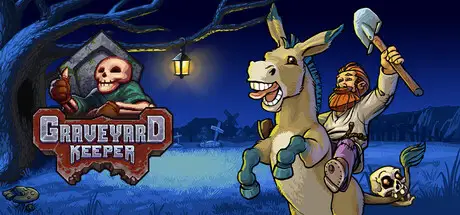

Opening
Graveyard Keeper is a grim little management sim where you dissect corpses, sell organs, and game the graveyard rating for cash, and honestly, it’s worth it if you like your systems deep, messy, and a little bit nasty. If you want something cozy and effortless, this is not that game.
The hook is the joke and the loop. You’re not just tending graves — you’re squeezing value out of the dead, climbing tech trees, and trying to keep a whole medieval hustle from falling apart. It’s part farm sim, part factory puzzle, part black comedy, and here’s the catch: the game loves making you work for everything. The production chain gets complicated fast, the tech system barely holds your hand, and if you hate looking things up, you’re gonna feel that pain early. This is the kind of game that rewards planning, not vibes.
But if that sounds like your thing, it has a nasty kind of charm. It’s got that damp gothic look, a very specific sense of humor, and way more depth than the usual chill pixel farm game.
Story | 7.5/10
Story: 7.5/10The Setup Is Absurd, Then the Game Makes You Work for Every Scrap of Story

Graveyard Keeper opens with a joke that’s way darker than it first looks. You’re a modern guy, you get hit by a truck, and instead of waking up in some cozy fantasy village with a fresh start and a basket of parsnips, you get dumped into a muddy medieval cemetery. Then a talking skull basically goes, “Cool, you’re the graveyard keeper now.” That’s the pitch. Your big emotional goal is getting home, but honestly, the game treats that more like a distant excuse to keep you digging, crafting, and doing increasingly sketchy things with corpses.
And that’s the important difference between this and something like Stardew Valley. Stardew pulls you along with neighbors, romance, festivals, little character arcs, all that warm social glue. Graveyard Keeper doesn’t really do that. Its story is thinner, colder, and much more mechanical. You don’t advance because you had a heartfelt chat at the town square. You advance because you finally built the right workstation, unlocked the right red, green, or blue tech node, hauled enough stone, made enough parts, and remembered which NPC is only useful on which day.
That can be frustrating, because the plot keeps getting interrupted by production gates. You’ll have a goal, sure, but then the game says, “Great, now go fix three broken supply chains before anything interesting happens.” So the story pacing is uneven. Sometimes it feels less like a narrative and more like a checklist wearing a monk robe. But here’s the catch: that also fits the game’s sick little worldview. This isn’t a story about being chosen. It’s a story about being trapped in a job, trapped in systems, and slowly realizing the fastest way out is probably going to involve bad choices.
So for story, I’m at a 7.5 out of 10. Not because the plot is rich. It isn’t. It’s because the premise has bite, the tone is weird in a good way, and the game commits to making its morality feel grimy through what you actually do.
The Best Characters Are Funny Because They’re Awful, Not Because They’re Deep

The character writing works best when Graveyard Keeper stops trying to be emotional and just lets everyone be kind of terrible. The Bishop is a great example. He’s not there to guide your soul or comfort the grieving. He cares about the graveyard looking respectable, the church becoming more impressive, and the whole operation gaining status. The dead are basically part of the décor. That sounds bleak, and it is, but the game plays it with a straight face, which is why it lands.
The talking skull is another piece of that. He’s not some noble fantasy mentor. He’s a weird, pushy little goblin of a roommate, constantly nudging you toward the next shady solution. Then you’ve got the alchemist side of the world, where the game leans into old medieval nonsense: strange ingredients, secretive experiments, and that feeling that nobody in this town should be trusted with basic tools, let alone human remains. None of these characters are written with huge emotional arcs, and if you’re coming in expecting deep party-member drama, you’re going to be disappointed.
But as black comedy props? They work. They give the world a nasty personality. The joke is that every institution around you has already made peace with hypocrisy. Religion wants better cemetery ratings. Business wants cheaper materials. Science wants bodies and ingredients. And you, the player, are stuck in the middle pretending you’re above it, while also carving up corpses for useful parts because the workbench says you need them. That’s where the side content has its best flavor. It’s not dense in the traditional RPG sense. You’re not drowning in branching conversations. But the side tasks do a good job of reinforcing the same punchline: in this place, morality is just another resource to manage. The writing doesn’t always go far enough with that, but when it hits, it’s sharp.
The Real Story Choice Is How Much of a Monster You’re Willing to Be

Graveyard Keeper doesn’t have some huge branching morality system where one button makes you a saint and another makes you evil. The choices are sneakier than that. They’re baked into the work. A corpse arrives, and suddenly you’re not just burying the dead. You’re checking skull quality, cutting out rotten organs, deciding what to keep, what to sell, and how to make the graveyard rating climb. The white and red skull system turns death into a spreadsheet, and that is easily the game’s best storytelling trick.
Because look, on paper, “manage a medieval graveyard” could’ve been a cute little sim. Plant flowers. Repair fences. Make the place peaceful. Instead, Graveyard Keeper asks what happens if the cozy farming loop gets dragged through mud, superstition, and capitalism. You’re not just crafting a nice headstone. You’re running a business built on bodies. You can use bad materials, dress things up just enough, and keep the machine moving. It’s gross. It’s funny. And it says more about the world than a long cutscene would.
The downside is that the story often gets buried under its own crafting depth. The multi-stage production is genuinely deep, going from quarry work to engraving and beyond, but when you just want to see what happens next, that depth can become a wall. The red, green, and blue tech point system gives you very little guidance, and if your supply chain breaks, the narrative basically stops breathing. That’s why the game’s reputation is so split between critics and dedicated players: Metacritic sits at 69, OpenCritic’s Top Critic average is 65.4 with only a 30% recommendation rate, but Steam is sitting at 86% Very Positive across 38,744 reviews.
And honestly, that split makes sense. If you push through the early confusion, the story and systems start feeding each other. If you don’t, it just feels like the game is wasting your time. Graveyard Keeper’s story isn’t strong because it tells a great tale from start to finish. It’s strong because it makes every ugly shortcut feel like part of the joke.
Audio | 6.0/10
Audio: 6/10One Thin, Miserable Little Music Loop, But It Fits the Graveyard

The music in Graveyard Keeper does one job really well: it makes you feel like you’re working alone in a damp, ugly little medieval backwater, and nobody’s coming to save you. It’s low-key, gloomy, and pretty restrained, so when the game flips between day and night, the shift in the track actually helps sell that lonely routine. You’re not getting big melodic lifts here. You’re getting a mood. And honestly, that mood works. It backs up the whole joke of the game, which is that you’re running a graveyard like a business while doing horrible things to keep the wheels turning.
The catch is that it doesn’t give you much variety. After a while, the soundtrack starts to feel like it’s circling the same drain, especially if you’re doing one of those long, efficient, slightly obsessive play sessions where you’re trying to optimize every production chain. That’s where the comparison to something like Stardew Valley gets obvious. Stardew Valley has way more musical warmth and range, so even when you’re grinding, it feels softer around the edges. Graveyard Keeper is colder and sharper, which fits the pitch-black humor, but it also means the audio can wear thin over time.
What saves it is that the game doesn’t lean only on the music. The ambient soundscape does a lot of the heavy lifting. You hear the hammer on stone, the furnace crackling, the creepy little background insects, the caw of crows, and all those tiny sounds of manual labor that make the whole thing feel physical. It’s the kind of audio design that reminds you, every few seconds, that you’re not just managing menus. You’re out there in the dirt, making awful choices with your hands.
No Voice Acting, Just Text Boxes and the Sound of Work

If you’re looking for strong voice work, Graveyard Keeper basically doesn’t have it. There’s no voice acting to lean on, so all the storytelling lives in text dialogue and the game’s written interactions. That’s not automatically a problem, but it does mean the delivery has to carry more weight on the page, and the audio can’t help sell characters the way voiced games do. So if you’re the kind of player who likes hearing people talk things out, this one’s going to feel pretty bare-bones.
Still, the text system does the job, and the game supports a pretty broad set of languages, including Simplified Chinese, which matters a lot for a game this systems-heavy. A lot of the actual meaning here comes through in the writing and the way the game frames its grim little errands, not through performance. So the absence of voices becomes part of the texture: quiet menus, sparse dialogue, and a world that mostly communicates through sound effects and descriptions instead of actors.
That said, I can’t pretend the audio package is rich. Once you’ve been playing for a while, the thin music loop and the lack of vocal variety start to show. The atmosphere still lands, because the hammering, furnace noise, and creepy outdoor ambience keep reinforcing the routine, but there’s not much sonic breadth beyond that. So my take is simple: the audio design is effective at selling the lonely, gothic workday, but it’s not especially generous. It supports the game’s dark comedy just fine. It just doesn’t have the depth to stay fresh forever.
Visuals | 8.5/10
Graphics: 8.5/10Rotten Stone, Mossy Walls, and a Very Funny Corpse Problem

This game looks great because it commits to the bit. Graveyard Keeper doesn’t just dress itself up in gloomy pixels and call it a day. It leans all the way into this damp, crooked medieval look, with tilted grave markers, mossy stone walls, and torchlight flickering down in the cellar like the whole place is one bad decision away from falling apart. And honestly, that’s why the art works: the visuals and the theme are locked together. You’re not getting the bright, safe, sunlit farming fantasy of Stardew Valley. You’re getting something colder, darker, and way more mean about it.
The character art helps a lot too. It’s got this exaggerated black-comedy comic feel that makes every weird little face land harder. The skull-faced servant, the money-hungry bishop, all those oddball NPCs—they’re easy to remember because the game pushes their silhouettes and expressions just far enough to make them funny without turning them into parody soup. That’s the real trick here. The art isn’t just “nice pixel art.” It sells the joke that you’re running a graveyard like a business while pretending this is somehow normal. Critical Hit called out the gorgeous art as a plus, and Generación Xbox did too, and yeah, that tracks. The game’s mood is doing a lot of heavy lifting.
Even the UI feeds into that same vibe, for better and worse. It’s clean enough to get by, but it doesn’t really pamper you. The tech-point system hangs over everything in red, green, and blue, and the interface doesn’t do much to soften how much planning that demands. So the look is charming, but it’s also a little stern. It wants you to sink into the world, not cruise through it.
Light On PC, Rougher On Consoles

Here’s the good news: on PC, Graveyard Keeper is not a machine-eater. The bar for running it is very low, which fits the game’s pixel-art style perfectly. You’re not here for ray tracing fireworks or DLSS wizardry. This is a lean visual package, and on a decent PC it does the job without acting precious about it. That matters, because the whole experience depends on repetition and long stretches of management, so the last thing you want is a game that fights your hardware on top of fighting your patience.
But the catch is that the good behavior doesn’t carry evenly across every platform. Console versions are shakier, and the Switch build especially gets flagged for frame drops. That’s a real drag in a game that already asks you to shuttle between the graveyard, the church, and the mine while juggling stamina and ugly little supply-chain chores. When the frame rate stumbles, the whole rhythm gets worse. You feel the grind more, and not in a good way. This is one of those games where technical roughness doesn’t just sit in the background—it messes with the flow of the work itself.
And yeah, the comparison to Stardew Valley matters here too, because the visual contrast is part of the pitch. Stardew is bright, warm, and welcoming. Graveyard Keeper is colder, dirtier, and more uniform in its gloom, and that consistency helps the whole thing stick. The problem is that the UI and platform performance don’t always keep up with the art direction. The mood is strong, the pixels are memorable, but the game can still feel clumsy when the interface slows you down or the console version starts hitching. So visually, it’s a win on mood and personality, a clear win on PC readability, and a much shakier story once you move off that best-case setup.
Combat | 8.0/10
Gameplay: 8/10The Corpse Business Is Gross, Smart, And Weirdly Efficient

Graveyard Keeper works because it takes the cozy farming loop and shoves it into a muddy medieval cemetery where your “crop” is basically human remains. That sounds like a gimmick, but honestly, it’s the game’s best idea. You’re not just planting carrots and waiting for rain. You’re dragging bodies to the morgue, cutting them open, pulling out organs, checking red and white skulls, and trying to turn a nasty corpse into a respectable grave that earns you better sermon money.
Here’s the hook: the graveyard rating system is simple to understand but nasty to optimize. White skulls are good. Red skulls are bad. So you start learning which body parts make a corpse worse, which ones can be removed, and how far you can push the system before you’ve made a mess. It’s pitch-black comedy, but it’s also real management. You’re improving the cemetery like a spreadsheet goblin, except the spreadsheet is made of bones, flesh, and questionable life choices.
That’s what separates this from something like Stardew Valley. Stardew is warm. Stardew wants you to breathe out. Graveyard Keeper wants you to ask, “Can I sell this organ, bury what’s left, and still make the grave look nice?” It’s less comforting, way more cynical, and mechanically deeper in this specific lane. The catch is, that depth comes with friction. If you’re here for a soft farming sim that gently teaches you everything, this game is going to slap the shovel out of your hands.
Red, Green, And Blue Points Turn Crafting Into A Maze

The tech tree is where Graveyard Keeper gets both addictive and annoying. You earn red, green, and blue tech points, and those points unlock workbenches, recipes, and whole chunks of progression. Red usually comes from physical work and building, green leans into nature and farming-style systems, and blue is the weird one early on because it’s tied to more advanced, spiritual, or scholarly stuff. The game does not hold your hand here. Sometimes you know exactly what you want to build, but you don’t know which station unlocks it, which material chain feeds it, or where the missing blue points are supposed to come from.
And that’s why the crafting feels so much heavier than the average pixel life sim. You don’t just grab stone and make a thing. You quarry it, haul it, cut it, process it, then maybe engrave it, and that one gravestone upgrade sits at the end of several tiny production steps. Same with wood, metal, church upgrades, alchemy, and later systems. When it clicks, it’s brilliant. You feel like you’ve built a dirty little medieval factory across your graveyard, church, mine, and workyard.
But when it doesn’t click, it’s brutal. Windows Central pretty much says you should read a wiki first, and yeah, I get why. Gaming Nexus criticized making things as feeling like a chore, and that also tracks. The game has around 35 hours in the base version, and with Stranger Sins, Game Of Crone, and Better Save Soul, you’re looking closer to 55, so this isn’t a tiny side snack. If you love production chains and optimal routes, that time flies. If you hate checking guides, you may bounce before the good part gets going.
The Grind Is Not A Bug, But It Will Test You

Moment to moment, Graveyard Keeper is less about reflexes and more about routing. It’s single-player, bird-view, isometric management with a stamina bar constantly poking you in the ribs. Chop wood, mine stone, carry bodies, craft parts, repair graves, walk back, realize you forgot one item, swear a little, walk again. Early on, there’s no generous fast travel safety net, and your workbenches are spread across the graveyard, church, mine, and other spots, so the running around becomes part of the challenge and part of the irritation.
The weekly visitor schedule makes that even sharper. Certain merchants and story characters only show up on fixed days, so if you burn stamina on the wrong errands or miss the right window, tough luck. You wait. That time pressure can be satisfying because it forces planning. You start stacking jobs by location, saving materials, timing sermons, and thinking two days ahead. But it can also make the opening hours feel like you’re fighting the interface more than the economy.
That’s the new-player wall. Stardew Valley lets you stumble into progress and still feel productive. Graveyard Keeper asks you to understand supply chains, tech colors, corpse quality, stamina, and NPC timing almost immediately, while explaining too little. Critics landed around the mid-range for a reason: Metacritic sits at 69, OpenCritic’s Top Critic average is 65.4 with only 30% recommending it, and that “Weak” label makes sense if you value onboarding. But the Steam crowd tells the other half of the story: 38,744 reviews, 86% Very Positive. The players who push through the ugly first stretch clearly find something critics were less patient with.
Deep, Dank, And Better For Planners Than Comfort Players

For gameplay, I’m at an 8 out of 10, but with a big warning label on it. Graveyard Keeper is not smooth comfort food. It’s damp, gothic, stubborn, and sometimes badly explained. The music loop gets thin over long sessions, there’s no voice acting to add texture, and if you’re on console, especially Switch, performance can drag. COGconnected called out frame drops as a problem, and that matters in a game already asking you to repeat routes and manage stamina.
But on PC, and especially if you’re the kind of player who enjoys untangling systems, this thing has claws. The fantasy isn’t “live a peaceful farm life.” It’s “optimize a morally bankrupt cemetery business until even corpse disposal has a profit margin.” The crafting chains go deeper than most farming sims, the grave rating system gives every body a weird little puzzle, and the red, green, and blue tech tree keeps dangling one more upgrade just out of reach.
So no, I wouldn’t hand this to someone looking for a breezy, pick-up-and-play farming game. I’d send that person to Stardew Valley. But if you like planning, grinding, routing, and occasionally asking yourself if harvesting organs is good business, Graveyard Keeper has a flavor nobody else really matches. It’s messy. It’s grindy. It’s under-explained. And somehow, that grim little machine still works.
Content | 9.0/10
Content: 9/10Thirty-Five Hours In, This Thing Still Has You Hauling Corpses
Here’s the honest read on Graveyard Keeper’s length: the base game is not some tiny pixel sim you chew through in a weekend and forget. You’re looking at roughly 35 hours just to see the main ride through, and that number makes sense because the whole game is built around friction. You’re not just planting carrots, petting a cow, and calling it a day. You’re digging up resources, dragging bodies, cutting out bad organs, fixing graves, unlocking church systems, chasing tech points, and slowly turning a filthy medieval cemetery into a business that probably should’ve been shut down by every authority in town.
And yeah, that pacing is both the hook and the problem. If you’re the kind of player who likes clean quest markers, fast progress, and cozy little dopamine hits every five minutes, this can feel like the game is wasting your time. Workbenches sit in different places, stamina runs out, early fast travel isn’t there to save you, and the red, green, and blue tech system barely explains itself. Windows Central wasn’t wrong to say you may want a wiki. That sounds like a joke, but honestly, it’s pretty fair.
But if you like production chains, this is where Graveyard Keeper gets nasty in a good way. The game keeps asking, “Can you make this system cleaner? Can you squeeze more value out of this corpse? Can you route stone, wood, faith, science, and money better than you did yesterday?” That’s why its Steam audience is way warmer than critics: 38,744 reviews, 86% Very Positive. The players who push through that early wall tend to find a weird, grimy machine with real bite.
The DLC Doesn’t Just Add Hours, It Adds More Bad Ideas
The three big DLCs are where the game really stretches its legs, and each one adds about 9 hours of stuff if you actually engage with it. Stranger Sins is the tavern one, and honestly, that fits Graveyard Keeper perfectly. Of course this game looks at a medieval cemetery sim and says, “You know what this needs? Booze, gossip, and another business to optimize.” It gives you a new angle on making money and digging into the world, without sanding off the game’s nasty little personality.
Game Of Crone is more story-focused, and that matters because the base game can sometimes feel like you’re being dragged from station to station by errands rather than characters. This DLC gives the world more shape. It’s still goofy, still dark, still a little mean, but it adds more narrative meat around the management loop. If the base game is you learning how to profit from death, Game Of Crone is the game remembering it has a whole rotten kingdom around that cemetery.
Then there’s Better Save Soul, which leans into the late-game workshop fantasy with zombie workstation stuff. And that’s the kind of expansion this game needed most. Graveyard Keeper is at its best when it lets you automate, optimize, and build ugly little systems that feel almost too efficient. Stack Stranger Sins, Game Of Crone, and Better Save Soul together, and the full package can push toward roughly 55 hours. Not because the game suddenly becomes massive in a flashy way, but because it keeps adding more loops for sickos like us to tune.
This Is Not Stardew’s Free-Update Fairy Tale
Now, compared to Stardew Valley, Graveyard Keeper’s long tail feels very different. Stardew is the friendlier game. It’s warmer, easier to recommend, easier to start, and its big updates have built this reputation where the game just keeps giving. Graveyard Keeper doesn’t really play that card. It extends itself mostly through paid DLC, not giant free updates that reshape the whole conversation every few years. That’s not automatically bad, but you should know what you’re buying into.
The tradeoff is personality. Stardew is the cozy benchmark, sure, but it does not let you carve up corpses, strip out rotten organs, and game a graveyard rating system through white and red skulls. Graveyard Keeper’s value comes from being colder, weirder, more cynical, and way more obsessed with layered crafting chains. From quarry work to engraving, from church upgrades to corpse quality, it wants you planning several steps ahead. It’s less “relax after work” and more “open a spreadsheet while pretending this is relaxing.”
The long-tail ecosystem helps, too. There’s an active mod community, and official Chinese support makes the game easier to stick with for a wider audience. That stuff matters for a game this guide-hungry, because half the battle is understanding what the hell the game wants from you. So no, Graveyard Keeper doesn’t have Stardew’s soft, generous update rhythm. But with the DLCs, mods, and localization support, it has a long shelf life for exactly the right crowd: players who want a dark, grindy, deeply breakable management sim and don’t mind getting their hands dirty.






Comments 0
Share your game review
Join the discussion and share your review of this game.
No comments yet. Share your thoughts on this review.