

























Opening
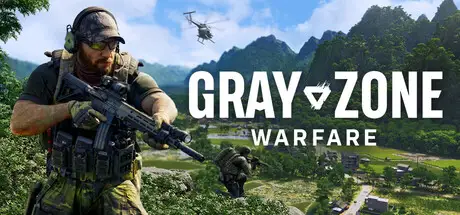
A helicopter banks low over the South-East Asian rain, the side door slides open, and the wet heat of the jungle pours in alongside the crackle of distant gunfire and the sound of your own quickening breath. There is no respawn here. There is only deployment, again and again, into a place that never stops feeling dangerous.
The ambition behind Gray Zone Warfare is enormous. It takes the punishing extraction loop that Escape from Tarkov made famous — carry your kit in, extract alive to keep your loot, die and lose it all — and drops it onto a seamless 42-square-kilometre tropical island where you can walk from your faction's base to any corner of the map without a single loading screen. The Czech studio MADFINGER had only ever made mobile games and arrived with no foothold in hardcore milsims, yet a trailer and a single promise — realism, at scale — sold half a million copies in four days and pushed the game toward 1.5 million in its first year, landing it across three of Steam's Best of 2024 lists.
The game is just as honest about its scars. It launched with brutal optimization, server queues, and AI so accurate it felt like cheating; the Chinese-language storefront cratered to roughly 17 percent positive. This is early access, and the studio itself calls it "only 20 percent finished." So the question this review answers is not whether the game is perfect. It is whether that island and that simulation are worth jumping into the rain for, right now, half-built and all.
Story | 5.5/10
Story: 5.5/10Come to Gray Zone Warfare for a story and it will let you down. Treat it instead as a machine for the story you write yourself on the island, and it gives you something stranger and more durable than any script. That contradiction is the most honest thing anyone can say about its narrative.
A quarantined island and an Event nobody will explain

The premise is a good hook on its own. Lamang is a tropical island sealed off after a disaster known only as the Event; the UN pulled out, and three private military companies came pouring in to chase the money. You are one of their operators, dropped into the gray zone to take contracts and, piece by piece, work out why the place fell apart. The setup dangles two mysteries at once — why am I here, and what happened to this island — and that is enough to carry the first dozen hours on curiosity alone.
What the game refuses to do is hand you answers. The narrative is scattered across tasks, contracts, and clues left lying in the world, and it expects you to dig. As environmental storytelling this lands beautifully: an abandoned village deep in the jungle, a checkpoint left in a hurry, an overturned army truck still smoking by the road. The deeper inland you push, the heavier the silence gets, until the absence of people becomes its own kind of narration.
The factions are the real characters

The job of actual characterization falls to the three private military companies, and they shoulder it well. The Lamang Recovery Initiative is bankrolled by a tech billionaire and dresses itself up as a humanitarian rescue outfit. Mithras Security Systems is a soldier-run mercenary company built on a Roman-legion ethos: competence earns its keep, and the spoils are split by merit. Crimson Shield International is the cold professional, infamous since the Syrian Civil War, advertising a 95 percent success rate and methods that draw quiet international alarm.
Those three stances do more for immersion than any named protagonist could. Which one you pick decides where you spawn, whose base you share, and the moral posture you carry across the island. The game never gives you a hero. It gives you a side. For an extraction shooter, that is a smart trade — your allegiance, not a cutscene, becomes the thing you role-play around. Early localization gaps did blunt this for a while; the Chinese-language reviews that bottomed out near 17 percent were as much about an unreadable interface as anything else, and only the Winds of War update, which added eleven languages including Simplified Chinese, opened those clues back up to the players who had been locked out.
A story that grows, and how it stacks up to Tarkov
To judge the narrative fairly you have to keep the early-access frame in view. The Spearhead 0.4 update rebuilt the task system, added over a hundred tasks and contracts, expanded the lore, and dropped in new locations — which means the story here is a living thing that each patch rewrites. Whatever feels thin today may not be thin in the next major build.
Set against Escape from Tarkov, the two are kindred spirits: light on plot, heavy on atmosphere, with a main thread that nobody buys the game for. What players remember is one nerve-shredding extraction, never a scripted beat. But Gray Zone layers in one thing Tarkov largely skips — a reason you are fighting, supplied by the clash of faction allegiances. The contracts you take read less like a campaign and more like a logbook of a war you happened to wander into, and there is a quiet appeal in that, if you are the kind of player who builds a story out of fragments rather than waiting to be told one.
So the 5.5 here is not a verdict on a bad story. It is a verdict on a game that never set out to tell one, and was honest about it from the start. Every ounce of authorial effort went into the island and the simulation; the plot is just the stage they stand on, holding up the mood without ever reaching for your heart. If a future update ever decides to aim higher, the bones — the Event, the factions, the sealed island — are sturdy enough to carry real weight. Today they simply hold up the scenery.
Audio | 7.5/10
Audio: 7.5/10In a realism-first shooter, sound is not decoration. It is intelligence, and it decides whether you walk out of the jungle. Gray Zone Warfare understands this better than most: it builds its audio as information you can read, not just noise you can enjoy.
Your ears are the radar

On Lamang you usually hear the enemy before you see them. The texture and direction of a gunshot shift with the round, the distance, and whatever wall stands between you and it; a flurry of distant fire might mean another squad is tangled up with the AI garrison, and whether you skirt around it or move in to pick the bones is a judgment call you make entirely by ear. The positional audio is solid and trustworthy, and it is a load-bearing part of the game's realist foundation.
The density of the ambience does the rest of the work, filling all 42 square kilometres with a sense of space. Boots land differently on mud, on grass, on loose stone; foliage rustles, rain ticks against leaves, insects and birds layer up into a wall of sound. Crouched at the edge of a rice paddy, holding your breath, you genuinely feel tucked inside a living jungle rather than parked on a textured map. And precisely because the ambience is so full, any wrong note an enemy makes — the rack of a bolt, a single snapped branch — leaps out of the background and becomes the signal that saves your life.
Helicopters, weather, and a soundtrack that knows when to shut up

If one sound stands for Gray Zone Warfare, it is the rotor wash of a helicopter. Every insertion and extraction is scored by that approaching, then overhead, then receding thunder, and it loads each drop with the ceremony of a real military operation. It is not only atmosphere; it is rhythm and warning. The sound of your own faction's bird means a safe window. An unidentified rotor from the wrong bearing means another team is on the move.
Once dynamic weather and a day-night cycle arrived, the tactical weight of sound climbed another notch. A downpour can mask your footsteps and the enemy's alike; thunder can cover a risky reposition or swallow the bolt-rack of someone flanking you. At night, in dead silence, you instinctively soften every movement, because you know that whatever distance you can hear, others can hear you across it too. The score, meanwhile, stays deliberately restrained — it serves tension instead of melody, which is exactly right for a milsim where the silence you need is the kind that lets you catch a twig breaking. Held up against Tarkov, the two share the same "sound is intelligence" DNA; Tarkov's years of acoustic polish still edge ahead on the finest details, while Gray Zone's positioning is already dependable enough to bet your life on. Call it 7.5: the direction is right, the foundation is sturdy, and there is real headroom left before it touches the top tier.
Visuals | 8.0/10
Graphics: 8/10Look out of the helicopter door the first time and you will probably freeze for a second. Below you sprawl unbroken rainforest, rice paddies, river valleys, and scattered villages, sunlight knifing through the canopy while a distant ridgeline dissolves into haze. Gray Zone Warfare lands its visuals on the first glance — but the visual story runs a lot deeper than "pretty."
A tropical island built in Unreal Engine 5

The game runs on Unreal Engine 5, and what it does best is nature. The lighting in the jungle, the layering of the vegetation, the way light scatters through humid air — all of it gives Lamang a wet, tropical heaviness you rarely see in a military shooter. This is not the gray rubble of yet another warzone. It is a living, breathing paradise smothered by conflict and quarantine, and that contrast alone makes it memorable.
What is rarer still is that the beauty is seamless. The whole 42-square-kilometre island is one continuous map, and whether you travel on foot or by helicopter, you reach any point of interest without ever hitting a loading screen. That spatial continuity keeps the immersion from being chopped up by constant loads — the mountain on the horizon is a mountain you can actually walk to, and the lit-up village in the distance is a village you can actually creep into and fight through. When what your eyes see and what your feet can reach line up perfectly, you get a sense of place that no slick cutscene can buy, and it raises the whole map's credibility as a battlefield. It also changes how you read a vista: that far ridge is not a backdrop but a route, that treeline is not set dressing but cover, and you start scanning the scenery the way a soldier would rather than the way a tourist does.
Weather, night, and the optimization that holds it back
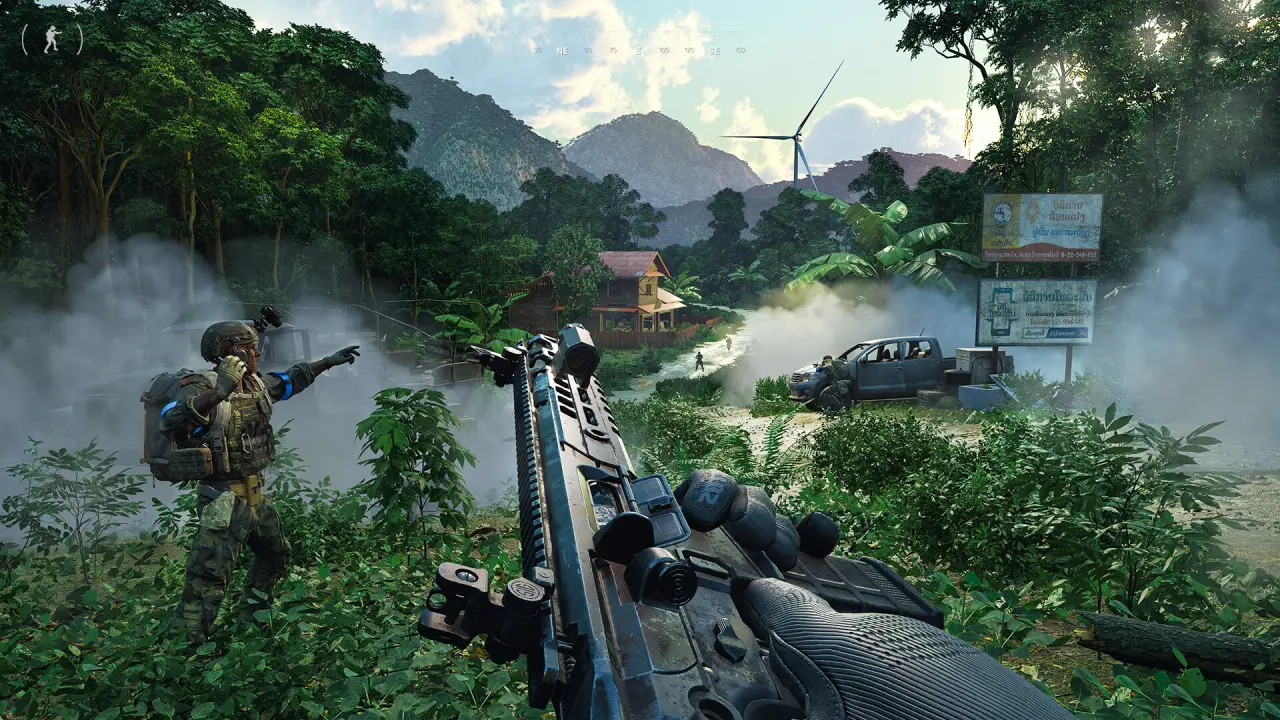
The dynamic day-night cycle from the Night Ops update, paired with the dynamic weather of Winds of War, is a genuine boost for this category. At night the entire island sinks into darkness and you lean on night-vision goggles — themselves breakable, consumable gear — to move, the jungle glowing an oppressive green while every distant muzzle flash burns bright. A sudden storm drops a gray curtain of rain, crushes visibility, and reworks the light until familiar landmarks turn strange and dangerous. The same map ends up wearing several faces: morning mist, noon glare, golden dusk, the black of a rainy night, each carrying its own mood and its own tactical math, so the same outpost stays fresh even after you have raided it a dozen times.
Honesty demands the real drag on this score is not the art; it is the optimization. At launch the stutters, hitches, and sub-par netcode were widespread, the PC requirements ran high, and that was a leading cause of the early review collapse. Even on mid-to-high-end hardware the early builds would still cough up the occasional hitch and audio crackle, and the dissonance of a beautiful jungle juddering at the worst possible moment — mid-firefight, mid-extraction — did real damage to first impressions. A game this reliant on atmosphere cannot afford a frame-rate that breaks the spell. But the trend is improving. The consensus from outlet testing is that on capable hardware it is "good looking and runs fairly well for the most part," and patch by patch the studio has been ironing the technical problems flat — the recent-review recovery from the low-60s toward 80 percent owes plenty to that work. Against Escape from Tarkov, Gray Zone wins on open natural vistas and long sightlines, while Tarkov holds firmer on interior detail density. Weighing art and tech together, the visuals earn an 8.0: the taste is there, the foundation is gorgeous, the identity is strong, and the points come off for that optimization pit it has not quite filled in — the very gap it most needs to close on its way from "good looking" to "good looking and good to play." Few shooters this young already have a look you would recognize from a single screenshot, and that, more than any benchmark number, is what the 8.0 is really rewarding.
Combat | 8.5/10
Gameplay: 8.5/10Gameplay is where Gray Zone Warfare plays its real hand, and where it bet the whole pot. Its thesis fits in one line: take hardcore realism all the way down to the bone, but do not slam the door on newcomers the way Escape from Tarkov does. Those two goals look like they should fight each other. The game pulls them off well enough to carry its best moments.
Ballistics, rounds, and recoil that changes mid-magazine

Start with the ballistics, because that is the hardcore heart of it. The studio advertises "precise real-world values and an authentic ballistics model," where a round's effect comes down to energy, velocity, and penetration rather than a chunk of health bar vanishing. Four round types behave differently: soft point expands on an unarmored target, full metal jacket punches through efficiently, armor-piercing defeats plates, and hollow point mushrooms on entry. The penetration model goes further still, calculating jacket damage and detachment, core deformation — the so-called mushrooming — ricochet physics, and even the temporary and permanent wound cavities a bullet carves inside a body.
All of which turns the question of what to load against what target into something you actually have to think about. Armor-piercing rounds wasted on unarmored locals is throwing money away; soft points against an armored player is tickling them. Recoil is dynamic too. On the same AR15, control can swing by as much as ten percent between a full magazine and a near-empty one, because the weapon's weight shifts with every shot fired. Stacked together, these details build the game's "every step tries to be true to life" character.
The gunsmithing trade-off, and a no-hitpoints medical system
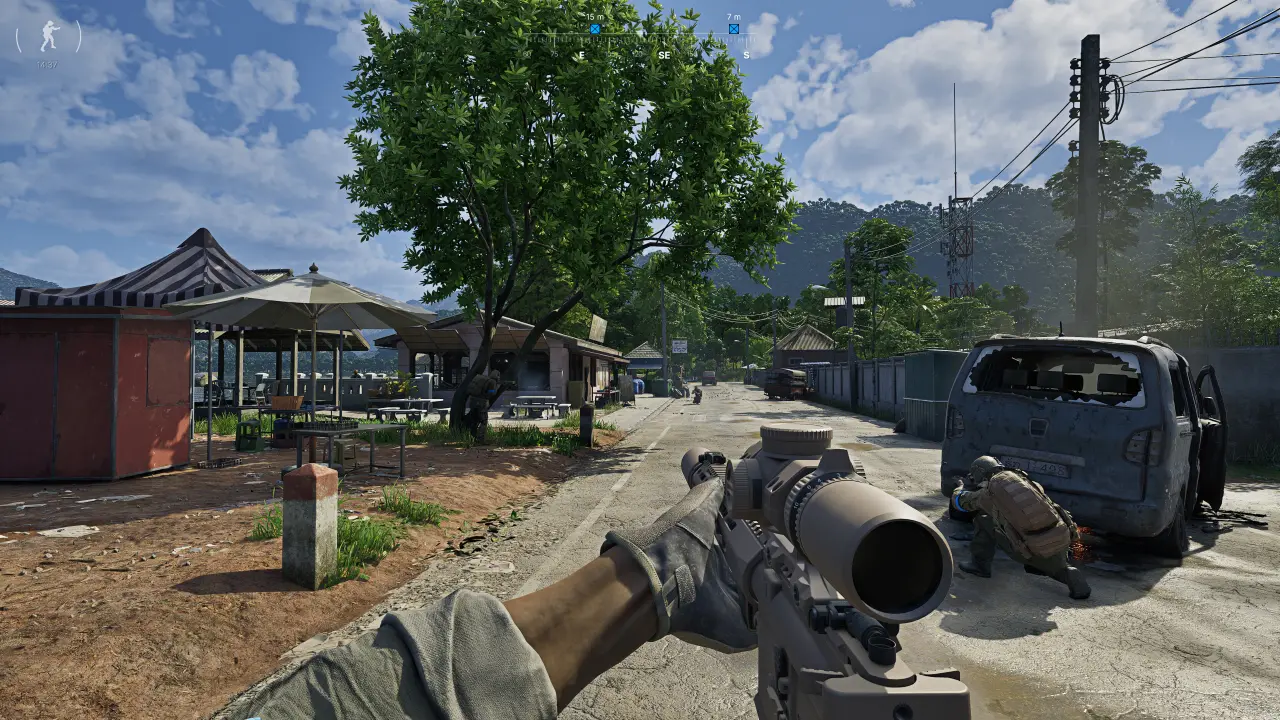
On top of dynamic recoil sits a gunsmithing system keyed to real components. Barrels, grips, optics, suppressors, and magazines each independently change weight, the recoil curve, and your aim-up speed — you do not get stronger by bolting on more attachments. A long, heavy, rock-steady build that raises a beat too slowly in a close jungle ambush can cost you your life; a light, nimble build can fail to hold its recoil in a long-range duel. So building a loadout you trust becomes an ongoing trade: steady or fast, a setup for the night run with suppressor and goggles or one stacked with optics for daylight duels. Plenty of players carry several loadouts for different jobs, and that "think about what you came to do before you leave the gate" prep is a pleasure unique to milsims.
The system that shows the realist ambition most, though, is the one with no hitpoints. Blood volume, hydration, organ integrity, and fractures are all simulated and tracked separately. Take a hit and you do not simply lose a bar — you have a few seconds to read which body part, how severe the bleed, whether a bone broke, whether an organ took damage, then dig the right tool out of your pack. And the tools are strictly single-purpose: bandages treat wounds but not bruises, tourniquets stop bleeding but never close a wound, splints set fractures, and only a surgery kit restores a damaged or destroyed organ. Misread it, reach for the wrong item, and you bleed out slowly in the jungle. Treating yourself becomes its own small firefight of decisions — and one of the easiest things here to get hooked on.
Factions, a shared world, and the gunplay everyone argues about
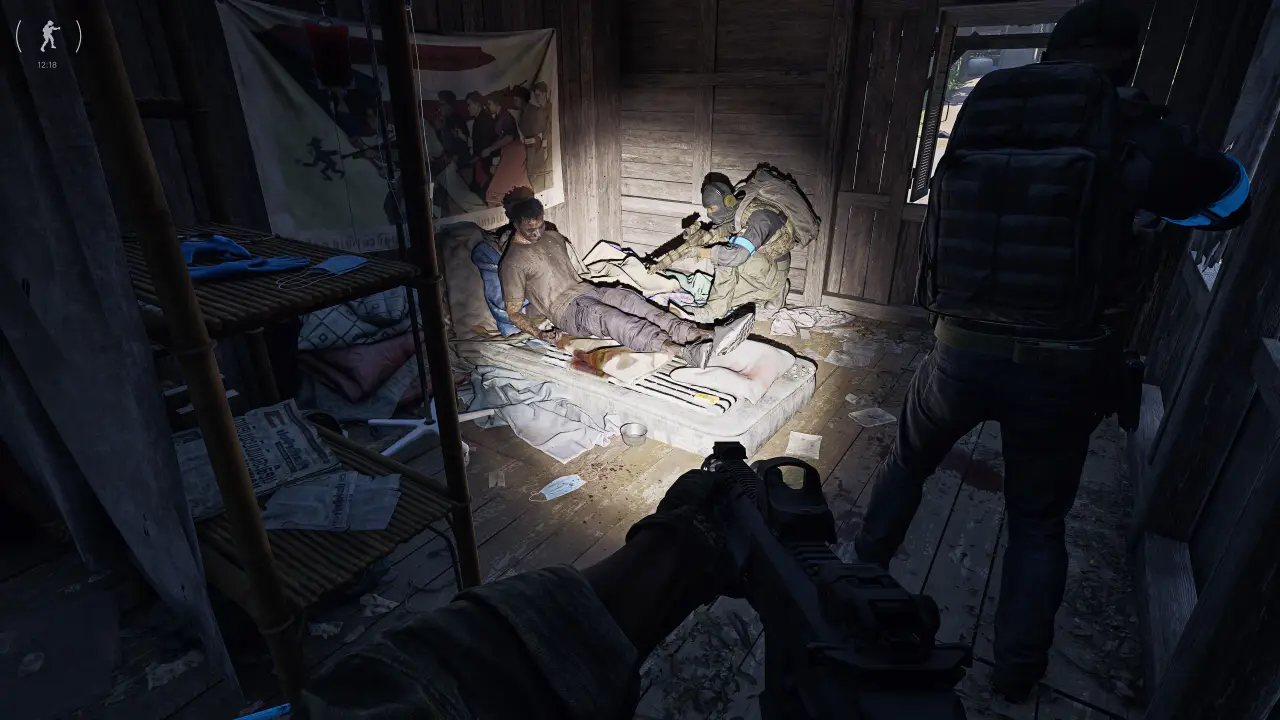
If all of the above is the hardcore, the friendliness that separates it from Tarkov rides entirely on the faction system. You pick one of three private military companies and spawn into its shared base — and the key is that even queued solo, you will find real players in that base and out on the roads. Having strangers watching your back is exactly what dissolves the newcomer-hostile isolation Tarkov is built on. Modes split into Warfare, the PvPvE mainline, and Joint Operations, a pure PvE lane that hands skittish players an entrance where they only ever wrestle the environment.
It is not without a soft spot, and the loudest one is the gunplay. A fair share of reviews call the weapon handling "floaty" and weightless, an awkward clash with the hardcore ballistics the game keeps advertising — the math underneath is convincingly real, yet the weapon in your hands lacks heft. That is the clearest distance between this and a genuinely top-tier shooter. Lined up against Escape from Tarkov, Tarkov's looting depth, item economy, and hardcore detail remain the ceiling, while its near-suicidal solo barrier of entry has turned away countless players; Gray Zone answers with a bigger map, a shared world, and real teammates, catching everyone who wanted realist extraction but could not stomach Tarkov's cruelty, at the cost of a loot-and-extract gamble that its task-driven loop noticeably waters down. Gameplay takes an 8.5 — a nod to the depth of its systems and the smartness of its trade-offs, with points docked for that under-polished feel in the hands.
Content | 6.0/10
Content: 6/10You cannot judge the content of Gray Zone Warfare without one fact up front: it is early access, and the studio itself says it is "only 20 percent finished." So this category is less a review of a finished house than of one with its foundation poured and its frame up but its roof nowhere in sight. You have to weigh what is here now against what it has promised to become, and you cannot skip either half.
A huge map the content density cannot keep up with

What is here now, first. The most obvious thing is that roughly 42-square-kilometre island, plus the endgame battleground the studio calls Ground Zero. On sheer scale it dwarfs most of its peers by miles; simply hiking from one point of interest to the next can burn through serious time, with garrisons and rival squads liable to find you on the way. But scale is a double-edged thing. The map got big, and the content density did not entirely keep pace. The repetition in task types, the emptiness of long overland treks, and the obvious lull once you have run the core loop dry are all real, and players name them often.
Put another way, what it offers right now is breadth, not density — acres of room to explore and fight across, but a thinner spread of things to actually do relative to the size of the canvas. For some players that emptiness is the point; the long, quiet walks are where the dread lives, and the open ground is what makes an ambush feel earned. For most, though, it tips into tedium once the novelty of the scale wears off, and there is no pretending the mid-game does not sag. That is why content lands at 6.0: the foundation is enormous, but not enough house has gone up on top of it yet.
An update cadence that earns the score the benefit of the doubt

Content, though, is a moving target for an early-access game, and the cadence here is brisk. Night Ops added the day-night cycle and night vision; Spearhead 0.4 rebuilt the task system and dropped in over a hundred fresh tasks and contracts; the largest update yet, Winds of War, brought dynamic weather, a reworked mission flow, and support for eleven languages including Simplified Chinese. Every major patch pours something real into that big map, turning corners that were empty yesterday into places with a reason to visit.
The monetization is worth a line too. The game sells a paid Edition Upgrade, which roughly half of all players bought in the first year, but it reads more as a way to support development than as a traditional expansion carving up the main game — the core experience is not locked behind a paywall, which is a decent posture for an early-access title to take. Beyond that, the studio has published a three-year roadmap: survival and crafting on Lamang, stealth mechanics that let you strike from the shadows, faction warfare escalated by both story and new systems, and Ground Zero as the ultimate contested battleground. Most of it has yet to fully land, but it sketches a blueprint whose volume keeps doubling, and that is the promise propping up the game's long-term value.
Measured against Escape from Tarkov, Gray Zone is plainly larger and more open, with more room to roam free; Tarkov's years of accumulated item-economy depth, looting richness, and system maturity still lead by a clear margin, with gear and the market alone capable of swallowing a veteran's hours. Which is exactly the fairest way to frame an early-access comparison: pitting a years-deep mature game's present against a 20-percent-finished newcomer's present was never going to be an even fight. What actually matters is how fast the latter fills its holes — and on that count Gray Zone's answer is far from weak. So content earns a 6.0, an honest record of a game that is sparse today but has its frame and its promises in place. You are buying a growth stock, not a finished product, and a year of update pace at least makes that stock look worth holding rather than dumping at a loss.






Comments 0
Share your game review
Join the discussion and share your review of this game.
No comments yet. Share your thoughts on this review.