

























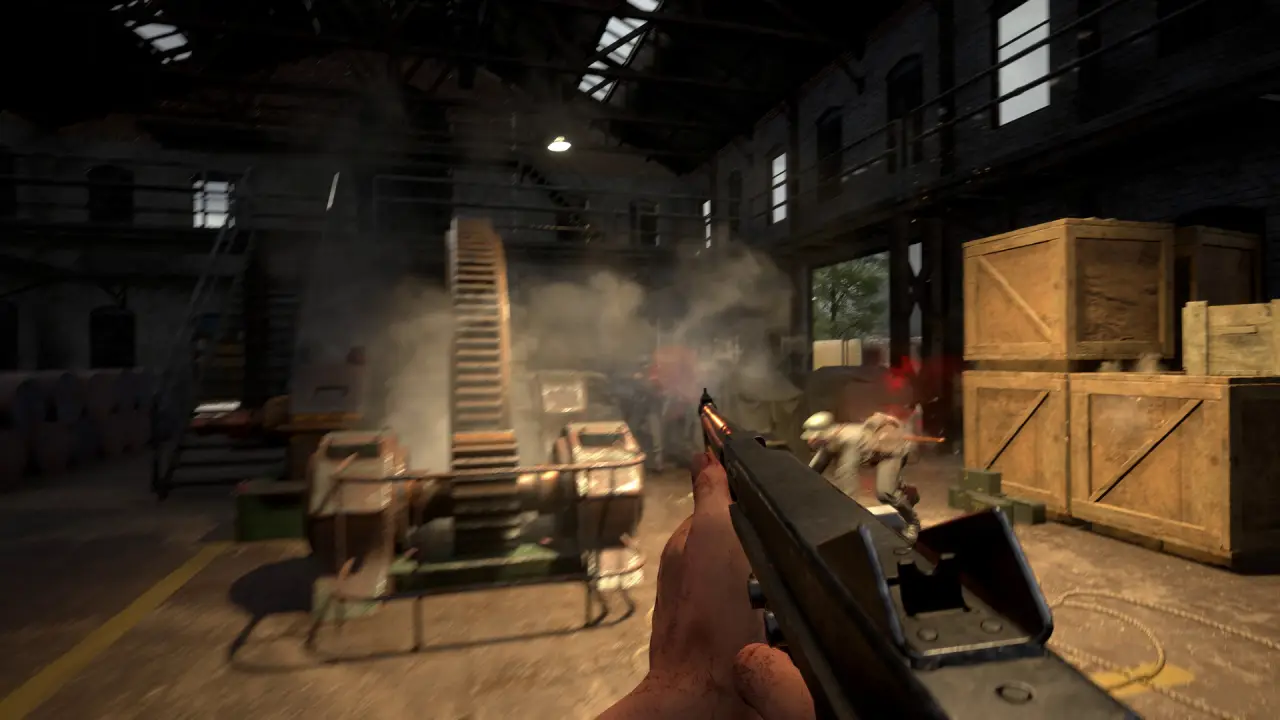
Opening
Most World War Two shooters ask the same question: how do we make you, personally, feel like a hero out there. Hell Let Loose tears that question up on the first screen. You, on your own, are nothing here — and that is exactly the point.
This is a 100-player, 50-versus-50 war fought across a single map rebuilt one-to-one from a real European campaign, roughly four square kilometres of mud, ruins and open killing ground. You are not the protagonist. You are one cog among dozens. Strip the lone-hero fantasy out of a shooter and most of them collapse; this one finds a place almost nobody else occupies precisely because it dares to.
It is not welcoming. For the first few hours it is downright hostile. But push through that fog of repeated, baffling deaths, fold yourself into a squad that actually talks, and you walk away with something no other shooter hands out: the collective high of dozens of strangers moving like one machine to take a single strongpoint. This review is about why that payoff is worth the patience — and, just as honestly, about who should never bother.
Story | 5.5/10
Story: 5.5/10Come here for a tightly scripted war story and you will leave hungry. There is no single-player campaign, no named hero walking you through Normandy, no cutscene to swell the strings. What narrative exists grows out of the battlefield itself — and that distinction is the first thing worth getting straight.
Nobody wrote this war — you fight it into being
The story is not authored; it is fought into existence. Each match opens on an empty board where nobody, not even the developers, knows what the next hour holds. One round your side punches a hole in the enemy line inside ten minutes. The next, two squads grind over the same wheat field for an hour and neither budges an inch. This is emergent narrative, and Hell Let Loose is one of the most convincing WWII games ever built around it.

What sticks with you is never a line of dialogue. It is a specific fight: crawling into a shelled-out building under long-range fire, an engineer slapping down a garrison in the corner, and forty strangers pouring up through that single point to drag a collapsing line back from the brink. That memory belongs to you. Nobody scripted it. Where a heavily staged war story spoon-feeds the emotion, this one hands you the spoon and walks away.
And because the story is grown on the spot, no two matches rhyme. The same map can serve up a clean, exhilarating breakthrough one night and an hour-long bloody deadlock the next, with nobody able to spoil how your battle ends because nobody knows. A screenplay only plays once; this ground rewrites itself every single time you load in. For veterans long since numbed by the assembly-line plots of other WWII games, that "I forged this one with my own hands" freshness is, quietly, the biggest hook it has.
The map is the screenplay, and the period does the talking
If nobody wrote the plot, then mood and place have to carry the weight — and this is where the game is at its sharpest. Stalingrad is a burned-out shell where every gutted factory might hide an ambush. Utah Beach drops you on open sand and asks you to push a full mile inland with nothing at your back but luck, and that exposure is itself a kind of storytelling.

Every map is reconstructed from real battles using satellite imagery, archival aerial photography and street-level rebuilds. You feel the weight of history without a single line of text — a factory hollowed out by shellfire, a ridge fought over until nothing green is left on it, an open field strewn with wreckage, each quietly narrating what happened here. Compare that with the high-budget set pieces of Battlefield V: that game tells you what the war looked like and feeds the emotion straight to your mouth; Hell Let Loose drops you into a battlefield you believe and hands the telling back to your own feet and eyes. Neither path is wrong, but they lead somewhere genuinely different.
An honest weakness, not a failure
All of which makes the story dimension a double-edged thing. As situational, atmospheric storytelling it sits near the top of the genre. As conventional "tell me a good yarn" craft it is close to blank. There is no through-line to pull you along, no arc to a named soldier, no scripted beat engineered to land in your chest at a fixed minute. If that is what you came for, you should know going in that none of it is here.
Our relatively cautious score for this dimension is not a knock on execution — it is an acknowledgement that the game never set out to write a story in the first place. It set out to let you live one, and on that count it succeeds more completely than almost anything else in the genre. Judge it on the war it stages rather than the tale it tells, and it is one of the most quietly affecting WWII games around; judge it on plot and it has almost nothing to offer. Both readings are true at the same time, and which one matters is entirely down to what you walked in wanting from a war game.
Audio | 7.5/10
Audio: 7.5/10Sound in Hell Let Loose is not décor. It is a survival feed — though one with a couple of glaring trade-offs baked into it.
A soundscape so full it stops warning you
Once a fight kicks off, your ears fill up fast: the dull thud of artillery somewhere over the ridge, treads grinding through rubble, the staccato of long-range fire snapping back and forth, teammates barking bearings over voice. That density nails the oppressive feel of a battle slipping out of control. You genuinely believe you are inside a mess too big for any one person to read.

But several critics flagged the cost. The mix is so saturated it loses its warning value. In a real exchange you can rarely place a threat by ear, because everything blurs into one wall of noise.
PC Gamer singled out the missing crack of rounds breaking the sound barrier near your head — in many rivals that sharp snap is the cue that tells you, instantly, that you are exposed. Here you often get no cue at all. For newcomers it deepens the "how did I even die?" frustration; for veterans, that same wash of chaos is read as a feature, not a fault — the fog of a real battle is supposed to be disorienting, and the audio commits to that fiction even when it costs you a clean read on the threat.
Voice is the real instrument, and the consoles lend a hand
The most important "sound effect" in this game is a human voice. The commander deploys the big picture over the channel; squad leaders call targets, shout cover, coordinate the push. The whole army runs on that spoken chain, and a single calm, clear voice on comms can be worth more than any amount of firepower. Mute the voice comms and the game loses half its lungs — which is exactly where its audio philosophy parts ways with every solo-driven shooter on the market, where chatter is optional flavour rather than the engine itself.

On the hardware side, the PS5 and Xbox Series releases lean on platform spatial audio, and on a map this size that extra layer of directionality genuinely helps claw back a little of what the overcrowded mix takes away. It will not turn you into a sound-whisperer, but it nudges the odds back toward you on the open maps where bearings matter most.
Set against Squad's clinical, locate-by-ear realism, Hell Let Loose tilts toward heavy historical atmosphere over acoustic precision. That is a choice, not an oversight, and once you accept it the soundscape stops feeling like a handicap and starts feeling like the point. The audio is not flawless, and the muddled directionality is a fair thing to flag — but it knows exactly what it wants: to press you down into a real, deafening, breathless WWII engagement and hold you there until your pulse agrees, until the noise stops being information you parse and becomes weather you simply endure.
Visuals | 8.0/10
Graphics: 8/10The visuals here do not win you over with spectacle. They win you over with something closer to obsession: lifting an entire battlefield, intact, and setting it down in front of you.
Built on Unreal Engine 4, scale is the whole flex
The game runs on Unreal Engine 4, and the thing that lands hardest is not any single graphics setting — it is the sheer footprint of that roughly four-square-kilometre map, rebuilt one-to-one from a real campaign. Stand on a rise and look out: the villages, the tree lines, the rolling ground out to the horizon are all space you can actually walk into and fight over, not a painted backdrop. That far hill is genuinely reachable. That copse will genuinely hide a man.

And the bigness does not come at the expense of texture. Churned mud, rutted tracks, pocked walls, grass that bends in the wind — those close-up details hold up even inside a hundred-player melee. This is not the cheap trick of looking great from a distance and dissolving up close. The game spends real effort on its surfaces, so whether you are surveying the whole front or hugging a wall on your belly, what you see is a battlefield you believe.
That scale is not vanity, either. It makes long-range fighting real — you can be dropped by a position hundreds of metres out that you never spotted — and it makes every advance feel long and dangerous. The visuals here are not pretty for the sake of a screenshot; the sheer reach of the map turns distance itself into something you feel, exploit, and occasionally die to.
Landmarks you remember, and a deliberately restrained palette
Scene to scene, there are sights that stamp themselves on you. The burned shell of Stalingrad, with ambushes lurking in every hollowed-out factory, breathes the claustrophobia of close-quarters fighting. Utah Beach is the opposite extreme: open, exposed, no cover, your back handed to chance as you push that full mile inland. Reconstructed from real battles and aerial records, these places are recognisable enough that history buffs can match them to period photographs — and that scholarship is its own kind of immersion. Knowing a place is real, that men actually fought and fell on this exact ground, lends every firefight a weight that no invented arena can fake.

It is not flawless. Several outlets noted room to grow on optimisation and level-of-detail handling; distant objects occasionally pop in as you close on them, and on PS5 and Xbox Series, while resolution and frame rate are broadly solid, carrying a hundred-player scene laced with vehicles and long-range fire keeps the hardware under genuine strain, with the odd dropped frame in the thick of it. None of this breaks the experience, but the graphics purist should know it going in, and a mid-range rig will feel the squeeze on the larger maps when a real battle finally erupts.
Form following the realist core
Set against the cinematic explosions of Battlefield V, Hell Let Loose is conspicuously restrained. It chases no movie-grade light show, no slow-motion shrapnel, no orchestrated building collapse carefully staged to land right in your camera frame. It pours its budget into one goal: a WWII battlefield you actually believe in.
That choice will not please everyone. Players raised on spectacle may find it drab on first impression, all browns and greys and overcast skies. But it sits in lockstep with the game's realist core — the visuals are not a showroom for tech, they are the foundation that immersion and honest tactics stand on. The muted palette is not a lack of ambition; it is the colour of the war it is recreating. Spend a few hours inside it and the restraint reads as confidence rather than poverty. For the players who are here for that, the restraint is the sincerity, and the believability it buys is worth more than any explosion. The most striking thing the game ever shows you is not an effect at all — it is the simple, sobering sight of a real battlefield stretching to the horizon, and the quiet, sinking knowledge that you are going to have to cross every inch of it.
Combat | 9.0/10
Gameplay: 9/10This is where Hell Let Loose keeps its soul. Other WWII shooters reward the fastest reaction and the steadiest aim. This one rewards something else entirely: whichever side is better organised. More often than not, the match is decided before you ever squeeze a trigger.
Garrisons: the real win condition
To understand this game you first have to understand the thing players nickname the garry — the garrison. It is a spawn point a squad leader can plant in any area with enough supply on hand, and it dictates where your entire army feeds reinforcements into the front. Simple to describe. Brutal to master.

When and where to build a garry is the single most debated decision in the game, full stop. Get it right and your side surges in from a direction the enemy never saw coming. Get it wrong and the front starves; dozens of players hoof it in on foot for five, ten minutes while the line buckles without them. A squad leader who reads the map well is worth more than ten sharpshooters playing lone wolf. The mechanic turns "where do I respawn" from background plumbing into a running strategic argument that never lets up: where, exactly, do we plant our next foothold, and is it close enough to matter without being so exposed the enemy razes it the moment we turn our backs?
A commander, three resources, and an RTS hiding in plain sight
Above the garrisons sits a wider board. Each fifty-strong side is topped by a commander who manages three map-wide resources — manpower, munitions and fuel. Those stocks decide whether the army can call in aerial recon, a supply drop, or a long-range bombardment when it matters most.

It is, in effect, a real-time strategy layer tucked behind a first-person camera. A commander who husbands resources can drop a wave of supply or a barrage at the exact moment a stalemate cracks; one who cannot leaves fifty players stranded, desperate to act and out of the currency to do it. The front line can fight like lions and still lose the board to a single bad call upstairs. Flip it around and a thoroughly average roster, led by a commander who truly reads the game, will drag a stronger team into the dirt. That two-tier structure — moment-to-moment feel downstairs, strategic accounting upstairs — is the design rivals find hardest to copy, because it asks the same hundred people to be both grunts and chess pieces at once.
Fourteen roles, one interlocking supply chain
Holding all of this together are fourteen sharply defined roles. The infantry line runs officer, rifleman, automatic rifleman, assault, support, anti-tank, machine gunner, engineer and medic. The armour line has tank commander and crewman. Recon brings a spotter and a sniper. And over the top of all of it sits that single commander, tying the whole apparatus together.
None of these is a reskin. Each is an irreplaceable link in the supply chain: engineers raise fortifications and resupply nodes, support troops drop ammo, medics drag downed teammates back, spotters call coordinates for artillery sitting hundreds of metres to the rear. Pull any one link and the chain jams — no support, the line runs dry; no engineer, the troops you pushed forward have nowhere to dig in; no medic, every loss is permanent for the round. A squad in rhythm threads these roles into a production line, firepower and resupply and recovery and recon all in their slots, moving like a drilled unit. Almost nothing on the market matches that depth of cooperation, and almost nothing punishes its absence so harshly.
Lethal by design, and the deliberate answer to Squad
Then there is the feel of the fighting. Engagements are savage — one or two hits and you are down or gone, with no walking off a wound. At first that breaks the brain of anyone raised on twitch shooters: you spend five minutes reaching the front and lose it all inside ten seconds to long-range fire you never saw.

But that cost is the whole point. It forces everyone to slow down, hug cover, call targets, and treat every metre of open ground as a gamble. Death here is not a punishment; it is a rule of the road, and the moment you stop resenting it is the moment the game finally opens up to you.
Measured against its closest rival, Squad, Hell Let Loose makes a shrewd trade. Squad runs a deeper, more demanding simulation and sets it in a modern war, walling off the more casual crowd. Hell Let Loose softens the on-ramp and the presentation just enough to make the reward for cooperation land faster and hit harder. It is not the purer simulator — but it found the balance between "approachable" and "genuinely hardcore" that almost every peer missed, and that single act of judgement is why it still endures today.
Content | 8.0/10
Content: 8/10As a live-service multiplayer game, the content question splits in two: the deep pool of maps and modes built up since launch, and the update cadence the game has kept since changing hands.
Seventeen real battlefields, three modes, three tempos
There are seventeen maps right now, every one drawn from a real WWII engagement — Stalingrad's ruined streets, Utah Beach's open sand, sprawling farmland, dense townscapes. The terrain swings hard, and no single playstyle survives across all of it. Open maps test long-range fire and vehicle movement; town maps are a house-by-house knife fight. Just learning where garries belong, where the key firing positions sit, and which approach gets you ambushed is dozens, even hundreds, of hours of study, and that knowledge is map-specific — mastery of one battlefield buys you almost nothing on the next. The result is a content pool that resists exhaustion, because the skill ceiling is tied to map literacy as much as to mechanics.

The modes layer on top. Warfare is the back-and-forth tug from the centre line that can sway for an hour or two and shows the system at its deepest, the version where the resource economy and garrison play really get to stretch out. Offensive locks one side into attacking, with a thirty-minute clock on each objective and the other side dug in to defend — tighter, less forgiving, the place where a single botched garry can cost the whole match. Control Skirmish strips it down to a smaller, sharper fight over a single point for players short on time or nerve. Three tempos, three headspaces, and enough room for the core loop to breathe no matter how long a session you have to give it that night.
A roadmap, a new war, and the numbers behind the community
The other half of the content story is the ongoing support. After the brand changed hands the new stewards published a 2025 roadmap: Tobruk and an Eastern Front map, a Stalingrad rework, new vehicles, weather variation, an XP-system overhaul and fresh long-range gear. Then, in August 2025, came the standalone expansion Hell Let Loose: Vietnam, lifting the garrison-commander-resource core wholesale into the 1965–1973 Vietnam theatre — new terrain, new factions, new toys, and proof the lifecycle is still expanding rather than coasting.

Does anyone buy into all this? The numbers answer plainly: roughly 97,744 user reviews at 83% positive, parked squarely in "Very Positive." Concurrent players peaked near 21,000 in early 2025 and settle around seven or eight thousand at prime time, with big updates pulling a wave back. And note that subscription-service and rival-storefront players are not even counted in that tally, so the real active base is larger than the figure suggests — a healthier population than the raw chart implies, and crucially one spread across enough regions and hours that you can almost always find a full server. For a hardcore, cooperation-first niche, holding a stable community this long is itself the strongest proof that the content keeps its hooks in. Games like this live or die on population, and this one is still very much alive.
Standing tall in its niche — caveats and all
Against its same-blooded WWII sibling Post Scriptum, Hell Let Loose comes out ahead on scale, map count and community activity alike — the clear benchmark in this corner of the genre. If you have ever bounced off a milsim for lack of a populated server at the hour you actually play, that activity gap is not a footnote; it is the difference between a game you can fire up tonight and one you keep meaning to get back to.
The long tail has its critics, of course. Some veterans grumble that several post-handover updates landed rough or slow, and hold the roadmap at arm's length, since a new owner juggling a complex legacy system and fresh content is bound to drop a ball now and then. Keep your expectations level and you will not be stung. The pool is large and genuinely durable, with enough maps and modes to swallow hundreds of hours; the steadiness of what comes next is the one part reasonable people still argue over, and it is a fair thing to weigh before you commit.




Comments 0
Share your game review
Join the discussion and share your review of this game.
No comments yet. Share your thoughts on this review.