


















Opening
Most games ask for your eyes. This one wants your ears first.

Put on a pair of headphones, hit start, and before you see anything you hear them — voices crowding in from behind your skull, brushing past your left ear, settling at your temples. One coaxes you to turn back. One laughs that you never could. One just repeats the same word until it stops meaning anything. They are not sound effects. They are the voices in Senua's head, and for the next eight hours they are the voices in yours too. Hellblade: Senua's Sacrifice is a game about a Celtic warrior carrying her dead lover's skull into a Viking underworld to bargain for his soul, but the real journey happens somewhere smaller and far more frightening: inside one grieving woman's mind. Ninja Theory built this portrait of psychosis the hard way — by asking people who live with it and by bringing in scientists to keep it honest. It won five BAFTAs, sold past a million copies, and shipped at thirty dollars. It has real flaws and a few strengths nobody has managed to copy since. This review is about both, and about whether you should put on those headphones and take the walk.
Story | 8.5/10
Story: 8.5/10The underworld is a map of one woman's grief, not a place you can stand in
On paper the plot is a straight line. Senua's lover, Dillion, was murdered by Norsemen. She carries his severed head north toward Helheim, the realm ruled by the death goddess Hela, determined to trade her way past death itself and bring him back. Along the road she has to survive trials set by gods who feel less like bosses and more like symptoms — Surtr's wall of fire, the illusionist Valravn bending what her eyes can trust, the hound Garm waiting in a darkness she has to creep through blind, and finally Hela herself.

Spend an hour with it, though, and the geography stops being literal. The gods, the trials, the underworld that keeps rebuilding itself around her — they are Senua's mind, projected outward and made walkable. She lives with psychosis, and the trauma of losing the person she loved most has rewritten her entire reality. The descent into hell is really a standoff between Senua and her own voices, memories, and visions. The game never sits you down and explains this. It lets you assemble the truth yourself, in the gaps between what is real and what is not, and that restraint is exactly what makes it land. You start noticing that Dillion and her father are spoken of constantly but never truly appear; they live only in flashback and hallucination, and yet those unseen figures are the real opponents of the whole trip.
The structure does something quietly clever with that. It stacks the outward adventure and the inner wound on top of each other, so that every fight is simultaneously a physical gate and a psychological reckoning, and every puzzle is both a lock on a door and a knot in her head. You are never just clearing a level. You are watching a mind try to find a way through itself, and the game trusts you to feel that without ever naming it aloud.
Nobody here treats psychosis as a spectacle
Most games that touch mental illness either reach for cheap scares or slap on a label and move on. This one does neither, and you feel the difference in the first ten minutes. Ninja Theory developed it alongside the Wellcome Trust and Cambridge neuroscientist Professor Paul Fletcher, and they brought in people who actually live with psychosis to describe the hearing of voices, the sense of being watched, the corrosive self-doubt — then wrote those accounts straight into the experience rather than around it.

A short text card opens the game, telling you plainly that what follows was made with the help of professionals and people who have been there. It is two sentences, and it sets the entire tone: this is an invitation to inhabit another way of perceiving, not a freak show built to make you flinch. The collaboration shows in the details — the voices argue with each other, contradict each other, undercut your small victories — and it is why the game keeps getting cited whenever anyone asks whether the medium can speak seriously about mental health. It can. This is the proof.
The ending is not beating death, it is learning to live with loss
If you walk in expecting a hero who triumphs over the reaper, you have it backwards. What Senua finally has to cross is not Hela but herself — the simple, unbearable fact that Dillion is gone and is not coming back. The game lands the theme on a line that hits like a stone: a life without loss is also a life without love. She does not win by force. She wins the moment she is finally willing to let go, and the whole eight hours have been quietly building toward that release rather than toward any final swing of the sword.
Set it beside God of War, the other great Norse-myth tentpole of its era, and the divide is clean. Kratos and his son carry a sprawling odyssey on the back of spectacle and combat; Senua's road is tiny, almost entirely solitary, and it spends everything it has on turning one person's most private interior inside out for you to see. Both are extraordinary. They are not the same kind of extraordinary. When the credits rise you probably won't remember a single fight, but you will remember the look on Senua's face when she finally sets the skull down — and a story this short leaving a mark that deep is not about length. It is about aim.
Audio | 9.5/10
Audio: 9.5/10The binaural audio is not a feature — it is the whole game
Here is the verdict up front: this is one of the few game soundtracks of the last decade worth pulling out and discussing on its own terms. Ninja Theory recorded Senua's voices with a three-dimensional binaural microphone, which means that with headphones on they do not arrive flat from a pair of speakers. They circle your head. One whispers against your left ear, one drifts in from behind, one cuts in the instant you are about to make a decision and tells you you've got it wrong.

The crucial part is that these voices are not ambience. They play. In a fight they shout that someone is on your right, that you need to block now; in a puzzle they sneer that you've misread it again. Senua's auditory hallucinations have been built into a living system that runs the length of the game. It took the BAFTA for Audio Achievement and the prize for best audio design at The Game Awards, and not because it sounds crisp — because it turned the experience of hearing voices, something almost impossible to convey, into something you have to go through yourself. There is one piece of community consensus nobody really argues with: you play this on headphones, or you lose half of it.
The voices are a crowd, and they do not agree
What lifts the design from clever to genuinely unsettling is that the voices argue among themselves. They are not one unified narrator; they are a handful of distinct throats — one barbed, one gentle, one barely holding together — and they interrupt and contradict each other the way a real crowd would. Do something right and one will praise you, only for another to scoff that it was luck. It is too alive to read as a tutorial prompt, because it sounds far too much like a roomful of people bickering inside your skull. That liveness is what promotes the audio from a technical trophy to the actual storytelling.
The score itself, by David García and Andy LaPlegua, is smart about when to stay quiet. Long stretches are left deliberately bare — just footsteps, breath, and the voices — so that when the music finally breaks over a scene, the weight of it is enormous. Sound and story are interlocked: when Senua comes apart, the voices and the score crowd and tangle together until you can hear her world collapsing, and when she finds a moment of calm everything retreats to wind. The environmental work is just as exact, the wet suck of mud, the heat-roar of approaching flame, the hiss of a blade through cold air, each one pinning you a little harder into a place that is damp and dangerous. Even on the visually compromised Switch port the binaural mix survives intact, and with headphones on a handheld that intimacy loses nothing. The studio clearly understood the one thing this game could never afford to lose.
Visuals | 8.0/10
Graphics: 8/10Twenty-odd people built a face most studios couldn't
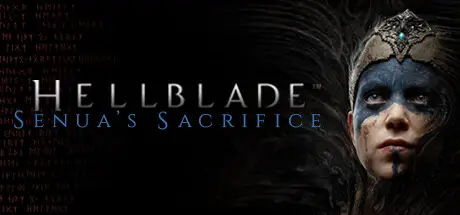
Hellblade runs on Unreal Engine 4, but the thing that actually holds the picture together is not a spec sheet — it is a face. Senua is played by Melina Juergens, and her performance capture carries the game's enormous appetite for the over-the-shoulder close-up. The camera lives on her, often inches away, and you can read every twitch of an eyelash, every loss of control at the corner of her mouth. That a team of roughly twenty people landed a human face this fine is, on its own, faintly absurd. Plenty of the era's characters were built by far larger art departments and have nothing like Senua's expressiveness; the game quietly proves that when it comes to feeling, resource counts matter less than how hard you are willing to stare at one performer.
The art direction is bleak, soaked, and grounded — a Norse-myth world held at a low, muddy register. Burning villages, drowned bogs, lightless caves, an atmosphere that never once lets up. This is not showing-off rendering; it is rendering that crushes every frame into the same mood. The game took the BAFTA for Artistic Achievement on the strength of it, and the award is no accident. Worth a separate note is how it handles the grotesque and the frightening — the underworld is heaped with corpses and crawling rot and burning bodies, and all of it could have tipped into spectacle. It never does. The violence carries narrative weight rather than cheap thrill, which is exactly why Steam flags the page for violence and gore and requires an age check before you can even reach it. That is the subject matter, not a marketing stunt.
The picture lies to you, because Senua's eyes lie to her
The most distinctive visual idea here is that misperception is part of the play. The Valravn stretch is the clearest example: the environment in front of you reassembles as your viewpoint shifts, a dead end folding into a path, a solid wall turning out to be a trick of light. The image is not there to be pretty. It is there to let you feel, first-hand, Senua's inability to tell the true from the false. The interface bends to the same goal — no health bar, no minimap, no quest marker, an almost zero-HUD screen that forces you to read danger and direction from the world itself, the way Senua has nothing filtering reality for her.
On the technical side, the Xbox Series X/S and PS5 upgrades fold in ray tracing and higher-fidelity, higher-framerate modes, and they lift an already mood-first aesthetic another notch — the firelight, the wet reflections, the shifting cave shadows all gain depth. For a game that eats danger and claustrophobia for breakfast, that is not garnish; it sharpens the exact feeling of being trapped that the game most wants to hand you. And even judged by the original 2017 build, almost none of this has aged. Strong direction outlasts brute force every time.
A camera that behaves like cinema, not like a game
The shot composition deserves its own paragraph. The game leans hard on the tight over-the-shoulder framing and the close-up, and almost never gives you the safe, god's-eye distance — the camera stays welded to Senua, so the world you see is the world inside her field of view, and whether something is creeping up behind you is a question you answer with your ears. That deliberately squeezed sightline keeps you in the same information-starved tension she lives in. Cutscenes and live play are stitched together with barely a visible seam, so performance and control flow into one another, and the whole thing reads more like a film you happen to be pushing forward than a game broken up by interludes. It is precisely this cinematic grammar that lets the visuals punch so far above their technical weight, and you often catch yourself forgetting the controller is even in your hands. That kind of immersion is exactly what countless effects-stuffed blockbusters chase and never quite catch, and Hellblade arrives at it not by spending more but by framing smarter — by deciding, in shot after shot, that the most important thing on screen is a woman's face and the dread just outside her sightline.
Combat | 6.0/10
Gameplay: 6/10The combat is competent, and it is kept on a leash on purpose
Let's be blunt: the fighting is not deep. It is close-quarters melee — a light attack, a heavy attack, a parry, a dodge, and a focus ability that briefly slows time — against mostly one-on-one, execution-style duels. Ninja Theory cut its teeth on Heavenly Sword, Enslaved, and DmC, so the bones of good melee are there; the feel isn't bad, the weight of a swing and the timing window on a parry both land, and that freeze-frame instant when you turn a blow away at the last possible moment has real snap to it.
But there are only so many moves, the enemy roster is thin, and by the back half the repetition is real. This is not a studio that couldn't do more — it is a studio that chose not to. Combat here is a supporting actor, a tool for piling pressure onto Senua's journey and pacing the descent, not a stage for you to grind out combos. Grasp that and you won't hold it to a blockbuster's standard; miss it and yes, it will leave you wanting. There's useful context buried in the 2026 coverage of the next game, where the studio finally explained why the original combat is so narrow: back then the team was barely twenty-five people, with no way to build a complex multi-system fight engine, so they deliberately narrowed the combat and bet everything on presentation, performance, and audio. Only with Microsoft's backing and a team grown past eighty did they start building real multi-enemy fights, dual-wielding, and stealth. That puts the shallowness back where it belongs — not laziness, but a small team's clear-eyed triage.
The puzzles turn "seeing what others can't" into a mechanic
What shows off the design's wit better than the combat is the puzzle work. The core idea is called focus: you hunt the environment for hidden rune shapes and align your viewpoint to a precise angle until a broken scene snaps together into a door you can walk through. The puzzles aren't hard, but the elegance is that they translate Senua's symptom — her ability to see patterns nobody else can — directly into something your hands do. You are not solving a puzzle so much as perceiving the world the way she perceives it.
The trouble is that this one trick repeats; it is always finding runes and lining up shapes, and puzzle diehards will leave the table hungry. And no account of the systems is complete without the infamous rot. The game opens by warning you that each death lets a rot creep further up Senua's arm, and that when it reaches her head your save is wiped. Plenty of players crept through on tiptoe because of it — and then the developers admitted it was a bluff, the rot's progress quietly capped, your save never actually at risk. The point was never to punish you. The point was to make you live, like Senua, inside a constant dread of having too much to lose. The argument over that choice is loud; some feel cheated, some call it a stroke of genius for wringing genuine fear out of a threat that does not exist. Either way it gives death a different weight here than almost anywhere else.
So what ruler do you measure this with
By now you can probably feel that the usual does-it-play-well ruler sits awkwardly against this game. Scored in isolation, the combat and puzzles are competent and little more; but they were never built to be standalone fun. They were built as carriers for mood and theme. Every fight drains Senua, every puzzle makes you look through her eyes, and play and story refuse to live apart. Put it another way: you would never recommend this game on the strength of its combat system, yet you absolutely would recommend it on the strength of the whole experience — and that experience is bricked together out of exactly these not-very-deep mechanics. Once that relationship clicks, your read on the gameplay tends to slide from "a little thin" to "exactly enough." Whether a game plays well, in the end, depends on what it set out to do — and on that score this one hits every mark it aimed at, because not one of its mechanics exists to be impressive on its own. Each is there to drag you a step closer to the inside of Senua's head, and judged against that intention, the systems are not a compromise. They are the point.
Content | 6.0/10
Content: 6/10Eight hours, and best taken in one breath
By HowLongToBeat's numbers the main path runs about eight hours, and chasing the corners pushes it to roughly ten — a night or two and you're done. That's small for an action game, but the design never meant to keep you for dozens of evenings. It plays more like a high-intensity interactive film, and the ideal way through it is lights down, headphones on, in a single sitting if you can manage it. Save and quit too often and the sense of being stalked, step by step, by the voices frays badly.
The only real collectible content is a scattering of hidden lorestones — more than forty of them — and finding and focusing each one earns a stretch of narration unpacking the Norse mythology underneath the story. They don't touch the main path, but they shore up the worldbuilding considerably, and anyone willing to stop and listen comes away with a deeper layer of narrative. Beyond that there are no side quests, no grind, no new-game-plus rewards. The content is exactly this clean, single line. It's easy to misread that as thin, but turn it around and it's a game that hands every minute back to the main thread — no filler busywork to pad the clock, no loot loop to make you stop. Your eight hours go almost entirely to what actually matters, and for an experience built on emotion and immersion that lack of dilution is its own kind of discipline.
A thirty-dollar indie AAA, with replay value that lives in the theme
Hellblade launched at roughly thirty dollars, and that figure was itself a statement: a small team could deliver near-blockbuster presentation and production without a blockbuster's budget or bulk. By any measure it made the case, and "indie AAA" as a phrase owes a great deal to games like this one. What your money buys is a dense experience, not a big box you'll be poking at for forty hours. Because the content leans that way, the replay value comes almost entirely from theme and performance rather than systems — you'll reopen it to feel Senua's situation again, not to grind the combat again. There's also a separate VR edition, free to existing owners, offering an even more total form of the same immersion. Worth noting too: when the 2024 sequel, Senua's Saga: Hellblade II, arrived, plenty of newcomers doubled back to play the original first, which dragged this 2017 release back into the conversation over the last couple of years.
So how you judge the length really depends on what you hold it against. Next to a hundred-hour open world it's tiny; next to a good film or a good novel, eight hours is a luxurious amount of room. It isn't trying to move in with you. It's trying to give you a night you won't forget, and for a lot of players that short-but-heavy shape ends up more memorable than the dozens of hours they sank into a big game and can barely recall a moment of. Set your expectations right and you almost certainly won't feel shortchanged. Buy it expecting a long, durable epic and you'll be disappointed.
Which version to buy on which platform
A last word on versions. The good news is the content is identical everywhere — the same complete run, with only fidelity and framerate separating the platforms. If you have a PC, an Xbox Series X/S, or a PS5 that can handle ray tracing, take those; you'll get the best image and the steadiest frames, and the PS5 build in particular ships as a free upgrade for existing owners, so PS4 players pay nothing extra. The Switch handheld version makes visual compromises, but as noted its essential binaural mix survives whole, and headphones under the covers lend it an intimacy of their own that suits anyone who loves handheld immersion. Whichever platform you settle on, hold onto the advice every player keeps repeating: headphones on, speakers off, a quiet night, ideally one unbroken sitting. More than half of this game's quality rides on whether you're willing to follow that one instruction — which platform you pick is, frankly, the smaller decision. Put differently: the hardware buys you sharper pixels, but it is the headphones and the undisturbed evening that decide whether the trip is worth taking at all, and that part costs nothing but your attention.





Comments 0
Share your game review
Join the discussion and share your review of this game.
No comments yet. Share your thoughts on this review.