
























Opening
Here is the heresy up front: Hitman: Absolution is the least Hitman-like game the series ever made, and it is also the best-looking.
That sounds like a contradiction until you boot it. In 2012, IO Interactive aimed its new Glacier 2 engine at Chicago and turned the city into a grimy, rain-slicked, neon-bruised pulp film. For the first time, the barcoded hitman known as 47 is not a blank instrument waiting for orders — he tears up the Agency's contract to shield a girl the organization grew in a lab as a weapon, and the whole world comes hunting. The series' signature pleasure, designing your own flawless kill, gets nudged into the back seat so the game can tell a story instead.
This review is about whether that bet paid off. Trading assassination for narrative, trading the open sandbox for linear levels — what it cost, what it bought, and why, a decade later, that divisive experiment turned out to be the spark that brought the series back to life.
Score it cold and Absolution sits at an 8.0, a genuinely good game weighed down by a couple of genuinely frustrating decisions.
But the number undersells the thing that makes it worth talking about: this is the most distinctive Hitman ever made, the one that looks and sounds and feels least like the rest, and that distinctiveness cuts both ways. Depending on what you came for, the same qualities are either the reason to play it or the reason to bounce off it. So the honest job of this review isn't to tell you it's great or it's a misfire — it's to sort out which of those two players you are before you spend the money.
Story | 6.0/10
Story: 6/10The first time 47 breaks a contract, it is to save a child raised as a weapon
The whole of Absolution rests on a premise the series had never dared: 47, the cold instrument written to have no humanity, tears up his own contract to protect a person.

It opens with Diana Burnwood, his handler of many years, breaking with the Agency and fleeing with a girl. The organization sends 47 to put her down. But before Diana bleeds out, she hands him Victoria — a child the Agency engineered as a living weapon, a kid treated as a killing machine before she ever grew up. 47 doesn't pull that last trigger. He runs with her instead, and from that moment the hunter becomes the hunted, chased by the very organization he served for a lifetime, by a city's worth of assassins, and by a foul-mouthed Texan arms dealer named Blake Dexter.
That arc — the assassin discovering something like fatherhood — is the biggest wager Absolution makes. It gives 47 a warmth he had never shown, and it is precisely that warmth that rubs longtime fans the wrong way. What they loved was a 47 who treated his targets as pieces on a board, calm to the point of cold. This game wants you to ache for him, to read protectiveness into that blank face. The thing is, three decades of the series were built precisely on not aching, on the chilly distance that made him fascinating in the first place.
It's worth being fair to what the swing achieves, though. There are real beats here — the quiet way 47 keeps Victoria at arm's length even while risking everything for her, the slow reveal of what the Agency actually made her into — that land harder than anything the old games attempted, because the old games never tried to make you feel. The wager isn't a foolish one at all. It's just aimed at an audience that may not be the one already in the room, and that tension between the fans it already has and the players it clearly wants runs quietly under every single cutscene.
Handing the screen to cutscenes is where it feels most like cinema and least like Hitman
Where the older games let you direct the kill, Absolution more often sits you down and screens a crime film IO already shot.
Roughly twenty chapters get strung together by one cutscene after another, and the pacing stays in the writers' grip almost the whole way. You get pushed through strawberry fields, a mine, Chinatown, a police station, each stretch hurrying the story forward. It is cinematic, no question — but it also means your time playing keeps getting sliced up by your time watching. That addictive series ritual of staring at one big map and slowly plotting an invisible kill gets compressed into small, doled-out beats, and the rhythm of play keeps getting interrupted right when it's about to find its groove. You are rarely left alone with a problem long enough to fall into it.
Worse, the script can't carry its own ambition. Game Informer flatly called most of the cast "insufferable exaggerations," with dialogue that swings between sharp and embarrassing. Powers Boothe voices Dexter as a greasy, dialed-to-eleven creep, and you can see IO straining for grindhouse — but the overcorrection keeps tipping the crime film into awkward instead of lurid. Diana, the handler who has threaded the entire series, finally steps into frame and into the center of the plot, and her turn against the Agency carries real weight; it is the rest of the cast that drags. For Chinese players there was an extra wall: no official localization at launch, so the noir puns and the swagger of the tone leaked out through community fan patches of uneven quality, which is part of why that audience, in particular, scored the writing as low as it did.
Audio | 7.5/10
Audio: 7.5/10It swapped out the series' signature electronica for something darker, and gambled
Ask a longtime Hitman player what the series sounds like and they'll hum Jesper Kyd — that cold, choral, electronic pulse, the Ave Maria swelling until a murder felt like a rite.

Absolution changed hands. Peter Peter took the score and simply put Kyd's signature electronica down, reaching instead for something more cinematic and more dour, all orchestra and atmosphere. It is a real trade, and not a safe one.
The new music suits the exploitation-film tone the game is chasing; that damp, dirty, something-is-about-to-go-wrong tension gets carried beautifully by the strings. But for the faithful, losing Kyd's beat means losing half the soul. Which side is right is an argument fans still haven't settled — and the fact that they argue at all, years on, tells you music was never just wallpaper for this series.
Full voice acting props up the performance, but the script keeps tripping it
If the score is a debate, the voice work itself is hard to fault.
David Bateson returns as 47, and that low, clipped, almost affectless voice is the character's soul after thirty years; he can carry a whole scene by under-reacting to it. A young Isabella Fuhrman plays Victoria, finding the fragility of a child raised as a weapon who still, somewhere underneath, just wants to be a kid. Powers Boothe leans into Dexter as pure venom, and on a pure delivery level he commits.
The problem sits above the actors, in the writing — Dexter's profanity-for-profanity's-sake lines only expose the cheapness of the text the harder the actor sells them. It's a strange mismatch, and it runs through the whole cast: the performances are film-grade, and the dialogue they're asked to serve often isn't worth the effort they pour into it. When the script briefly behaves — most of 47 and Diana's exchanges, where understatement does the lifting — you get a glimpse of the sharper crime film this could have been, which somehow makes the cartoonish stretches sting a little more.
The crack of Point Shooting is this game's loudest flex
The most memorable thing in the sound design hides inside the violence itself.
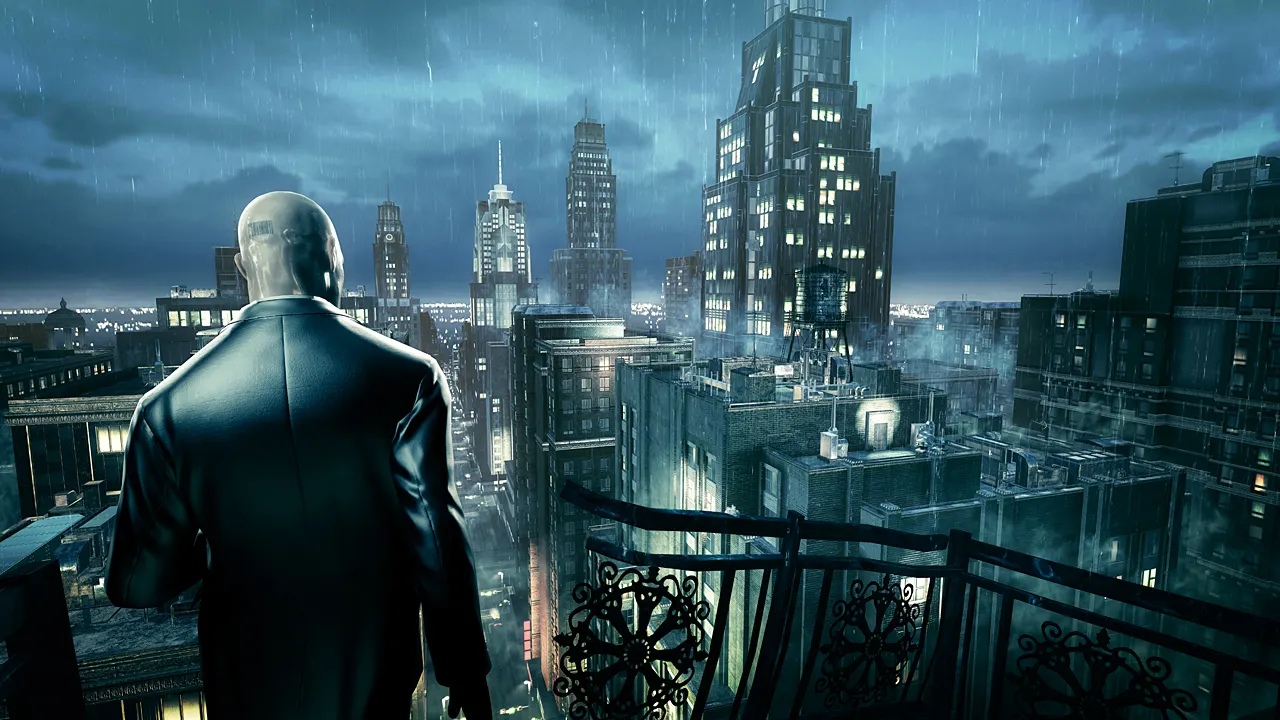
Trigger Point Shooting, slip into bullet time, tag every enemy in the room one by one, then chain the headshots in a single fluid breath — the gunfire, the brass on the floor, the slowed exhale all get mixed into something like a violent ballet held in slow motion. That treatment pushes the grindhouse aesthetic, bloody and faintly romantic, out of the picture and into your ears. Layer that over the soundscape of the streets — the roar of Chinatown's square, the bar noise under buzzing neon, rain ticking on metal, distant sirens bleeding through walls — and the whole audio mix bends in service of that one noir film. On that count, whatever you make of the score, IO did the work.
What ties it together is how rarely the music overplays its hand. Long stretches of a level run almost silent, just ambience and the scuff of your own footsteps, so that when the orchestra finally swells under a kill or a chase it actually means something. That restraint is the most cinematic instinct in the whole sound design, and it's the clearest sign that dropping Kyd's wall-to-wall electronica was a deliberate aesthetic choice rather than a downgrade — you can disagree with the call, but you can hear the intent behind it.
Visuals | 9.0/10
Graphics: 9/10Glacier 2's debut was, in 2012, genuinely front-of-the-pack
Absolution is the first outing for IO's in-house Glacier 2 engine, and it does not waste the chance.
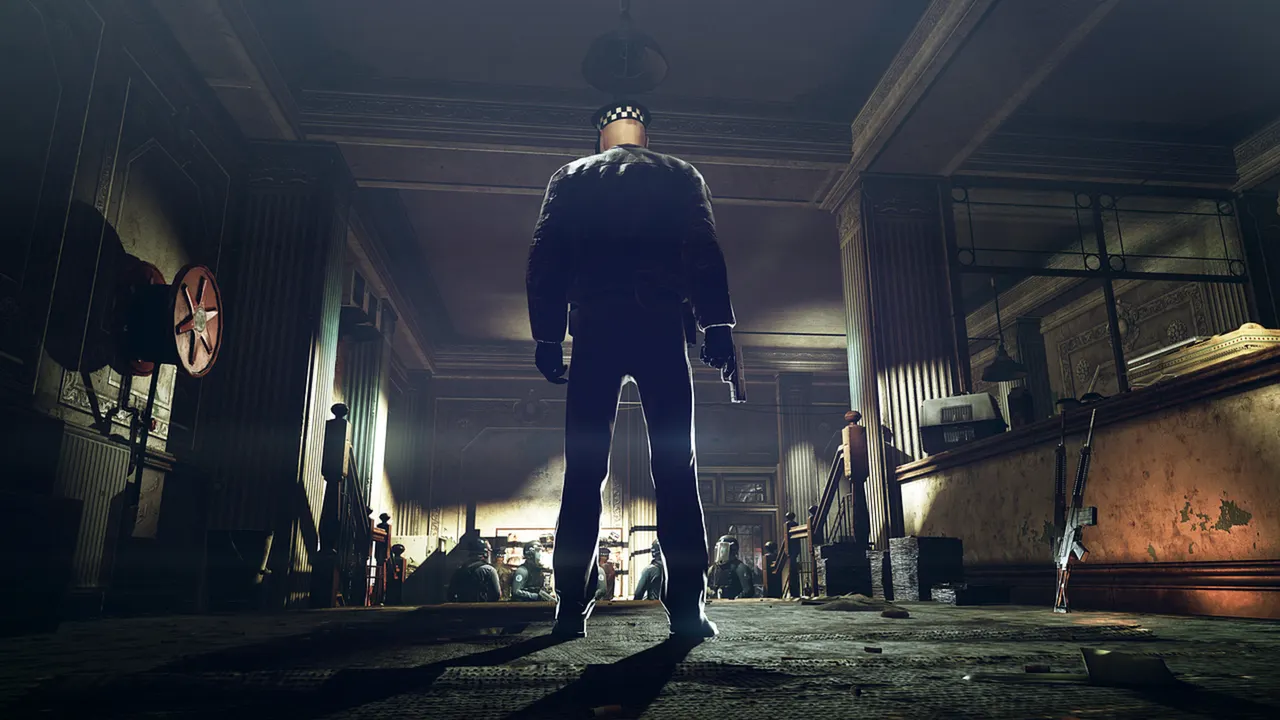
Drop it back into 2012 and the lighting, the cloth physics, the smoke particles all stand near the front of the line. Rain catches the neon, 47's suit creases and sways as he moves, the haze in a bar curls around your steps, sweat sheens on a face caught in the wrong light. None of it is showing off for its own sake; every effect is pulling toward the same grimy, lived-in feel. Those details stack into a real, tangible texture rather than a checklist of effects.
The PC version even shipped its own GPU benchmark — a Crysis-grade stress test for the day — and simply running it maxed and locked at a stable frame rate was a bragging right back when high-end cards buckled under it. That foundation, the sheer competence of the rendering, is why graphics is the highest-scoring column in this whole review, and why the game still photographs well more than a decade later.
That hundreds-strong parade in Chinatown is its costliest single frame
If you wanted one scene to prove what Glacier 2 could do, it would be Hunter and Hunted.
In Chinatown's New Year parade the game renders hundreds of NPCs at once, a crowd that genuinely jostles and flows and reacts to you, so 47 can plunge into the throng to shake his pursuers. That crowd density was a textbook flex in 2012 — keeping that many actors alive at once, each with its own behavior and collision, was a brutal load on the hardware of the day.
This is the level where hiding in a crowd, the thing the series had always reached for, finally became visually convincing. The sensation of being swallowed by bodies and still maybe getting spotted at any second is a kind of presence very few games of the era could deliver, and it remains the single most impressive thing the engine puts on screen.
It doesn't chase photorealism; it wears a grindhouse stink nobody else does
Technology alone isn't really the point, and it never was. What makes Absolution genuinely hard to copy on the visual front, even today, is its art direction rather than its raw horsepower.

It doesn't reach for the cold realism some big games of the year prized; it dives headfirst into grindhouse exploitation cinema — filthy motels, cheap flickering neon, the sick white of fluorescent tubes, Chicago blocks gone soggy in the rain. That deliberately grubby, deliberately lurid look gives it a face you'd pick out of a lineup of its peers. Set it beside Dishonored, released the very same year, and the contrast snaps cleanly into focus: Dishonored takes the painterly, stylized road, Absolution takes the realist-cinema one — opposite directions entirely, and each one nailing its own distinct kind of visual identity. The technical edge got caught by time long ago, the way all technical edges do, but that exploitation-film attitude hasn't aged a day, and that confident, dirty sense of style is the part of the presentation that flatly refuses to go stale.
It helps that the art direction is doing real work beyond mood, too. Levels are legible at a glance — sightlines, guard positions, the route a disguise can carry you down all read clearly out of the visual clutter, which matters enormously in a stealth game where misjudging a single line of sight gets you caught. The interface stays mostly out of the way, the on-screen prompts are clean, and the whole thing holds up better on a modern display than its release year would suggest. That combination of a strong look and a readable one is rarer than it sounds.
Combat | 8.5/10
Gameplay: 8.5/10Instinct rolls vision, disguise, and headshots into one meter
The biggest new thing Absolution bolts onto the old series is Instinct, and it nearly redefines how you think inside every level.

Instinct is really three tools sharing one bar. Press it and you see through walls — enemy positions, their patrol routes — and plan around them like you've turned on x-ray vision. Wear a disguise and draw a wary look from someone in the same uniform, and you can spend the bar to raise a hand over your face and bluff past. Fill it and you trigger Point Shooting, tagging every enemy in a room during bullet time before chaining the headshots clean. The clever part is the unification: scouting, sneaking, and going loud all draw from the same well, forcing you to manage and ration it — spend it scouting, or hoard it for one decisive sweep. It hands a long-running series a genuinely new layer of strategy.
The "same-uniform spots you instantly" rule is the most hated design in the game
But the reason Instinct is forever draining traces back to a single choice that had veterans cursing: the disguise system.
In the older games a guard's uniform basically made you invisible; you could stroll past sentries in plain sight. In Absolution the rule flips to "same-profession NPCs see through you fast" — wear a guard's outfit and other guards lock onto you first, draining your bar as you keep raising a hand to hide your face. The intent was to make disguise a tense, ongoing resource. The lived experience is absurd: why would a coworker spot a man in the same uniform, head down, faster than a stranger would? The logic is so broken that the 2016 trilogy quietly rewrote it so only specific "enforcer" NPCs can pierce a given disguise — a public admission that this step went sideways.
A broken save system strangles the trial-and-error that stealth lives on
If the disguise system makes you wince, the checkpoint system makes you want to throw the controller.

The core joy of Hitman is meant to be patient trial and error — building toward a perfect kill, failing, trying a new angle, failing again until it clicks. Absolution's save logic turns that loop into punishment.
Checkpoints are scarce to begin with, and worse, restarting from a mid-mission checkpoint doesn't actually keep your progress: enemies respawn, the traps you painstakingly set reset, the bodies you hid reappear, and you're effectively tossed back to a default state. So most players simply stop experimenting and inch along the safest, least-likely-to-fail route they can find. The bravery that makes stealth worth playing gets strangled by the save system — and this, more than the disguises, is the single most concentrated target of the game's bad reviews.
Park the gripes and the per-level feel is the series' best
Set all that aside and there's a fact the anger keeps burying: level for level, the moment-to-moment stealth here is the smoothest, most satisfying the series has ever produced.
A classic open kill like The King of Chinatown hands you a small, carefully built sandbox with a pile of solutions — poison the target's food, drop a chandelier on his head, rig an "accidental" electrocution, each one clean. Pair that with five difficulty tiers from Easy up to Purist and the series' trademark Silent Assassin grade, and it pushes you to replay a level chasing a no-witness, surgical run. Set it beside Blood Money's open sandbox and beside Dishonored's many-solution design from the same window: Absolution loses on levels chopped too small and freedom locked down by structure, but it wins on the feel and precision of a single sneak. Its problem was never "not fun" — it was good stuff packed into the wrong box.
It's worth saying how cleanly that good stuff actually plays. Moving through a crowd, lifting a disguise off a body and stashing it, reading a guard's patrol against the clock, choosing between a silenced shot and a staged accident — the verbs feel tight and responsive in a way the earlier games, for all their freedom, never quite nailed. The animation work sells it: 47 snaps targets' necks, slips a wire around a throat, drops a body behind a counter with a weight and follow-through that make each interaction read instantly. If Absolution had paired this moment-to-moment polish with Blood Money's open structure, it would simply be the best Hitman ever made. The tragedy of it is that the two halves never got to be in the same game at the same time — and you can feel that missed alignment in every level that's smooth to play but cramped to plan.
Content | 7.5/10
Content: 7.5/10Twenty-odd chapters and a dozen-plus hours make it a long one for the series
On main-story bulk alone, Absolution is on the heftier end of Hitman.

Roughly twenty chapters; a main route that lands around thirteen hours by HLTB's median, and longer still if you creep slowly and comb every corner for a Silent Assassin run. That length sits high for the series.
But honestly, a good chunk of the "long" is padded out by the forced pacing of linear levels and a heap of cutscenes. The time you spend watching story unfold, ducking pursuers, and escaping buildings isn't all the kind of playing you came to Hitman for. The number on the box looks generous; the density behind it isn't even, and the slice of those hours that's genuinely about planning an assassination has to be heavily discounted against the runtime. A long game and a long Hitman game turn out to be two different things, and Absolution is far more the former than the latter.
What carries the long tail is Contracts handing the kill-box back to players
If the main story is a one-and-done, Contracts is where the game actually hooks you in — and it's the most underrated thing here.
The logic is simple and ahead of its time: pick a stretch of a story level, choose one to three NPCs as your targets, set the rules — which weapon, disguise or not, hide the bodies or not — and the game publishes your custom contract alongside your score for the whole world to challenge and beat. That hands the series' core open-sandbox assassination back from the level designer to the player; you stop accepting someone else's targets and start directing, setting your own puzzle. Wire that to Silent Assassin grading and a leaderboard and, just for the score chase, hardcore players can sink dozens of hours into one map.
Half the levels have no target at all, and that's its biggest structural fight
Contracts shines, but back in the campaign the level structure is split down the middle.
The levels come in two flavors. One is the classic open kill — The King of Chinatown, the mine library — targets given, tools given, go play. The other is pure stealth-escape with no target to kill at all: dodge the cops swarming a building, cross the open strawberry field unseen, slip out of the police station before they lock it down. That alternation of kill-level and escape-level is the sharpest structural break from the older games, and it's why so many feel it isn't Hitman: for nearly half your time you aren't designing a murder, you're playing 47 in a chase movie. Tally full completion and a Purist clear and HLTB lands around thirty-eight hours, and the Contracts grind stretches further still — the raw volume is there. It's the "Hitman content per hour" that's distributed unevenly. Commercially it worked too, whatever the purists felt: a million copies sold in the first week, more than 3.6 million all told by early the next year, even as Square Enix said publicly that the number still fell short of their internal hopes for the brand.
There's also a scoring layer that quietly extends the whole package. Every level grades you on how you did it — kills, witnesses, bodies hidden, disguises burned — topping out at the series' famous Silent Assassin rank, and the five difficulty tiers run all the way up to Purist, which strips out the HUD, the Instinct meter, and every prompt. For the kind of player who treats a level as a problem to be solved perfectly rather than a story to be watched once, that grading loop plus Contracts is where the real hours live. It's the part of the content that ages best, precisely because it has nothing to do with the divisive narrative.





Comments 0
Share your game review
Join the discussion and share your review of this game.
No comments yet. Share your thoughts on this review.