


























Opening
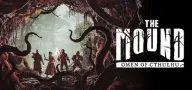
Imagine the SCP Foundation never let you run. Instead it handed you a lanyard and a desk and told you to manage the monsters. That is the joke at the heart of Lobotomy Corporation, and it is not really a joke at all: you are not the hero here, you are middle management. Clock in, draw up the shift roster, send your people into the containment cells to "work" with things that should not exist, and pray nobody gets their body stolen, nobody flips the whole floor into a red-alert massacre, and the day's energy quota somehow gets filled on the way out.

This is the debut from Korean studio Project Moon, crowdfunded in 2016, released in full in 2018, and past a million copies sold by early 2023. It stitches monster containment, corporate spreadsheet logic, psychological horror and a roguelite restart loop into a single garment, and the seams hold. Nearly 50,000 Steam reviews sit at 94% positive, written by players it tormented into starting a third run anyway. What follows is an attempt to explain exactly why it earns that love and that resentment in equal measure.
Story | 9.5/10
Story: 9.5/10The real horror writing lives in the case files, not the cutscenes
Most management games bolt a story on top. Lobotomy Corporation does the opposite: it shreds its narrative and buries the pieces inside the monsters themselves. Crack open an Abnormality and you unlock more than its breach odds and a handling manual — you get a cold, restrained little fable about what the thing is and where it came from.
Take One Sin and Hundreds of Good Deeds, the only one you can touch on day one. On the surface it is a docile creature that hands back a few points of sanity. Read its file to the bottom and it turns into a parable about guilt and self-punishment. The mechanics and the meaning are the same object, and you cannot pry them apart.

Climb to an ALEPH like WhiteNight and the darkness stops whispering and starts shouting. It is the second form of the Plague Doctor; it converts your blessed employees into Apostles; and the moment it breaches you cannot even hit pause. You sit there and watch a floor of your facility become a religious sacrifice in real time, hands tied. The story does not pause for you because the story is the breach.
The payoff is that every new creature dangles a hook. You want stronger E.G.O gear, so you have to handle nastier monsters, and to handle them you have to read them, learn their temper, sit with their dread. You are never passively watching a movie. You are actively assembling, one classified report at a time, an answer to the question of what this company is and why anyone built it.
That is also why the story sinks its hooks so deep: it twists two completely different appetites — "what is this next creature's story" and "how do I get stronger gear" — into a single rope. In most games, plot and stats run as parallel lines; you push through encounters for the rush and glance at the lore on the side. Lobotomy Corporation welds the two together. The greedier you get, the stronger you want to be, the further you have to wade into the most dangerous and most storied Abnormalities. Reading the fiction stops being a reward and becomes the road to power itself, and that fusion of narrative drive and mechanical drive is the single hardest thing here for an imitator to lift.
Angela's golden eyes turn "die and retry" into a payoff
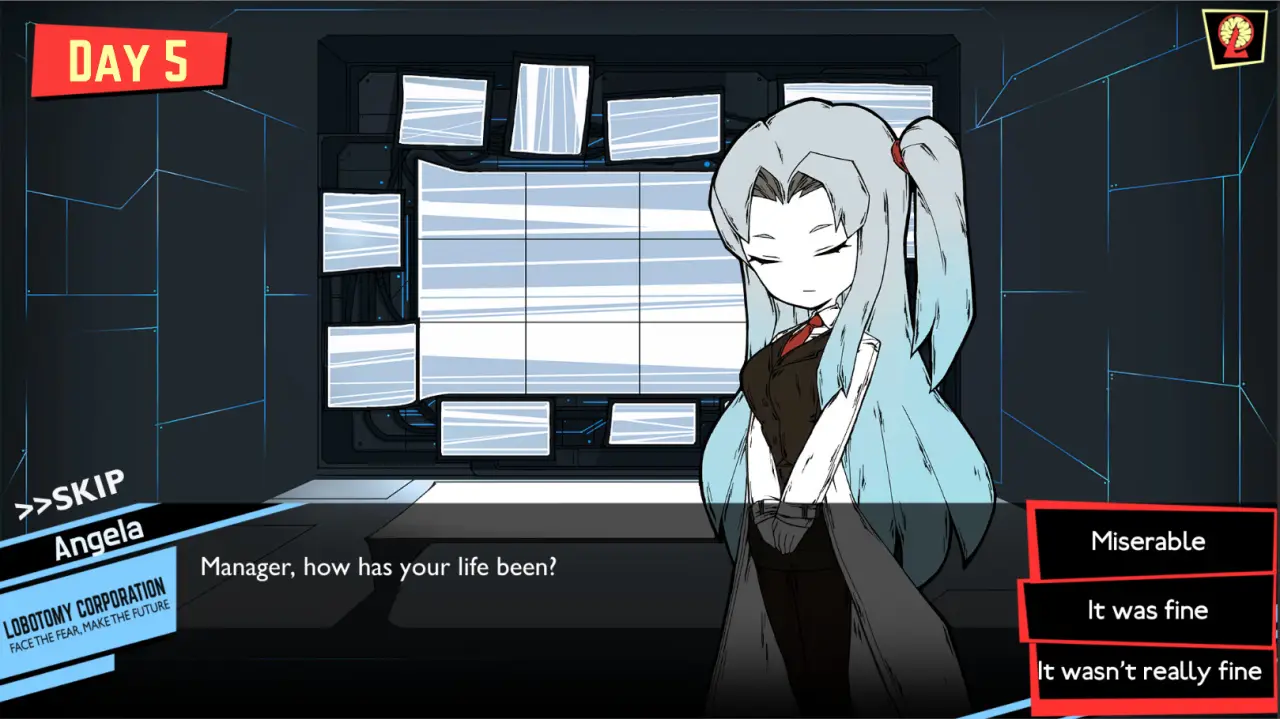
Threading the whole thing is Angela, the AI assistant whose name comes from the Greek for "messenger." She narrates in a voice so calm it curdles, and that calm sits in deliberate contrast with a facility that is constantly screaming, alarming, detonating. The more you flail, the more serene she sounds, and the temperature gap alone is enough to raise the hair on your neck.

Here is the move that makes it special, though. The roguelite "die and retry" is written into the plot. You assume resetting a day, restarting a cycle, is just a system. Push deep enough and you realise those restarts are wired straight into Manager X's memory and the company's reason for existing. Failure is not a punishment to be endured; failure is narration. Every restart drags you one notch closer to the truth.
By the true ending, Angela opens her eyes for the first time — bright gold, hair let down — and reveals that an electronic brain modelled on Carmen's is the source of her feelings. It lands as a high point for nearly everyone who reaches it, and crucially it is not handed to you in a glossy cutscene. You earned it across dozens of hours and several failed runs.
A talking Tree of Life, where each department is a person
Every department head is a Sephirah, mapped onto the ten nodes of the Kabbalah Tree of Life, and the whole facility is laid out along that tree. This is not set dressing. Information classifies and files your Abnormalities; Discipline, Safety and Training each run their own domain; and unlocking a department drags its head's personal arc into the light with it.

Line it up against its most direct rival, 2018's Frostpunk, and the ambition snaps into focus. Frostpunk's moral choices genuinely bite, but the citizens you freeze and the coal you burn carry no story of their own. Lobotomy Corporation inverts that: even a minor creature's breach mechanic is sitting on a parable. The same studio's later Library of Ruina and Limbus Company hold up an entire shared "City" because the foundation was poured right here — this is chapter one, and it is the chapter that welds plot to play most tightly.
Audio | 7.5/10
Audio: 7.5/10How a student team's royalty-free playlist props up the dread
Let me get the awkward part out first. The soundtrack leans heavily on royalty-free tracks. The reason is plain — Project Moon was essentially a student team during development, with neither the budget nor the bandwidth to commission a bespoke original score. If you came expecting a soundtrack that earns its keep on first listen, that is not what is on offer here.

And yet this unglamorous music serves the tone it wants with unnerving precision. During low-risk stretches the backdrop is a clipped, mechanical, office-white-noise loop, perfectly evoking a dull morning at a real company. It does not grandstand. It just makes "you are at work" feel solid, which makes the loss of control that follows hit so much harder. That restraint is the whole trick: it refuses to telegraph drama early, so when the drama finally arrives it has somewhere to climb from. You stop noticing the music exactly when the game wants you complacent, and that complacency is precisely what it later weaponises against you.
It is worth noting how tightly the score hugs that "going to work" theme. The repetitive, cold loop of the daily grind, heard long enough, can produce a genuine sort of office burnout — which is exactly the feeling the game is reaching for. You are not living a hero's tale; you are clocking in, day after day, at a monstrous corporation. As the late game piles on more high-danger Abnormalities and hitting quota on time gets harder, the "produce or something breaks" anxiety humming under the track conveys the pressure more directly than any line of dialogue could.
When the red alert lands and the floor falls apart
As you contain more high-danger Abnormalities at once and a department's core suppression looms, the bed of sound ratchets up layer by layer. It is not simply louder; the whole sonic field rises with the facility's danger level, like a string slowly tuned past comfort.

When an ALEPH actually breaches, the floor goes red, and your employees start to scream and panic, the music, the effects and the visuals together shove that "I have completely lost the room" suffocation up to its peak. WhiteNight is the cruellest case: it locks out pause and speed entirely, so the audio becomes the only thing keeping you company, and the trapped feeling rides entirely on sound. There is nowhere to look away to and nothing to mute the panic, so your ears do the work your eyes cannot. By the time the alarm has finished ramping, the soundscape has done more to convey "this is out of your hands" than any animation on screen.
Punching above its production budget on purpose
So the verdict on audio is a strange one to write. As a production, it is nowhere near top-tier; the source of the music and the thinness of the effect layers both show the ceiling on the money spent. There is no shame admitting that.
Judged on whether the sound serves the emotion this game wants to deliver, though, it is genuinely clever. Stacked against the same year's better-funded management sims, it cannot win on production values, but it wins on restraint — it knows exactly when to shut up and when to press down on your chest until you flinch. Plenty of richer scores would have over-played the early hours and left themselves no headroom for the breaches. This one hoards its intensity like a budget it cannot afford to waste, and spends it only when the floor is already on fire.
Visuals | 6.5/10
Graphics: 6.5/10A cutaway grid of cells that draws the word "corporation" into the frame
Lobotomy Corporation plays out in a 2D side-on view, the whole facility presented like a cross-sectioned ant farm: a grid of containment cells, runs of corridor, banks of elevators, your employees scuttling between them like little office workers. This cutaway layout is not just the cheap option. It serves the core experience directly — you can watch the state of several Abnormalities at once and tell at a glance which cell is about to go wrong.

The interface speaks a cold, minimal, cyber-corporate dialect: slabs of grey-black, tidy data panels, blinking danger-tier badges, the back-office of a company that really does count human lives as KPIs. That visual language has a high recognition factor. It does not win on texture resolution; it wins by holding one consistent, restrained aesthetic until "indifferent megacorp" simply radiates off the screen. Every readout looks like something a soulless HR department would actually ship, and that deadpan consistency is what sells the dread before a single monster appears.
The Abnormalities are the art direction
What actually lodges in memory is the creature design. The warped silhouette of Nothing There, the holy-yet-horrible shape of WhiteNight — each Abnormality's look is fused tightly to its mechanic and its story, and together they form this game's strongest visual hooks.

That fusion matters more than fidelity. You will not remember a normal-mapped wall here, because there are barely any. You will remember the exact moment a creature you had only read about in a file finally showed itself on screen, and the design told you, before the mechanics did, that you were in trouble. A great horror design does half the explaining on its own, and these do exactly that: the shape warns you what the rules are about to confirm. The art budget went into silhouette and intent rather than surface detail, and for a game this much about reading a room, that is the correct trade.
It is worth dwelling on, because plenty of horror games divorce a monster's look from its mechanics — it looks frightening, but it fights like every other enemy. Lobotomy Corporation does the reverse: an Abnormality's silhouette is practically its manual. Look at WhiteNight's holy, oppressive form and, file unread, you can already half-guess it is not something you want to provoke. That "threat legible at a glance" visual grammar makes the plain 2D art more effective than a pile of high-resolution textures would be. It spent its limited budget entirely on outline and aura, and for a game that is fundamentally about reading a room full of monsters, that is money well spent.
The plain foundation buckles late, when the leaks pile up
Plainly, the technical base is modest. It runs on Unity, the art spec was unremarkable even by 2018 standards, and it never set out to compete with the big-budget lookers of its day. Judge it as a system-heavy, mood-heavy indie and that is fair.

But modest is not the same as clean. The most concrete fault is that across the later in-game days, as more Abnormalities, employees and effects run at once, optimisation visibly degrades and memory leaks accumulate. At its worst the frame rate craters badly enough to break your inputs, and can force you to restart an entire hard-won day — brutal in a game that is already long and already punishing. One stopgap is to avoid cramming too many high-danger creatures onto a single floor to keep simultaneous effects down, which eases late slowdown, but that is trading away play freedom for stability rather than fixing anything. The look earns a thumbs-up; the technical execution scrapes a pass.
Combat | 9.0/10
Gameplay: 9/10Sending people to "work" with monsters: the four-verb core loop
The underlying loop is startlingly plain. You order an employee into a cell and have them perform one of four kinds of work on an Abnormality — Instinct, Insight, Attachment, Repression. Each attempt rolls a result on a Bad / Normal / Good / Great scale; the better the work, the more Enkephalin energy spills out, and the closer you edge toward the day's quota.

It sounds like a click-and-wait idle game until you notice the devil is in the pairing. Every Abnormality favours certain work types and demands certain employee stats; pick the wrong verb or send the wrong person and, at best, sanity drains away, at worst the thing breaches outright. So the daily roster becomes a genuine puzzle: given this batch of unevenly skilled employees, how do you deal them out across these temperamental monsters and still hit quota without a body count.
Its smartest stroke is roping risk and reward onto a single line. Stronger employees demand you handle more dangerous Abnormalities; the deeper you go, the stronger the E.G.O gear you can extract, but the steeper the price of a wipe. The whole loop becomes addictive inside that "press my luck or play it safe" tug.
The feedback on a work result is quietly a teaching tool, too. Day one's One Sin and Hundreds of Good Deeds is a gentle tutor: land a Good result and it hands back four points of sanity, so without anyone spelling it out, you learn the most basic survival chain — pick the right work type, earn the good result, keep your people's minds intact. The game does not bury you in a tutorial wall. It lets you pry the rules loose yourself, one creature at a time, and that "learn by handling" design is exactly why a game so off-putting up front keeps tightening its grip on anyone who sticks around.
The Qliphoth Counter and five danger tiers tighten the screw
What makes the management genuinely tense is the Qliphoth Counter. Most Abnormalities carry one; the lower it drops, the closer the creature is to escaping, and zero means it is loose. The slyest example is Punishing Bird: every time you set an employee to work on a different Abnormality, its counter has a 20% chance to tick down one, and any time an employee panics, it ticks again. You manage everyone else with one eye permanently on it.

Creatures sort into five danger tiers — ZAYIN, TETH, HE, WAW, ALEPH — nastier as you climb. At the ALEPH ceiling sits something like Nothing There, which steals an employee's body on a bad result and must be put down in a dedicated disposal mode or it is game over. Your people grow along four stats — Fortitude, Prudence, Temperance, Justice, graded I through V — governing health, sanity, work success and combat speed in turn. Veterans all know the open secret: stats are the cheap currency, accruing on their own so long as people keep working, while E.G.O gear is what actually decides a fight. The smart play is never "max every stat," it is "land the key piece of equipment first."
Inhumanly hard, then suddenly fluent: trial, error, suppression
Honestly: the on-ramp is steep to the point of cruelty. The game wants you to begin with near-zero knowledge, and many creatures' real mechanics are things you learn only by watching employees die one by one. The first few cycles are almost pure trial and error — fail, lose, review, retry — and that flavour runs the whole way through. Impatient players and anyone allergic to setbacks will bounce hard.

Each department's core suppression flips the game briefly into a light RTS: Abnormalities breach en masse, hostiles spill across the facility, and you direct your whole staff to fight, suppress or destroy them. Each trial targets a different skill, forcing you to spend stats, gear and raw execution all at once. Set side by side, Frostpunk tests macro decisions, Oxygen Not Included tests systems planning, Darkest Dungeon tests your nerve inside a sanity spiral — Lobotomy Corporation kneads all three pressures together, which is why it is harder and stranger than any of them. But "hard" is only the first half of the sentence. Once you have a creature's temper memorised and your people and gear dialled in, a day that used to be chaos runs like clockwork in your hands, and that climb from cluelessness to total command is the most addictive reward it offers.
Content | 8.5/10
Content: 8.5/10Fifty days of quotas, and a "clear" that is sneakier than it looks
The body of the game is a 50-day energy-quota gauntlet. Each day settles into a near-fixed rhythm: read the current department's energy shortfall, pick the right Abnormalities, assign employees with the right stats to work them, bank enough Enkephalin to clear the bar, weather whatever breaches or core suppressions interrupt you, and roll into the next day as the company — its cell count, its hireable staff — expands around you. Fifty discrete days sounds tidy on paper, but no two of them play the same, because the roster of creatures you are juggling keeps shifting as you contain more of them.

Fifty days does not sound long, yet the game all but guarantees you will not clear it in a single run. The reason is blunt: the final two departments set minimum suppression thresholds so absurd — Gebura, the Discipline head players call "the red one," chief among them — that virtually nobody beats her core suppression on a first playthrough. That is not a bug, it is design. The community long ago settled on this being a "three runs minimum" game, and treats a first-run failure less as a defeat than as an enrollment.
The replay loop is the content, not a side dish
So you cannot measure its content by one main path's length. The real volume hides in the replays: every restart, you set out again carrying last run's creature knowledge, the traps you already sprang, the plans you sharpened, and you close on the final truth. The route is not a straight line. It is a spiral tightening in on itself.
That structure is a double-edged sword, and you should know which edge you are gripping. The good edge: replay actually means something. You are not re-grinding the same level, you are bringing a sharper read to a harder problem, each run inching toward the "full containment, zero casualties" ideal. The painful edge: it asks a great deal of your time and patience. You have to accept that the first run is, in all likelihood, tuition paid in dead employees, and you have to swallow a lot of early failure and restarting. If you are the kind of player who wants to clear a game once and never replay it, the single line "the community assumes three runs" may be enough to send you elsewhere.
This is also where the long tail comes from. Dozens of Abnormalities, each with its own mechanic and its own fable, plus the steadily unlocking manuals, add up to a "book of dark parables" you have to keep diving back in to finish — and that compulsion is the engine that powers your multiple runs. How many times you are willing to restart to finally understand one creature is, in effect, how many hours the game returns to you.
A buy-once codex with no paywalls, and a saga's first chapter
Worth a line of its own: the generosity. This is a buy-once title with no paid DLC; one payment buys the whole thing. In an era of season passes and microtransactions, that alone is rare. Project Moon even went back and entirely re-did the early English translation that the British outlet RPS once branded "awful," and existing owners got it for free.
Its second source of staying power is its position as chapter one of the "City." Play it through and you actually understand what Library of Ruina and Limbus Company are later talking about; the whole series grows out of this soil. Measured by hours-per-dollar, the density is high — a self-consistent system, a monster codex you cannot finish, and the origin point of a sprawling world, all inside a single buy-once box. The "content I generate for myself" tail is precisely the kind no amount of stacked DLC can buy, because the hours come from your own curiosity rather than a publisher's release calendar. You are not waiting for more to be added; you are mining what is already there, and it runs deeper than its install size suggests.






Comments 0
Share your game review
Join the discussion and share your review of this game.
No comments yet. Share your thoughts on this review.