
























Opening
Glance at your wristwatch, watch the dial tick down one notch at a time, and you finally understand what Metro 2033 Redux is really asking of you. This is not a game about standing your ground and trading firepower. It is a game about the clock — about jogging across a poisoned Moscow surface while you do the math on how many seconds of clean air you have left, praying that whatever waits behind the next slab of rubble has not heard you coming. When your breathing turns ragged inside the mask and frost begins to creep in at the edges of your vision, the panic that grips you is the one thing no other studio has managed to copy.
This was 4A Games' debut, the seed of an entire franchise, and an adaptation of Dmitry Glukhovsky's novel of the same name. It takes a Moscow driven underground by nuclear war and renders it, faithfully and claustrophobically, through a first-person lens. The 2014 Redux took the more mature engine from the sequel, Metro: Last Light, and turned it backwards onto the 2010 original — relighting it, remodelling it, re-animating it, rebuilding its enemy behaviour from the ground up. Thirteen outlets on OpenCritic landed it at 85 and a Mighty tier, while 91 percent of Steam players echo that verdict almost exactly.
Its strength was never scale. It was concentration. Across six dimensions — story, audio, visuals, mechanics, content, and the final verdict — this review explains why a strictly linear game you can finish in an afternoon has, in all the years since, never had its particular brand of dread fully reproduced.
Story | 8.5/10
Story: 8.5/10The smartest thing Metro 2033 Redux does with its story is refuse to hand it to you. It makes you earn the world one station at a time.
A novel grown into a tunnel system
The game adapts Dmitry Glukhovsky's cult sci-fi novel, itself a phenomenon that began as a Russian web serial before becoming a print bestseller. The premise is precise and unforgiving. Nuclear war has turned the surface of Moscow into an unbreathable wasteland, the survivors have retreated into the metro, and over the years each station has hardened into its own little nation-state: the ideologically frozen Red Line, the extremist Fourth Reich, the trade-driven Hanza alliance. You play Artyom, a young man raised at VDNKh station, and the story starts small — his home is threatened by a mysterious presence called the Dark Ones, and he has to leave the only place he knows to find help.

You are not the chosen one here. You are an ordinary person swept into something larger, forced to keep walking forward, and that modest framing is precisely what makes the whole journey feel earned rather than scripted. The story never inflates Artyom into a savior; it just keeps him moving, one dangerous platform to the next, and lets the weight of the world accumulate around him.
Told by the walls, not the cutscenes
If anything keeps this narrative fresh after all these years, it is the density of its environmental storytelling. Cutscenes are rare. Instead the game buries its information inside the scenery itself: the overheard chatter of survivors in a corner, the graffiti scrawled across a wall, a letter left in an abandoned room, a voice crackling out of a broken radio. Stop and look, and the world opens up to you. Hurry past, and it lets you go without complaint.
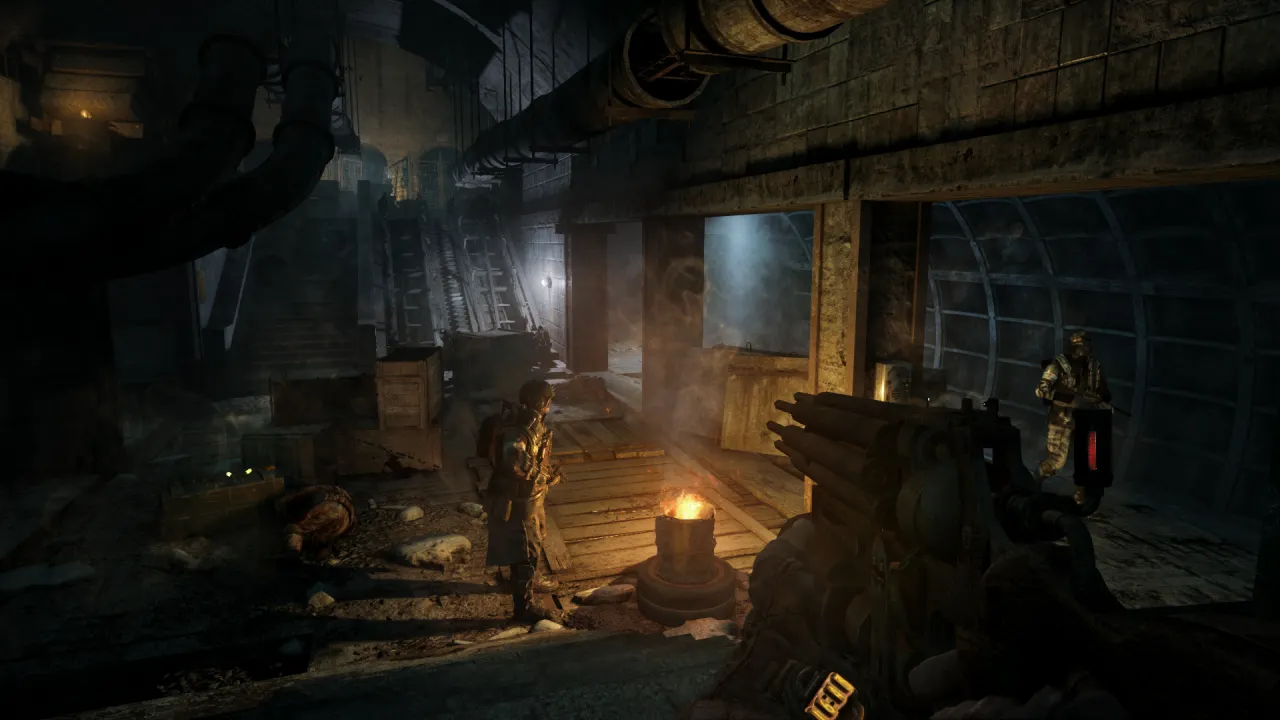
A discarded child's drawing, a corpse still frozen in a posture of escape, a missing-person notice pinned to a beam — none of it needs a single line of explanation, yet each fragment lets you reconstruct an entire family's fate in the apocalypse. The game trusts you to assemble the story yourself rather than spoon-feeding it. Walk from a bright, bustling platform where children are playing into a black tunnel littered with the dead, and the sheer contrast does the narrative work on its own. It says nothing, and somehow says everything. This restraint puts Redux closer to the lineage of Half-Life 2 and BioShock — linear, focused, driven by mood rather than a checklist of quests.
A silent ledger that decides your ending
Underneath all of this runs a morality system that never announces itself. Every choice you make along the way — open fire or slip past unseen, stop to hear an NPC out or stride straight on, lend a hand or look away — quietly accrues in a hidden ledger. No "your choice has been recorded" prompt ever flashes on screen. It simply watches, then in the final moment decides which of two endings you have earned.
Because it gives you no prompt, plenty of players finish their first run with no idea they were ever being measured, only realizing at the very end that their restraint along the way actually meant something. The system never lectures and never interrupts; it just records, then hands the answer back to you. When you see the ending your particular path has produced, you know it was not chosen for you — it was shaped by every small decision you made. That sensation of having your conscience quietly weighed lingers far more than any visible good-or-evil meter ever could, and it is what drags people back for a second run, deliberately playing against their own instincts.
The price of all this is real. Compared with the half-open regions of the later Metro Exodus, 2033 is more enclosed and more confined; the English voice acting carries a heavy Russian accent that some take as immersion and others as a distraction; and a chunk of the lore only surfaces if you slow down to read. But honestly, those flaws are buried under the sheer force of the atmosphere. This is not a story of dazzling plot twists. It is a journey of overwhelming mood — and the way it tells that story remains a benchmark the genre still cannot ignore.
Audio | 8.5/10
Audio: 8.5/10Sound in Metro 2033 Redux is not wallpaper. It is a system you survive by.
In the dark, your ears do the navigating
This is a world with almost no real light sources. The depths of the tunnels are frequently pitch black, your visual information is scarce, and so hearing gets shoved to the front of the experience. The distant shriek and growl of an infected creature warns you of a threat ahead; the broken chatter of a Fourth Reich patrol gives away the enemy's position and numbers; the echo of footsteps on wet ground tells you something is closing in. More often than not, you hear danger before you ever see it, and you learn to trust your ears the way you would trust a flashlight anywhere else.
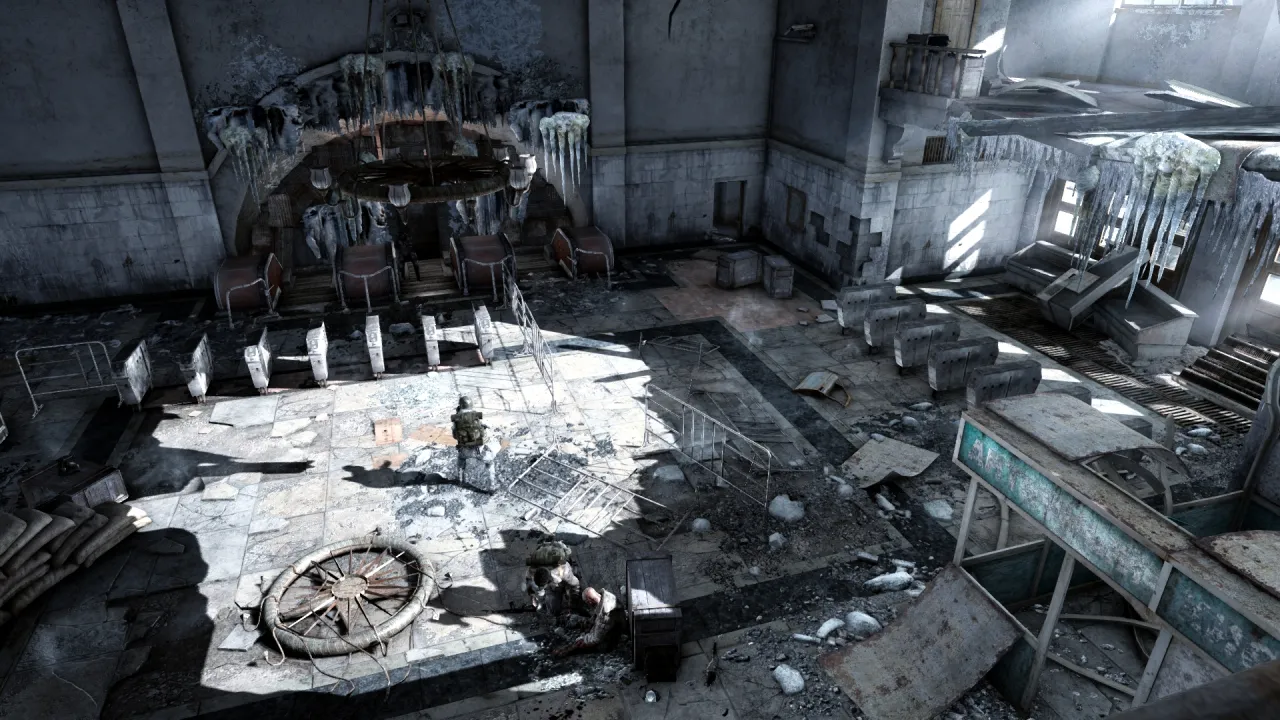
What makes it work is the layering. A drip of water falling into a puddle, the low hum of distant machinery, the rush of air through a ventilation duct, the faint scrape of claws as something moves in the dark — each sound has its own place and distance. Stacked together, they convince you that you are inside a vast, damp, living underground rather than a hollow corridor of level geometry. That spatial depth, built entirely out of audio, is one of the load-bearing pillars of the game's oppressive mood, and few atmosphere-driven games ever push their sound design to this functional a level. You stop walking, you hold your breath, and you tilt your head just to work out which direction a noise came from — and in that pause the game has already done its job, because it has made you afraid of a sound rather than a monster on screen.
The breath behind the mask
The single finest stroke is the first-person physicality the gas mask brings. Pull the mask on and step onto the surface, and your own heavy breathing immediately floods your ears. The filter ticks down on your watch, demanding a replacement every so often. Take a hit and crack the mask, and the breathing turns frantic and leaky while frost climbs in at the edge of your sight — that choking, I-might-not-make-it sensation is hammered into you almost entirely through sound rather than any number on a HUD.

This matters because it translates the abstract idea of "survival" into a language your ears understand directly. You never need to check a value; you just listen to whether your breathing has quickened and how dense the filter's ticking has become, and you instinctively know how much trouble you are in. The two play modes shade this differently — the survival-focused mode is quieter and more suffocating, long stretches filled only with your steps and your breath, while the faster mode is busier and louder, with more open exchanges of fire. When the game reached the Nintendo Switch in 2020, this breath-and-heartbeat audio design carried over remarkably intact, and with a pair of headphones a handheld player feels every ounce of that pressure on the chest.
Visuals | 9.0/10
Graphics: 9/10The Redux's most immediate value lives in how it looks — and this was never a simple resolution bump. It was a teardown and a rebuild.
The sequel's engine, aimed backwards at the original
The core idea behind this remaster is genuinely unusual. Rather than patch up the aging tech of the 2010 original, 4A Games dragged in the 4A Engine from 2013's Metro: Last Light and used it to rebuild the first game wholesale. What got remade was not only texture fidelity but entirely new meshes, a fresh lighting model, reworked character animation, and even revised enemy AI behaviour. For anyone who only ever played the original, the Redux is close to meeting the game again for the first time. The coarse, stiff, hardware-hungry feel of 2010 is gone, replaced by the ceiling of what 4A could technically muster at the time.

Most remasters merely stack higher resolution and sharper materials onto existing assets; 4A's approach is closer to constructing the whole thing again in a new engine. That is why the uplift is total — not just clearer, but reflections, the gradation of shadows, the drift of smoke particles, all of it reborn. You can feel that this is a now-mature team turning back to mend its own debut with real care, and the result is one of the rare cases where critics agreed almost unanimously that a remaster was, in their words, remaking done right rather than a cash-in.
The benefit is not purely cosmetic, either. Because the lighting and material work were redone from scratch, spaces that once read as flat boxes now have genuine depth and texture — a tunnel feels carved out of wet rock rather than wallpapered with it, a station feels lived in rather than decorated. That extra fidelity feeds directly back into the tension, because a world you believe is a world that can frighten you. The remaster does not simply make 2033 prettier; it makes it more convincing, and conviction is the whole point of a game built on dread.
Warmer light, a world worth looking at
If you want one place that captures the craft, it is the lighting. The original ran cold and harsh, its contrast sharp to the point of being abrasive. The Redux warms the palette and softens the contrast until certain scenes look, in the words of more than one outlet, completely different — no longer a rigid split of light and dark but a gentler, more natural transition. Surface ruins take on a desolate beauty under the warmer light; the dim amber glow of the underground stations conjures that claustrophobic sense of safety. It is a palette that understands its own subject — cold enough to feel the radiation in the air above, warm enough to make the cramped platforms below feel like the last refuge they are. The contrast between those two registers becomes its own kind of storytelling, telling you when to dread and when to breathe long before any line of dialogue does.
The art identity holds up just as well, and it does so without ever leaning on bright spectacle. The dog-like Watchmen that stalk the surface are almost horrifying to look at, and the faceless Nosalis prowling the narrow tunnels below are grotesque, their silhouettes paired with murky lighting to produce images you do not forget. The horror here is rarely about what you see in full; it is about what the darkness only half-reveals, the shape at the edge of the torchlight that your eye fills in for itself. On the platform side, the Reich's stations carry the symbolism of a dead era, giving each faction a distinct visual personality. As for hardware, the Redux landed on PC, PS4 and Xbox One with 4K-class clarity, and the 2020 Switch port, locked to 720p and 30fps in handheld, still earned a 9 from Nintendo Life as a rare high-quality atmosphere piece on the platform. Within the series, this is the visual ceiling for 2033 specifically — the later Exodus pushed toward open vistas and more advanced lighting tech, but for the narrow art of using light and shadow to build pressure in a confined space, 2033 Redux remains a textbook demonstration, and a large share of that 85 Mighty rating is owed to it.
Combat | 8.0/10
Gameplay: 8/10At heart, Metro 2033 Redux runs on a loop of resource pressure. It makes you pay for every action, and that sense of cost is what holds the whole experience up.
The filter timer as the core loop
The most iconic mechanic is the gas mask and its filters. Step onto the contaminated surface and you must wear the mask, but each filter has a finite life that drains steadily with time. You track what remains by the seconds counting down on your wristwatch, and when that number hits zero, you suffocate. Every stretch of surface travel becomes a race against the clock: you have to push forward while simultaneously scrounging for spare filters scattered along the way, and the slightest delay tips you toward disaster.
The brilliance is that it converts the abstract notion of survival pressure into something concrete and felt — into muscle memory. You never forget how much time you have left, because the figure sits right there on your wrist. Better still, checking the watch is a deliberate act; it pulls your head down and occupies your line of sight, so in a tense moment with a threat bearing down, you are forced to choose between glancing at the clock and keeping your eyes on the danger. That one small interaction stitches resource management and live pressure together seamlessly. You are not coldly reading a value in a menu — you are gripping your own fate in your hand at the worst possible second. This is the hardest thing about 2033 to copy. Plenty of games talk about survival; almost none make the anxiety this personal.
Materiel that doubles as money
The second elegant system is the resource economy. Pre-war military-grade materiel is the most effective resource in the game, but it is also the universal hard currency of the metro — you can trade it to vendors for supplies and gear. That creates a constant dilemma: do you spend this precious unit now to deal with the threat in front of you, or hoard it against a future cost?
Paired with this is the improvised-equipment system. A pneumatic device like the Tikhar launches steel pellets you can craft from everyday scrap rather than relying on scarce factory-made materiel, which makes it a dependable early-game option — at the price of needing to be manually re-pressurized, its output tapering as the pressure drops. Each piece of gear also accepts scavenged or purchased modifications: optics, suppressing parts, extended components, letting you tune a setup to your own approach. The design rewards observation, scavenging and planning rather than grabbing the strongest device and coasting. It turns scarcity from a slogan into a decision you weigh every single minute. In this world nothing is taken for granted; even one unit of materiel, even one filter, has to be reckoned with carefully.
Stealth, confrontation, and Ranger mode
When it comes to actually advancing through a level, 2033 hands you two paths. Light and shadow drive the stealth — kill a bulb, slip into the dark, take down a lone foe quietly up close — and nearly every level built around human opponents offers a route that lets you avoid direct confrontation entirely. You can also choose to engage head-on, but the scarcity of materiel is a constant reminder that recklessness has a price.
If you want to push that pressure to its absolute limit, the game offers Ranger mode. It strips every assistive readout from the interface — health, supply counts, the lot — and dials the stakes up to a brutally realistic level, where a single accurate hit is decisive for you and your opponents alike. It drives the game out of shooter territory and squarely into survival simulation, which is why series devotees call it the only correct way to play. Set against the open-world first-person games of its era, such as Far Cry 3, 2033 makes the opposite bet: instead of a vast playground to roam, it pours all its design energy into one meticulously choreographed linear path, buying density and pressure far beyond its size. It is a road few studios take, and one this game walks all the way through, never once blinking at the discipline its own design demands.
Content | 6.0/10
Content: 6/10On content, Metro 2033 Redux is a game you have to be honest about. Its size is exactly what it is — both its defining trait and its easiest target for criticism.
Five to seven hours with nothing wasted
Start with the hard numbers. According to HowLongToBeat, the main story runs roughly five to seven hours, and even a full 100 percent completionist run lands at around nine. There are no side quests and no optional content; from start to finish it is a single, meticulously choreographed linear path. That journey is strung together from a sequence of chapters — out from Artyom's home station at VDNKh, through abandoned tunnels, exposed surface ruins, and faction-held platforms, all the way to the Ostankino tower. Each chapter rotates its rhythm between stealth infiltration, open confrontation, surface exploration, and pure atmospheric traversal, sidestepping the monotony linear games so often fall into.
The surface segments, where you must wear the mask and watch the filter, stand in sharp relief against the relative safety of the platforms, and that tension alone is enough to hold five or six hours without letting your attention drift. This short-but-dense orientation is, in a sense, a deliberately counter-cultural choice. In an era that loves to pad playtime with mountains of busywork, 2033 runs the other way, packing every minute and refusing to hand you filler traversal or repeated checklist chores. It does not waste your time, because it never intended to — and that restraint is a kind of confidence in itself. There is real craft in knowing when to end. Many games of its scope would have stretched this campaign to twice the length with filler, and almost all of them would have been worse for it. By trusting its own brevity, 2033 keeps every set-piece sharp and every quiet stretch meaningful, so that when the credits roll you feel a journey completed rather than an obligation discharged.
A collection, a replay loop, and the limits of it all
A point worth clearing up: what you buy today as the Redux is usually a bundle, packaging both Metro 2033 and its sequel Metro: Last Light together with all their DLC. So while 2033 alone is a five-or-six-hour affair, the bundle's total content more than doubles that, which makes the package, honestly, quite substantial. For anyone new to the series, it is the ideal entry point — you experience the full evolution from debut to sequel in one go, watching 4A polish the same core mechanics toward maturity, from 2033's survival-leaning, oppressive tone to Last Light's brisker, better-armed cadence. That side-by-side is genuinely interesting; it shows you a studio growing up across two games, and it means even a short 2033 leaves you holding a preserved slice of series history rather than a thin product.
Because there are no side quests and no open exploration, though, 2033's replay value rests almost entirely on three things: switching difficulty, chasing the morality ending, and full collection. Diaries, postcards and other narrative fragments are scattered throughout, and gathering them serves both the 100 percent achievement and the completion of the lore — a "story-as-collectible" design that stands in stark stylistic contrast to the pure number-grinding of contemporary open worlds. But in fairness, content is also the dimension that costs the game the most points. GamerSky, while handing it an 8.1, flatly noted that the level design is merely competent and the hidden extras are somewhat throwaway. If you are used to open worlds that run for dozens of hours, or you want a shooter you can grind on indefinitely, then 2033's compact, strictly linear, side-quest-free structure will indeed feel thin. Its content is not abundant; it is concentrated — and whether that suits your palate basically decides the score you give it. The honest framing is this: you are not buying a game to live inside for a hundred hours, you are buying a single, sustained, perfectly weighted experience that asks for one focused evening and gives all of itself in return. For some players that trade is exactly right; for others it will always feel like too little. Neither reaction is wrong, and the game makes no apology at all for which particular camp it sets out to court.




Comments 0
Share your game review
Join the discussion and share your review of this game.
No comments yet. Share your thoughts on this review.