






















Opening
Most horror games scare you with a face lunging out of the dark. Metro: Last Light Redux scares you with a clock that will not stop ticking. The moment Artyom climbs out of the tunnels, straps on a gas mask and steps into the poisoned air above Moscow, a filter timer starts bleeding down in the corner of your vision. His breathing thickens. The glass fogs. You are not racing an enemy here — you are racing your own lungs.

That is the ace 4A Games pulls after cramming an entire civilisation into the subway: it never wins by volume. It wins by making suffocation feel real, turning wasteland survival into something you can almost choke on. This 2014 remaster unifies both games, folds in every scrap of DLC and runs at 60fps. Veterans will find the upgrade thin, but for anyone new it is the cleanest, most complete door into this Russian apocalypse. Below, we take story, sound, visuals, gameplay and content apart one piece at a time.
Story | 7.0/10
Story: 7/10The hunt that becomes a question about forgiveness
The story picks up a year after Metro 2033, in 2034. At the close of the last game Artyom called down the strike himself and wiped out the Dark Ones — the species the whole of humanity had decided to fear. He carries that guilt into this game, sent to hunt the last surviving Dark One child, the one players took to calling the Little One.

The deeper he goes, the less the mission holds together. This dreaded little creature means no harm at all, and can even speak to Artyom mind to mind. So the whole weight of the narrative slides quietly from "destroy the threat" toward "earn redemption, learn to feel." What you are hunting turns out to be a mirror held up to human prejudice, and the longer you look, the worse the reflection gets. Gamersky titled its review "The Purgatory of Human Nature," and that is exactly the layer it caught — this is not a corridor of monsters to clear, it is, at heart, a parable about fear and the willingness to forgive. Lashing one man's private guilt to the fate of an entire species gives every choice real weight, and it is where the writing hits hardest.
Faction warfare: everybody wants D6
If the Dark Ones are the emotional thread, D6 is the political one. D6 is an abandoned military bunker holding the things Metro dwellers cannot live without: crates of supplies, working power generators, water purifiers. In a world where even clean air is something you fight for, whoever takes D6 holds the windpipe of the entire underground.
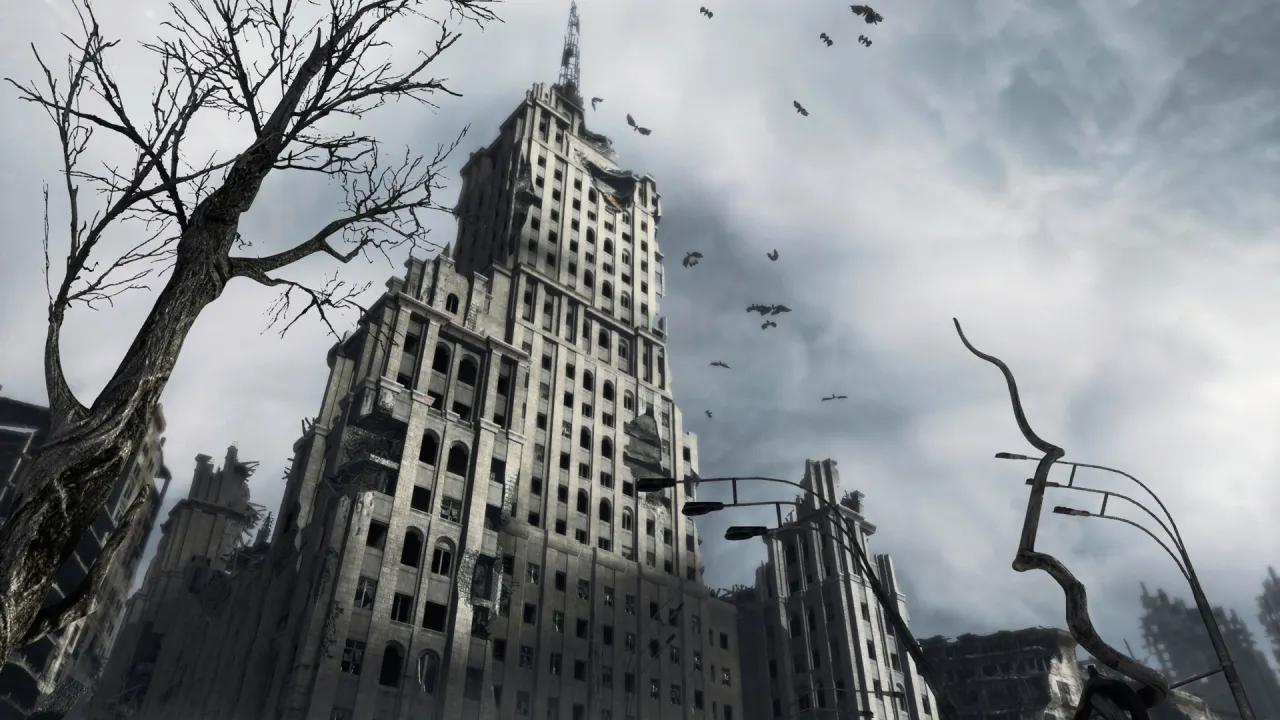
So the Red Line — what's left of the communists — and the Fourth Reich — the neo-Nazis — tear each other apart over it, with Artyom and the Rangers wedged in the middle of a war neither of them started. The scramble for D6 strings together a run of wildly different stages: a crowded platform bazaar humming with hawkers, a fortified Reich frontline bristling with searchlights, a cold sodden swamp, a thundering armoured train. That thread keeps the apocalypse from being mere backdrop and makes it a living ecosystem of rival powers, each convinced its own survival justifies the next atrocity. It lends Artyom's intimate quest for redemption a heavy, believable foundation of human-made carnage underfoot — he sets out to save a species, but everywhere he steps is a slaughterhouse of humanity's own making.
Karma: the game is quietly keeping score on you
The smartest piece of writing here is a hidden morality system you never actually see. The game never throws up a banner telling you "you made a good choice." It just keeps a quiet ledger: whether you spared an enemy with his hands up, whether you stopped to overhear a conversation, whether you slipped a beggar something, whether you held your fire when stealth was on the table.

Those small kindnesses pile up into positive karma, and they decide whether you reach the good ending or the bad one. The beauty of it is the silence — most players blunder past the hidden good ending on a first run, then read the discussions afterwards and go back for a deliberate second pass to farm the karma they missed. That hands-off design, paired with storytelling that works by eavesdropping — families around a fire, drunks grumbling in a bar, kids chasing each other — packs the underworld with both warmth and despair, and lets the story seep in without ever lecturing.
The one real letdown is the landing. Gamersky flagged the story as anticlimactic, and they are right: the early tension is wound tight, but the finale snaps shut a little too fast and never fully cashes in the setup.
That is why this dimension can't score higher. The journey moves you more than the destination does — and yet the journey is strong enough that the soft ending stings precisely because you cared so much along the way. A weaker game wouldn't have earned that disappointment; you only resent a rushed finale when everything leading to it had you fully invested, and Last Light absolutely does.
Audio | 8.5/10
Audio: 8.5/10One mask carries half a horror film's worth of sound
The cleverest sound design in the game lives inside that gas mask. Step into a gas pocket or out onto the surface and you have to put it on — and suddenly the whole world is heard through a muffle. What reaches you is no longer clean ambience but your own breath, getting heavier, threaded with the suggestion of a filter counting itself down notch by notch.

The mask fogs. It catches splatters of blood and grime. Take a hit and it cracks, each fracture a sharp little snap that tightens your chest.
Built around the act of breathing, this soundscape translates the abstract idea of "survival pressure" into a signal your ears receive directly: the faster the breath, the less time you have. There is no on-screen timer doing the work — the warning is the sound itself, and your body answers it before your brain has caught up. It never reaches for a jump scare — it pins you to the seat with a steady, physical tension instead. That is a class of dread most games stuffed with audio stings can't touch, because here the fear isn't startled out of you, it's slowly squeezed out.
In the black tunnels, sound is the only eye you have
Pull the mask off and descend into the pitch-black depths of the Metro, and the other face of the audio opens up. The environmental work down here is textbook: noises with no clear source coming from every direction, water dripping overhead, a single distant gunshot from nobody-knows-where, something skittering behind the wall.
Where you can't see your own hand, sound becomes your only eye and your chief supplier of fear — Nintendo Life noted that being deep in those dark tunnels, surrounded by strange noises, is genuinely frightening. The score, meanwhile, holds to a bleak Russian-apocalypse register: low, oppressive, restrained. It never grabs the spotlight to show off; it quietly serves the story's breathing, hushing when the room needs to hush, twisting the knife when it needs to. That sense of music knowing exactly when to shut up puts it on the same wavelength as BioShock, another first-person shooter that builds its world through sound — the lore isn't spoken at you, it's steeped into the air.
On Switch with headphones, the dread doubles
On Switch, the power of this audio actually intensifies in handheld mode. Nintendo Life put it plainly: playing handheld with headphones is the truly phenomenal way to soak in the atmosphere. The logic isn't hard to follow — the small screen narrows your field of view while the sound fills your fear to the brim, and that sensation of being boxed in by darkness and noise lands far closer to your face right at your ears than it does across a living-room TV. Add the precise feel of gyro aiming and the handheld version turns out to be a surprisingly fitting, surprisingly immersive way to play, the headphones doing more heavy lifting than the screen ever could. So you can say it without hedging: on every platform, sound is the real lead of this game's immersion — even with your eyes shut, your ears alone tell you exactly how suffocating and dangerous this underworld is, where the threats are and how close. It isn't a supporting act. It's the engine of the whole horror, and the single thing the game does that most of its imitators never quite figure out.
Visuals | 6.0/10
Graphics: 6/10What the remaster did, and what it didn't
Let's be honest up front: if you came for a visual leap, this remaster will leave you a little cold. 4A Games rebuilt both games on an upgraded 4A Engine, unified the look, folded in every DLC and got things running at 60fps, and all of that is real, concrete work.
The trouble is that the original Last Light was never ugly to begin with, so there simply wasn't much headroom left to add. PC Gamer said it bluntly: next to the far more substantially reworked Metro 2033 Redux, this Last Light is little more than a GOTY version — meaning the content bundle is complete but the visuals hold nothing that makes you sit up. For veterans who already finished the original and wanted more out of the picture, that is a thin reason to pay again, with little visible return on the money. So this dimension lands low, and to be clear about why: the deduction isn't for being ugly or badly made. It's for the word "remaster" failing to deliver the weight and the good faith it implies.
But this Russian-wasteland art still grips you
Set the question of "how much was upgraded" aside and look at the art on its own terms, and the visual identity here punches well above its weight. Its strength isn't resolution, it's voice: dank dripping Metro tunnels, the gas-choked ruins of Moscow, mutant fliers wheeling and diving against a dead sky, then swamps, prisons, armoured trains — stage after stage of distinct character.
This Russian end-of-the-world aesthetic carries a singular damp, oppressive, mildew-thick texture that makes the despair of "civilisation driven underground" hang heavy in every frame — one glance and you feel uneasy, which is precisely the effect it wants.
The scene changes are paced with care, too. Light and dark, warm and cold, open and cramped trade off so you never grow tired of one shade of grey, and a stretch above ground in sick yellow daylight hits harder for the hours of tunnel-black that preceded it. It proves something plainly: a clear artistic direction outlasts raw technical spec every time. Years on, with the fidelity no longer cutting-edge, you still recognise this clammy underworld at a glance, and you could pick a Metro screenshot out of a lineup in a heartbeat. That is the power of style.
An interface that lives on your hands, sealing you inside the world
The thing this game's visuals deserve the most credit for is that it nearly abandons a traditional "interface" altogether. Your status is never reported by a floating bar or number in the corner; it's all carried by props that live on Artyom's own hands, that he physically handles. Filter running low? The mask begins to fog and his breathing thickens to warn you. Need the map and your current task? He digs a creased little notebook out of a pocket and holds it up. Out of light, torch dead? He has to hand-crank the dynamo a few times before the beam comes back. Every piece of information hides inside an action.
The mask even catches flies and blood-grime, and when it fouls you have to raise a hand and wipe it before you can see the way ahead. Those details turn "reading a HUD" wholly into "reading the world," keeping your attention down in the wasteland rather than floating on overlay icons — the key move by which 4A welds the immersion shut, and one most HUD-laden shooters simply can't copy. The platforms are well looked after too: the Switch build runs 1080p docked, 720p handheld at a steady 30fps, and the smaller screen actually helps mask texture compression that would stand out on a big television. Pair that with brilliantly implemented gyro aiming and the handheld version looks better than many expect, no real compromise to carry around in your bag. Load times are the one genuine cost — some levels take roughly a minute to come up — but for a port of this scale running on portable hardware, that is a price most will happily pay to take the Metro with them.
Combat | 9.0/10
Gameplay: 9/10Turning survival anxiety into a mechanic you can touch
This is the soul of the game's design, and the reason it pulls the highest score in the piece. 4A never reduced "survival" to a number draining away. They split it into several systems you can feel directly. The core one is that gas mask: mandatory on the surface and in gas pockets, its filter counting down by the minute, so wherever you go you're nagged by how many bars are left and where the next filter might be.
Crueller still is the economy. Your supplies come in two flavours, and the military-grade rounds double as currency — you can spend them at traders for gear and provisions. So every pull of the trigger sets a quiet sum running in your head: is what I just fired a bullet, or money? Do I knock this one out with my fists to save it, or hoard the good rounds for a better loadout? That "whatever you fire is whatever you spend" design hauls resource anxiety off the corner of the screen and into a decision you recompute in every firefight, giving the word "survival" real teeth that keep you from ever relaxing. It also makes every clean stealth takedown feel earned — you didn't just save a few rounds, you turned a profit.
Stealth: the best slow the series has ever offered
Plenty of players will tell you the best of this game is when it slows down and commits to stealth. Nintendo Life put it directly: the game truly excels when it sticks to slower, more methodical stealth action. It doesn't hand you a tightrope; it hands you a hunting ground with room to move.
You can shoot out a wall bulb to carve yourself a pocket of shadow; hug the wall and slip behind a sentry to knock him out without a sound; study a patrol route and find the gap that lets you clear the whole room.
That "play it however you like" tactical freedom is the heart of the stealth here, and the reason it's regarded as the best the series has managed. Crucially, the lighting is a system you manipulate, not just set dressing — a thrown knife into a lamp is as valid a tool as the silenced sidearm on your hip. Set against S.T.A.L.K.E.R.: Shadow of Chernobyl — the wasteland-survival shooter forefather from the same corner of Europe — that world is freer and wider but also rawer and more random; this game takes the other road, machining its enclosed-space stealth into something finer, more coherent, more deliberate.
Three difficulty tiers, from suffocating to trigger-happy
Difficulty here isn't a plain easy-to-hard slider — it's two distinct playstyles. Survival models itself on the first Metro 2033, choking off ammo, filters and meds while making enemies deadlier, forcing you to scrimp like hunted prey. Spartan loosens the supply lines and leans into head-on action shooting, so anyone who just wants to let rip can play smoothly too.
On top of that you can stack a Ranger tier, which strips out the HUD, the crosshair and the ammo counter entirely, leaving you to read your own state almost purely from feel — the fogging mask, the ticking filter — in what 4A billed as the way the game was meant to be played. That combination lets hardcore players suffocate and gives newcomers a comfortable way in. The gear system holds up that freedom too: pneumatic rifles need hand-pumping to pressurise and lose pressure as you fire, and your kit takes silencers, scopes and stocks, so you can readily build two separate loadouts for stealth or assault.
The one thing that breaks the spell is those scripted boss fights and on-rails handcar sequences. Now and then they wrench you out of a carefully tended, breath-held stealth flow, and the rhythm turns stiff and loud, an awkward clash with the restraint of a second before — the small blemish that keeps gameplay from a clean perfect mark, though it's rare enough not to do lasting harm. Tellingly, even Nintendo Life singled out one handcar stretch as a series highlight, so the on-rails idea isn't broken so much as occasionally misjudged.
Content | 8.0/10
Content: 8/10The campaign is short, but not a minute is padding
The main campaign runs around 11 hours, and a completionist run that combs the side content, collectibles and details lands near 18. Next to open worlds that swallow hundreds of hours that number looks slight, but its worth is in the density — across those dozen-odd hours almost nothing exists to inflate the clock, none of that filler stuffed in just to stretch the runtime longer.
From the faction bazaars of the underground platforms, to the gas-shrouded surface ruins, to cold swamps, oppressive prisons and a thundering armoured train, the scenery shifts briskly and the pace keeps moving, so you rarely think "this place again." It's a carefully arranged line where every chapter owns its theme, its mood, its particular thing it wants you to feel, rather than smearing one gameplay loop across a whole map for you to digest alone.
For players who've had their fill of open-world bloat and map screens swarming with question marks, this "short, solid, every stretch counts" experience comes as a forgotten luxury. You don't spend dozens of hours clearing a to-do list — you simply walk this one road through to the end, and the road remembers to keep surprising you. A campaign that respects your hours is rarer than it should be, and this one never overstays.
All four expansions packed in, the world fleshed out
The other core value of this remaster is that it bundles in the four expansions the original released piecemeal: the Faction pack adds extra missions, the Tower pack brings challenge modes, the Developer pack tucks in a museum and a firing-range simulator, and the Chronicles pack fills in character backstories. Back in the original's day these were sold one purchase at a time; now they all ship inside the base game.
The Chronicles pack in particular is worth singling out: it gives the Reich sniper and Ranger Anna — characters who flit through the main story but leave a mark — their own side chapters, letting you see this world through their eyes and grasp the reasons behind certain choices, and the lore grows noticeably rounder for it. The Tower and Developer packs are lighter, more arcade-flavoured diversions, but they earn their place by letting you keep handling these weapons once the credits roll.
Put another way, what you buy is not a bare-bones base game but a complete set with every side story already installed — which is exactly the confidence behind calling it the definitive way to experience Last Light, with no newcomer left fretting over which slice of content they forgot to buy. In an era where season passes routinely fragment a game across a year of paywalls, getting the whole thing in one box still feels quietly generous.
Linear craft versus open-world heap, and it chose the former
You can't talk about content here without one comparison: both are nuclear-apocalypse fiction, yet Fallout 4 walks the open-world-by-the-pound road — big map, tangled systems, mountains of quests and collectibles — winning on scale and freedom, while this game walks the opposite extreme: linear, finely cut, its pacing fully under control. It doesn't pretend to be a wilderness; it knows it's a carefully laid track.
It won't hand you a boundless map to wander aimlessly and amuse yourself on; it designs and polishes every stage you'll pass through ahead of time, making sure each step you take has had its rhythm and mood arranged for you in advance, nothing left to procedural chance. Neither road is higher or lower than the other — it's purely about what you want right now: for free exploration, mass content and making your own fun, the open world clearly fits better; for a meticulously staged, well-modulated, jealously focused journey, this "short and fine" linear approach hits closer. For anyone who prefers the latter, the gold-content of these dozen-odd hours runs far higher than open worlds dozens of times its size — because here, every minute has already been thought through for you, with no padding to wade through and nothing asking you to make your own fun out of an empty stretch of map.





Comments 0
Share your game review
Join the discussion and share your review of this game.
No comments yet. Share your thoughts on this review.