



















Opening
Most medieval multiplayer games teach you how to win. Mordhau teaches you how to read a stranger's mind through the windup of a longsword. The distinction matters, and you feel it the first time you charge into a sixty-four-player melee, raise a two-handed blade like you mean business, and get folded in half by a man wearing nothing but his underwear and a frying pan. That is not a humiliation the game apologizes for. That is the game introducing itself.
Built by the tiny independent studio Triternion on Unreal Engine 4, this is a simulationist sandbox of cold steel. It welds free-directional swordplay, a per-object collision physics system, and battlefields of up to sixty-four players into something almost nobody has managed to copy. Critics landed it between 81 and 82, OpenCritic stamped it Strong with an 86 percent recommendation rate, and yet those numbers hide the real headline: this is a game that chooses its players as ruthlessly as its players choose their gear.
Across the next six dimensions — story, audio, graphics, gameplay, content, and the final verdict — we will lay its edge and its barrier on the same table. The short version first: if you are willing to spend time earning a sky-high skill ceiling, it hands back a kind of duel you simply cannot find anywhere else.
Story | 6.0/10
Story: 6/10Let us be clear up front: there is no campaign here, no cutscene, not a single line of scripted dialogue. Strip away the expectation of authored narrative and you find the only honest way to talk about Mordhau's story: it handed the pen back to the battlefield.
The script is gone, so the drama writes itself
Walk into a Frontline push and watch a story assemble out of nothing. Your side drifts into a shield wall without a word of coordination; the enemy answers with their own. Two human walls grind against each other at the center of the map, and from behind the front rank a pikeman threads his spear through the gaps to form a second line of defense. Nobody ordered any of this. Tactics simply emerged, the way weather emerges.
That emergence is the whole magic, and it is something no branching dialogue tree could ever fake. Every match is a tiny war chronicle you cannot replay: the time you held a bridge alone long enough for your team to rally, the time a thrown axe caught you in the skull one objective from victory. None of those beats were written by a designer. Sixty-odd players improvised them together, in real time, out of their own choices. The tension is real precisely because nothing was pre-arranged. What you remember afterward is never a line of dialogue but a specific fight, a stranger who held the flank beside you, a comeback or a collapse that belonged only to that match.
You name your mercenary, and that becomes the arc
Characterization arrives sideways. The mercenary editor lets you sculpt a face, set a build, pick a voice, choose a name, and pin your own heraldry to your chest. It looks cosmetic, but it quietly hands identity back to you. You are not piloting a nameless conscript — you are fighting as a person you named and armed with your own hands, and that ownership does more emotional work than any voiced protagonist would. Watch your own ridiculous, hand-built mercenary go down swinging and it stings in a way a stock avatar never could.
Then the community takes over. Voice chat becomes an improv theater where one player roars his own dramatic soundtrack, another plays a peasant fleeing in terror, and a third organizes a parade-ground march in the lull before a siege. This is dark-humor co-authorship, and it gives every map a folklore of inside jokes. The characters do not live in a screenplay. They live between the players, in the running bits and the shared absurdities that accrete over hundreds of hours on the same maps.
Set it beside For Honor and the trade is obvious
To see the choice clearly, hold it up against For Honor. Ubisoft's medieval brawler ships a full single-player campaign, named heroes, and a story wrapper, using locked one-on-one duels to turn each fighter into a recognizable character with a backstory and a personality. It is the conventional approach, and it works on its own terms. Mordhau does the opposite. It throws out the script and the hero roster entirely and bets every chip on emergent battlefield drama, trusting that sixty players left to their own devices will generate better stories than any writers' room could storyboard in advance.
It is an honest trade, and it is the main reason this dimension scores low. We will not pretend there is deep narrative here, because there isn't, and it was never trying. If you came for a story told well, a main thread with a beginning and an end, characters to ache over, it will disappoint you on all counts. But it poured every resource into a battlefield nobody else can replicate rather than half-building a mediocre campaign that would have been forgotten in a weekend. Read that way, the low story score is not a failure of execution but a deliberate allocation of effort. It is the price the game knowingly paid, and arguably the right call — a forgettable solo mode would have added a number to the score and nothing to the experience. Its story was always yours to write with the blade in your hand, one match at a time.
Audio | 7.5/10
Audio: 7.5/10Almost every sound in Mordhau bends toward one job: making you hear the weight of a hit.
Half the impact lives in the audio
A landed swing satisfies because your ears do half the work. A two-handed sword thudding into plate, a dagger skittering across leather, a spear punching clean through — every weapon meeting every material produces a distinct, readable sound. This is not decoration. It is feedback. With your eyes closed you could still tell whether the blow bit deep, whether the target wore light or heavy armor, whether you connected at all.
The audio is welded to the per-object physics. Steel ringing off a stone wall, knocking against a wooden shield, sinking into a body — three different sounds, three different weights, each one a tiny verdict on what just happened. In a packed front line where a wall of bodies blocks your view, sound alone tells you the truth: that cut landed on an enemy's gut, or it caught a teammate's shield rim, or it jammed against the corner behind you. You learn to fight by ear as much as by eye, adjusting your next swing off the report of the last one. Here, sound is not ambience. It is combat information you act on, frame by frame.
Sixty-four players need a soundscape, not a soundtrack
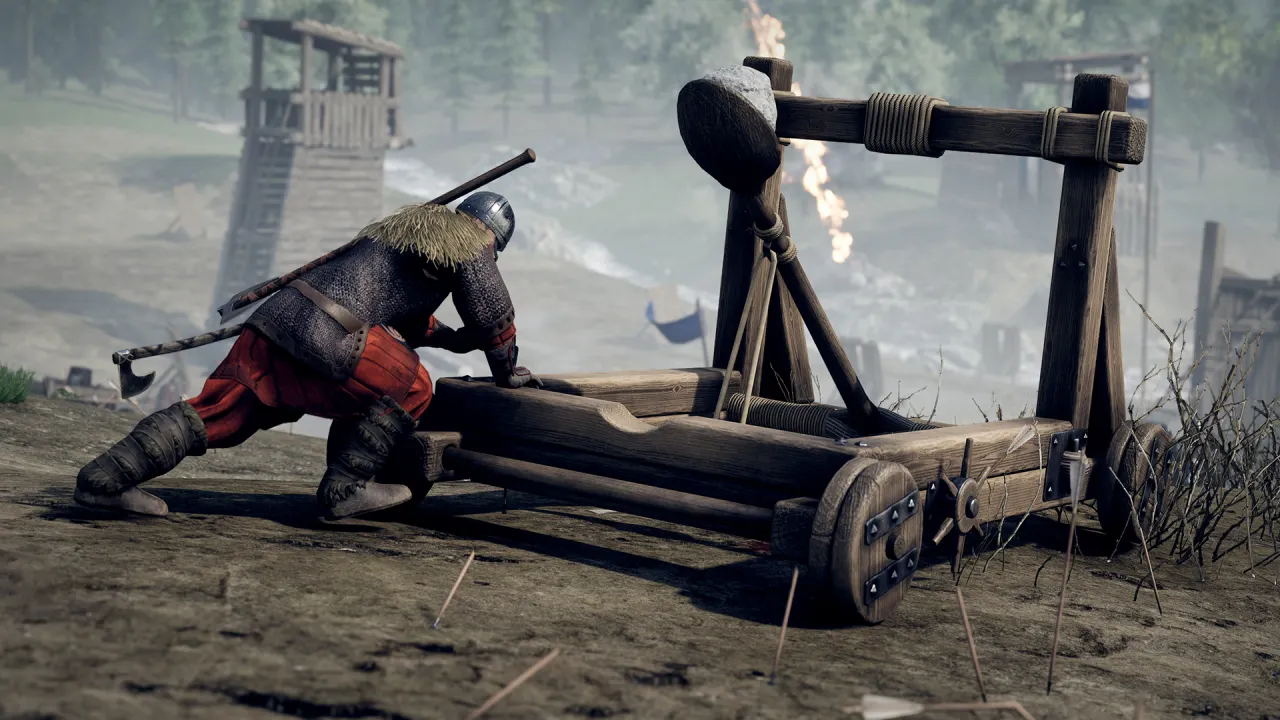
Pull the camera back and ambience does the heavy lifting on atmosphere. Trampling footsteps, hooves swelling from somewhere off-screen, the groan of a siege engine grinding forward, distant war cries and dying screams — layer them and a sixty-four-player Frontline finally earns that suffocating sense of an army bearing down on you.
The clever part is that none of it is wallpaper. The ambience carries hard tactical data. You hear cavalry wheeling around a flank you cannot see and turn to brace before they arrive. You hear which stretch of your own line is buckling, because the cries from that direction pick up a note of panic. You hear the distinct creak of a ballista being wound somewhere behind the enemy ranks and know to break formation before the bolt arrives. When the view is choked with bodies, the ears often read the tide of the battle a beat before the eyes do, and the players who lean on that edge tend to be the ones still standing when the dust clears.
Console blunts it, so set your expectations
Platforms diverge, and you should know it going in. On a PC with mouse and keyboard the audio-visual feedback is razor-tight; every hit-sound clicks into your input with no slack. On console the controller already dulls the directional micro, and that drags the whole satisfying thunk of a clean landing down a notch with it, so the feedback loop never quite snaps shut.
Stack it against the louder, more theatrical mix of Chivalry 2 and the contrast is plain. Mordhau's sound is colder and more grounded; it serves immersion, not spectacle, and it trusts you to find the drama in the realism rather than having it piped in. You are not getting an audio fireworks show — you are getting a medieval brawl that sounds like it might actually be happening. The cost of that choice is fussiness about hardware. Only on the right setup, with a decent pair of headphones, does the full value of this mix reach your ears and the sense of being inside the fight truly land the way the designers clearly intended.
Visuals | 7.5/10
Graphics: 7.5/10The visuals here are not built to stun you. They are built to hold up a physics system, and every brushstroke steps aside to let a real fight happen.
A cold, grounded medieval texture
Unreal Engine 4 renders a realist medieval world with no cel-shaded brightness and none of the gaudy flourish of high fantasy. What you get instead is mud, rust-bitten plate, grass churned into ruin by a thousand boots, and battlements that look genuinely grim under an overcast sky. As a technical showpiece it is not the front of the pack — on texture detail and lighting it trails the era's best, and it never pretends otherwise. There are no ray-traced reflections to gawk at, no photoreal faces, no weather system showing off. What there is, is consistency: a world that commits fully to looking like a place where people grind each other into the mud with sharpened metal.
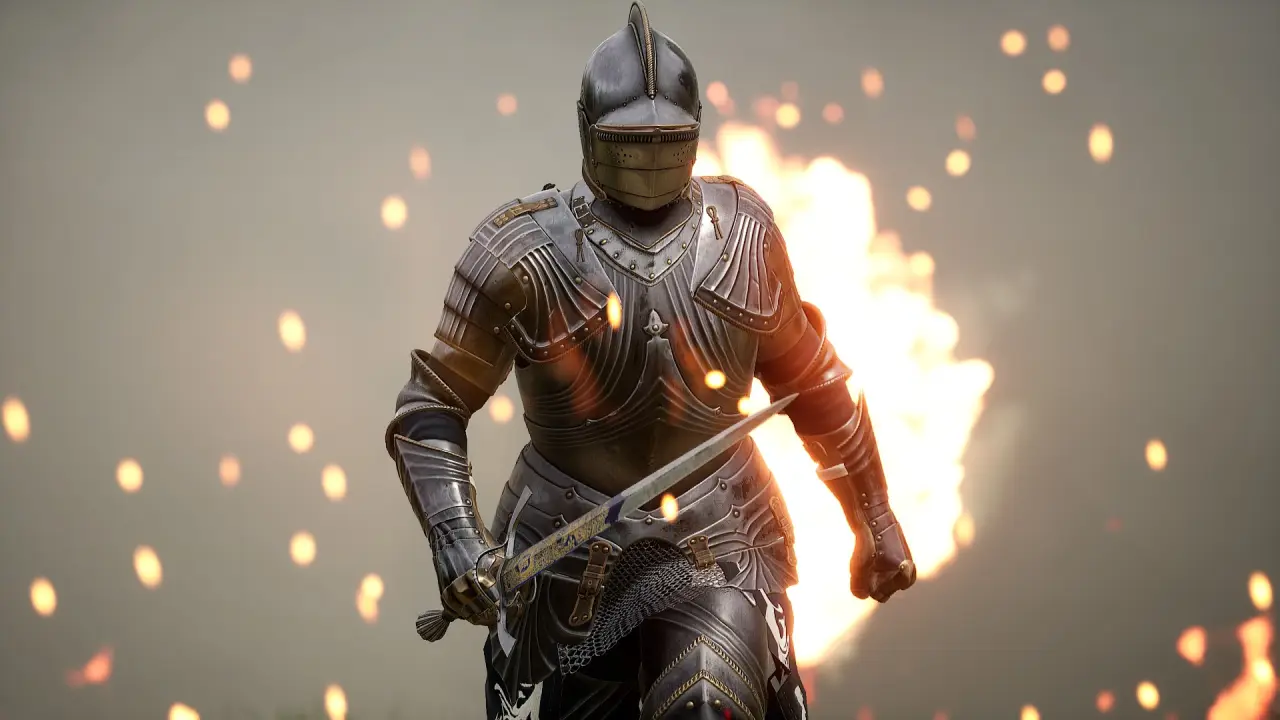
But it lines up perfectly with the game's simulationist aim, and that alignment is the point. The art's task is not to dazzle you; it is to convince you. It sells the lie that this is a fight that will bleed, tire, and leave you sprawled in the dirt rather than a glossy performance staged for a trailer. The palette is deliberately muted, the armor scuffed and dented, the wounds matter-of-fact. Even the injury detail and blood are handled with restraint — consequences of a physical exchange, not gore staged for shock value or paraded for its own sake. By the only yardstick that matters here, persuasion, it does its job.
The real spectacle is the physics
The thing that actually lands on screen is not texture resolution but collision physics made visible, and it is genuinely unlike anything its peers put in front of you. Weapons get blocked by walls, by teammates, by the clutter strewn across a map. You watch a horizontal swing that should have connected clang off an ally's shield rim, or a pike get pinned in a narrow gateway because there is no room to bring it around. That visible truth is something no other medieval game fakes with canned animation, where a weapon is just an effect clipping through the world rather than a solid object with volume that obeys the space it occupies.
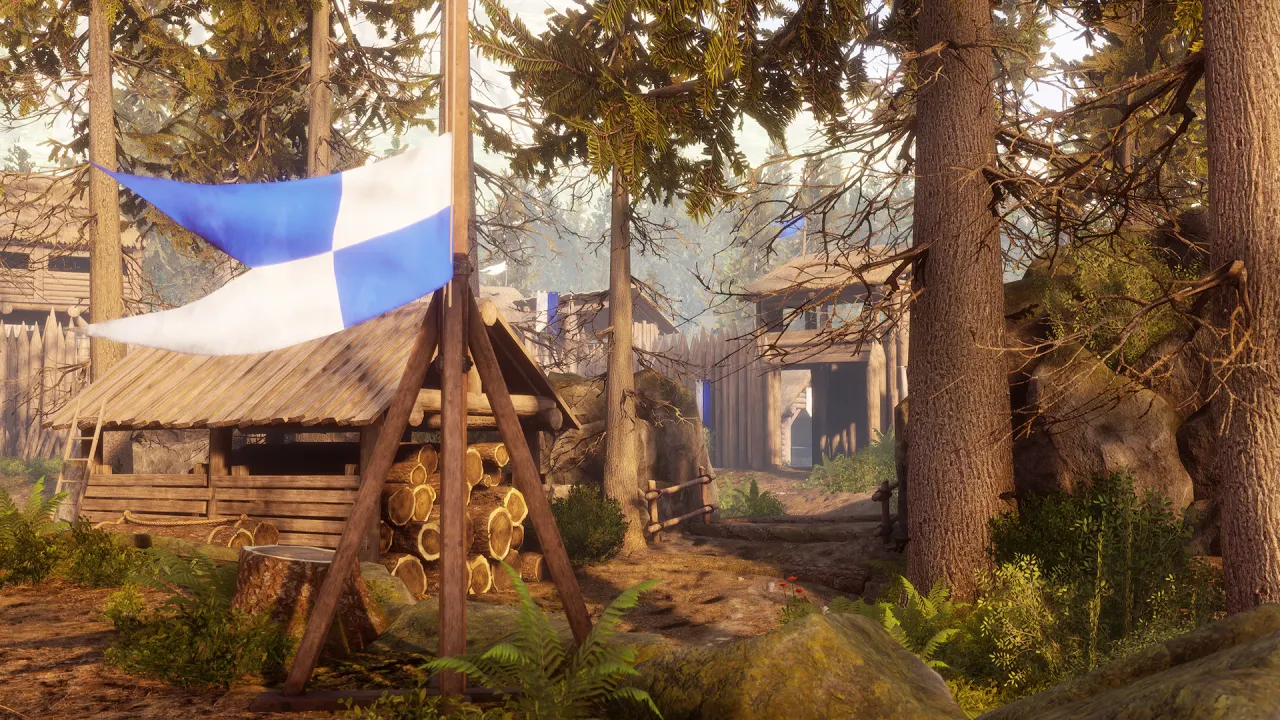
The mercenary and part-by-part weapon systems then paint highly readable customization across the whole battlefield. From across the field you instantly recognize the player in the absurd armor hauling the bizarre polearm he stitched together himself, because every silhouette is unique. That readability is not just flavor — it is information, letting you clock a heavily armored anchor or a lightly clad flanker at a glance and pick your target accordingly. Frontline's big maps and siege arenas carry their own identity too — weathered walls, creaking drawbridges, lumbering siege towers — giving each map its own tactical landmarks and memory hooks. You come to know a chokepoint by sight, to remember which courtyard always turns into a meat grinder, and that familiarity quietly deepens the strategy.
Platform trade-offs
Performance splits across hardware in obvious ways. On PC the headroom for resolution and framerate is widest, and with enough machine behind it the big battles stay smooth even at sixty-plus players on screen. Console has to balance fixed hardware against that same crushing load, so fidelity and frame stability both pull back a little; cramming that many independent physics bodies into one scene is a genuine strain on the box, and the four-year-late port wears that strain on its sleeve. Players chasing maximum spectacle will want to lower expectations and meet the game on its own grounded terms. Either way, fidelity was never the reason to show up. The visual charm hides inside a system where every swing and every collision obeys your physical intuition — not in the resolution of the textures, and not in the polish of the light. Come for the graphics and it will not wow you; play a handful of rounds and the sense that the blade can genuinely be stopped — by a wall, a friend, a doorframe — will grab you and refuse to let go. It is a rare kind of visual appeal, the kind you feel in your hands rather than admire from a distance.
Combat | 9.5/10
Gameplay: 9.5/10Gameplay is the soul of this thing, and the only reason it earns a 9.5. It takes the simplest possible action — swing a sword — and turns it into the deepest mind game in the entire subgenre.
Three directions to start, simple enough for anyone
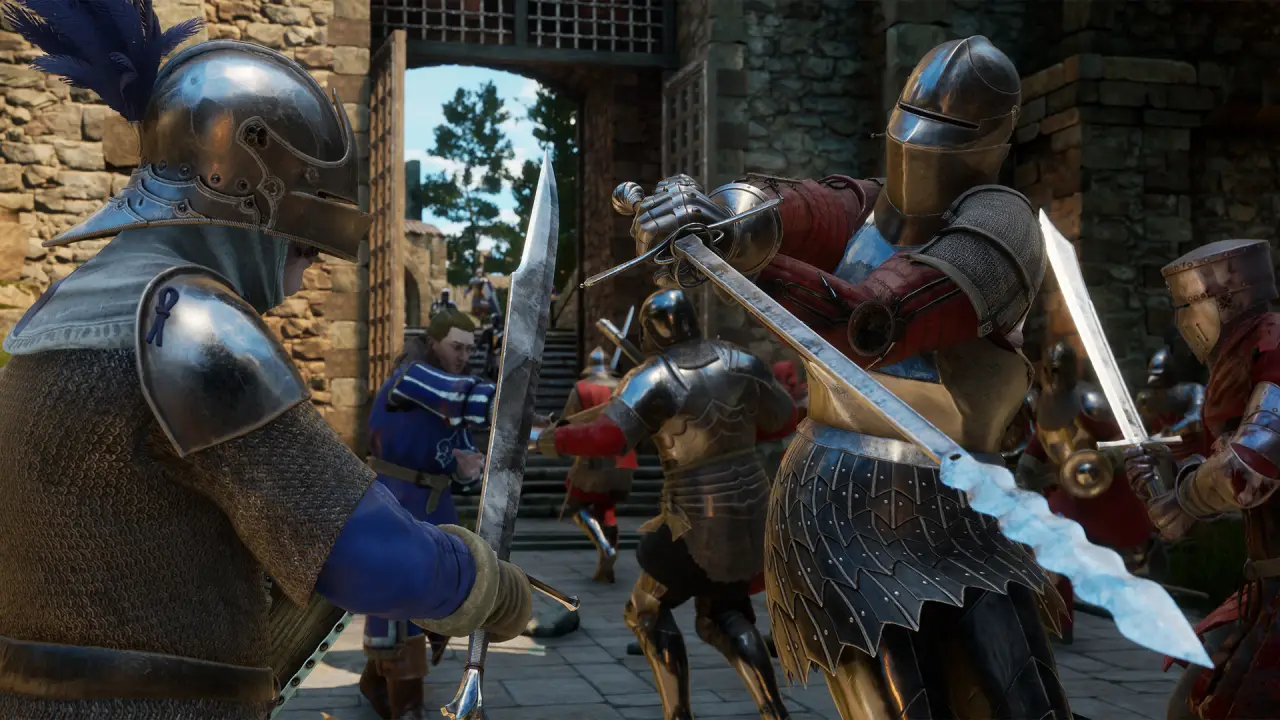
The bedrock is three-directional attack: a horizontal slash, a vertical chop, a thrust. The slash sweeps a wide arc and clears a crowd; the chop comes straight down and slips past a guard held to the side; the thrust is a flat stab, deadliest the instant you are nose to nose. Each direction owns a best situation and each owns a weakness.
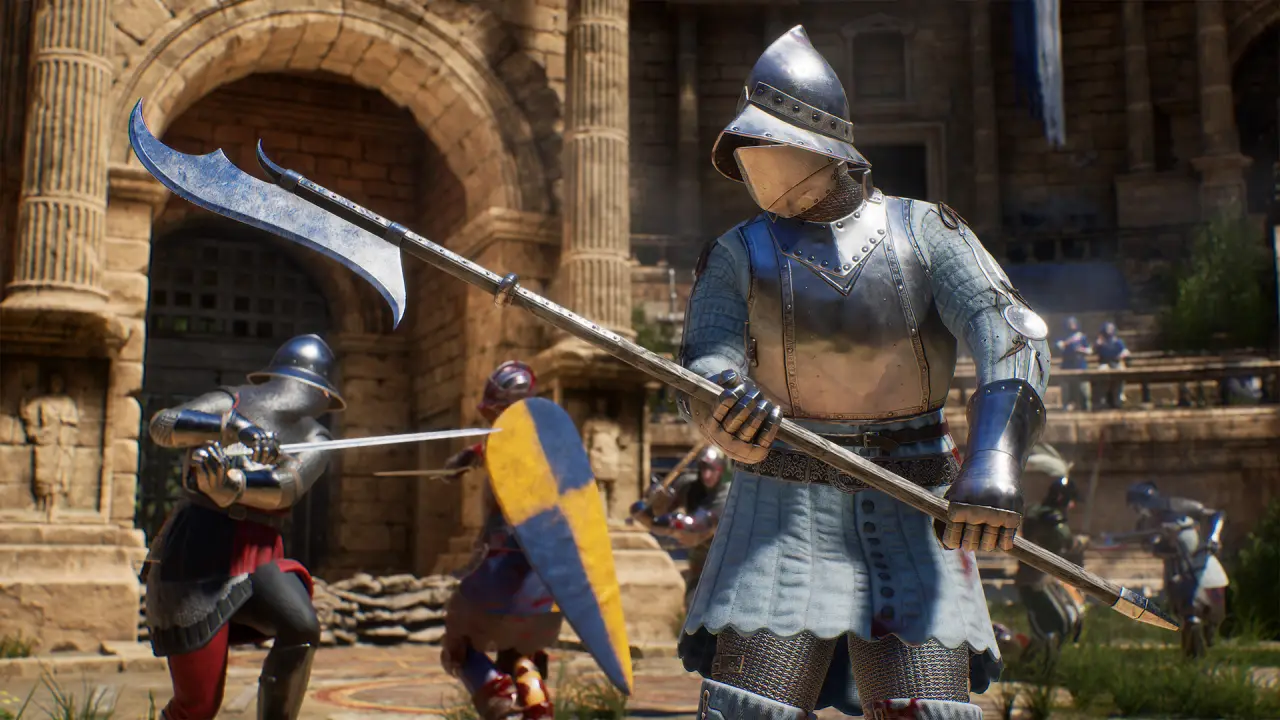
The defender, meanwhile, has to read which direction is coming and only then decide the timing and angle of a parry — too early and it whiffs, too late and you eat the blow, off-angle and it slips past anyway. A kick can break a turtling foe's guard; a dodge can sidestep a committed thrust. The base rules fit in a sentence, and anyone gets them on the first match; you will be hacking away, clumsily, within minutes, trading blows and occasionally even landing one by accident. That low floor is the welcome mat. But the moment you assume that is all there is, the actual abyss opens up beneath you.
Morphs and feints turn a duel into a reading contest
Top players are not racing reflexes; they are racing each other's heads. A morph lets you change a strike's direction mid-windup — you cock back a horizontal slash, your opponent lifts to block the left, and you bend it into a thrust mid-motion straight into the gap he just left exposed. A feint is the crueler cousin: you fake the attack, bait the early parry, then cancel at the last possible frame and punish the gap he handed you.
So when two veterans square off, both heads are running the same loop. Is this swing real or a lie? Was your parry timing one I baited out of you, or are you the one reading me? That nested mind-reading makes every duel a contest of split-second prediction, decided in fractions of a second of psychological nerve. A successful parry flows straight into a riposte, converting that defensive instant seamlessly into offense, an attack-and-defense rhythm with no seam in it. This is exactly why critics keep reaching for Dark Souls — both share a learning loop where a loss is almost always your own failure to read or execute, never the game cheating you. Losing that legibly is precisely what keeps pulling you into one more round.
The trade-offs begin before the fight does
The depth even runs backward, out of combat entirely. Armor splits across head, torso, and legs, each piece offered in light, medium, or heavy, and armor, weapons, and passive perks all draw from one shared point budget. You cannot wear full heavy plate, carry the biggest greatsword, and stack every perk at once — every loadout is an act of accounting. Want the armored bruiser? Accept sluggish movement and a thinner pool for weapons and perks. Want the nimble assassin? Accept a body that drops in a hit or two. This budget economy stretches the tactical layer all the way to the staging screen, making character building its own discrete game. A spear gives you reach but flounders the instant someone closes the gap; a maul ignores armor but swings slow enough to telegraph. Every pick answers a question about how you intend to fight, and the smartest players carry a stable of loadouts tuned to different situations. You make this match's first decision before you ever press the button to spawn.
Deeper and steeper than Chivalry 2
Look across the subgenre and the direct rival is Chivalry 2, which runs the louder, broader, friendlier line — exaggerated animation, brisk pace, perfect for someone who just wants to hack about. But it simplifies the duel: fewer directions, shallower reads, leaner builds. Mordhau goes the other way — more directions, deeper mind games, higher freedom — and pays for it with a far steeper curve. They are not rivals so much as two answers to the same question, one tuned for fun and one for hardcore fidelity.
The breadth backs the depth, too. From one-on-one Duel dojos to sixty-four-player Frontline to the cooperative wave defense of Demon Horde, a single combat core spans the full spectrum from competitive to casual, and it holds up whether you want to grind technique, play spoiler in a hundred-strong scrum, or just clown around with friends for an evening. The cost is just as real, though: for the first few dozen hours a newcomer mostly gets schooled, barely landing a counter. That slope is the highest barrier and the most loyal filter the game owns — whether you survive the beatdown phase all but decides whether you uninstall or fall in love.
Content | 8.0/10
Content: 8/10As a buy-once multiplayer game, its content is not measured in campaign length. It rests on three pillars: breadth of modes, depth of customization, and a long tail of updates. To judge it fairly you have to drop the single-player reflex of "how many hours to the credits" and swap in the question that actually matters here — how long can this system keep me coming back.
One combat core, every appetite fed
The mode spread is wide enough to cover nearly every kind of player. Frontline is the sixty-four-player team push where most people put down roots, shield wall against shield wall, pike line stacked behind pike line, macro tactics at their fullest. Invasion sends an attacking side breaking through a chain of objectives, attack and defense carrying a natural narrative. Duel is the pure one-on-one dojo, the place experts grind reads and footwork. Then there is a solo battle-royale elimination mode, smaller-scale deathmatch and team deathmatch, skirmish variants, and outright joke modes built for laughs. The range runs from a tense one-versus-one where a single read decides the round all the way out to chaotic large-team warfare where your individual skill is one current in a much larger tide.
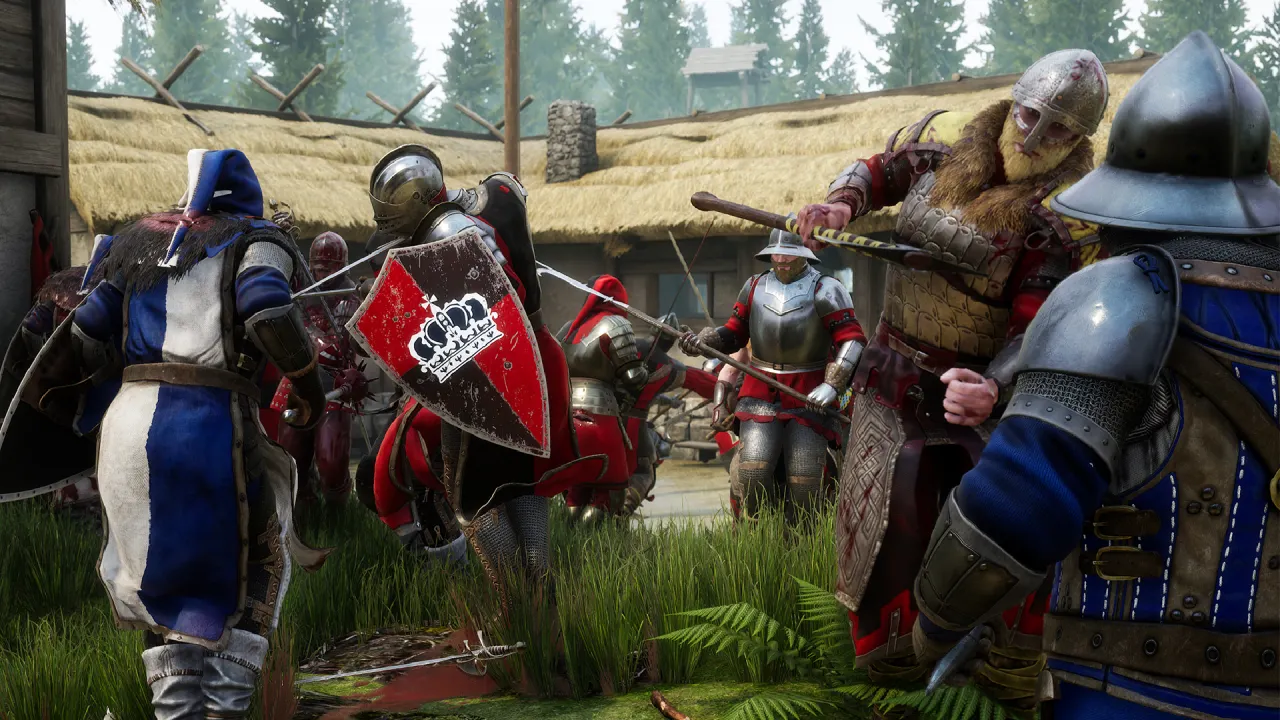
The genuinely smart design choice is that every mode shares the same combat core. Whether you want the tension of hardcore competition or a relaxed night of co-op wave clearing, you never relearn an alien control scheme — you just change the arena on top of muscle memory you already own. The fundamentals you ground out in a duel carry straight into a sixty-four-player siege, and the reflexes you built holding a line transfer intact to fending off a horde of AI. That shared spine means your time is never wasted: every hour spent anywhere makes you better everywhere. It keeps players engaged across every mood, and retention follows naturally rather than being bolted on with daily-login bribes.
Customization is the real bottomless pit
If modes provide horizontal breadth, customization provides the vertical depth. The mercenary editor plus a weapon built piece by piece from parts yields a near-infinite combinatorial space. You can prepare several wholly distinct loadouts for different modes and tactics — heavy armor and a long halberd to anchor a line, light armor and twin shortswords to slip in for the kill, a bow or crossbow to harass and kite from the back.
Just tuning loadout trade-offs and cosmetic combinations supplies long-term goals on its own. You catch yourself unlocking new plates, dialing in new weapon-part combos, dressing your mercenary in something gaudier and more recognizable, sometimes assembling a deliberately ridiculous getup purely for the bit. A whole evening can vanish in the loadout screen before you even queue. That character-raising pleasure stretches a competitive game's playtime by an order of magnitude, and it does so without ever charging you for an advantage. More than that, it makes every veteran's battlefield silhouette unique — and recognizing a familiar absurd outfit mid-melee, or getting complimented on a loadout with taste, breeds a belonging that raw stat-grinding never delivers.
Still updated five years on
Rarer still is the long-tail maintenance. The fifth-anniversary patch upgraded the old wave mode into Demon Horde, folding in four fresh maps, new weapons, and new enemy types, plus quality-of-life tuning for prop interactions like banners and bear traps. Alongside it came the Adventurer Pack and Weapons Pack, two cosmetic bundles, modest in scope and deliberately restrained — extra looks for players who care to pay, never touching balance or selling power.
One thing has to be said plainly: only two contract developers, working remotely, are left maintaining content, so the cadence will never be fast and big changes stay cautious. The concurrent count has shrunk from a sixty-thousand peak to a daily few hundred to a thousand or so; peak hours still match quickly, off-peak you may wait a while. Even so, set against the same-genre forebears that long ago went dark, a game still alive and still receiving content five years on is itself proof of how sticky the core community is. This is a small-but-steady evergreen, not a dead game abandoned by its studio, and for the player who clicks with its combat that steadiness is worth more than a flashier game with no one left to fight.




Comments 0
Share your game review
Join the discussion and share your review of this game.
No comments yet. Share your thoughts on this review.