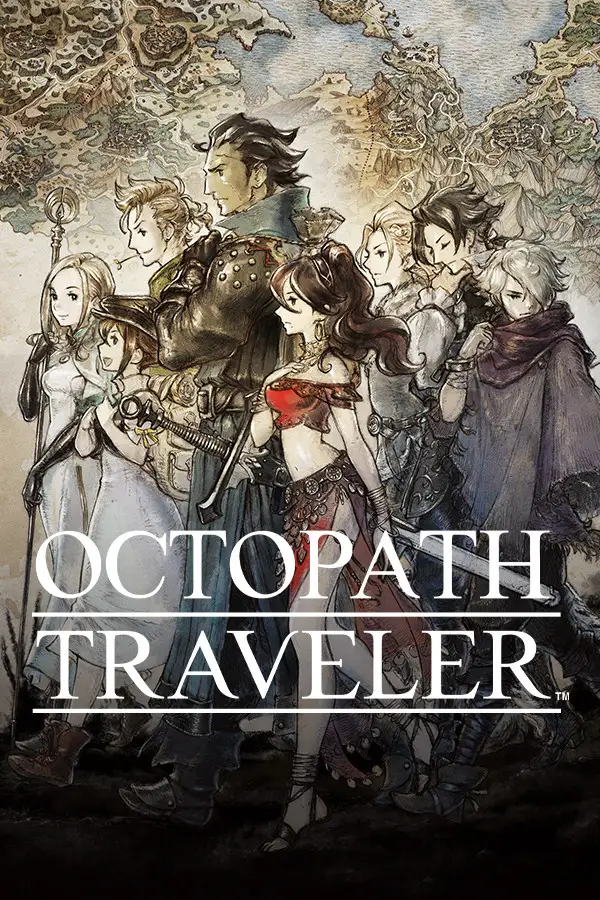


OCTOPATH TRAVELER™
Price History
Past 36 months · Updated dailyPrices cover Steam and 39 authorized stores; only legitimate offers are counted. The chart shows weekly market-wide lows and Steam's official price across the past 36 months.
01About OCTOPATH TRAVELER™
OCTOPATH TRAVELER™ follows eight travelers across Orsterra, each with a distinct story to uncover. Explore eight regions, take on side quests, and use character-specific abilities in turn-based battles where spotting enemy weaknesses matters. Steam players rate it 85% across 14,073 reviews. The Steam PC version was released on June 7, 2019. Interface languages include Simplified Chinese, Traditional Chinese, English, French, Italian, German, Spanish, Japanese, and Korean.
Credits
Lowest recorded in 36 months
$17.302026-07-30 · KinguinBase game · same records as the chart above; USD history, not a regional Steam low.Language support
| Language | Interface | Subtitles | Audio |
|---|---|---|---|
| Simplified Chinese | Yes | Yes | — |
| Traditional Chinese | Yes | Yes | — |
| English | Yes | Yes | Yes |
Show 6 more languages
| Language | Interface | Subtitles | Audio |
|---|---|---|---|
| French | Yes | Yes | — |
| Italian | Yes | Yes | — |
| German | Yes | Yes | — |
| Spanish | Yes | Yes | — |
| Japanese | Yes | Yes | Yes |
| Korean | Yes | Yes | — |
Steam PC edition data · 2026-10-19
02Before you buy
Language and controls
The Steam PC version has full controller support. English is listed for interface and full audio; several other interface languages are supported.
Play style
Steam lists the game as single-player. Combat is turn-based, with character-specific abilities.
03Frequently asked questions
How many protagonists are there?
You follow eight travelers, each with an individual story and side quests.
What is combat like?
Battles are turn-based. Identifying and targeting enemy weaknesses is central to breaking through their defenses.
What can I explore?
Orsterra spans eight regions, with side quests and different ways to resolve quests and story scenarios.
Latest news about OCTOPATH TRAVELER™
Popular Steam reviews
Native-language selection · 10 reviewsSelected helpful reviews in this language show both recommendations and criticisms. This selection does not represent the overall positive rating; opinions reflect the version reviewed.
Is it good ? yes Is it overpriced ? MASSIVELYShow moreShow less
The game is so enjoyable. but not worth the price If you can wait, i suggest you to wait for salesShow moreShow less
Wow, this is a hard game to review, particularly as you have to give it either a thumbs up or a thumbs down when all is said and done. Okay, full disclosure: I played this during a mammoth replay session of the Legend of Heroes (Trails) games, in preparation for the release of the Geofront Zero translation, and Cold Steel III to hit stores. As a result, that may bias my opinion of this game, as I was used to a certain quality in storytelling, character development, and the like. I bought Octopath Traveller hoping to be transported back to the golden era of Final Fantasy - ie Final Fantasy VI - but with the sort of QoL improvements that time has granted us. I was left... underwhelmed, to tell you the truth. The battle system is fun enough, albeit super exploitable when the strongest side classes get involved, and it has a deceptive amount of depth to it. The graphics lend a glorious nostalgia without looking ugly, which is no mean feat to be honest. Each character has a 'path' action - albeit each path action is essentially doubled up on with a noble set and a rogue set - which allows side quests to be a bit more interesting than many a game's side quests. So far, so good. The soundtrack seems serviceable but nothing that left me humming. Unfortunately it's let down by a couple of things. The characters each have 4 self contained chapters which all give hints of overlapping deeper webs at play. Unfortunately, they are utterly self contained. There is no interaction with any of the other characters as their chapters play out, even though they are backing them up in combat. As a result it's very difficult to care for any of the characters. They build up no camaraderie with each other, and, because you have the chapters of 7 other characters to go through before you see each character's next chapter, it's hard to build much affinity with them individually. There are occasional scenes where the characters in your party comment upon what has happened, or talk at the local tavern, but this only serves to remind you of what the game is lacking. The other main issue is the difficulty. The way the game deals with levels is frankly not fit for purpose. Enemies award xp liberally and with no scaling to levels. What this means is that even with a skill equipped which lessens enemy encounters, you end up way over-levelled for whatever part of the game you are in at any one moment in time. You can't even reliably flee encounters until you are over-levelled, so you can't manually force that difficulty into the game. Also, as your main character is locked into your party until you finish his 4 chapters, you will end up with a vastly lopsided party, where your main character nukes all the enemies, and the other characters faff around not having to do much else. This issue is so bad that you will probably never even start to understand the most interesting parts of combat until you've unlocked the secret final boss which requires liberal use of skilful play that the game has never encouraged you to build. (Or tonnes of grinding, I guess.) To add a more measurable perspective to what this entails - I didn't enter a single optional dungeon until I had completed the game, because were I to have done that, I would have ended up even more levelled than I was. If I'm skipping dungeons not because I don't want to enter them, but rather because I have no way of entering them and keeping at a level where there is some difficulty (and hence interest) in the game... well, that's a problem. So, overall thoughts - enjoyable at times, but it's flaws (just) force me to not recommend this game. Certainly not at full price: if you want to give it a go, my advice is to wait for a sale, and buy it then.Show moreShow less
Fun game and i don't blame you if your waiting on a saleShow moreShow less
It's a great game but overpricedShow moreShow less
If you manage to find this review buried under the other 10 000, and you're thinking about buying the game, please read this: Those who claim that there's no link between the 8 characters and their respective stories didn't play the game until the end. It is not obvious at first, but nearing the end of a few chapters you'll notice that some characters refer to a thing in particular, hinting at what's coming after you finish all chapters: the real ending. Once you finish all 32 of them, don't uninstall OT right away. Google how to find the post-game dungeon, THAT is the real ending. It's a shame that only 5,8% of the players experienced it, as the achievement indicates. It is understandable though, as getting into that dungeon is not exactly a straightforward process.Show moreShow less
This is a fascinatingly contradictory game. On one hand, there's great music, the visuals are charming, the environs are interesting, and I quite enjoyed the break battle system. On the other hand, this game's experiment with eight independent travelers collapses completely as it repeatedly undermines the game system and the story. I'll go through these two problems separately; the story part will obviously have spoilers. == Game System == Abysmal level balancing: The premise of the game is that eight travelers each go through four chapters of their own, independent stories. You have the freedom to choose in what order they resolve. Unfortunately this means there's some serious balance issues. This is a game that could've used some limited auto-leveling (ala Skyrim), but there is none. You reach Chapter 2 with level 14-ish characters and the game reveals that all Chapter 2 stories want you to be at least level 20. So the first Chapter 2 story you tackle will be really difficult while the last one will be piss easy. The same thing happens in Chapter 4, which are all fixed at level 45. I'd killed 5 of the 8 final Chapter 4 bosses in about three turns, completely missing all of their mechanics and also feeling no impact for the story. You need to grind: There is no exp share, so the 4 characters in your party will gain levels while the 4 sitting in the bar will not. But you need all of them to be at reasonably high levels to finish their stories. You can't just have a strong character carry them - you need their levels because of "path actions", field actions with success rate/possibility tied to your level. There are also a few mandatory duels and you need to level for those again. And the need to grind makes it so that you must have a strong mage character in your party to aoe-blast dungeon monsters ASAP. That limits your playstyle; most players would've gone through the entire game basically aoe-blasting everything. Stealing breaks the game: There are items balanced for level 40 characters in the starting towns, held by NPCs that give you a 3% chance to steal them. You have 5 tries before the game stops you from stealing, but you can just pay the bartender some gil to reset those 5 times. That's a pretty good chance to steal some insanely powerful items that make the first two chapters a joke near the start of the game. You need to grind more: If you want to fight the true final boss, the recommended level for fighting the boss is around level 70. You'll have maybe four characters at level 50-ish and four way below after finishing all the Chapter 4's. With optimal grinding that will still take many, many hours. Hours of circling around a point mindlessly one-shotting enemies because the highest level dungeon is 58. Dungeon design: Every dungeon is a mess of paths with random spawns and chests at the end of paths. There's no special dungeon mechanics at all - all of them are the same. Remember the part in FF6 where you drop down a hole and a bunch of moogles appear to defend you and suddenly you're playing this little tactical mini-game with the moogles? Or the raft ride? Or the one where you're climbing the alcove in the theater? FF6 was a good game. Purple chests: You can't open those without Therion, and they're everywhere. Nothing's more annoying than going down a winding path in a dungeon to find a purple chest at the end. You know you're not coming back for it. So you have to have Therion at all times unless you love missing out on stuff. To be fair, I don't think the above are deal-breakers. Lots of decent games have janky systems. But the story is what kills it for me. == Story == Party? What party?: While you control four characters in almost all parts of the game, the story refuses to acknowledge that there are four people with you. All eight stories pretend that there is one and only one person in front of them all the time, creating some massive ludonarrative dissonance to an almost nauseating degree. In one part you are ambushed and thrown into jail, but when you wake up there's your entire party in there with you. In another part you're supposed to win duels in a colliseum, but when you enter the battle there's four of you and three enemies appear on the enemy side (somehow). After each fight, you go back to the cutscene and it's 1v1 again. This keeps happening over and over. The story would be completely and exactly the same if all eight travelers never formed a party and went their separate ways; in fact the story was explicitly written as if that were true. We haven't invented chemistry yet: Because each story is completely independent and refuses to acknowledge other characters, there is almost no interaction between the characters. After certain story threads the game wants you to press a little button that makes another character talk about what just happened with your story character in a pop-up room dimension. This will only happen if that character is in your party, so yes you will miss 4/7 of all such interactions. And the interactions are absolutely written with the expectation that you'll miss them. They're short and bland comments on characters and the scenery. No friendship, no magic: The story never gives you a reason why these eight characters would work together: they all have completely different goals and three of them are utter lone wolves who have no reason to accept any company. There's a hilarious part where your party approaches the lone wolf thief who needs to steal a jewel in a heavily guarded mansion (which your noisy steathless members would absolutely compromise) and he goes "bah I need to go alone but you're following me anyway aren't you?" The true mark of friendship. Some of their goals are also highly time-dependent (in terms of story, not the actual game) so they would never have accepted diversions into other characters' stories. One character risks death chasing down a target she has to kill, and the moment she steps out of town I have to make her go to six towns where her target isn't, because she's not high enough level yet and I have more Chapter 1 stuff to do. Another journeys to save her master but hold on, the thief has to steal everything in every town first. Speaking of which, how are the goody two shoes in the party (the majority of it) remotely okay with the thief? Moral choices fall flat: To be clear, there are no choices the player can make. But even the characters' choices often don't seem like choices at all. A story needs a central conflict and the conflicts in this game are bland and weak. A villain who tried to kill me invites me to join her, but offers me nothing; why does the game pretend the hero denying the offer was a big deal? A dying healer tells you he once killed someone for revenge and the hero decides to cure the healer anyway so he can heal other people - how is this not obviously the moral thing to do? A villain who killed your father at the last moment tries to convince you that revenge is hollow - yeah, sure, but not as hollow as your chest's going to be in a second. None of these involve any stakes, so when the character makes such a choice it doesn't feel important. Just... the writing: All of these ridiculous cliches happen, often several times: - Someone kidnaps someone to make you chase after them, but when you reach them they forget they're a kidnapper and try to fight you instead. - The hero declares that they are powerful because they believe in themselves and/or others. - Evil characters talk with obviously evil dialogue and over-the-top villain voices (both EN and JP). - Game tries to be melodramatic and sad about a terrible situation that will be resolved instantly when the villain is defeated. - Your party easily kills enemies but suddenly gets captured when the story says so. - Good characters never do evil acts, and evil characters never do good acts.Show moreShow less
Probably it's the only one truth about this game that is great but too expensive.Show moreShow less
I'm honestly confused by the positive reviews, because I was deeply disappointed by the game and I would actively recommend against playing it, both to veterans of the genre and to new players. I've played a lot of JRPGs -- in comparison, this feels more like a tech demo than a finished game. I honestly think the developers must have been under time pressure or didn't have writing budget or something. The Good The aesthetics of the game are fantastic. The visuals are beautiful, the music is engrossing. The engine the developers have built was obviously meant to be used for future RPGs, and I'm happy they did that. The Bad The gameplay is okay, but gets boring really fast. Other people have mentioned the grinding, but it was even worse than I expected. Other RPGs that require grinding make it, at least to some extent, fun. Persona 4 has a wide array of personas to collect and "golden hand" enemies that give you large amounts of XP and gold for more effort. The later Tales games have "streaks" that give you more XP if you jump from battle to battle. Some older RPGs I've played don't even require grinding as long as you take care of side content (or at least I don't remember grinding in the Final Fantasies, Chrono Trigger, Xenogears...) This game has zero incentives to grind, other than "you have to". There's lv 10 areas and lv 20 areas and nothing in between, no place to get more XP than usual, no randomized dungeon or special reward. After all the chapter 1s, I had a set of heroes ranging from lv7 to lv17 -- lv10 areas gave me too little XP and lv20 were annoyingly difficult. And it was incredibly boring to just walk around an area and wait for the numbers to go up, no other reward, no randomized dungeon, nothing. Boss fights start off kind of interesting, but get very boring very quickly. Bosses are damage sponges and without a health bar there's no way to tell how much damage you're doing with one accumulated big attack. Normal fights are also a pain with the "shield" system. It's an interesting system, don't get me wrong, but it desperately needs balancing. The Ugly The worst part of the game, the part that absolutely broke it for me, is the story, or the lack thereof. This isn't 8 people coming together, it's 8 separate mini-RPGs whose story is, at best, "okay", but usually kind of weak. The characters don't interact with each other. There are these weird "Press a certain key to have dialog" moments that sit weirdly in the middle of the game. Okay, but why did my noble knight decide to join the thief to steal a gem? Why did the thief who "used to have a partner, but now works alone" immediately agrees to have 2 people join him (even though he's alone for all the dialogue, so does he agree?). It *really* hurts my suspension of disbelief to watch the game just throw the characters together in battle and pretend they're alone for their cutscenes. I recognize it's hard to combine so many people, but other games have managed it in the past. Suikoden has groups of rich character interactions along the storyline and the related characters stay on as "supporting" ones. Fire emblem includes interesting support conversations that build up some side story. Live-a-live has the characters live in their own worlds with separate parties, stories etc, before they get together. It's a solvable problem and Octopath Traveler doesn't even try to solve it. The sidequests are also absurdly isolated from the world. There was one that had poor people planning to rise up against the rich people. The way you "solve" this is by stealing their weapons (what?) and then this one NPC is like "somebody stole our weapons, I guess we need to *talk* to the rich people now" and they do and it's all nice and dandy. It's this one NPC and a few more that talk in this quest, literally nobody else. The NPCs you steal the weapons from have no extra dialogue before & after, no response to this, at all, nothing changes in the world as a result of your actions. As I was playing, I was constantly thinking of much better RPGs. Grandia had new dialogue for all NPCs for every new event. I distinctly remember walking around the city talking to everybody whenever something new happened, because there were so many minor plot threads between these people. It *felt* like a real city with real people, unlike whatever this is. Final Fantasy 6 changes the entire world halfway through, Chrono Trigger has time travel affect people and dialogue... Summary It's not a good game. It's a good demo for the game engine, and I'm glad they made it, but it was a deeply disappointing experience. I recommend you play one of the better games coming out for the engine. Live-a-live is a "several different characters get together" game and it's orders of magnitude better.Show moreShow less
Source: original Steam user reviews. Helpful votes are an archived snapshot, not live data. Last collected: 08/15/2026.
