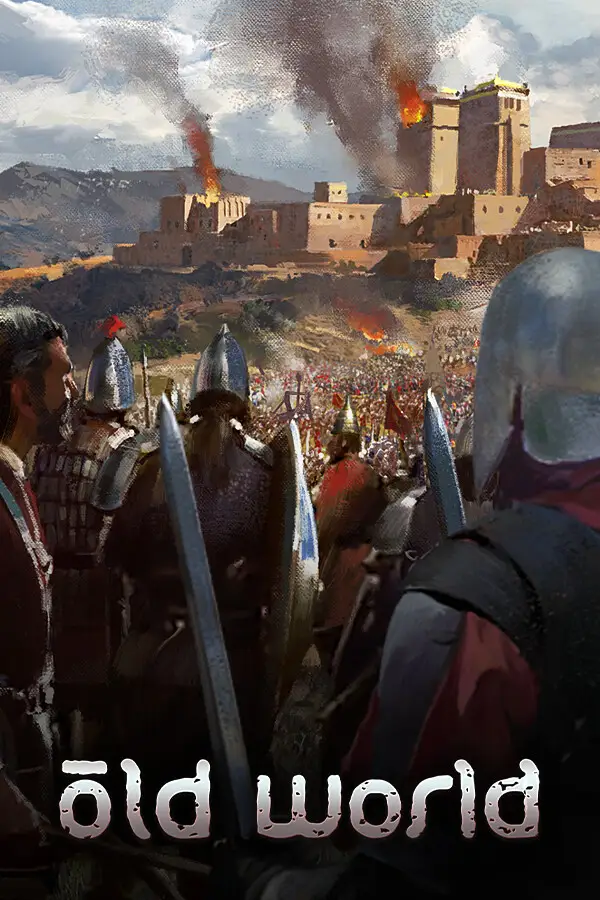

Old World
Price History
Past 36 months · Updated dailyPrices cover Steam and 39 authorized stores; only legitimate offers are counted. The chart shows weekly market-wide lows and Steam's official price across the past 36 months.

01About Old World
Old World is a historical 4X strategy game about guiding an empire across generations, developing cities, waging wars, and building a dynasty. Rulers and important characters age, gain traits, and die, leaving successors to carry on their legacy. Noble families, marriages, events, and diplomacy shape each reign. Handcrafted or randomly generated maps, scenarios, challenges, and multiplayer modes broaden the campaigns. The Steam PC version supports single-player and multiplayer. Interface text and subtitles are available in Simplified Chinese, Traditional Chinese, English, French, German, Spanish, Japanese, Russian, Portuguese-Brazil, and Korean. The game released on May 18, 2022. 82% of 6,049 Steam reviews are positive.
Credits
Lowest recorded in 36 months
$0.932026-07-30 · KinguinBase game · same records as the chart above; USD history, not a regional Steam low.Language support
| Language | Interface | Subtitles | Audio |
|---|---|---|---|
| Simplified Chinese | Yes | Yes | — |
| Traditional Chinese | Yes | Yes | — |
| English | Yes | Yes | — |
Show 7 more languages
| Language | Interface | Subtitles | Audio |
|---|---|---|---|
| French | Yes | Yes | — |
| German | Yes | Yes | — |
| Spanish | Yes | Yes | — |
| Japanese | Yes | Yes | — |
| Russian | Yes | Yes | — |
| Portuguese-Brazil | Yes | Yes | — |
| Korean | Yes | Yes | — |
Steam PC edition data · 2026-10-13
02Before you buy
Modes
The Steam PC version supports single-player and multiplayer, including hotseat, asynchronous, and cloud modes. Steam Cloud and cross-platform multiplayer are also listed.
Language
Interface text and subtitles are available in English, French, German, Italian, Spanish, Japanese, Polish, Brazilian Portuguese, Simplified Chinese, and Traditional Chinese. Full audio is not listed.
Controller and requirements
The Steam PC categories do not list full controller support, and the supplied facts do not include system requirements.
03Frequently asked questions
What is the core premise?
You guide a realm across generations while rulers age, fall ill, and die. Successors inherit the dynasty and unfinished ambitions.
How do families matter?
Each of the seven kingdoms has four noble families. Events, actions, and marriages shape their relationships, producing benefits or conflict.
What content is included?
The game includes handcrafted and randomly generated maps, historically inspired scenarios, weekly challenges, and more than 3,000 unique events.
How does its 4X system differ?
Units draw from a realm-wide pool of Orders and can move multiple times per turn until fatigued or the pool is depleted.
Popular Steam reviews
Native-language selection · 10 reviewsSelected helpful reviews in this language show both recommendations and criticisms. This selection does not represent the overall positive rating; opinions reflect the version reviewed.
This review is written for people who like Paradox games and Civ-alikes, rather than more general 4X games. If you like those two things, this is a good mixture of the two things, however there is nothing revolutionary here. This is what in tabletop rpg's we would call a "Heartbreaker" type game. It's someone looking at their inspirations and saying "I can't make something NEW out of this, but I think I can remix it to be BETTER." It largely succeeds at that, but lacks the charm of Civilization, and lacks the RNG and event emphasis of CK2 or Stellaris. Decisions are fed to you in tiny microdoses and if that is your thing, this game will provide a nice experience slightly different from the above mentioned games. If you're looking for a ruler simulator, look elsewhere. If you're looking to finish a game in a single sit down, look elsewhere. If you have little experience with 4x games outside of Civilization, I think this game will come off extremely interesting and a little fresher. like a slightly more advanced version of it. So if you want Civilization with more subsystems, this is your game. [Qualifiers: 2k hours in Civ6, Civ5, around 2k hours in Stellaris and CK2)Show moreShow less
I strongly disagree with the combat system. 1. Enemy units move over your entire vision range in one turn. I've seen elephants from their capital embark go 7 tiles on boat disembark walk 4 tiles and attack. In a single round. Building fronts is just madness. 2. Units that attack take no damage. This is even more absurd. What is this simulating? Game play wise this leads to insane optimal strategies. Since if you are attacked by your western neighbor you should have all you units as far from the front as possible, that you can let them enter deep into your territory and then just kill them with the counterattack taking no damage. What? This also makes combat incredibly one sided. You either just mop the floor with them or vice versa. Edit: After more time i maintain my criticism. The infinite movement is really insane. The enemy is breaking through at the center? Just teleport in 6 units to kill them. Need a unit to finish off an enemy unit? Just teleport a cavalry unit 20 tiles(for three orders over boats btw) and finish off not one but three enemies. On the opponents turn you get to watch this from the other side. Fresh spawned Units just walk from Assur to Babylon(500km in rl) in one round and attack. The effect is that you essentially just trade off units and combat devolves to a drunken bar fight in a chaos dimension. It also devalues a lot of decision making, because mistakes in unit distribution are easily mitigated by just teleporting. There is no possibility to perfectly position your units so you lose nothing in the counterattack because you will be attacked from newly produced units halfway around the world that you obviously could not know about/plan for. Yes if you are inefficient with your orders you pay in the long run. In the context of the war i never ran out of orders for my units (just for everything else at times). If you have a slight advantage you just snowball because defensive positions do not exist. (Not even a city wall(and subsequent defensive buildings)/stronghold/citadel building keeps enemies from entering your urban areas) For me the conclusion is: Tactical combat in old world feels like stepping into a insanity dimension of teleporting bronze-iron age units. If you can accept this it might be worth trying, since it is overall very innovative in every system. I will just mention one and otherwise refer to other reviews: The order mechanic makes alliances incredibly important. If you can get another civ to declare war on a common target and you have 80 orders of your alliance against 40 orders for the target they will loose even if their military would be strong enough to fight both, they just can’t order their troops to fight both. So the setup before the war, the posturing at the border can be genuinely interesting, once the war starts the dice are cast and it gets boring to me. For this reason Multiplayer might be very interesting/stressful. (Though i have not and probably will not try.)Show moreShow less
The bastard child of the Civ and CK dynasties. Due to its illegitimate birth, it was raised outside of the Steam court and only recently admitted into the halls of power. Despite some rough edges, it has successfully integrated the greatest strengths of its parental lineages, and with the brilliantly simple orders system it brings a youthful vigour into the echoing halls of strategy gaming. A worthy heir, perhaps?Show moreShow less
5/10 so-so. I took the plunge because some reviews raved about it being "better" than Civilisation and that the game was a mix of Civ with Crusader Kings. In reality, it's a fairly narrowly focused 4x game, think of Civilisation but with just the one 'era', and a handful of nations to play with. There are some unique mechanics; Cities can only be settled on pre-defined city sites for example, you also don't benefit from 'tiles' unless you build an economic action (i.e. a farm, mine) on them, and you also can't get luxury resources until you build the economic action PLUS a specialist unit on them. The mechanics make it different, a little flavour to the whole thing, but it's still at its heart a civilisation building game, with the same tricks as always - expand, exploit massively, and carry a bigger stick than your rivals. The other 'unique' spin on the game is a bit of Crusader Kings, you have to settle cities with 'families', who all bring different things to the table; A military family will make a city a military powerhouse, whilst landowners classes make ideal farming cities etc. You get to pick 3 from 4 families, and these families dictate your overall build of cities (ideally), so everytime you find nice farmland areas, out come the landowning classes, and anytime you find a nice seafaring spot, you might pick a family that offers strong naval bonuses. Thrown into this mix, are a fairly watered down family and character setting, with various events to go through ~ you marry people off, have children, educate them for when your leader dies, and so on. Keeping everyone happy is another cog in the machine, but it seldom feels unique and interesting in the grand scheme of things, for me anyway. Overall, it's a decent, average attempt at the genre. Worth the full price? Nope. Worth the sale price? Probably not, unless you get it under £20 personally, unless you're a massive Civ style fan, in which case you probably already own the damn thing. I think it's worth a try, but whether you'll stick to it, is up in the air, it just doesn't really feel that compelling to hang around in tbh.Show moreShow less
Really great game if you like this kind of stuff. Compares to the best. Pushes all my buttons. Plus I am 72 so I really love the name. I live in it. But really, buy it because you will love it.Show moreShow less
I gave it a shot, I really did. I'm a historian of the classical world (early Roman empire, specifically), so this was a really easy sell for me thematically, but I'm just not having fun. I really liked some aspects, such as the music, the setting, the artwork of the character portraits, the graphics in general. I actually enjoyed the pre-set city aspects, take the rushing like a maniac for a really strategic spot such as can happen in Civ games. I enjoyed the order system once I got my head around it, though clearly I was doing something wrong as my opponents seemed to have at least twice at many as I did at all times. What I didn't enjoy is far more substantial. The graphics are good, but they're also weirdly fuzzy and hard to discern - everything kind of looks the same. Civ V, when you highlighted strategic resources, gave very clear sharp icons that made it really easy to recognize what was what on a grounded map. By comparison, in OW you get a tiny font text saying the what you are looking at is dyes. I found it tiring to use, and having to zoom in constnatly to see what was what is kind of annoying. I found the almost constant barrage of decisions just got worse and worse as the game went on. I get the dynastic qualities that take from Crusader Kings, but I don't find it enjoyable. Characters die pretty damn fast (which I gather can be lengthened in the options, but I can't be bothered to run an entirely new game to see how this works out), but in the end, there are so many members of the court and family, and they die off so rapidly, that who cares. Picking a governors can take several minutes looking at the massive lists of bonuses and maluses, and that might be over four or five candidates, and before you know it, they're dead. The last turn I played before quitting, I had seven different pop up decisions to make before I could even move units, build things, etc. By the last few I just clicked what seemed the least damaging decisions. Speaking of decisions, it doesn't seem to matter what you do regarding opponents, they arbitrarily hate you, or if they love you, their opinion spins on a pin to loathing you - have a ruler of Rome who's your buddy? Well his son is a psychopathic drunk and the years of trade and peace doesn't mean jack anymore and the Roman state despises you. It's not particularly fun in game terms, plus making relationships with the ai seems to boil down to massively bribing them or kowtowing to their demands. I also really hate the "You must declare war on A to stay at peace with B, or declare was on B to stay at peace with A" decisions - screw you game, I'm classical Switzerland! Fear my chocolate and clocks! But, but, all these, the not great graphical display, the decision fatigue, the crappy diplomacy, the endless seemingly irrelevant choices, the increasingly massive and unwieldy court that becomes a chore to manage, all this is trumped by the one straw that breaks the camel archers back. Combat sucks. I mean, I really really don't like, and it could have redeemed the entire experience for me, but it doesn't, it sweeps the legs and riffles through the pockets of the fallen. And I think I've worked out the most egregious aspects. For me its that there really is no defensive aspect - yes you can build forts, and units take less ranged damage in trees, but that's because to be on the open terrain is suicide. Units take pretty huge damage (sometimes half), but do virtually no retaliatory damage, so you're forced into constant attack. And units die soooo rapidly, I don't know if I'm just not getting some game mechanic (but I can't be the only player) but I hit end turn, the enemy wipe out one of two units, I do virtually no damage back, they retreat their damaged units, then the Mongol Horde of reinforcements suddenly come out of the fog of war. Did I mention that that unit that got wiped out (with its general and five promotions) took 7 turns to build? Maybe 10 for large units, but they die just as fast. So yes, combat feels like a frustrating sloggy mess with a cheaty little ♥♥♥♥♥ of an ai. I don't find it fun, and for me that really hamstrings any fun from the game. So, if you've read through this, please reward yourself with a cookie, biscuit, or treat of some local variety, hail Caesar, and have a very good day.Show moreShow less
Old World is a brilliant historical 4X strategy game that is much more than the sum of its parts. It has dethroned Civ4 as my all-time favourite strategy game. Here’s 14 reasons why: 1. History in Depth not History in Passing Old World is set in antiquity, from the late Bronze Age through to the end of the Iron Age. Focusing on one period of history like this brings the setting to life in ways that just aren’t possible in all-of-history games like Civ. There’s really good integration and balance of economic, diplomatic, and militaristic gameplay. You get time to make use of each unit tier. Your buildings and wonders don’t need to go obsolete. You get time to explore and play to the map. You get time to engage with historical characters and cultural details. You’re not rushing through history or playing insanely long games to compensate for it. Progression comes not just from tech and expansion and ever-increasing yields but from the stories that develop. That "One More Turn" feeling is here in abundance. 2. Emergent Storytelling Turns out that characters and events are a superb fit for the 4X genre. They add drama and intrigue, internal instability, richer diplomatic interactions, and help make your civilization feel more alive and your decisions more meaningful. There are families and priests to placate, characters age and marry and die, and there are all sorts of succession shenanigans. No immortal cartoon figureheads! The stories that emerge are a lot of fun and help make the game even more replayable, encouraging you to try different strategies and make unusual choices. They help keep gameplay engaging when you’re winning as well as when you’re losing. In fact, some of the most fun I’ve had playing is when a game is going badly for me. 3. Depth of Design Old World isn’t afraid to break some long-held genre conventions and it does so in a way that solves many problems of the genre. The developers have borrowed concepts and mechanics from other games (PC and tabletop) and meshed them together brilliantly. Nothing feels superfluous or tacked on and everything is interconnected cleverly. The more you play, the more this depth is revealed, and the more you’ll wonder why other 4X games don’t adopt similar mechanics. Fans of Civ IV might be wary of Old World having 1UPT and tactical combat. Fear not, it works brilliantly here. 4. Competent AI The AI is the best in the genre. It’s quite capable of defeating you, especially in combat. It knows the rules of the game and it knows how to play them very well. It doesn’t cheat and it doesn’t rely on bonuses or handicaps, though you can customise it with either should you wish. When you first start playing, be sure to play through the excellent tutorials and Learn by Playing scenarios and start on a low difficulty setting. Especially if you’re a Civ veteran. Despite its heritage, expecting Old World to play like Civ is a surefire path to defeat. You’ll need to ‘unlearn’ quite a bit, but it is well worth doing so. 5. Great Scenarios and Campaigns The main game is the main draw, but don’t overlook the included (and DLC) scenarios and campaigns. They are excellent and well worth playing and replaying, rich in historical detail and sometimes feature entirely new game mechanics. 6. Customizable and Moddable The Advanced Settings screen is a thing of beauty. Many aspects of gameplay and difficulty can be adjusted, and some mechanics (e.g. characters or events) can be switched off almost entirely. It’s easy to tailor the game just how you like it. But if that’s not enough, Old World also has very comprehensive mod support. There’s a built-in map editor, event editor, and portrait editor. There’s a built-in mod manager. Steam Workshop and mod.io are supported. Extensive changes are possible from XML adjustments alone, but if you want to delve in even deeper, most of the C# source code is included with the installation. 7. Effective UI 4X UI is notoriously hard to do well, but Old World’s is better than most. Although it can feel a bit "modular" in places, everything you need is there, and even after years of playing I’m still discovering cool little quality-of-life features. Tooltips are comprehensive and nested – tooltips for tooltips! The Encyclopedia is helpful but it’s mostly a repository of tooltip info and doesn’t contain very much historical or strategic detail. Other than that, the UI is better than in any edition of Civ. No 'consolitis' here! 8. Looks Good Terrain and city graphics are beautiful and semi-naturalistic, similar in style to Civ 5 but more attractive and detailed. Unit graphics and animations are decent, though unfortunately without much cultural variety. Character portrait and event art is done in a faux oil painting style which is gorgeous and really suits the historical theme. There are no wonder completion animations, intro or victory movies, but that’s to be expected from an indie studio without the budget of Firaxis. 9. Sounds Good Sound design is good and the soundtrack is absolutely wonderful. A really great selection of historical instrumentals and vocal chants as well as several new compositions by Christopher Tin (who wrote Civ IV’s Baba Yetu). 10. Runs Good On my Mac (M1 Max) everything runs smoothly (50-70fps) at 4K, even on huge maps with every nation. Turn processing time is decent and there’s minimal endgame slowdown. Your experience may vary, obviously. The game is also quite quick to launch without endless annoying splash screens and messages. 11. Native Mac and Linux Support Native Apple Silicon build. Same-day updates. Same-day DLC. Cross-platform multiplayer. Saved game compatibility. Full modding compatibility (even for DLL mods). I urge all Mac and Linux users with even a passing interest in strategy gaming to buy the game and support these indie developers because they’re doing a much better job of this than Firaxis or Paradox ever have. 12. Nails the Basics No launcher. No anti-cheat. No online requirement. Free demo. Excellent tutorials. A proper old-school manual with extensive strategy tips. Solid array of accessibility features. Updates that don’t break saved games. No need to save scum because there is an UNDO button! You don’t even need to own the same DLC to play multiplayer. Pure class. 13. Keeps Getting Better Old World was great at launch but now it’s absolutely excellent. There’ve been free updates every 3-4 weeks since launch, not just for bug and balance fixes but often adding new features and quality-of-life improvements as well. The base game is balanced and complete; you do not need any of the DLC to enjoy the game. But once you’re hooked you’ll want all of the DLC because they add a lot of extra depth and diversity. 14. Phenomenal Developer Support Possibly the game’s greatest strength. The developers are accessible and helpful, responsive to feedback, open to suggestions, fast to fix bugs, and innovative when addressing imbalances. It’s clear that they genuinely love and understand what makes the genre so great and what makes this era of history so compelling.Show moreShow less
I hate having to give Old World a negative review. From the moment I opened it up and started exploring the game options, to playing through my first game, I could see the countless places where the developers of this game clearly saw some of the deepest design flaws of Civilization and came up with clever ways to remedy them. There are some real clever ideas here; this game has more novel ideas than Civilization has had in at least a decade, and I think the developers really genuinely cared about trying to create a game fundamentally more interesting than Civ. But the sum total of all those ideas is, unfortunately, just not very fun. As the game goes on it gets more and more nightmarishly micromanagement-heavy. Some of the strategy games I love most are filled with micromanagement -- I'm someone who enjoys Hearts of Iron and Victoria -- but the micro here ends up turning into a draining chore. Old World presents me with a dizzying array of choices, but almost none of them actually matter that much, so it doesn't feel at all satisfying that I made them. The later-game balance feels particularly all over the place; because cities just keep expanding (not to mention the option to buy tiles), even a small number of workers easily turns into incomes of 100-200+ per turn of the core resources, to the point where none of them even matter anymore. And some of the late-game stuff like buying and selling orders, combined with the law that lets you buy at the same price you sell... it feels like the whole economy just starts to fall apart as all the game's various Numbers balloon. In the end, Old World has a crisis of identity that it never really solves. It asks you to manage a micro-heavy Civ-like where your empire gets more grindy to manage every turn (the enormous number of tiles cities cover exacerbates this), while at the same time optimizing an ever-increasing array of courtiers and heirs. Both of these things sound like they should be fun, but somehow as the game goes on they turn into a chore instead. I can't even imagine how one would "fix" this game; it just seems fundamentally frustrating to play at its core, despite being built out of a whole pile of rather good ideas.Show moreShow less
At the end of a busy week I used to pour myself a red wine and play Civ V. But that was years ago. I tried to adjust to the Civ VI art style but … Anyway, I'm giving OW a shot and this is my first game review ever. I'm having fun … getting frustrated … having fun … getting frustrated … taking a break … and then having fun. It's only early days but I've realised now that my old Civ V mindset can be the main source of my frustration. Also, interestingly, once I better understand a new OW mechanic, I usually find that it's an improvement. For example, I'm used to building a diplomatic relationship with the one abstract leader (George Washington in Classical Antiquity?) that is continuous and consistent for many centuries. But now my political influence has to extend to both the leader and their heir (like in real history). I have to be prepared for … or take advantage of … their internal regime changes (like in real history). And I have to prepare for my own nation's succession (like in real history). All of this initially frustrated me but now I'm having fun with it. Another example, combat, I'm used to enemy warriors moving only 2 hexes in a 40 year turn and taking retaliatory damage while they attack. But now, in a 1 year turn, an invading warrior can cross my border, move several hexes and attack one of my workers near the capital (like in real history). It's also up to me to retaliate (like in real history). This initially frustrated me but now I'm having fun adapting my military tactics. Another example, the significant (emotional) investment in armies. I'm used to pumping out units and spacing them out along the border. No problem if I lose a few, I can build some more. But now, I assign my leader, courtiers or family members as generals (like in real history). The units develop using a new training resource. They achieve promotions (like in real history). Now, when I lose an army, I feel the loss. I'm yet to see the Teutoburg Forest on the map but when hordes of raiders descend out of the trees to annihilate three of my armies I want to yell, "Varus, give me back my legions!" and then rage quit and rage review on steam … until I take a break and then come back for some more fun. I've experienced several other examples of the fun/frustration/fun cycle eg. the orders system, the technology card system and the fixed city sites. But there are other examples of new mechanics where I have had only fun. Expanding borders is interesting with certain events, placing specialists in city improvements and buying tiles allowing expansion to that important resource just outside my territory. Cities being connected by rivers and the ocean is interesting (build a short section of road between the inland sources of two rivers to create a long network). Using different resources (food, iron, stone and wood) to build various items is fantastic. Managing families and courtiers is in enough detail for me to enjoy in a 4X empire building game without the extreme psychology of a CK game. OW can be customised in so many different ways. The number of event/decisions can be reduced to minimal if CK is not your style. There is a Colorblind Filter (which helps me) and tooltip sizes can be enlarged (which may help others?). For those wanting an epic Classical Antiquity experience, there is a choice of real Earth regional maps, each turn can be a semester (instead of a year) and the 200 turn limit can be switched off if you want to keep on playing forever. You choose how you want to play … and I don't even know what mods will do? Personally, I think the appearance of the map and the artwork is perfect for this type of slower-paced thinking game and I'm finding my way around the UI without any problems. As I say, it's early days for me and there is still so much more to learn, but I wanted to get my first impressions review out early in case other Civ V players (history fans) are experiencing something similar? My suggestion is to have patience. I'm happy to give OW a left-hand thumbs up and a right-hand wine glass raise. Cheers!Show moreShow less
Game has promise, but in current state ends up feeling bland. The only way to properly win is to never, ever engage in warfare with another nation. Or at the very least, wait until they've just finished fighting another nation and wiped out most of their military forces first. Because you'll find yourself leading an army of 5-10 units in a siege of a city.. And all of a sudden 6 enemy troops come from half way across the map, annihilate 3 of your troops, mostly get killed off in the next round, just for another 6 enemy troops to suddenly appear again and murder the rest of your army. With only having 200 years to play in I understand needing to have high mobility for troops... But it's ridiculous just how quickly you can move massive troop forces and how the AI just seems to always have more available. The family concept and events sounded fun at first. Seemed like a good way to engage. But most of your rulers will be in their 40's when they take over and will die in their 60's. By the time I got halfway through my first game I stopped caring about the characters except for what benefits they gave. There's no proper depth to them and a lot of times you'll be buggered by RNG anyways. Got a super promising prince set up to take over leadership? Oh no! He got into a fight at school and now he's wounded. And now he's dead. That's okay, you had a daughter second in line! But her tutor is a bit strange.. And now she's a lunatic. That's okay though, a neighboring nation that you've been just barely avoiding war with has decided they want to marry a son to her anyways. Your two prospects? ♥♥♥♥♥♥ and ♥♥♥♥♥♥. Rejecting them though? Insults the nation and incites them to war. The whole ambitions for victory thing also just strikes me as weird and kinda shallow. Why would the other nations care that your dynasty managed to reach some milestone of ambitions? Your culture isn't that amazing. You aren't that technologically advanced. And you sure as hell didn't defeat them in combat and conquer them. But dang. You did happen to make five improvements a total of 10 times! As I said though, the game does show promise. I like the diversity of the nations. There's a lot of map types. The graphics aren't bad. The improvement system is nicely done. The city development needs a lot more to it I feel, more in line with how you develop cities in civ, but it's got bones to develop on. The actual events can be intriguing and some could be really good starts for engaging and on going stories. This could be a great game. It truly could be. As of right now though? It's Civ with events and pointless combat.Show moreShow less
Source: original Steam user reviews. Helpful votes are an archived snapshot, not live data. Last collected: 08/15/2026.