





















Opening
Take away a player's ability to fight back, hand them a camcorder with a dying battery, and lock the doors behind them. That is the entire pitch of Outlast, and more than a decade on, it remains one of the most uncomfortable promises a horror game has ever kept. You are not a soldier clearing a building. You are a journalist with a broken leg, hiding in a locker, praying the footsteps in the corridor fade before the night-vision runs dry.

Red Barrels — ten people, fourteen months, a debut — understood something most studios with ten times the budget still miss: fear is loudest when you strip the player of agency. There is no weapon, no health bar, no clever counter. There is only running, hiding, and the cold arithmetic of how long your camera can light the dark. This review walks through every face of that design, and asks why a tower built entirely on helplessness has proven so stubbornly difficult to knock down.
Story | 8.5/10
Story: 8.5/10Outlast tells its story the hard way — not through cutscenes, but through the documents you choose to read and the footage you choose to shoot. The deeper you dig for the truth, the closer the truth drags you to the centre of the danger. That binding of narrative to risk is the smartest thing the script does.
A journalist walks in by choice
Freelance journalist Miles Upshur gets an anonymous email about human experiments at Mount Massive Asylum, a remote facility run by the Murkoff Corporation, and drives out alone in the dead of night. The detail that matters is the choice. Miles is not a victim who stumbled in; he is an investigator who decided to walk through the front door. Every step deeper carries the weight of a fate he picked for himself, and that single framing decision colours the whole game.
Moments after he gets inside, an enormous figure throws him through a window and shatters his leg, trapping him for the rest of the night. His only tool is the camcorder, and whenever he records something important, his own handwritten note scrawls across the corner of the frame. That "reporter's scratchpad" device welds the player to the investigator's point of view. The horror and the storytelling stop being two separate layers and become a single experience — you are not watching a plot unfold, you are filing the report.
Three antagonists, three flavours of dread
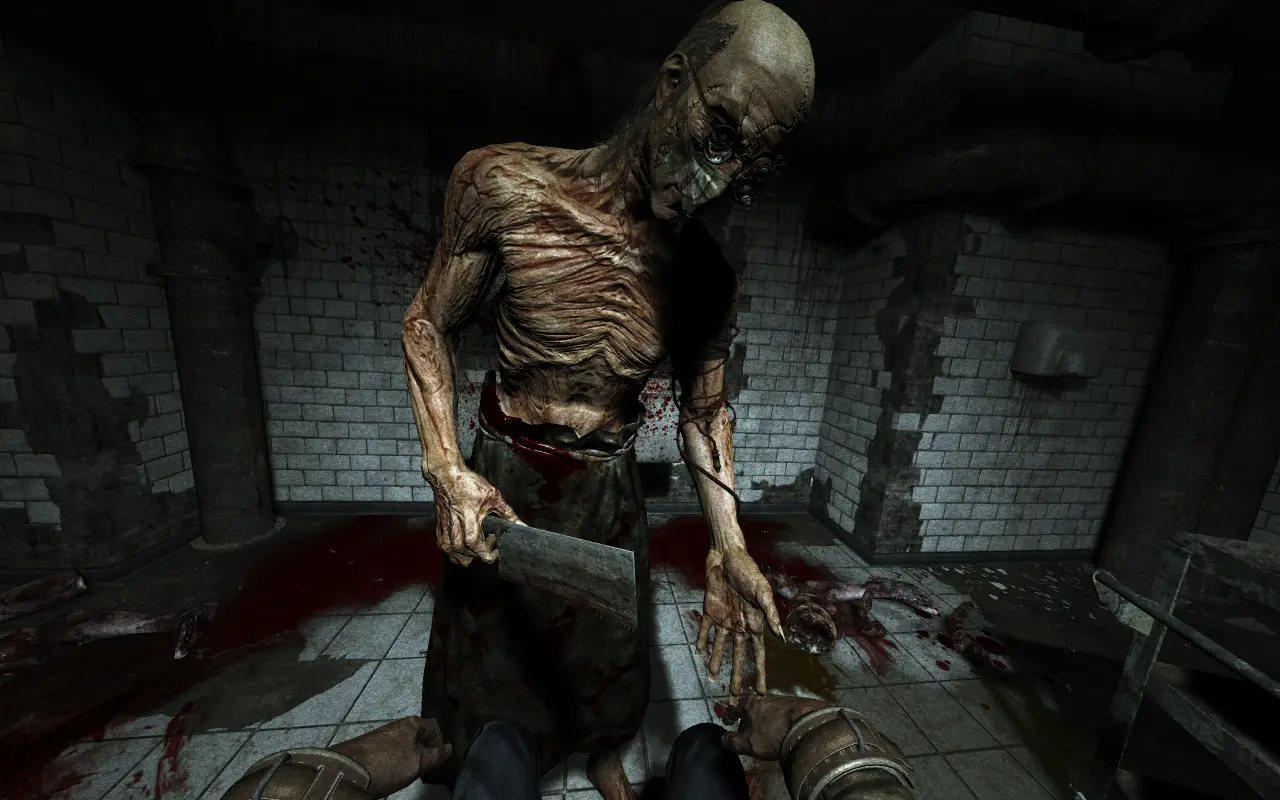
The asylum's key figures each carry a different strain of horror, which keeps the threat from flattening into one note. Chris Walker, a transformed former military policeman, is the relentless pursuer of the main campaign — bulk you cannot out-muscle, only out-think. He embodies pure, physical inevitability.

Father Martin Archimbaud is a quieter terror entirely. He worships the supernatural presence as a deity, speaks to you almost tenderly, and is utterly unmoored from reality, eventually ending himself on a cross in the third-floor chapel as an act of devotion. His calm is more unsettling than any chase, because he is not trying to stop you so much as convert you, and a believer is always harder to reason with than a brute. Richard Trager — once a Murkoff executive, now a gleeful tormentor — pulls the fear down to a bodily, visceral register; the scene in which he removes two of Miles's fingers is, for many players, the single most unforgettable beat in the game. Pursuit-horror, faith-horror, body-horror: three figures, three escalating registers, each maxed out in turn.
The supernatural core and an ending with no exit
As you descend, the answer assembles itself: an entity called the Walrider, a swarm-like presence that needs a living host to act, originally bound to a comatose patient named Billy Hope. The collapse of the entire asylum is the fallout of one experiment that slipped its leash. Outlast never hands you this lore in a monologue; you earn it page by page, and that makes the dread feel discovered rather than delivered.
The ending refuses to let you off. Miles reaches the underground lab and shuts down Billy's life support, believing he has ended it — only to be surrounded by Murkoff's mercenaries. As the gunfire drops him, Dr. Wernicke murmurs that "he has become the host," implying Miles himself is now the Walrider's new vessel. There is no relief here, no triumphant exhale, no rescue waiting past the last door. The fear bleeds past the screen and lingers, turning the player's hard-won progress into the very mechanism of the trap. It is a genuinely heavy finish in an era that mostly settled for jolts, and it reframes everything you did to get there as a setup for one final, quiet gut-punch.
Whistleblower: the story sharpened
Beyond the main campaign, the Whistleblower DLC stars software engineer Waylon Park — the very man who sent Miles that anonymous email. Its timeline overlaps the original, letting you re-read the whole catastrophe from a second angle and filling in gaps the base game left deliberately open, so that two playthroughs become a single, fuller picture of the same night.
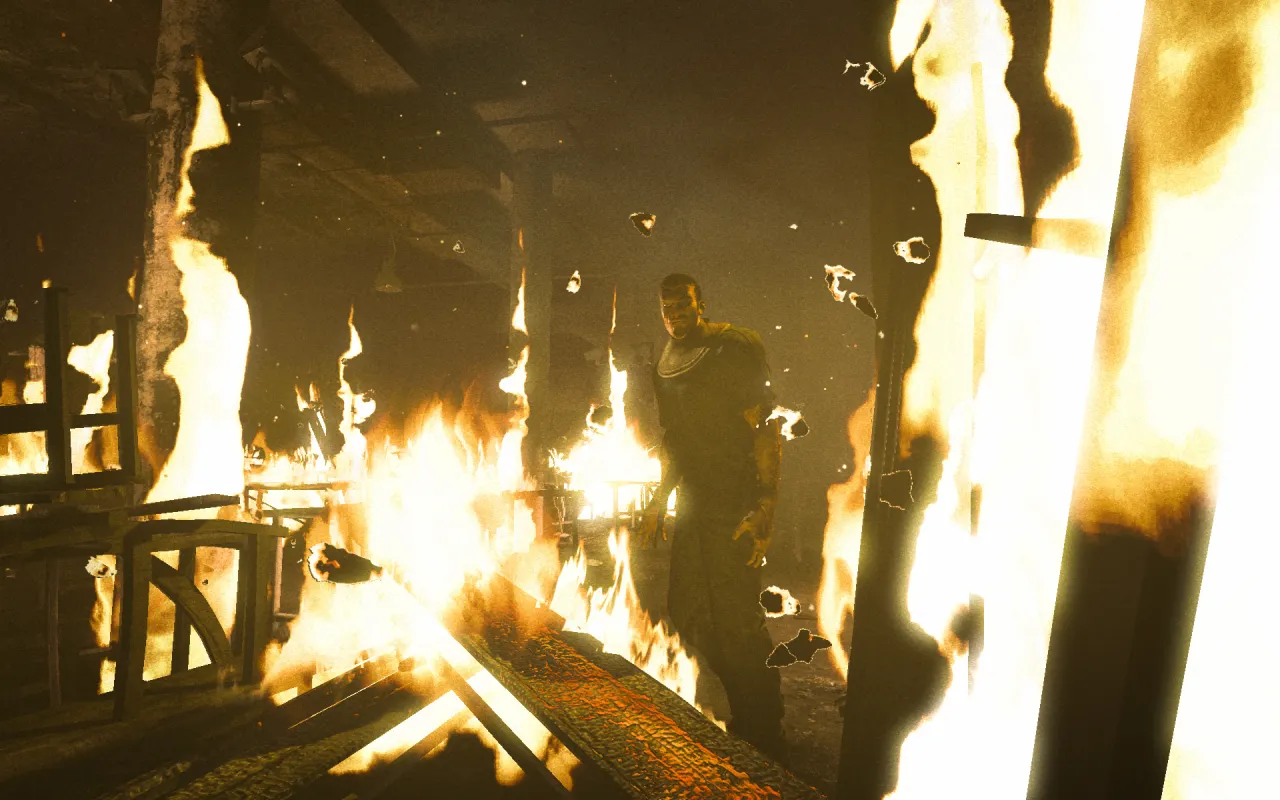
Across roughly four hours it introduces Dennis, a patient fractured into multiple personalities, and Eddie Gluskin, the so-called "Groom," who fixates obsessively on finding a "bride." Eddie carries genuine trauma yet curdles into something profoundly warped, and that mix of pity and revulsion is exactly why he has become one of the most discussed antagonists in the series, a character players argue over rather than simply fear. The consensus is plain: Whistleblower's scare density and dramatic punch outpace the back half of the base game. Set against the pure-atmosphere storytelling of Amnesia: The Dark Descent, Outlast simply draws its characters sharper, and they stick.
Audio | 8.5/10
Audio: 8.5/10Mute the screen and Outlast still works. Sound here is not garnish laid over the visuals; it stands shoulder to shoulder with the camcorder as a primary engine of fear, carrying a full half of the pressure.
The chase score: a string pulled to breaking
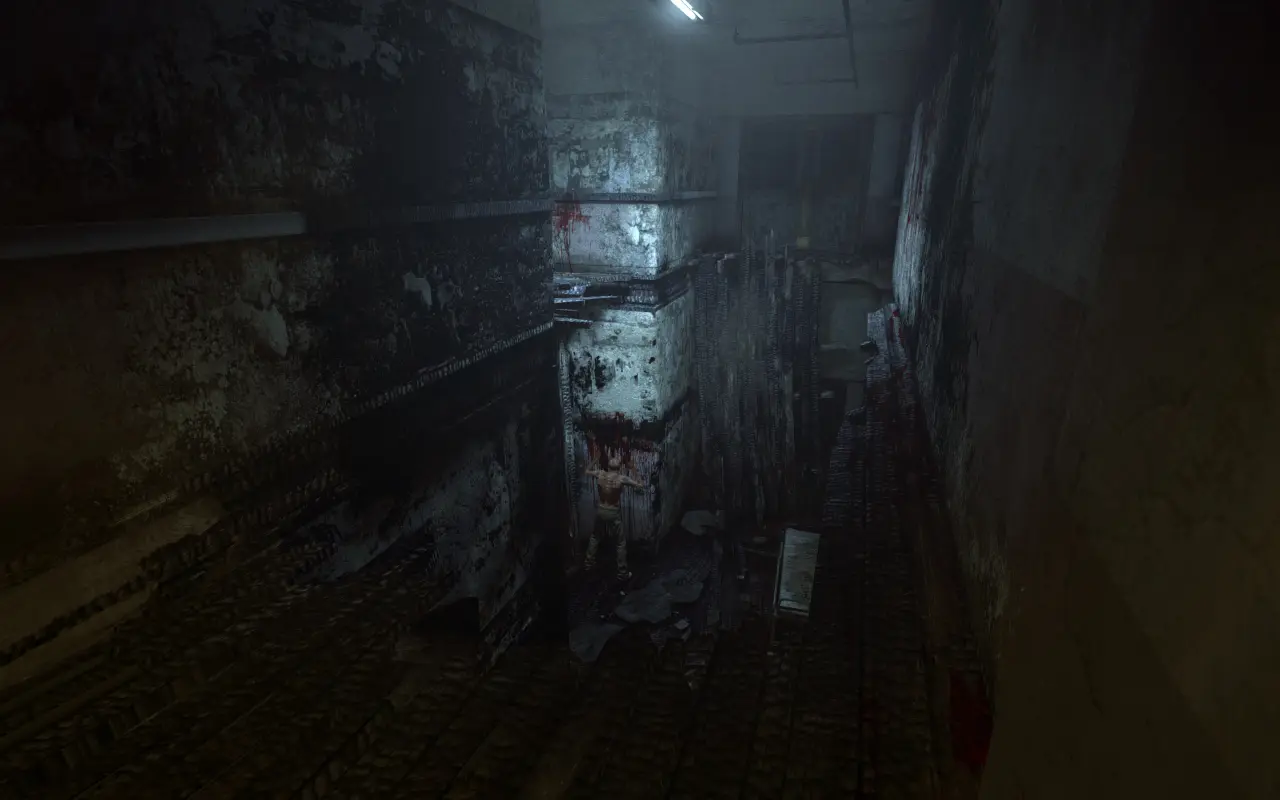
Composer Samuel Laflamme builds his best work on contrast. Exploration passes in near-total silence, the world unnervingly quiet — and then the moment a figure spots you, strings and percussion snap taut in a single instant. That heart-stopping surge is, for many, the most direct source of terror in the game. Players describe it the same way again and again: before you have even registered who is chasing you, the music alone has already turned your legs to water.
The "music as alarm" approach is clever precisely because it refuses to lean on constant volume. It works the gap between long silence and sudden eruption. Once you have settled into the quiet, the sting lands like a blow; once the cue fades, instinct tells you the danger has passed — which is exactly when the game likes to slip the next surprise through the seam.
That control over tension and release keeps the nerves stretched from start to finish, and it is what separates Outlast's audio from cheaper soundtracks that simply blare. A lesser game would loop a dread track over the whole asylum and call it tension. Laflamme trusts the silence to do the heavy lifting, and trusts the player to fill that silence with their own worst expectations. The result is a score that feels reactive rather than decorative — it is not playing at you, it is hunting with the things in the dark.
Negative space, and letting you scare yourself
The truly sophisticated move is the deliberate emptiness of exploration. In corridors with no score at all, you hear your own footsteps echo, a distant pipe dripping, a scream or a whisper leaking from somewhere far off. None of it jumps out to frighten you; all of it insists, quietly and continuously, that something is wrong here, holding you in the expectation that the next corner is hiding something.
What makes it sing is how tightly sound locks into play. The camcorder hums faintly while recording, the protagonist's heavy breathing gives away his position when he panics, and the scramble of footsteps during a chase is fear itself given a voice. These are not mere ambience; they are real, actionable information. Lower the camera in the dark and you are navigating almost entirely by ear, judging where a threat stands from sound alone.
Play with headphones and the soundstage pins you to your chair — which is exactly why nearly every review insists this is a headphones-mandatory game. The directional cues are precise enough that you can map a pursuer's path along a corridor without ever seeing it, and that knowledge is somehow worse than blindness; you hear it getting closer and there is nothing the sound lets you do but freeze. Hold it next to Amnesia: The Dark Descent, another master of audio dread, and Outlast still edges ahead on the sheer rhythmic impact of its chase music, planting its sound design firmly in the front rank of its generation.
Visuals | 6.5/10
Graphics: 6.5/10Visuals are the easiest stick to beat Outlast with, and also where it hides its most enduring image. By today's measure its fidelity has fallen behind, yet its art direction turned this asylum into one of the most recognisable locations horror has ever produced.
A dated engine, said plainly
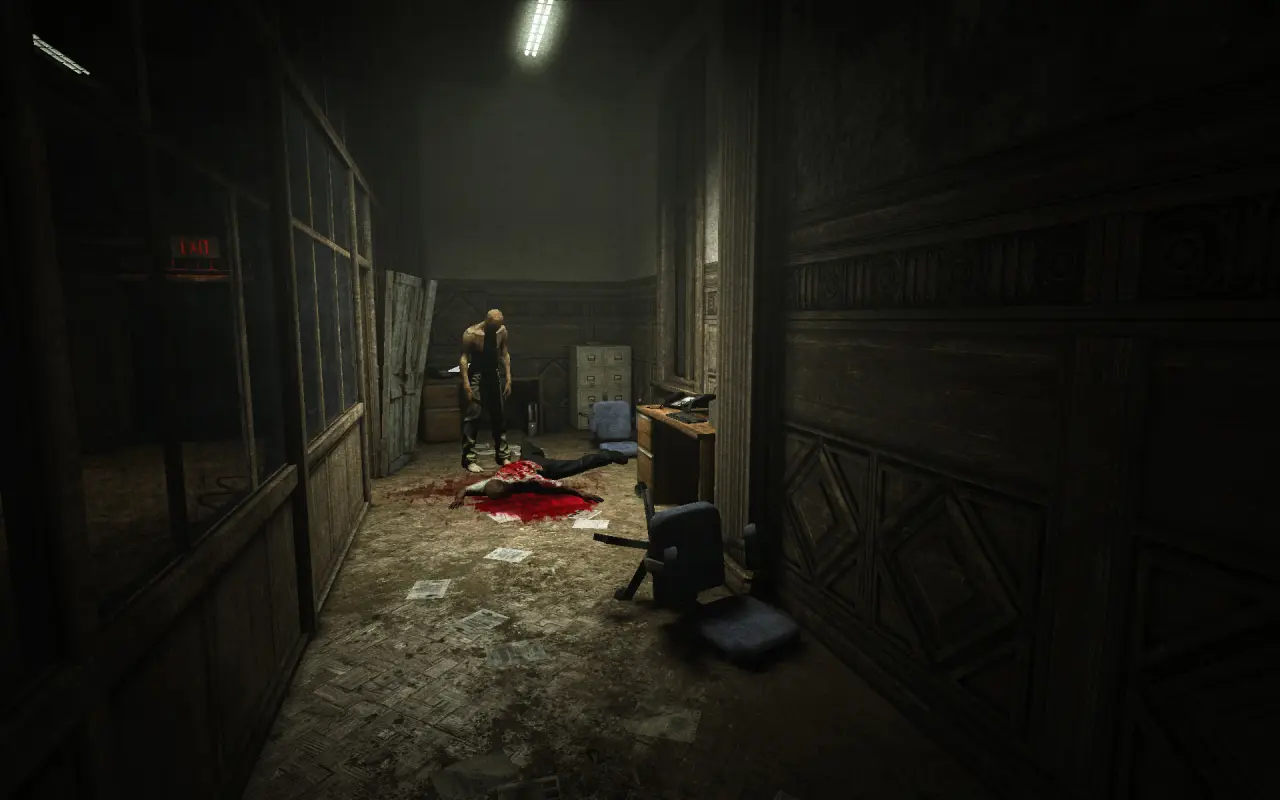
Outlast runs on Unreal Engine 3, and by its 2013 launch that engine was already past its prime. Looked at now, the hard edges of the models and the resolution of the textures wear their age openly; faces and close-up props do not survive a lingering camera. This is the one thing an honest review has to state without flinching — if you came for fidelity, the game cannot hand you the photoreal sheen of the 2020s, and no amount of goodwill changes that ceiling.
What is striking is that the dated tech never drags the horror down with it. The reason is structural: the field of view is deliberately narrowed at almost every turn. Darkness, night-vision, a tightly clipped sightline — all of it dilutes whatever roughness the textures carry. You spend most of the game staring into gloom, and gloom does not invite you to count polygons. The very constraint that should have exposed the engine's age instead becomes camouflage for it, and the limitation quietly turns into an asset the design leans on.
Art direction wins the fight technology lost
What actually carries the game's visual reputation is design, not horsepower. Mount Massive Asylum is enormously legible as a space: peeling walls, rusted beds, wards scrawled with frantic writing, and lights that gutter and sway combine into the specific, marrow-deep dread of an abandoned institution. Every room reads like a silent account of what happened here, and that environmental storytelling outclasses raw spec sheets every time. A studio with a smaller budget cannot out-render its competitors, but it can out-imagine them, and Red Barrels chose the second fight and won it decisively.
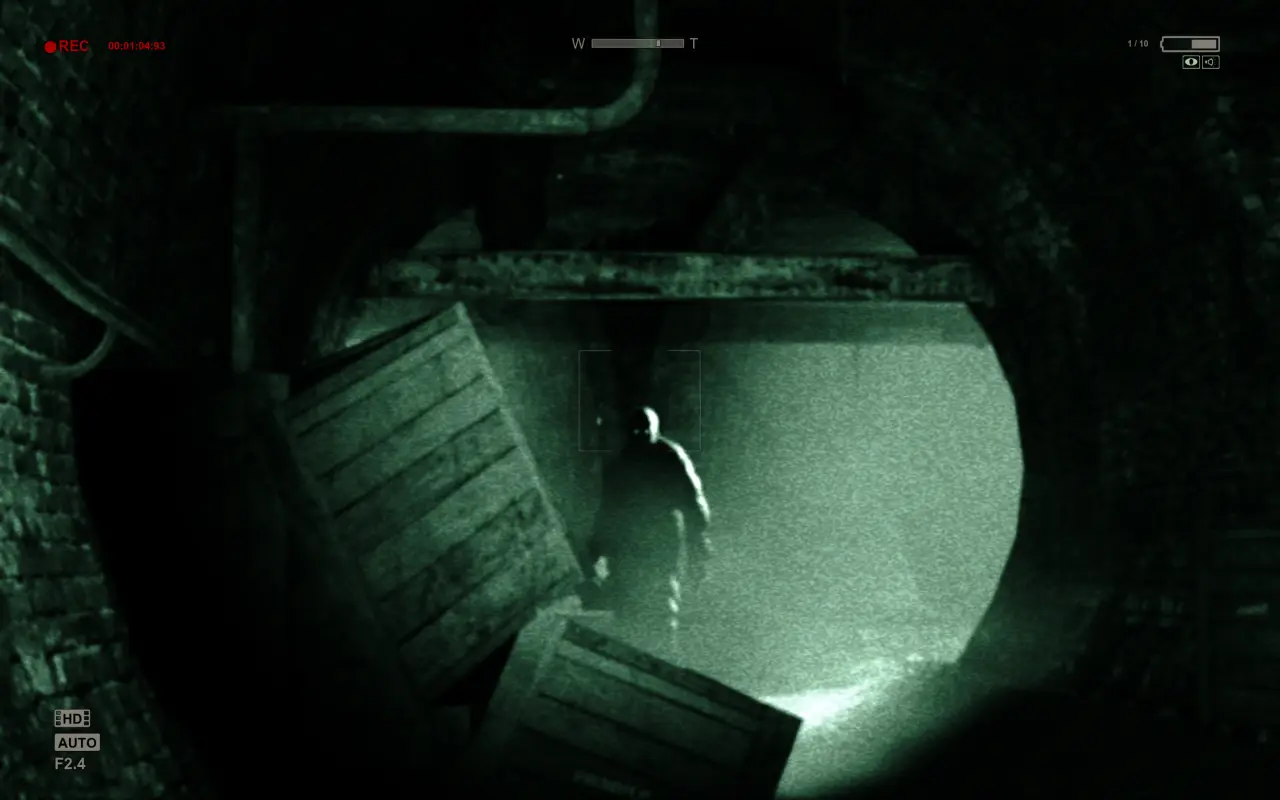
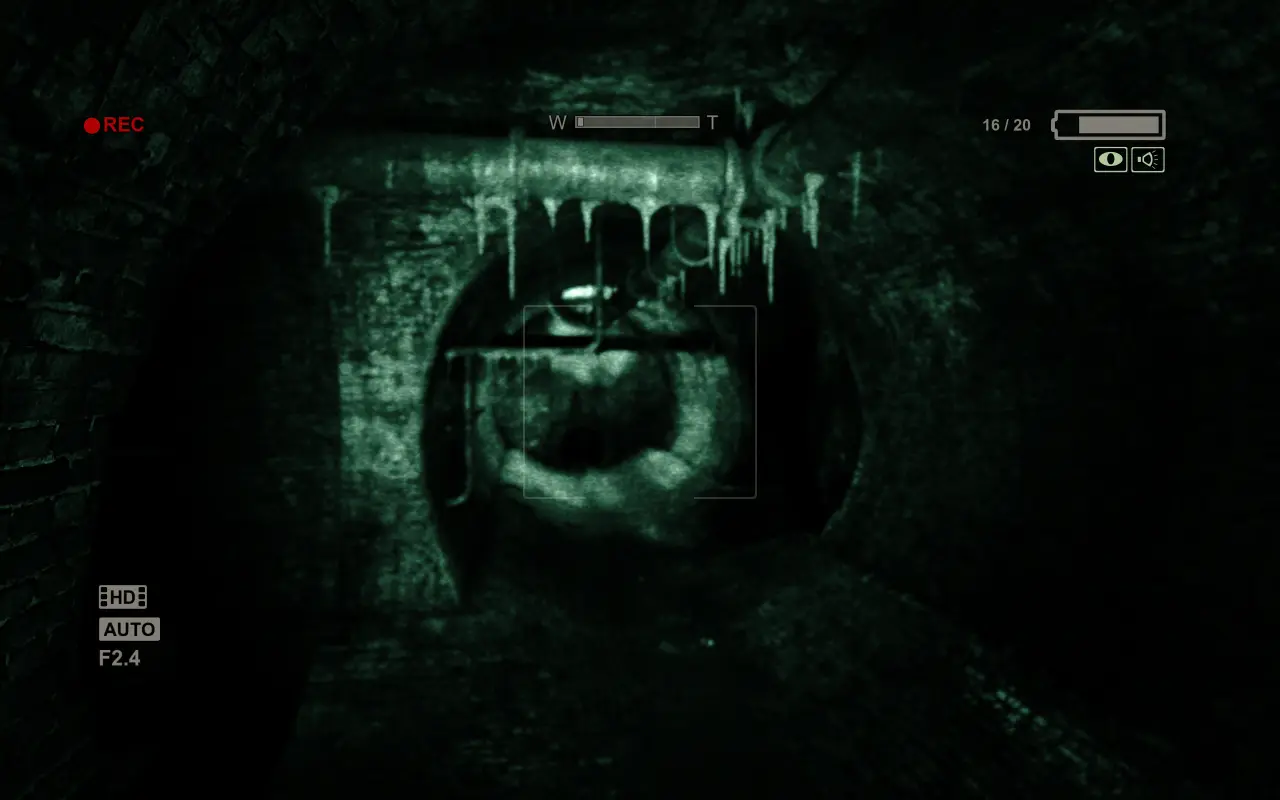
And the defining symbol is, without question, the grainy green wash of the camcorder's night-vision. Say the word "Outlast" and most players picture that green, static-flecked corridor and a face surfacing suddenly out of the black.
The construction of that single visual hook is a triumph. It went on to define the look of an entire strain of horror games, the green-tinted found-footage frame that a thousand streamers and successors have since borrowed. There is real craft in how the effect doubles as both light source and limiter — it shows you just enough to move and never enough to feel safe. Unremarkable on the tech sheet, perfect on recognisability, it is the rare visual idea that became shorthand for a whole genre.
Platforms and editions, each a trade-off
UE3 brought one more upside: friendly optimisation. Outlast asks little of the hardware, runs smoothly on mid-tier machines, and ships uncapped on PC, which lowered the barrier to entry back in the day and meant a streamer or a curious newcomer could run it on whatever they happened to own. It went on to land on PC, PS4, Xbox One, Linux, macOS and Switch — wide coverage by any standard, and part of why so many players have a personal first encounter with it.
Each version makes its own bargain. The PC build offers the highest fidelity and frame ceiling, and pairs best with a mouse for swinging the camcorder around; the PS4 release, once given away free to subscribers, did enormous work spreading the game to players who had never touched horror before, and arguably did more for the franchise's reach than any marketing line; the Switch Bundle of Terror packages the base game with Whistleblower, selling portability at the cost of some visual polish.
Taken together, Outlast is a clean case study in technology stepping aside for atmosphere. It left a deeper visual memory than many works with far more horsepower, and it did so on an engine already considered old at launch — proof, stated as plainly as the review can manage, that a horror game's visual punch was never decided by resolution or polygon counts alone. What you remember is the green static and the peeling wards, never the texture resolution, and that is the whole point.
Combat | 9.5/10
Gameplay: 9.5/10Gameplay is the soul of Outlast and the reason it earns its highest mark. The core idea reduces to a single sentence: strip away everything the player could fight back with, and leave only the running. That subtraction, counterintuitively, produces the purest and most helpless tension of its generation.
No combat, and the power handed to the room
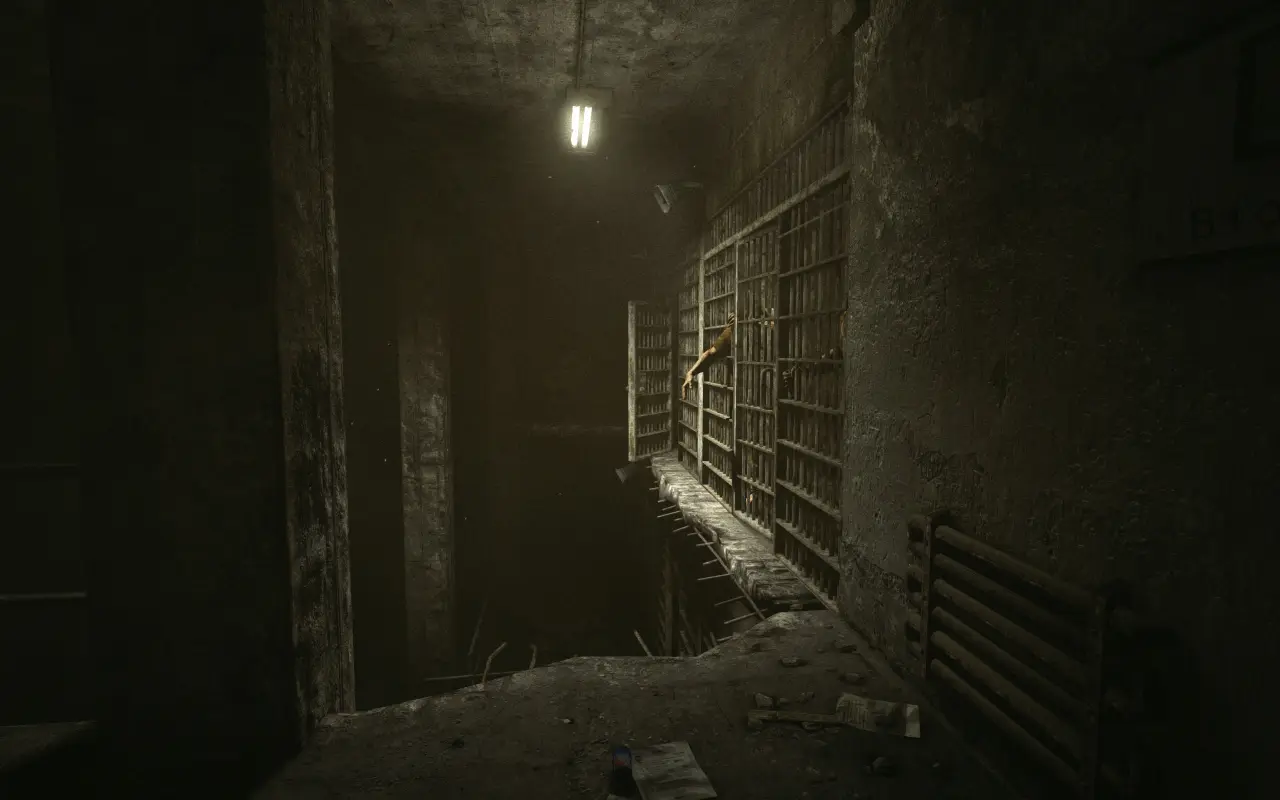
Most horror-action games equip you, and the tension comes from rationing supplies and health. Outlast does the opposite — it gives you nothing. Faced with a pursuer, your options are running, hiding, vaulting and crawling, full stop. That total powerlessness pins the player firmly into the role of prey; the fear stops being "can I win this fight" and becomes "can I get away."
The brilliance is in where the agency goes. Stripped from your hands, it is returned to the environment and the antagonist. You cannot reshape the situation, only adapt to it. When a hulking shape barrels down the corridor, your mind is not reaching for a weapon — it is racing through the nearest locker, the side passage that might shake him, the stamina you have left.
That forced, near-instinctive calculation is the deepest root of the game's dread. You are the hunted from the first minute to the last, and once that footing is set, the fear never lets go. Other horror games let you earn a moment of control — a weapon, a defensible chokepoint, a safe room with a typewriter. Outlast withholds all of it, and the withholding is the design. The few times the game hands you a brief reprieve, you do not relax; you brace, because you have learned that the floor is always about to drop away again.
The camcorder and its battery: a tool that becomes a threat
Your only crutch is that night-vision camcorder. It fits the journalist fiction and doubles as the sole light source in the dark — but the game wisely chains it. Night-vision drains batteries continuously, and when the charge dies, the screen goes pure black.

So you are forever scavenging batteries, and every activation of night-vision becomes a small gamble over a dwindling resource. Do I switch it on now? Can this charge last to the next pocket of safety? That standing tension turns the simple act of seeing into a decision with a price, and gives the darkness a genuine, throat-tightening menace. It is a tiny resource loop on paper — a meter, a consumable — yet it reframes the most basic verb in any game, looking, as something you have to ration and earn. When the battery bottoms out and the picture vanishes, you are left judging a threat's position by footsteps and your own ragged breath — one of the most suffocating stretches in the entire game, and the first time many players truly feel cornered.
Hiding, the difficulty curve, and how it stacks up
Hiding is the other lifeline beyond the sprint. You can fold into a locker or slide under a bed and hold your breath until the threat moves on. The mechanic looks plain, but it makes spatial memory the key survival skill — players who have learned every side passage and hiding spot live far longer. The first run through a wing is panic; the second, after a death, is a cold reading of the map, and that shift from terror to planning is its own quiet pleasure.
Outlast's loop is not above criticism, though. The campaign is linear, and the difficulty curve advances mainly through a string of chase set-pieces. The trouble is that by the back half those chases grow predictable, and dread starts giving way to "right, time to run again," with repetition trailing behind — the most common deduction across reviews. Once you have internalised the rhythm of a Red Barrels chase, the seams start to show, and a few late encounters trade genuine fear for muscle memory. Measured against Amnesia: The Dark Descent, which shares the no-combat conceit, Outlast uses the camcorder and the reporter's identity to pull pacing and immediacy tighter and more concrete, and to stay more approachable — which is exactly why it became the template-setter for pure run-and-hide horror.
Content | 7.5/10
Content: 7.5/10On content, Outlast is a game to weigh carefully. It is not long — short, even — but short in a dense, disciplined way. This section lays out the runtime, the DLC, the editions and the series scale, so you can judge whether it is worth your hours.
A short, dense, linear run

According to HowLongToBeat, the main campaign runs roughly five hours and is strictly linear; a first clear rarely stretches much past that figure, and there is little incentive to wander since the path forward is the only path at all. For players raised on forty-hour open worlds, that is genuinely small, and it is the deduction critics and players reach for most often when the praise runs out.
Flip the angle, though, and the brevity reads as self-awareness. Horror tension is a high-intensity drain, and sustaining that pressure for too long tips players into fatigue and numbness. Outlast does not pad to hit a number; it concentrates the fear into those five hours, keeping the pace tight and the experience high-octane throughout.
Short is not the same as slight — what matters is whether every one of those five hours pulls its weight, and Outlast largely makes good on the bargain. There is no fetch-quest filler, no bloated map to traverse twice, no busywork between scares. For this genre, lean and short beats bloated and long, and a horror game that overstays its welcome is far more common, and far worse, than one that leaves you wanting another hour.
Whistleblower and the edition to buy
If the base game leaves you wanting, the Whistleblower DLC is close to mandatory. Starring Waylon Park, running about four hours and overlapping the original timeline, it lets you re-read the catastrophe from a fresh vantage, recasting events you thought you understood. More importantly, its scare density and characterisation arguably surpass the back half of the main game, and the antagonist Eddie Gluskin — the "Groom" — became a calling card for the whole series, a figure players cite long after the rest of the cast has blurred.
Base game plus DLC lands a complete experience around the nine-hour mark. That is the length at which Outlast feels fully expressed: long enough to deliver a complete arc and a proper second act, short enough that the dread never curdles into routine. Buying the base game without Whistleblower, in hindsight, leaves the package feeling slightly unfinished, because the DLC is where several of the franchise's most-remembered moments actually live.
For that reason the edition to reach for is the Bundle of Terror, which packs the base game and Whistleblower together and hands you the fullest story and richest scares in one go, sparing you a split purchase and the risk of finishing the base game without ever touching its strongest hours. Whichever platform you are on, defaulting to that bundle is rarely the wrong call, and it is the version I would point any newcomer toward without hesitation.
Series scale: from phenomenon to long-runner
A single instalment may feel limited, but set against the whole series the weight grows. Cumulative sales have cleared fifteen million copies; the base game alone had sold around four million by 2016, and by 2024 the series counted thirty-seven million players — a bona-fide phenomenon.
Around the original, Red Barrels built a larger ecosystem. Outlast 2, released in 2017, moved the stage to an eerie rural wilderness with an entirely different mood; the 2024 co-op spin-off The Outlast Trials gave the once-solitary dread a multiplayer dimension for the first time. These follow-ups widen the series' content and, in turn, prove how sturdy the template the first game laid down really was.
As a single product the content is modest — but as the cornerstone of an IP, its value long ago outgrew those five hours. Few debut games get to define a genre and seed a franchise in the same breath, and the original Outlast did both before most studios would have finished their first patch. The five-hour figure that looks like a weakness on a spec sheet becomes, in context, the seed of a thirty-seven-million-player series — a reminder that content value is not always measured by the hour.




Comments 0
Share your game review
Join the discussion and share your review of this game.
No comments yet. Share your thoughts on this review.