
























Opening
Most survival games ask you to gather wood and dodge monsters. Oxygen Not Included asks you to understand the Carnot cycle. Klei Entertainment's space-colony simulator buries a full, working model of thermodynamics and fluid dynamics under a friendly cartoon shell, and the result is one of the deepest, most demanding, and most quietly brilliant simulation games ever made — a title where every catastrophe is, genuinely, a live science lesson.
The premise is simple and merciless: a handful of cloned colonists, the Duplicants, wake up inside an asteroid with finite air, water, food, and heat, and your job is to keep them breathing. The genius is that nothing here is faked. Every tile of gas and liquid diffuses, layers, and pressurizes by real rules; heat is conserved and must go somewhere; oxygen is electrolyzed from water that you have to find, purify, and recycle. A colony does not fail because a timer ran out — it fails because you misjudged a temperature gradient three hundred cycles ago.
That depth is the whole appeal and the whole barrier. The learning curve is famously vertical, the mid-game demands real physics literacy, and it lives on PC alone. But for the player who clicks with it, ONI offers a feedback loop unlike anything else: the slow, hard-won transformation of a dying rock into a self-sustaining machine. This review breaks down where its near-perfect systems earn their marks, and exactly who should brace for the climb.
Story | 7.5/10
Story: 7.5/10Oxygen Not Included has no written plot, no scripted campaign, no dialogue tree — and yet it generates more memorable stories than most narrative games, because every colony you build is its own unrepeatable disaster report. The narrative here is entirely emergent, authored by the collision of your decisions with an unforgiving physics simulation, and the story score reflects both the richness of those player-made tales and the absence of any authored arc to anchor them.

Every Colony Is a Science Accident Report
The core of ONI's storytelling is failure, and failure here is never arbitrary. When a colony collapses, it collapses for a traceable, physical reason — a heat buildup you ignored, a pocket of chlorine you vented into the wrong room, a water source you contaminated and then drank. The result is that each playthrough writes itself into a specific, legible chronicle: the cycle the food ran out, the moment the base hit boiling point, the desperate dig toward a cold biome that arrived two cycles too late. These are not scripted beats; they are the consequences of systems interacting, which makes them feel earned in a way no writer could fake.
That is the deep pleasure of the genre at its purest — the same emergent-narrative magic that made Dwarf Fortress legendary, translated into a readable, visual, physically simulated form. You finish a failed colony not frustrated but fascinated, already narrating to yourself exactly where the cascade began, and that post-mortem is half the reason you immediately start again, determined to get it right this time.
Duplicants as a Mini Sims Cast
The Duplicants are what give those disaster reports a human face. Each colonist arrives with independent traits, skills, and quirks — one is a gifted digger who cannot cook, another is a brilliant researcher prone to stress vomiting, a third snores loudly enough to wreck a dormitory's sleep schedule. PC Gamer singled out this personality system as one of the three reasons the game works, and it is easy to see why: the Duplicants turn an abstract optimization puzzle into a tiny, chaotic Sims cast you become genuinely attached to.
That attachment is what raises the stakes. When a stress-spiraling Duplicant has a breakdown, vomits into the water supply, and triggers a contamination chain that poisons the whole base, the catastrophe lands emotionally because you know that colonist — you assigned their jobs, managed their moods, watched them struggle. The personalities transform mechanical setbacks into small dramas, and they are the connective tissue that makes a spreadsheet of gases feel like a living, suffering little community. You name them, you remember them, you mourn the ones you lose, and that simple act of attachment is what turns optimization into something that feels, against all odds, like caretaking.
A World That Grows With You
The thin official world-building expands meaningfully over the game's long life. The base experience frames you as the steward of a single dying asteroid, but the Spaced Out expansion reframes that into a story of interplanetary engineering — launching rockets, colonizing clusters of smaller asteroids, evolving from a survivor scraping by on one rock into a true space-faring engineer managing a network of worlds. It is environmental, implicit storytelling rather than authored plot, but it gives the long campaign a genuine sense of progression and scale.
The honest caveat is exactly why this dimension scores lower than the rest. For all the richness of its emergent tales, ONI offers nothing in the way of crafted narrative — no characters with arcs, no themes developed on purpose, no ending that means anything beyond "you survived." Players who need authored story will find the game cold, and even its admirers acknowledge that the storytelling is something you bring to it rather than something it gives you. That is a deliberate trade — Klei spent its narrative budget on systems instead of scripts — but it is a real limitation, and the score names it honestly. It is worth being clear about what kind of stories this is and is not: ONI will never make you cry over a character's fate, but it will absolutely produce the kind of anecdote you recount to a friend for ten minutes, the saga of the colony that boiled itself alive because you piped hot water past the farm. Whether that counts as "story" is partly a matter of temperament, and the middling score is the fair compromise between those two readings.
Audio | 8.3/10
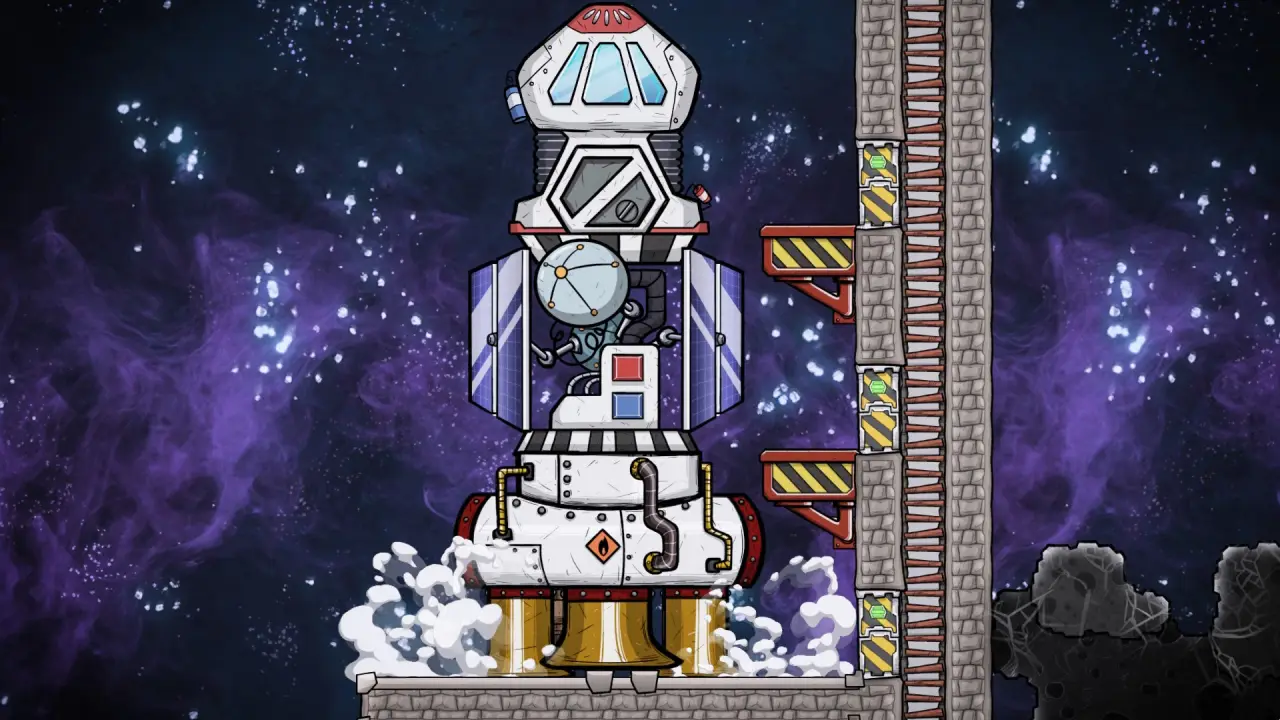
Audio: 8.3/10For a game this mechanically dense, the audio has a deceptively important job: keeping the experience warm and legible while you wrestle with thermodynamics. Klei's sound design leans into charm and clarity rather than spectacle, and the effect is a soundscape that softens the hardcore systems underneath and quietly feeds you the information you need to keep a colony alive.
Charming Voices and Functional Feedback
The Duplicants are the heart of the audio just as they are the heart of everything else. Their gibberish chatter, little grunts of effort, and emotional squeaks give the colony a constant, endearing texture, and the cartoonish voice work does a lot to make a brutal simulation feel approachable. A Duplicant's stressed whimper or content hum is as much a status readout as a personality flourish — over time you start to register the mood of your base by ear before you ever open a menu.
The machinery and infrastructure layer is where sound turns practical. Pumps, vents, generators, and the flow of liquids and gases through pipes all carry distinct functional cues, so the hum of a working system and the silence of a broken one become things you read without looking. In a game where dozens of subsystems run at once, that audio feedback is a genuine usability tool, telling you that a generator kicked on or a pipe stopped flowing in the corner of your attention while your eyes are somewhere else entirely.
Music, Alarms, and a PC-Only Soundscape
The soundtrack runs a light, jazzy, low-key register that is exactly right for the game's tone. ONI can be enormously stressful, and the relaxed background music acts as a deliberate counterweight, keeping the long hours of micromanagement from tipping into anxiety. It is unobtrusive by design, looping gently beneath the work so that hundreds of cycles pass without it grating, and occasionally swelling just enough to mark a moment of progress. It is mood-regulation as much as melody, and it is a smart fit for a game you sink dozens of hours into in single sittings.
Cutting through that calm are the alarm and notification sounds, which carry real informational weight. A specific tone for a Duplicant in distress, a warning for a system failure, an alert for an incoming threat — each is distinct enough to parse instantly, so you can triage a crisis by sound before you have even found its source on the map. That clarity matters enormously in a game where multiple failures can cascade at once. The one limitation worth noting is platform reach: ONI is PC-only, with no console or mobile build, so the full audio experience is tied to a desktop, and players hoping to manage a colony from the couch or a commute are simply out of luck. Within those bounds, though, the sound work does precisely what it sets out to do — keep a punishingly complex game feeling human, readable, and oddly cozy.
Visuals | 8.5/10
Graphics: 8.5/10The visual design of Oxygen Not Included performs a small miracle: it makes one of the most complex simulations in gaming readable, and even charming. Klei wraps a forbidding tangle of physics and chemistry in a warm, hand-drawn cartoon style and a suite of visualization tools so clever that the art direction is arguably the single biggest reason the game broke out of its hardcore niche at all.
Klei's Hand-Drawn Cartoon Shell
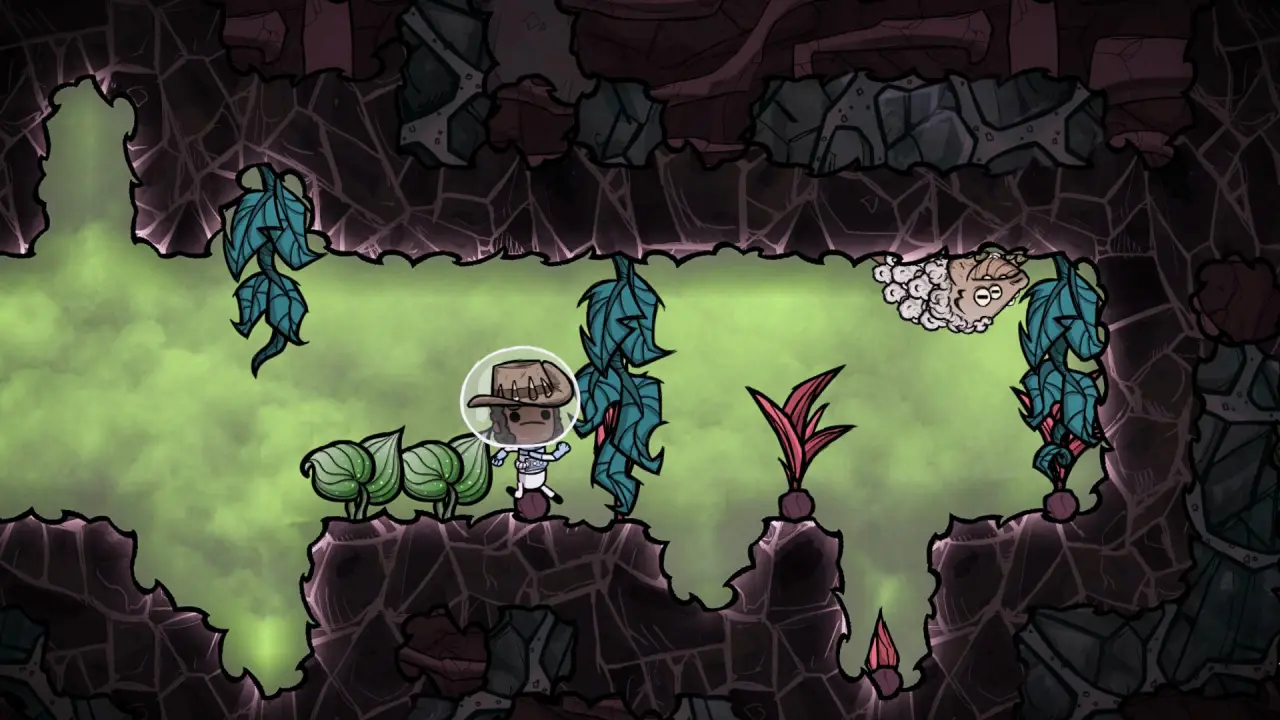
The studio's signature aesthetic — the same warm, slightly rubbery hand-drawn style that defined Don't Starve — does enormous work here. The Duplicants are round, expressive little figures, the machines have a tactile toy-like solidity, and the asteroid biomes glow in distinct, saturated palettes. That cartoon warmth is not just decoration; it is a deliberate counterbalance to the cold, punishing systems underneath, making a game about suffocation and heat death feel inviting rather than clinical. You are managing a thermodynamic nightmare, but it looks like a friendly ant farm, and that tonal sleight of hand is a big part of why people fall in love with it.
The character animation extends that charm into personality. Duplicants visibly strain when they carry heavy loads, slump when stressed, and beam when content, so their moods read at a glance from across the base. Those tiny animated cues turn abstract status values into legible body language, reinforcing the attachment that makes the colony feel alive rather than like a spreadsheet with sprites. The environmental art pulls the same double duty — each biome is color-coded enough to be functionally informative while still being genuinely pretty, so the frozen, caustic, oil, and jungle regions are as much navigational landmarks as they are scenery. The aesthetic never forgets that in this game, looking good and being readable are the same job.
The Cross-Section View and the Overlay System
The foundational visual idea is the side-on cross-section. Presenting the asteroid as a cutaway means you see your entire colony at once — every room, pipe, gas pocket, and Duplicant laid bare in a single readable plane. It is the perfect frame for a game about layered, interacting systems, letting you watch heat creep across rooms and gases settle by density in real time. The base view alone communicates an astonishing amount of information without a word.
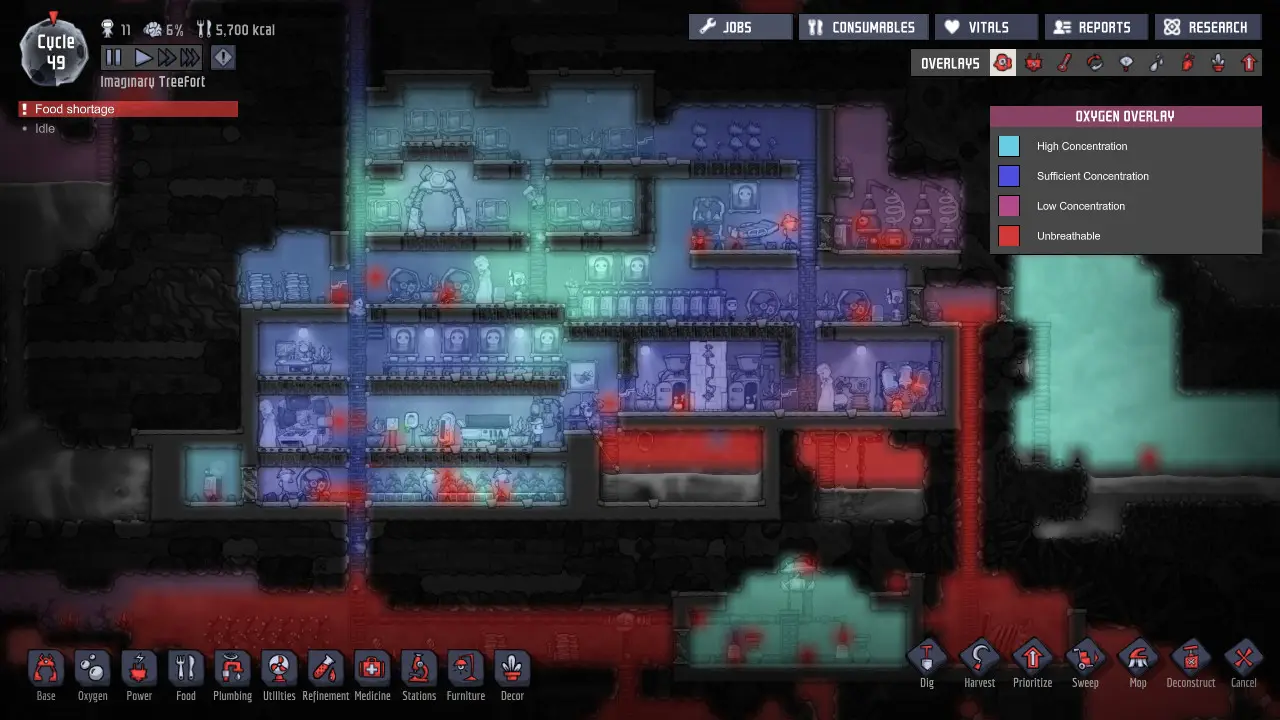
But the real triumph is the overlay system. ONI lets you toggle between dozens of visualization layers — oxygen, temperature, power, plumbing, decor, germs, and more — each translating an invisible, complex variable into intuitive color-coded imagery. Suddenly the unseeable becomes obvious: you can literally see the heat gradient threatening your farm, the oxygen thinning in a far corridor, the wiring overloading on a circuit. This is the tool that makes the impossible legible, the bridge that carries a player from "I have no idea why my colony died" to "I can see exactly where the system is breaking." It is, quietly, one of the best pieces of information design in any game, and it is the mechanism by which a hardcore physics simulator became something a mainstream player can actually parse.
Information Density and Platform Limits
The interface as a whole is built around that same goal of taming complexity, and mostly it succeeds, surfacing a staggering amount of data through menus, tooltips, and the overlays without fully drowning the player. It is dense — there is no pretending otherwise — and newcomers will feel buried by readouts at first, but the design consistently rewards the effort to learn it, and veterans come to read the screen with fluency. The lone hard limit is platform: ONI exists only on PC across Windows, Mac, and Linux, with no console or handheld version, so its visual experience is tethered to a desktop and the mouse-and-keyboard precision its dense interface depends on. Within that constraint, the presentation makes the incomprehensible comprehensible better than almost anything, and it is exactly what earns this dimension its strong mark. It is the kind of visual design that does not announce itself with flashy effects but reveals its brilliance the deeper you go — the more complex your colony becomes, the more you appreciate that you can still read it at a glance, and that quiet, functional elegance is a higher achievement than any amount of surface polish.
Combat | 9.4/10
Gameplay: 9.4/10This is where Oxygen Not Included reaches greatness. The gameplay is a near-flawless systems sandbox built on a foundation of genuine science, and the result is a depth of engineering and optimization that almost no other game attempts, let alone matches. It earns its towering score by making real thermodynamics not just a backdrop but the actual puzzle you spend hundreds of hours solving.
The Core Loop of Engineering Escalation
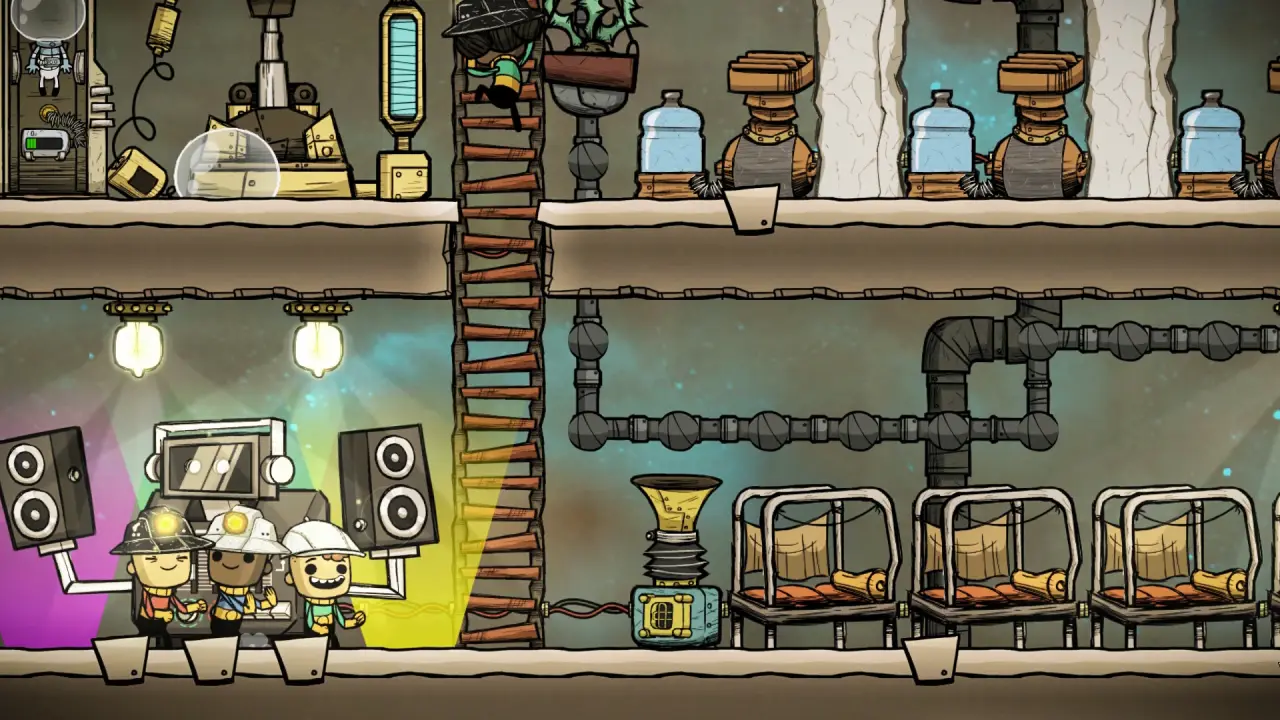
The moment-to-moment play is a constant escalation of engineering problems. Early on you survive on simple oxygen diffusers and algae, scraping by cycle to cycle. Soon that runs out and you must graduate to electrolyzing water into oxygen, which means finding water, which means managing the heat and power that process generates, which means building cooling, which means understanding heat transfer — and on and on, each solution spawning the next problem in an endless, satisfying chain. There is no padding in this loop; every step is a real systems challenge with a real physical solution, and the feeling of finally closing a sustainable oxygen-water-power cycle after hours of leaks and failures is one of the great payoffs in simulation gaming.
What makes it sing is that the systems genuinely interact. Temperature affects gas behavior, gas behavior affects your farms, your farms affect your food, your food affects your Duplicants' stress, their stress affects their productivity. You are never solving one problem; you are solving a web, and the web is modeled with enough fidelity that mastering it feels like learning an actual discipline rather than memorizing a game's rules. That interconnection is also what makes the game endlessly re-solvable: change one variable and the whole web shifts, so even a problem you have solved before demands fresh thought on a new asteroid.
Thermodynamics and the Programming Layer
The physical simulation is the bedrock of everything. Heat is conserved and must be moved or stored; gases and liquids obey pressure and density; matter changes state at real thresholds. This is not flavor — it is the literal ruleset you engineer against, and it is why the game has earned a reputation as a kind of accidental physics tutor. Players routinely come away genuinely understanding concepts like the Carnot cycle, heat exchange, and pressure-driven flow, because the game punishes misunderstanding them and rewards mastery so concretely.
On top of that sits the automation layer, which is where ONI quietly becomes a programming game. The Automation Innovation update introduced sensors and logic gates — AND, OR, NOT, buffers, filters — that let you build genuine automated control circuits: a temperature sensor that triggers a cooling pump, a pressure switch that gates a door, a self-regulating system that runs without your input. Designing these circuits is real combinational logic, and it lifts the late game from "survival sim" to something closer to engineering and light programming, giving expert players a near-bottomless ceiling of optimization to chase.
Breadth, Difficulty, and the Climb
The Spaced Out expansion widens the whole thing dramatically, turning a single-asteroid puzzle into an interplanetary one — rockets, resource logistics between worlds, and the management of a cluster of distinct biomes each with their own challenges. Across the base game and five DLCs, the sheer breadth of systems to master is enormous, and it is a major reason the content sustains thousands of hours for its devotees. The one unavoidable caveat is the difficulty curve, which is brutally steep: most new players genuinely cannot progress past the mid-game without consulting YouTube tutorials or community guides, and players without any STEM grounding will hit real walls when the Carnot cycle and pressure mechanics become mandatory. This is not a flaw so much as an identity — ONI is uncompromisingly hardcore by design — but it does mean the reward is gated behind a serious investment. For those willing to make it, the gameplay is as deep and rewarding as the medium offers, which is exactly what this near-perfect score reflects. The defining feeling is the long arc from helplessness to mastery: the same systems that bury you in the first ten hours become, by the hundredth, an instrument you play with confidence, building self-regulating machines that would have looked like magic to your earlier self. Few games make growth this tangible, and fewer still make the act of understanding feel like the reward itself.
Content | 9.2/10
Content: 9.2/10Content is one of Oxygen Not Included's highest scores, and it is fully earned. This is a game with effectively no ceiling on playtime — a single colony can absorb hundreds of hours, and the game offers a near-endless supply of self-set goals on top of a vast, continuously expanded foundation. Between deep base systems, five DLCs, a thriving mod scene, and nine years of live operation, the sheer volume on offer is staggering.
From Thirty Cycles to Five Hundred
The base game's progression is measured not in a linear story but in cycles survived, and the curve is vast. Early survival is a desperate scramble to reach cycle thirty without suffocating; the mid-game is the long climb toward sustainable oxygen, water, food, and power loops; and the late game stretches to five hundred cycles and beyond, where you pursue self-sufficiency, automation, and ambitious megaprojects purely for the satisfaction of engineering them. Crucially, the "content" is largely self-directed — the game hands you a sandbox and a physics engine and lets you set your own targets, so the experience scales from a tense fifty-hour survival run to a thousand-hour optimization obsession depending entirely on how deep you want to go.
That open-ended structure is the source of the game's astonishing replayability. Procedurally generated asteroids, dozens of interacting systems, and an enormous space of possible base designs mean no two colonies play the same, and there is always one more system to master, one more efficiency to chase, one more ambitious build to attempt. The difficulty settings and asteroid options further multiply this, letting you tune everything from a gentle introductory rock to a punishing resource-starved nightmare, so the same game can serve a curious beginner and a hardened veteran chasing a self-imposed challenge run without either feeling shortchanged.
Five DLCs, Mods, and Nine Years of Support
On top of the base game sit five DLCs that have steadily broadened the experience over the years. Spaced Out is the headline expansion, transforming the single-asteroid game into an interplanetary one with rockets and multi-world logistics, and it adds enormous play breadth for veterans ready for more. The smaller content packs layer in new biomes, critters, buildings, and challenges, deepening an already dense game. The one genuinely divisive entry is the Bionic Booster Pack: its bionic Duplicants do not breathe oxygen, and a vocal portion of the community argues this bypasses the central constraint the entire game is built around — a fair critique, and the one real asterisk on an otherwise generous content record.
Beyond the official material, the Steam Workshop hosts thousands of community mods — over forty-five hundred pieces of user content spanning quality-of-life tweaks, new buildings, total overhauls, and visual mods — that extend the game's life almost indefinitely for those who want to customize or expand it. And underpinning all of it is Klei's remarkable commitment: nine-plus years of continuous updates, culminating in the game winning a Steam Labor of Love award in 2024, a rare honor that recognizes exactly this kind of sustained, good-faith long-term support. That track record matters for a buyer's calculus: this is not a game that shipped and was abandoned, but one that has grown richer every year, and the trust Klei has earned through that consistency is itself part of what you are buying. The studio's willingness to keep deepening a finished game, rather than racing to sell a sequel, is the kind of long-term thinking that turns a one-time purchase into a years-long relationship.
Standing Among the Colony Sims
Placed against its peers, ONI's content matrix is among the deepest in the genre. It does not match RimWorld's narrative variety or the storytelling-driven replay of a Dwarf Fortress, but in pure systemic depth and the volume of engineering problems to solve, it is arguably without equal. Where many colony sims give you content to consume, ONI gives you a simulation to master, and the difference is that mastery has no real endpoint. For the player it is built for, the practical content here is functionally infinite, and across a 96-percent-positive review base of well over a hundred thousand voices, that depth is exactly what keeps people coming back year after year. It is the rare game where a player's hundredth hour can still be teaching them something new, where the content is not consumed but cultivated, and where the limiting factor on playtime is your own curiosity rather than any boundary the developers drew. For the audience it was built for, that is the highest compliment a content score can pay — which is precisely why this dimension scores as high as it does.





Comments 0
Share your game review
Join the discussion and share your review of this game.
No comments yet. Share your thoughts on this review.