






















Opening
Most platformers treat speed as a button. Pizza Tower treats it as a thing you earn.
You are Peppino, an Italian cook with a face permanently stuck mid-panic, and a tower full of living food stands between you and the demonic pizza about to torch your restaurant. That is the entire premise, and the game spends none of its energy defending it. What it spends everything on is motion. Stand still and Peppino is the slowest, clumsiest body on screen. Keep him running, though, and he builds — jog, sprint, then a near-uncontrolled Mach dash that lets him scale sheer walls and bowl through rows of enemies like skittles. The longer you hold the line, the stronger he gets, until movement stops being the means to the level and becomes the whole point of it.
This is the indie that vaulted onto Steam's top-rated shelf the day it launched and, by August 2024, sat as the highest-rated 2D platformer on the entire store — past Super Meat Boy, past Celeste, past Katana Zero. A pseudonymous team built it in GameMaker over roughly five years, and nearly every English outlet reached for the same comparison: this is the Wario Land baton Nintendo dropped, picked up and run faster. What follows is a look at how a game that resembles a cancelled Saturday-morning cartoon turned out to be one of the most replayable action games of its decade.
Story | 6.5/10
Story: 6.5/10If you came to Pizza Tower for a story, it will let you down — but the letdown is the design working exactly as intended.
The premise fits on a napkin, and that is the point

Here is the plot in full: an Italian pizza chef hears his shop is about to be destroyed by a demonic pizza at the top of a tower, so he grabs nothing and charges up. There is no second act. No branching dialogue, no characters to level, no lore codex begging to be read. Pizza Tower carries almost zero narrative baggage, and it travels light on purpose.
That is not laziness; it is a clear-eyed trade. Every ounce of the team's design attention is welded to one thing — how it feels to move — and the story exists only to give that lunacy a stage that is loud, funny and never steals a scene. Why is Peppino so frantic? His shop is dying. Why climb the tower? There is a villain at the top. The motivation is thin to the point of being a shrug, and it is precisely enough; you never need a better reason to understand that you must, right now, get to the top at full speed.
The contrast with Celeste is instructive. Celeste binds its narrative and its mechanics into a single fabric, a delicate piece about anxiety and self-acceptance where the climb and the confession are the same act. Pizza Tower runs the other way entirely, sanding the story down to its thinnest possible layer so the play can hold the spotlight alone. Neither approach is wrong; they are simply not the same kind of game. But it does mean that the root reason Pizza Tower cannot score highly here is a decision it made on day one — it declined to compete on this axis before the timer even started, and judging it on narrative is a little like marking a sprinter down for not pacing himself.
There is a small cost to that purity worth naming. Because the framing is so featherweight, the few story beats the game does stage — a mid-game twist about who is really behind the tower, the late reveal that recolors the whole climb — land with less force than they might have, because you were never asked to care in the first place. It is a price the design pays willingly, and most players will not feel it. But it is a price.
Performance, not prose — every character lives in the animation

What is striking is that the cast still lands, only the tool is caricature and motion rather than written lines. Peppino is a middle-aged cook ground into a nervous wreck, and his entire interior life is legible on his face: his expression contorts when he sprints, his eyes bulge to the edge of their sockets when something startles him, and there is a desperate, all-in fury in the way he seizes an enemy. You read his complete emotional state without a single word.
The Noise, added in a later update, works the same way. He is a smug, skateboarding little antagonist who exists to needle the hero, and his whole personality is built out of cocky tricks and taunts — no exposition required. You watch him gloat for two seconds and you have the entire character: a brat who turned up to wreck your day. Nobody had to hand him a backstory monologue.
Zoom out and the tower's real narrative is encoded in its art direction: a world where every enemy and every boss is a piece of food given legs and a grin is, by itself, a story about chaos and slapstick menace. Sausages bolt away on stubby legs; cheese wheels leer; a pizza you punched through turns to glare back at you. None of it is written down anywhere, and all of it tells you what kind of place you have wandered into. Pizza Tower did not abandon storytelling. It picked the story up out of the script and dropped it into the animation cels — and that approach has a ceiling. It can make you laugh and make you remember a handful of faces, but it cannot prop up a high score in this dimension, and it will never satisfy the player hunting for narrative density and a proper arc.
Audio | 8.5/10
Audio: 8.5/10If the art is Pizza Tower's face, the soundtrack is its pulse — and the story of where that pulse came from is worth telling on its own.
A first-timer and a high-schooler wrote one of the year's best scores

The music is mostly the work of three people: Ronan de Castel, who records as Mr. Sauceman; the composer who goes by ClascyJitto; and Post Elvis, who handled the title theme. The first two are the interesting part. For de Castel this was his first formally released music of any kind — he has said composing was barely more than a hobby, and that he had never put a track out before because he simply did not trust his own work enough. His collaborator ClascyJitto, who wrote the bulk of the in-game tracks, was still a high-schooler while doing it.
Two people who by any résumé read as amateurs produced a score PC Gamer placed among its best of the year. It folds chiptune, house, jazz, drum and bass, funk and metal into one bag — absurdly eclectic, yet always faithful to the jittery, gleeful energy of '90s platform games. It broke out far enough to earn a 2xLP vinyl pressing that fans collect as a standalone record, a rare reach for an indie OST and a fair measure of how hard the music grabs.
The score is a metronome, not a backdrop

What deserves the most credit is how tightly the music meshes with the play. Every floor of the tower gets its own theme — from a lazy, loose-limbed jazz to a frenzied drum-and-bass blowout — setting the emotional key for that floor before you have run a step. A sleepy desert floor opens on something almost lounge-like; a haunted floor leans on warped, woozy synths; an industrial stretch comes in on hammering percussion. The track tells you how to feel about a place before the level design gets a chance to. And the harder and cleaner you chain your movement, the more the backing track sounds like a live score for your own spiking adrenaline; player and music end up locked into the same groove, until you cannot say whether you are running to the beat or the beat is keeping up with you.
The peak is reserved, without hesitation, for the timed escape. The moment you topple the pillar and the countdown starts, the music snaps over to the signature getaway anthem, "It's Pizza Time!", the tempo yanked to its ceiling against a frantic on-screen clock and a vengeful pizza hard on your heels. The cut is not a fade — it is a hard switch, a gear-change you feel in your hands as much as your ears, and it is the single most effective music sting Pizza Tower has.
Why one track became the game's defining moment

Plenty of players will tell you that this one track is what turned the escape from a cold rule into the most unforgettable beat in the whole run. You are not coasting to the exit with music in the background; you are being chased, hounded and dragged into running faster than you thought you could. The vocal stabs and the relentless forward pulse do something a countdown number alone never could — they make panic feel good. That is the trick the whole soundtrack pulls: it does not accompany the speed, it manufactures more of it, leaning on you the way a pace-setter leans on a runner. Fuse that with the art and the feel and you get a three-way integration that explains, better than any review score, why the audio reputation runs as high as it does. The one knock, if you want one, is that with five floors and a fixed set of themes a long P-Rank grind will loop the same tracks past the point of novelty — though by then most players have stopped hearing them and started obeying them.
Visuals | 9.0/10
Graphics: 9/10The look is the reason Pizza Tower is recognizable at a glance among a thousand pixel indies — but the cleverness is not in the pixels. It is in how they move.
High-res hand-drawn pixels that dodge the NES-nostalgia trap

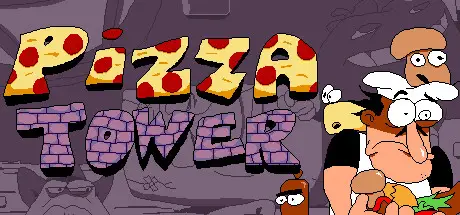
Most indies waving the "retro" flag chase the low-resolution grain of the NES or SNES, trading on nostalgia to do the heavy lifting. Pizza Tower refuses that lane. Art lead McPig set out specifically to avoid that old-pixel flavor, reaching instead for high-resolution hand-drawn pixel art — and the reference points are not games at all but '90s Nicktoons. Think Ren & Stimpy and SpongeBob: exaggerated, rubbery, faintly gross and relentlessly cheerful, with a dash of French-comics character design stirred in.
What lands on screen is an all-out living-food world: the tower's enemies, bosses and hazards are almost uniformly foodstuffs handed legs and faces — sprinting sausages, wobbling cheese, pizzas grinning like cheerful fools. Nintendo Life pinned it perfectly as a cancelled '90s Nicktoon crossed with the rough edge of a drawing program. The great advantage of this style is that it cannot date, because it never belonged to any real era to begin with — it is a forged childhood memory of a cartoon that never aired. It looks familiar and you cannot place it, which is exactly the effect.
The jittery animation is not crude — it is speed, drawn

What truly brings the art to life is its animation principles, not its resolution. Every one of Peppino's movements is pushed to the brink: his face warps wholesale at a full sprint, his body overstretches and then snaps back the instant he brakes, and slamming a wall folds him up like a crumpled sheet of paper. That deliberately rough, twitchy frame-by-frame work reads as unfinished at first glance, when it is in fact a precise reconstruction of the manic register of old Saturday-morning cartoons — judged with real craft.
More importantly, the exaggeration is welded to the play rather than dabbed on for looks. The reason you feel Peppino getting stronger as he runs is the animation doing the talking: the deep backward lean at top speed, the limbs smeared into afterimage, the visibly overcooked recoil when he stops short. Speed stops being a number and becomes a visible, near-slapstick physical comedy. The same logic shows up in the tiny stuff — he bares his teeth grabbing an enemy, his whole face slackens the moment a pizza slice tops up his combo, and even at idle he paces impatiently, daring you to get moving. These are frames somebody drew by hand, one at a time, and they give a pixel character more readable interiority than most fully voiced 3D protagonists manage.
Built by hand on a humble engine, with style standing in for budget

The technical story underneath is almost a rebuke to the arms race. There is no ray tracing here, no 4K texture budget, no proprietary engine with a tech demo attached. A pseudonymous team built the whole thing in GameMaker — an accessible, almost hobbyist toolkit — over roughly five years, and the only thing they poured the budget into was animation frames. That is the entire trick: where a bigger studio would spend on fidelity, Tour De Pizza spent on motion, and on the sheer volume of hand-drawn frames it takes to make a sprint read as a full-body event rather than a sprite scooting sideways.
It is worth sitting with what that implies, because it cuts against the grain of how the industry talks about graphics. Pizza Tower will run on a potato and look gorgeous doing it, and it will still look gorgeous in ten years, precisely because none of its appeal is pinned to a hardware generation. There is no fidelity to age out, no ambitious lighting model that will read as quaint in two console cycles — just drawings, and good drawings do not expire. The art proves a simple thing the spec sheets keep forgetting: what makes a 2D game beautiful was never the pixel count, but whether those pixels have a soul when they move. By that measure it is one of the most identifiable looks of its year, and the lesson is portable — style is a budget decision, not a hardware one.
Combat | 9.5/10
Gameplay: 9.5/10If one line has to explain why Pizza Tower plays so well, it is this: the game makes momentum the protagonist.
The Mach dash that gets stronger the longer you hold it

In most side-scrollers speed is a toggle — hold dash, go fast; release, slow down. Pizza Tower turns it into a curve you have to charge. Run long enough and Peppino shifts from a jog to a sprint to a near-uncontrolled Mach dash, and only inside that dash can he scale walls and punch clean through ranks of enemies and obstacles. The implication is simple and total: you cannot stop. A stationary Peppino is the most leaden body on the field; a full-tilt one is close to unstoppable.
This get-stronger-the-faster-you-go design produces a rare kind of positive feedback. You are not spending speed to clear the level; you are taking your pleasure from the act of keeping the speed alive. Every clean corner, every wall-kick into a higher line, is the game saying don't let go, faster still.
Chinese outlet Gcores singled this out — once practiced, a player can tear across a stage at full velocity, and that sense of flight is not handed to you by a stat, it is something you built with your own hands. This is the part no peer has reproduced: many games are fast, but very few make staying fast the core joy, and that distinction is the whole ballgame.
Seven-second combos and Pizza Time, one level played as two heartbeats
Running fast alone is not enough, so Pizza Tower bolts two systems onto the speed to give it weight. The first is the combo: down an enemy and a seven-second timer starts; keep killing or grabbing pickups to top it up, and the whole flow of your movement reorganizes around never letting it lapse. You start routing deliberately, treating enemies as stepping stones rather than threats — and once you know a stage, you notice that what looked like random enemy placement is in fact sitting exactly where you need it, the run quietly turning into a rhythm game.
The second is the headline mechanic, Pizza Time. Topple a pillar named John deep in the level and the countdown begins; you must retrace your route to the start before an evil pizza catches you from behind. The crucial wrinkle is that the return path is frequently not the outbound one — on the way in you can dawdle and probe for secrets, but on the way back the clock has you by the collar and you must run the moves you just learned in one unbroken take. So the same terrain is an exploration stage in its first half and a time-attack in its second. The two systems then bite into each other: to post a high Pizza Time score you have to chain enemies along the escape route anyway, which fuses fleeing and combo-building into one act and demands you be both fast and ruthless.
A floor anyone can stand on, a P-Rank ceiling almost nobody can reach
Pizza Tower's smartest call is to refuse you a difficulty menu. There is no easy/normal/hard; the difficulty is buried inside the ranking system instead. The on-ramp is almost absurdly gentle — no health bar, no lives, contact merely docks points and shaves two seconds off your combo, and you simply cannot die outside of a boss. So you learn the sprawling movement set under zero pressure, feeling out the quirks of momentum through trial and error.
But the instant you decide to chase a grade, the game turns on you. A top-tier P-Rank demands a checklist: a combo that never once breaks, all three Secret Eyes collected, the Tower treasure secured, and a full second lap of the stage. Now it is brushing up against speedrun precision. This is exactly where it parts ways with Celeste. Celeste wins on the exacting, death-and-retry hardcore loop and wears a cold come-suffer face at the door; Pizza Tower hides an equally high ceiling inside an optional grade, with a floor low enough that anyone can walk in and a ceiling tall enough to swallow dozens of hours. One game keeps both the tourist and the speedrunner.
Content | 8.5/10
Content: 8.5/10Pizza Tower is the kind of game that looks short on paper and turns out to have no floor once you are in it. Whether it has "enough game" splits into two answers.
Five floors, twenty levels — six hours that never reskin a thing
The main structure is clean: one tower, five floors, four levels each, twenty regular stages in all, with a boss waiting at the end of every floor. If you only want to barrel straight to the finish, HowLongToBeat clocks the main line at roughly six hours; sweep up the secrets on a normal complete run and it lands somewhere between eight and twelve. Stare only at that number and a slice of players will, fairly, call it short.
But short is not the same as thin. Pizza Tower barely reskins anything — every level is rebuilt around a fresh mechanic, whether that is a cheese character hosting a round of mini-golf, a chick named Mort who hands you a double jump, or some stage that breaks gravity or the camera outright. You carry the same core moveset throughout, but each level forces that familiar kit into an unfamiliar new rule, and that is how the novelty holds, one stage to the next. One level hands you a barrel to ride; another straps you into a pinball table; a third drops you into pitch darkness lit only by what you are running past. The constant is your toolkit, never the context, and the design never lets you settle into autopilot. It is a structure closer to a great Mario game than to most modern indie platformers: each level is a self-contained idea, fully explored and then dropped before it wears out its welcome. Layer on the three Secret Eyes hidden in every level, the caged Toppins waiting to be freed, and a treasure locked away by the janitor, and fully clearing a single stage is already a good chunk of back-and-forth. Put another way, that six hours is just the shortest reading — the one where you hug the ground and sprint for the exit. The moment you stop and look back, every level is hiding multiples of itself. That is the gap between this and the many linear games stamped with the same six-hour figure: theirs end at the credits, while Pizza Tower's six hours are only the entry ticket. The real game starts the instant you decide you want the grade.
Free updates that doubled the game, with no IAP and no season pass
What truly settles the question of size is the run of free post-launch updates. The heaviest of them turned the smug, contrarian troublemaker The Noise into a fully fledged second playable character — not a reskin but his own kit, with a skateboard, a double jump and an entire bespoke moveset, letting you run the whole tower again on a completely different line and feel. Clear his dedicated campaign and you unlock a two-player Swap mode that flips between the pair mid-level.
Harsher still is the slab of hidden content built for completionists. Gather all fifty-seven Secret Eyes scattered across the game and you crack open a deeply buried true final level, Secrets Of The World, which strings those fifty-seven secret rooms into one long marathon with the room order shuffled at random each attempt — a genuine final exam for perfectionists, and the kind of thing that turns a "finished" save file back into an open question.
And the point worth underlining is the business model behind all of it: every bit of this — The Noise, the hidden finale, the earlier Halloween update with its bonus level and pumpkin collectibles — arrived as a free patch, with no in-app purchases and no season pass anywhere in the box. The 2024 Switch port aside, you pay once and the game only grows. In a market that reflexively reaches back into your wallet for a cosmetic bundle or a "definitive edition," an indie willing to double its content for free is, in itself, an uncommon posture — and it reframes the whole short-versus-long argument. You are not buying six hours. You are buying a toolbox that the developers kept adding to for over a year, asking nothing further for the privilege.




Comments 0
Share your game review
Join the discussion and share your review of this game.
No comments yet. Share your thoughts on this review.