























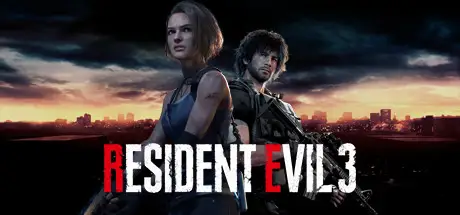
Opening
Raccoon City has one night left, and so do you. By sunrise a devastating strike is going to scrub it off the map, and Resident Evil 3 hands you a single, unambiguous job: get out before the whole city falls into the pit it's been digging for itself.

It does not ease you into the fear. Inside ten minutes the apartment blows, the asphalt splits, fire climbs the walls, and a two-metre thing in a stitched bodybag has already put a fist through your sense of safety. That's Nemesis — the weapon Umbrella let off the leash to hunt down a witness named Jill Valentine. The street chase that follows is still one of the most electric openings the series has ever staged: you run, you dodge, and you watch a city die under your own feet.
The catch is that the high lasts about six hours. The near-flawless RE2 remake set the bar a year earlier, and every place this entry shrinks gets measured against that bar in unforgiving light. Loud, fast, cinematic — and short.
So which is it? An underrated horror-action rush worth every second of its sprint, or a golden bowl of fried rice that someone only filled halfway? That's the question this review wants to settle, and the honest answer turns out to be: a bit of both.
Story | 7.0/10
Story: 7/10One night, one goal — and a campaign built to sprint
The plot here boils down to a single sentence: Jill has to walk out of Raccoon City before the strike lands. The virus has already eaten the place; Umbrella, eager to bury the truth, drops a bioweapon codenamed Nemesis to chase down the ex-S.T.A.R.S. operative who knows too much. Everything that follows is the sound of that monster driving you from an apartment to a subway, down into the sewers, and finally into an underground lab.

A goal this clean has its rewards. You always know what you're doing, the tension never slackens off the single taut wire marked "run," and the pacing refuses to sag. There's none of RE2's slow forensic loop around a police station.
The cost is depth. The city is gone before you've had time to feel anything for it, and a horror story that never lets you stand still also never lets you grieve. Raccoon City dies as a backdrop, not as a place you knew, and that's a real loss for a game whose whole pitch is the death of a city.
The bigger problem is scope. This is one campaign, Jill's, and it's over in roughly six hours. Set that beside RE2 remake's two full scenarios — Leon and Claire each completing the other's truth — and the storytelling here is visibly thin. You finish, and the urge to run it again from another angle simply never arrives. There's a confidence to a story this lean, the kind that trusts momentum to do the work of depth, and for a stretch it pays off. The trouble is that momentum can't carry a world the way time can, and Raccoon City needed time it was never given.
Carlos: the half that fills a gap but never quite a story
The narrative doesn't ride on Jill alone. Midway through, you take over Carlos, the mercenary who's one of the few people still standing in this mess, and the two trade cover as they push for the city limits. The standout stretch comes when Jill goes down poisoned and Carlos pushes into a hospital alone for a cure, holding off a swarm of the dead in the process — the emotional peak of his thread, and the moment he stops being a plot device and turns into a partner you'd actually trust.

This second perspective patches a seam the original always had, and it gives the plot a layer the lone-Jill sprint wouldn't have on its own. But it stays a B-plot. Carlos gets the short, loud, straight-ahead chapters — closer to an action interlude than a story of his own. You warm to him, and then his section is done.
Where RE2 wrote both leads as complete arcs and let the truth surface in the overlap, this game treats Carlos as seasoning rather than a second course. He's likeable, he's useful, and he's gone before you've decided how much you care. The gap is filled, sure. It just stops a breath short of full, and you feel that missing breath every time the camera snaps back to Jill.
Nemesis: the best villain in the film, and its deepest regret
If anything in this script lands, it's Nemesis itself. The creature never speaks, yet its presence drowns out every line of dialogue. The bodybag silhouette sells the idea of an unfinished prototype, and the way it keeps tearing apart rooms you'd written off as safe — all the way to a final mutated form — is character work done entirely through body language. The story settles things with it down in the NEST 2 lab, which conveniently stitches the whole thread back onto RE2's timeline and closes the Raccoon City book.

The regret is that a villain this good is never fully spent. Its best material is front-loaded into that opening street chase. After that, it shows up on cue, a set-piece boss rather than a ghost that might come through a wall the instant you relax. The original's "it could be anywhere" dread is dissolved by the rigid structure around it.
So Nemesis is written beautifully and used incompletely. You'll remember it, and you'll mourn it a little — this could have been the series' most terrifying stalker, and it ended up a very handsome prop in a chase scene.
Audio | 7.5/10
Audio: 7.5/10Ambience: the horror is turned down, but the craft is intact
Half of any survival horror's fear arrives through the ears, and the groundwork here is solid. The wet, dragging snarl of a zombie coming out of the dark; the sharp clatter of an empty clip hitting tile; the two heavy footfalls of Nemesis that land like something dropped on the floor above you — pull any of these out on its own and the texture earns the engine's industrial standard. Move through the ruins of Raccoon City and you can read where the danger is closing in by sound alone.

Compared with the RE2 remake, though, the mix is plainly serving action rather than dread. RE2 used sound to manufacture that held-breath, don't-turn-the-corner suffocation; this game leans on the roar of explosions, chases and collapsing concrete to shove you forward. The sensory hit is generous and the pressure is real, but the pure horror built from silence and the unknown gets buried under the spectacle. That's not a flaw so much as a different choice — louder, fiercer, more cinematic, at the price of the series' trademark quiet terror. Worth flagging: that signature low growl of "S.T.A.R.S." drifting in from somewhere off-screen still works like cold water down the spine. It needs no explosion; one syllable does the job, and for a moment the game remembers what it used to be — a thing that frightened you with restraint rather than volume. There are a handful of those moments scattered through the run, quiet pockets where the sound design stops pushing and simply lets you dread, and they're some of the strongest minutes here. You just wish the mix had trusted them more often.
Voice and staging: the layer that holds the cinema together
This is a fully voiced game, and it's performed well. Jill's actor pulls a tired, stubborn humanity out of what could've been a stone-faced operative, and Carlos lands that mix of swagger and dependability. The few scenes the two share carry a believable partnership entirely on the strength of the delivery, which is the precondition for cinematic storytelling working at all.

What deserves a closer look is how sound and staging fuse. The opening collapse is the production peak for a reason, and the audio is half of why: low-frequency blasts that punch you in the chest, the shriek of breaking glass, the background roar of an entire city coming down. Stack those and the "nowhere to run" pressure reaches from the screen into your ears. Combat works the same way — gunfire snaps with weight, and the little audio flourish on a perfect-dodge slow-motion makes the action feel more solid in the hand.
So the sound design has no weak link; it has simply moved its centre of gravity from scaring you to driving you onward. As a piece of cinematic action horror it clears the bar with room to spare. It just clears it sounding a little less like Resident Evil — more blockbuster, less haunted house, and your tolerance for that swap will track closely with how much of the old series you're carrying in with you.
Visuals | 9.0/10
Graphics: 9/10The engine, the city, the light — this is the dimension that carries the game
If anything here is beyond argument, it's the way this game looks. It runs on the same engine that carried the RE2 remake, and this time that tech turns Raccoon City from a map into a city in the act of dying. The neon is still humming over streets that have already split open; standing water in the subway throws back the red of the emergency lights; the hospital corridors are a cold, surgical white; the lab below is chilled metal and bruised blue glow. Every space speaks its own material language instead of recycling one rubble texture.

The loudest stretch is still the opening. Asphalt buckles under you, fire pours in from both sides, a whole tower folds downward — real-time destruction at that scale was a rare spectacle at launch and still hits today. It doesn't fob you off with a cutscene; it makes you watch the city break apart in pieces while you run, the camera staying with you rather than cutting away to admire its own work. That cinematic sense of collapse is the hardest single asset in this game to imitate, and it's the moment that lingers longest once the credits roll — the one image everyone who played it can still call up on demand.
The light deserves its own paragraph, because it's the soul of the look. Surviving neon drags long reflections across wet tarmac, emergency lamps stain a hallway an anxious red, cold blue light runs down the pipework of the lab. None of it is decoration: it's how you read a room's mood — where it's safe, where something's waiting, where the city is keeping its last bit of warmth. A place this far into its own ruin still holding light this delicate is the real measure of the team's craft.
Stand the two games side by side — same engine, same city — and this entry's visual standard is at least the equal of its predecessor's, and a few of the big exterior set-pieces are richer still. There's no corner-cutting in the image. If anything the budget has visibly been poured into those one-off spectacle moments, the kind you only see once but never forget, and you can feel where the team decided the money should show.
Monster design and platform polish — Nemesis is worth the ticket on its face alone
The other half of the visuals is the creatures. Nemesis is the game's signature: the stitched bodybag, the exposed sinew, the silhouette that warps and grows uglier as the plot drags it forward — repulsive and threatening in equal measure, legible from across a room as something you do not want near you. Ordinary zombies sell their hits too, their flesh coming apart in detail grim enough to crawl your scalp. That care in monster modelling is the face of a horror game.

On hardware, the game holds a smooth frame on PC and current consoles, and the later next-gen patch pushed the frame rate and fidelity higher, the lighting cleaner, the textures holding up under a closer look. This was never a launch-day optimisation disaster — it runs sweet on most configurations and loads fast. Crank a strong PC and it'll hold a high refresh with the wet reflections, the drifting smoke particles and the slick of torn flesh all turned up, and the sheer density of visual information is considerable. It's the kind of game you'll slow down for just to read a single weathered wall.
The honest catch is that the visuals are strong on staging, not exploration. Because the explorable Raccoon City itself got cut down, you don't actually spend that long admiring these handsome spaces — more often you're catching the good views in the corner of your eye while Nemesis runs you down. A game this good-looking almost begs to be wandered, and it rarely lets you. That's a content problem rather than an art one, but it bleeds into how the craft lands: the better it all looks, the more you grieve the brevity, and the more the cut districts feel like rooms in a beautiful house you were never allowed to enter.
Combat | 8.0/10
Gameplay: 8/10The dodge is the whole idea — it wants you to stand and fight, not slink past
The single biggest mechanical change is the close-range dodge handed to Jill. In the sliver of time before an attack lands, hitting dodge slips you clear of the danger; time it perfectly and the perfect-dodge reward is a beat of slow motion to feed rounds straight into whatever's lunging at you. That one addition rewrites the entire philosophy of the fight.

Classic Resident Evil teaches you to ration ammo, count resources and go around when you can. This game uses the dodge to talk you into standing your ground, reading the tell, and hitting back with style. It turns combat from survival into a duel. The feel is genuinely satisfying — the dodge window is generous, the counter snaps, and a clean sequence carries the buzz of a proper action game. The cost is just as direct: the instant your brain is busy with "how do I make this look good" instead of "how do I stay alive," half the survival-horror skin peels away. The mechanic itself is well built; the issue isn't whether it's fun, it's that it drags the whole game closer to action and further from horror.
Two characters, looser resources — Carlos lets the rhythm off the leash
Beyond Jill you also handle Carlos, and he feels nothing like her: a high-powered automatic weapon that chews through a crowd, a melee that staggers the dead before you finish them off, and chapters that run straighter and harder. The hospital defence is the clearest example — heavy firepower against wave after wave, the pacing nearly pure third-person shooter. The contrast between the two bodies puts a little variety into an otherwise lean run.

The resource loop is all present — conserve ammo, craft gunpowder, mix the green-red-blue herbs, juggle a limited inventory grid — but the supply points sit denser and the squeeze is gentler than RE2's, and you're rarely backed into a truly dry corner. You feel the difference most on a second run, when the old terror of opening your case to find three spare rounds and a half-green herb never quite materialises; there's always a little more in the tank than the genre conditioned you to expect. The crafting ratios are blunter too, so you can decide at leisure whether this batch becomes light rounds or a heavier charge. It all confirms the same leaning: the game doesn't want scarcity to frighten you, it wants you charging forward at full tilt. Flip it around and that looser economy lowers the barrier for newcomers; veterans will just miss living bullet to bullet.
The Nemesis fights and the wider field — a blast, but heavy on the script
Fighting Nemesis is the most split part of the design. The creature's AI is cranked absurdly high: tentacle swings, a flamethrower, a rocket launcher on its shoulder, a leap that crosses half a street to land on you. Taken one encounter at a time, every one is loud enough and oppressive enough. The trouble is they're almost entirely scripted — you know full well that the Nemesis beat has arrived, when it shows, where it comes from, how many phases it runs. The original's "it might be behind any door" unpredictability is mostly gone.
Held against the rest of the series, the RE4 remake balanced action and horror far more steadily, fast and tense at once, while this entry tips hard toward the action end. The combat is competent and often excellent — the dodge, the firepower feedback, the boss staging all deliver — but once those action elements outweigh the horror, it reads more as an action game wearing Resident Evil's skin than survival horror with action bolted on. Strip away the series baggage and treat it as a third-person shooter and the fighting is genuinely smooth: the dodge hands you control, the firepower pays you back, the enemy roster and scene pacing never quite curdle into repetition. There's no real fault in the play. What gives you pause is what it chose to be — and that choice, more than any single mechanic, is the one the faithful least wanted to see the series make.
Content | 6.0/10
Content: 6/10Six hours — the wall it can never quite get over
You can't talk about this game's size without the number: a campaign of roughly six hours, and only Jill's. For a full-price remake of a beloved classic, that's genuinely thin, and no amount of polish quite argues the number away. You're just lit up by the opening collapse, just settled into the dodge, just starting to enjoy the city's mood, and the story is already sprinting for the exit. It hands you a high-intensity rollercoaster, and when the ride stops you blink: that's it?
Set against the RE2 remake the gap is stark — two full scenarios for Leon and Claire, plus each one's second-run variant, just to walk the whole truth runs well past a dozen hours. On the question of "how much longer can I play this," this game leaves veterans very little room.
To be fair, those six hours are packed with dense staging and combat with almost no filler; reframe it as a brutally quick horror-action film and the length flips into a virtue — it never wastes a minute, never lets up. Plenty of longer games would kill for a run this free of dead weight. The catch is only that it ends too early, early enough that you haven't had your fill, and "I wanted more" is a strange complaint to hold against a game precisely because it never bored you.
A Raccoon City with pieces missing — the clock tower haunts everyone
What hurts the faithful more is the cutting. In the 1999 original, Raccoon City was far bigger — the clock tower was a real landmark where Jill solved puzzles, faced Nemesis head-on, and Carlos ran errands while she recovered; beyond it lay the park, the graveyard, the dead factory, whole explorable districts. In this remake the clock tower is gutted almost entirely; you never see the inside, it shows up only in the background of a single boss fight, and its puzzles, enemies and story role simply evaporate.
The park and graveyard get mostly squeezed into linear set dressing too, glimpsed in passing rather than lived in. The upshot is that the explorable Raccoon City here is visibly smaller than the original's, a corridor where there used to be a labyrinth. You no longer get to lose yourself in this place, to puzzle it out slowly, to be quietly frightened by a monster that might appear at any moment — in their place is a single carefully laid track shoving you forward. Players have even built mods to drop the clock tower and a more unpredictable Nemesis back in, which says plenty about how much the loss stings for the core. The added Carlos material and cutscenes don't fill the holes they dug out — they hand you new things while taking away exactly what the long-time fans prized most: the exploration and the unease.
Trimmed systems and Resistance — a sincere patch, not a deep one
It isn't just the map. The original's signature multiple endings, its live-selection branching, and the Mercenaries mode the series debuted there are all gone, and to this day there's been no paid or free DLC to restore any of it. For a horror series that lives on replay value, that's no small loss. The trade behind it is really a shift in design thinking: replay value moves from "study the same run for different approaches" to "here's a separate multiplayer mode."
As compensation, the game ships free with Resident Evil: Resistance — a one-against-four asymmetric online mode where four survivors try to escape a facility run by a Mastermind who can lay traps, summon monsters and work the cameras in real time, even drop in personally to hunt. The idea is genuinely clever and giving it away is decent goodwill, but the character balance and long-tail depth both drew criticism, the heat faded fast, and it never became a real pillar for longevity. It's the kind of bundled extra you try for an evening, nod at, and rarely return to. Tallied up, the compensation reads more like a plaster than a new piece of the puzzle, and most players who came for the campaign treat it as exactly that.




Comments 0
Share your game review
Join the discussion and share your review of this game.
No comments yet. Share your thoughts on this review.