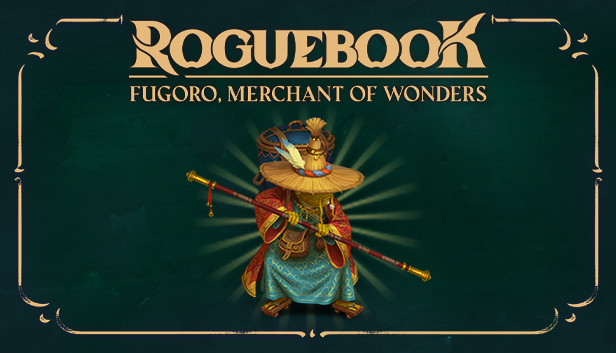
Roguebook makes the position of your two heroes part of the deckbuilding strategy: the front hero protects the one behind. At ≈ $1.20 from GOG, it is a timely entry point if tactical synergies and replayable runs are what you want. The Steam PC version has full controller support, and 84%% of 3,487 player reviews are positive.
That makes the purchase easy to weigh against your interest in solo card games and the available interface language, without assuming any extra content.At $24.99 from GOG, Roguebook is an opportunity to try its two-hero tactics, evolving decks and procedurally generated maps on Steam PC.
GamesPlanet DE+2·Platform:Steam·~ $28.05-10%~ $25.24Buy now
GamesPlanet FR+2·Platform:Steam·~ $28.05-10%~ $25.24Buy now
GGselRoguebook РФ+СНГ+ВЕСЬ МИР Steam КЛЮЧ+2·Platform:Steam·~ RUB 115.08Credit/Debit CardBuy now
All-time low ~ $1.37across Steam & third-party storesat the recorded all-time low
Loading store offers
Wishlist price
Set a target to receive an email when an eligible offer in your selected region is at or below that amount.
Price History
Past 36 months · Updated daily
Historical Low~ $1.402026-07Current Low Across Stores~ $2.12Kinguinvs. Historical Low+51%
Prices cover Steam and 39 authorized stores; only legitimate offers are counted. The chart shows weekly market-wide lows and Steam's official price across the past 36 months.
Lead two heroes through a roguelike deckbuilder, assembling your deck as each run unfolds. Combine cards, relics and skills, switch your heroes’ positions, and explore a procedurally generated world of hexagonal tiles.84% of 3,487 Steam player reviews are positive.The Steam PC version supports single-player and full controller input.
Credits
Developer
Abrakam Entertainment SA
Publisher
Nacon
Steam player reviews
84%positiveVery Positive3,487 Steam reviews
Lowest recorded in 36 months
$1.402026-07-30 · KKinguinBase game · same records as the chart above; USD history, not a regional Steam low.
Language support
Language
Interface
Subtitles
Audio
Simplified Chinese
Yes
Yes
—
Traditional Chinese
Yes
Yes
—
English
Yes
Yes
Yes
Show 9 more languages
Language
Interface
Subtitles
Audio
French
Yes
Yes
—
Italian
Yes
Yes
—
German
Yes
Yes
—
Spanish
Yes
Yes
—
Japanese
Yes
Yes
—
Korean
Yes
Yes
—
Polish
Yes
Yes
—
Portuguese-Brazil
Yes
Yes
—
Russian
Yes
Yes
—
Steam PC edition data · 2026-11-02
02Before you buy
Two-hero deckbuilding
Lead two heroes with distinct cards, relics and skills, combining their strengths in tactical battles.
A changing run
Build your deck as you play, while the map and its encounters are procedurally generated for each run.
Language and controls
The Steam PC version has full controller support. English has full audio; other supported languages provide subtitles.
03Frequently asked questions
Can I play solo?
Yes. The Steam PC version is listed as single-player.
Does the world change between runs?
Yes. The map, mysteries and dangers are procedurally generated for each run.
How does difficulty progression work?
Beating the final boss unlocks an Epilogue level, and the game has 20 difficulty levels.
Popular Steam reviews
Native-language selection · 10 reviews
Selected helpful reviews in this language show both recommendations and criticisms. This selection does not represent the overall positive rating; opinions reflect the version reviewed.
RecommendedSteam player
First of all, I'm leaving this review to inform new buyers that the main reason why this game has gotten negative reviews has been fixed. There is no longer a day 1 content DLC to purchase for this game, the devs have now included that content DLC for free with the base game. They also issued refunds to all those that purchased the DLC before this change.
That said, this really is a great deckbuilder roguelike. It's unique in the way that it will actually reward you with powerful passive abilities the larger your deck becomes. Also their is a positional dynamic in the game where the location of the heroes (front or back) will change how different abilities work. I encourage anyone who likes deckbuilders to give this game a shot and not heed the negative reviews (the ones pertaining to the DLC) in your decision to try it out.Show moreShow less
12.3 hours at review162 people found this helpful
Not recommendedSteam player
+ beautiful artwork and animation
+ interesting take of the genre of the deck builder adventure
+ interesting sound and music
~ feel a bit too similar each run until you start unlocking a few cards
- meta progression and character leveling is just awfully grindy, its just about 100 runs to unlock stuff that make the games "easier"
- balance is out of the window, from a designer like Richard Garfield, im not that suprised.
- because of the balance is not great, the difficulty is awful
-After like 10 or so hours the game doesnt offer enough to continue, there isnt enough to really be interesting or give enough to replay with the higher difficultyShow moreShow less
8.5 hours at review182 people found this helpful
RecommendedSteam player
Follow my Curator Page for more Strategy Games!
Roguebook is a roguelike deckbuilder. This is certainly not another copy of Slay The Spire but shares some similarities for sure.
Your goal is to defeat the Roguebook. Naddim tells you the basics of how the Roguebook works and will guide you through your journey(s). Fight your way through the Book with two heroes and beat three bosses to beat the Roguebook.
Maps
The Roguebook consists of three maps. You could call them Pages but because a currency is called pages, I will call them maps to prevent confusion.
Maps are randomly generated. At the start of each map, the main route to the boss will be unveiled. Usually, there is one elite fight, a normal fight, and a new card. To the left and right of the main route are dozens of fields you can't visit yet. You need to use ink to unlock new fields and you really should do that to make your heroes stronger.
Items, gold, pages, events, fights, and more will be on these fields.
Resources
With gold, you can open vaults. In these vaults, you will find three cards and you can select one of them which will then be added to your deck. Aside from that, Naddim will be your local retailer. He sells cards, artifacts, and gems.
Gems give either abilities or attributes. You can craft gems into cards.
Artifacts are permanent upgrades to either your whole team (For example: "Gain 3 Mana at the start of each battle") or one specific character ("If the character loses half his health he will gain 3 Power).
Overall Progression
Pages are another resource you will collect on your journey. They serve as a currency to unlock permanent upgrades to the book (one more heart appears on each map, an alchemist will appear on each map, etc.). This will make future runs easier.
Aside from that, there are permanent unlocks after playing with a hero. You will gain EXP to level up each character and the party in total. Each level up, you will unlock a new card for the specific character or a new gem or artifact if you level up the party.
Battles
Battles are turn-based. Both heroes will share Mana, a deck, and block. That's where Roguebook gets different enough battle-wise compared to other games in the genre.
Enemies will usually attack the front hero. You can swap your heroes with cards. Some cards can only be played when your hero is in the front or the back, many cards will have the keyword "Charge". Charge will swap the hero to the front.
As you can imagine, there are several keywords I won't explain now, but the game offers a lot in that department to make it tactical enough.
What I want to mention are Allies. You can summon allies in the battle. They mostly have special abilities but also attack each turn. This is a nice addition to make it even more tactical.
Deckbuilding
It's very rare to remove a card from your deck. In Roguebook, your goal is to get good cards and many of them. Players who try to keep a small deck in other Deckbuilders will have to change their strategy. Having 14, 18, 22, and 26 Cards each unlock a new special ability.
The Good
A Great Atmosphere! - The visuals are beautiful. The game just looks great and the music perfectly fits into the world. The concept of a Roguebook reminds me of a fairy tale and everything there is, story-wise, is just very well written.
Battles - With dozens of mechanics, different enemies which require different strategies, the battles are demanding and very tactical. It just scratches the same itch Slay the Spire and addictive deckbuilder do!
Heroes - Each hero has his own set of cards, unlocks, and a special trait. Thanks to all that, they feel completely different. Combining two of them in a run spices things completely up. This way, there many different strategies to use.
Difficulty - Roguebook has just the right balance to make it hard but not unfair. It's easy to learn the game but hard to beat.
The Bad
Overall progression - While the overall progression is balanced pretty well when talking about pages and the unlocks tied to that, leveling up a character or the party takes a long time and just unlocks ONE new card or item. By the time you will reach level 10 with one character, you will have beat the game several times.
Game+ - After beating the game, you don't unlock a new difficulty or something. You can play again, discover new enemies, bosses or events or unlock items but the difficulty stays the same. I would like to see something like a harder mode or corruption like in Monster Train. SEE MY EDIT for additional info on that matter.
Conclusion
Roguebook is highly addictive. It scratches the same itch Slay The Spire, Monster Train, and other great games in the genre do while not being a copy of them. Roguebook will be the next game in the genre you will compare future deckbuilders with and the only thing missing to make it a masterpiece is a bit more content and higher difficulty settings after beating the game.
If you like roguelike deckbuilder, you will love Roguebook. Get it!
If you like my review and strategy games, please consider following my curator page on Steam!
Edit: As it seems there is some increase in difficulty after beating the game. It's called epiloges and is basically like a challenge to make the run harder. When I beat the game a few days ago this wasn't implemented yet and my save file was erased when they pushed out a big update. I don't know exactly yet what these challenges are but I will edit my review again once I find out.Show moreShow less
7.5 hours at review113 people found this helpful
Received for free
Not recommendedSteam player
I sometimes wish there was a neutral review on steam - Roguebook is game that is exactly between something I would recommend and not recommend.
On one hand it plays well - card combats play fine, building decks is fun, exploring the world works. There are some minor details that are annoying (e.g. no reliable way of removing cards from deck).
On the other all that innovative mechanics (gems, 2 heroes, worldplay) don't really bring that much to the genre - the majority of time you play combat anyway. If you played too many spire-likes already (as I did) you will be bored really fast. As a person new to the genre you will surely have great experience.
In the end instead of flipping a coin to decide hand up or down - I let minor detail decide. Freaking "rate me please" button at the end of a run. Not only this is manipulative (people are happy with the game after they win) but also is a practice that reminds me of mobile, which I hate. Please have this review as asked.Show moreShow less
13.5 hours at review151 people found this helpful
RecommendedSteam player
I really like this game. It might be for you if you like to play once in a while and prioritize the quality of the experience over endless grinding opportunities, and/or if you enjoyed Slay the Spire but would like to enjoy once again the pleasure of discovery, the freshness.
I love Slay the Spire, both because of its looks (style, world building and general aesthetics) and its pure gameplay. I am a long time Magic The Gathering player, and I typically enjoy the process of deck building, but I do not have much time to play so I would rather enjoy a 1st person game on my own terms. I need some degree of challenge, but I don't like much to grind. StS will be my 1st point of comparison.
I also quite enjoyed Monster Train. The gameplay was quite refreshing after StS, with interesting twists, notably the necessity to combine two deck styles in one. On a surface level, it could be more fun than StS, but it was also shallower and after a while, games became more like always the same than StS. There is no doubt to me that even though MT is a nice game, StS is a greater game. MT will be my second point of comparison.
Roguebook draws good points from both games (and more but I did not play those). It has a fun and light (humorous) style that is closer to MT but a much better world building and general aesthetics like StS. It has the double-deck twist like MT and other fun features like the discoverable map, while remaining deeper than MT although not as much as StS at least for the moment. But the balance is excellent and that is a strong point of the game. That might be the point that deserves unpacking the most.
A problem with MT is that each hero (i.e. "deck") comes with one or two strong strategies to pursue, and that these strategies become viable depending on cards or relic combinations. Although the game is fun by itself in the beginning, progress ends up coming from a difficulty rise that narrows down viable strategies to a handful of the most successful ones, which makes each game look like a bet on whether or not the picked strategy can be assembled. MT still has a tactical element that makes it enjoyable but the deck building part of the gameplay does not remain fresh and interesting beyond a few dozen hours (in my case). Which is not bad at all, by the way. In comparison, a key characteristic of StS is how it forces you to compromise and hybridize telegraphed strategies to succeed. Where MT has more cards that are a pay-off in the right circumstances by meh otherwise, StS has more cards that would give you a small edge if you pushed your deck in certain directions. There are still a few overpowered strategies, but the goal of the game is not to find them, it's rather to cultivate the emergent synergies of your pool. That is what makes StS a superior game in my opinion. RB is much closer to StS on that aspect. Although at the same time, it seems that you could easily get lucky enough to have some overpowered relics or combinations that win by themselves. So in that sense it is more fun and less demanding than StS. I am in fact totally fine with that, because the gameplay does not get boring. It has a little bit more of tactics than StS (character placement) and most importantly it does not depend on you betting on one of the few viable strategies. I think that the cards are better designed.
One problem I have with StS is that it exceeds my competences. Like high level competitive MtG or simply any game, like tarot, a high level of engagement gives you the most out of it. Tarot is to me highly enjoyable with skilled players, but quite boring with beginners, because much less interesting things are happening. With StS I ended up on the other side of that line: it seems to me that the game was balanced for a type of player that is much more engaged than I am. For instance, certain cards are good because of some details in the mechanics that are not apparent, because they were not supposed to matter, but that were nevertheless discovered by the player and exploited in a perspective of absolute optimization. That's an integral part of games and gamers' community, and that's fine. But sometimes balancing for those cases can lead to less balance for less engaged players. It's a question of design, of situating your game design on a scale from fun and random to deterministic gameplays. StS has in mind a player that is a bit too much like a Chess player to me. RB has in mind a player that is a little bit more like a Hearthstone player. Which I like because, and I must stress that now, the card design is still great. It is balanced to provide fun, even though it might not get as balanced to players who are highly engaged and know the hidden details.
Before I wrap up, I want to say I highly appreciate the characters: having a strong female, an older person, a fat hedonistic guy... The references are not cliché like MT's american-centered devils and angels, I like to see yaks and frogs. The music is a bit generic in its style (cinematic) but very well made, and the sound design is excellent. And these choices resonate greatly with the game design. I appreciate in particular the play style of the Kappa grandma for its flavor (Seifer's gameplay is a great flavor match too but a bit less unexpected).
In short: great music, graphics, and aesthetic choices. Excellent design on multiple terms, balanced for fun and flavorful. It's a bit early to speak of replayability, but I expect a lot of it considering the cards' design.Show moreShow less
36.2 hours at review55 people found this helpful
Not recommendedSteam player
The game isn't actually bad or anything but there's a button when you finish a run that asks you to leave a review and I always click it instead of continue and it's annoying enough that I'm leaving this as a negative review until they remove that ♥♥♥♥.Show moreShow less
13.5 hours at review141 people found this helpful
RecommendedSteam player
Good but not great
It's not a cannonical deckbuilder, since the primary focus of the game is at growing your deck at all costs (literally, the progression of your characters depends on how many cards you have in the deck, the more the better).
There are no reliable mechanics helping to clean up your deck (or at least I haven't found one in my 22h with this game). I was able to remove a card from my deck once or twice in my ~10 runs. You are rewarded for having a huge deck. What you end up with is this huge deck, where you'll see your cards once per fight and depend on chance too much.
What this game does well though is combining this non-conventional deckbuilding with tile placement / exploration.
So the game is good, but not great. Yet there are so many great games out there! Try Faeria if you like the idea of combining deck builder with tile placement. Play Monster Train or Slay the Spire if you want a true cannonical deckbuilding experience.Show moreShow less
22.1 hours at review54 people found this helpful
Not recommendedSteam player
Over $40 worth of DLC on day one, WOW.
Update; Glad to hear that the developer has made a positive change by reintegrating the content DLC. I will keep an eye on the game, possibly to return in the future.Show moreShow less
3.4 hours at review139 people found this helpful
RecommendedSteam player
Pros
1. Glorious UI very nicely presented.
2. Immersive battles with fluid animations.
3. Lots of nice dopamine hits.
4. Uncover fights, upgrades, gold, health etc by exploring over-world map.
5. Very accessible "drip-feeding" style of revealing game mechanics.
6. Seems nicely balanced after 6 hours of play.
7. No bugs experienced.
Cons
1. No Run History feature. (All the greats have it.)
2. No way to zoom-in or zoom-out while exploring map.
3. No way to pan camera on world map.
4. No Bestiary or Encyclopedia entry for monsters (discovered or not).
5. Little to no possibility to remove cards during a run.
Overall, it's a great game!
A. Not quite in the same league as Slay the Spire or Monster Train for sheer innovation and brilliance.
B. Above the unnecessarily complicated (but pretty decent) Griftlands and Gordian Quests of this world.
C. Definitely on a par with the latest magnificent entry of the genre: Tainted Grail.
D. Ahead of the really decent Steamworld Quest, Night of Full Moon and Neoverse.
D. Keep yer eyes on...Across the Obelisk, Arcanium, Banners of Ruin, Coffin Lid, Deepest Chamber and Vault of the Void. (Early Access games made by small indie developers thrown in as an FYI.)Show moreShow less
6.2 hours at review51 people found this helpful
Not recommendedSteam player
So you want to play another STS-like? Play Monster Train, it does everything Roguebook does, but much better. Roguebook suffers strongly from some questionable design choices;
First off, I want to talk a bit about the overworld and the ink-throwing board game that comes with it. Seems very original, right? True.. but even Monster Train's simple choice between left lane or right lane is more interesting in the end. Coloring in the overworld map plays out exactly the same every single time, and even after just doing it three times I was already bored with it. Tile randomisation changes absolutely nothing about this.
Secondly, there's a terrible design choice that gives you an extremely powerful perk every time your deck reaches a certain number of cards, which is unbelievably dumb. The best thing about deckbuilders is finding synergetic strategies, so incentivising the player to always take additional cards is just terrible game design, leading to your strategies being watered down to the point where it doesn't even play like a deckbuilder, but more of an ability based turn based tactical game that sometimes locks you out of your abilities randomly.
Thirdly, there's no story or exposition to save some face here, just like most deckbulider roguelites you simply boot up a new run from the menu. All that persists between runs is a terribly grindy and unappealing looking metaprogression tree.
Another major problem I have with the game is with its extensive randomisation of enemies, even chapter bosses. It's such a weird design choice, since it makes it so that chapter two is in no way different from chapter one, apart from having blue tiles instead of green ones. A game like this needs a chapter boss that has some personality, so if you get beaten by it you can swear revenge and try again. Showing up at the end of a chapter only to face a randomly generated foe is extremely unfulfilling.
Lastly, the game doesn't seem to be mechanicly stable. I had to abandon my first decent run just before entering chapter two's boss, because every single time I tried to enter that battle the game would crash completely. After six or seven attempts I gave up, losing two and a half hours of play time, which felt extremely bad.
I have only played seven hours of this game but I'd rather just play more Monster Train than boot up another Roguebook run. Feels kind of bad to dunk so hard on this game, because it does look very pretty, but I just can't think of many good things to say about it other than that. It was somewhat fun for a few hours, but just has too many problems.Show moreShow less
6.6 hours at review135 people found this helpful
Source: original Steam user reviews. Helpful votes are an archived snapshot, not live data. Last collected: 08/15/2026.






 GOG, it is a timely entry point if tactical synergies and replayable runs are what you want. The Steam PC version has full controller support, and 84%% of 3,487 player reviews are positive.