
























Opening
Few sandbox titles get to run for twelve straight years and still sit, more or less unchallenged, at the top of their own narrow genre. Space Engineers does exactly that. Keen Software House, a mid-sized studio working out of Prague, pushed it onto Steam Early Access on 23 October 2013, reached the 1.0 milestone on 28 February 2019, and then watched its own sequel — SE2 Alpha — go live in January 2025, at which point the original quietly slipped into maintenance. Across that stretch the numbers piled up: roughly five million copies sold, an 89 percent positive rating on Steam, and well past a hundred thousand user reviews. In the independent sandbox space, only a handful of products ever reach that kind of longevity.
What makes the game hard to replace is not any single headline feature but three things that, taken together, nobody has managed to copy in over a decade. The first is the programmable block, which runs a genuine C# .NET subset and lets automation go deeper than anything else in the sandbox category. The second is the VRAGE2 voxel engine paired with a dual large-grid and small-grid build stack that can push past a hundred thousand blocks of simulation in a single frame. The third is eleven explorable planets, each carrying its own gravity field, atmosphere, and ore distribution, which turns the survival mode into something genuinely varied rather than cosmetic.
This review walks through six dimensions and keeps returning to one question: why has no rival caught this ecosystem in twelve years, and if you are touching the game fresh in 2026, which entry path is worth taking and which traps are worth avoiding. The maintenance-mode reality after SE2, and the honest verdict on whether that famously steep scripting curve pays off, sit at the center of the discussion rather than buried in the footnotes.
Story | 5.0/10
Story: 5/10The honest reality of no campaign and half-narrative DLCs
On the story axis, Space Engineers occupies an awkward seat. There is simply no main campaign. A survival run begins with you tumbling out of a wrecked escape pod or waking inside a prefab base, and from there nothing tells you what to do next. No cutscenes, no quest log, no NPC dialogue trees — you alone decide which planet to visit and which ore to start mining. This near-total absence of scripted narrative is a deliberate choice on Keen's part. The studio never wanted authored plot to elbow its way into the engineering sandbox, and you can respect the intent while still admitting that the story column has to reflect what is actually there.

The thin sliver of narrative texture that does exist comes from two DLCs. The Frostbite pack, added in 2022, drops you onto an ice planet at minus eighty degrees to track down a missing engineer team, and it carries a simple linear thread plus a few triggered events. The Contact pack, released in June 2024, layers in a story-flavored scenario set and stands as one of the rare moments where the game reaches for something resembling a plot. Together these two prop up what you might generously call a half-narrative touch, but both arrived as late patch-style additions and neither shifts the underlying fact that the base game has no campaign to speak of.
Economy contracts and the community telling its own stories
The 2019 economy update changed the calculus a little. It introduced a contract system where NPC factions hand out hauling, combat, and exploration jobs, paying out in Space Credits that you then spend at neutral trading stations on parts and blueprints. This gave survival mode a goal loop — no plot, but money to chase — and it was probably the single most important gameplay-layer addition after the 1.0 release. You can stretch the definition and call contracts a quasi-narrative hook: each one ships with a sliver of background text and a reward curve, and players really do plan their next stretch of play around contract payouts. Even so, it never reaches the depth of a conventional story-driven game.

What actually fills the official narrative vacuum is the community's own roleplay servers. The Imperial Star League, or ISL, is the best-known long-running military RP server in the game, where players take on the roles of engineers and commanders across rival empire factions and coordinate long-arc storylines, fleet engagements, and diplomatic alliances through Discord. ISL has been running for more than seven years, and it stands as the textbook example of community-generated narrative. This kind of player-driven story does, in a real sense, patch over the missing official plot — but it leans entirely on the players themselves and is not something the game can hand every newcomer on day one.
Where the 5.0 actually comes from
Set against its peers, the picture sharpens. Kerbal Space Program likewise has no campaign, yet ships a mission mode and contracts as its own quasi-narrative scaffold. Minecraft at least gives you the Ender Dragon as a final boss and village ecosystems as implicit narrative. Space Engineers lands between the two, leaning on half-narrative DLCs and community RP to fill the gap. That positioning is the objective basis for a 5.0 on the story dimension — not a punishment, just an accurate reading of how much authored plot the game itself can hand you.
Keen's minimalist stance on scripted story splits its veteran audience down the middle. One camp insists this is exactly what a sandbox should be: the game supplies a physics engine and a parts library, and the rest is yours to author. The other camp argues that twelve years was more than enough time to build a proper campaign, and Keen simply chose never to. From a review chair, the stance itself resists easy judgment — but the score has to mirror the plot volume the game delivers, not the extra content stitched on by RP servers and the wider community. If a future SE2 ever lands a real narrative structure, this low mark will only look starker; if SE2 walks the same minimalist road, the figure stays put. For players, grasping that trade-off matters more than the number: you come to Space Engineers for C# programmable blocks and voxel physics, not for a script — and that user profile has not budged in twelve years.
Audio | 7.5/10
Audio: 7.5/10Vacuum silence as a design tool and the score that fills it
The audio design here gets to do something most space games can only fake: it can legally exploit the fact that a vacuum carries no sound. Out in open space a ship under thrust produces no engine roar at all. Only once you step inside the cockpit do you pick up the low-frequency tremor of the drives and the hum of the life-support loop. This split between an exterior dead-silent soundscape and an interior pressurized one is rare in the space sandbox, and it is the core of what makes the audio immersive. When a thousand-meter hull glides silently past the camera, the sense of menace it carries lands harder than any sound effect ever could.

The Czech composer Karel Antonín handled the soundtrack, working in a register that leans toward ambient space textures and slow-tempo electronic synthesis. Representative tracks include pieces built around the engineer's theme, solar wind motifs, and the frozen-frontier cue tied to the Frostbite DLC. This score never reaches the breakout recognition that C418's Minecraft work achieved, but it serves the engineering sandbox's atmosphere reliably — during long building sessions the music recedes to make room for focus, and as you slip into combat or a planetary descent it swells back up slowly.
The environmental effects are what carry the dimension into above-average territory. Atmospheric planet surfaces ship wind and dust audio, and you can hear a Martian red storm approaching from a distance. Underwater scenes lean on an oppressive low-frequency bed. Inside the suit, your breathing quickens the moment an oxygen warning fires — a key audio hook for the tension of survival mode.
Missing voice work and a soundtrack with no breakout hook
The game has almost no voice acting. Nearly all information reaches you through text prompts and UI notifications. This deliberately voiceless approach is a common one for engineering sandboxes, keeping you locked on the task rather than interrupted by chatter. But measured against 2026 player expectations, where even low-budget independent sandboxes ship at least rudimentary spoken lines, the total silence here feels a touch dated. The Contact DLC slipped in a small amount of cutscene audio — a rare instance of the human voice in this game — but the share is too small to dent the overall reality of absent voice work.

Held up against Minecraft's C418 score, this OST has no standalone memorable hook. A few of Minecraft's signature piano pieces have become shared memory for a whole generation of indie players, listened to as music in their own right, detached from the game. Space Engineers has produced nothing of that kind in twelve years, and that is Keen's long-standing weak spot on the musical-narrative side as well as the ceiling this dimension cannot climb past.
The Steam Workshop does carry player-made soundtrack-replacement mods, letting you swap the default OST for a library of your own — classic science-fiction film scores, space-themed electronic albums, and the like. These community patches ease the awkwardness of the official soundtrack's weak recognition, but they cannot fill the central gap of having no signature original score. For a title that has run for twelve years, failing to develop its own musical language is a genuinely regrettable pacing choice.
Visuals | 7.5/10
Graphics: 7.5/10The VRAGE2 voxel engine and a hard sci-fi aesthetic
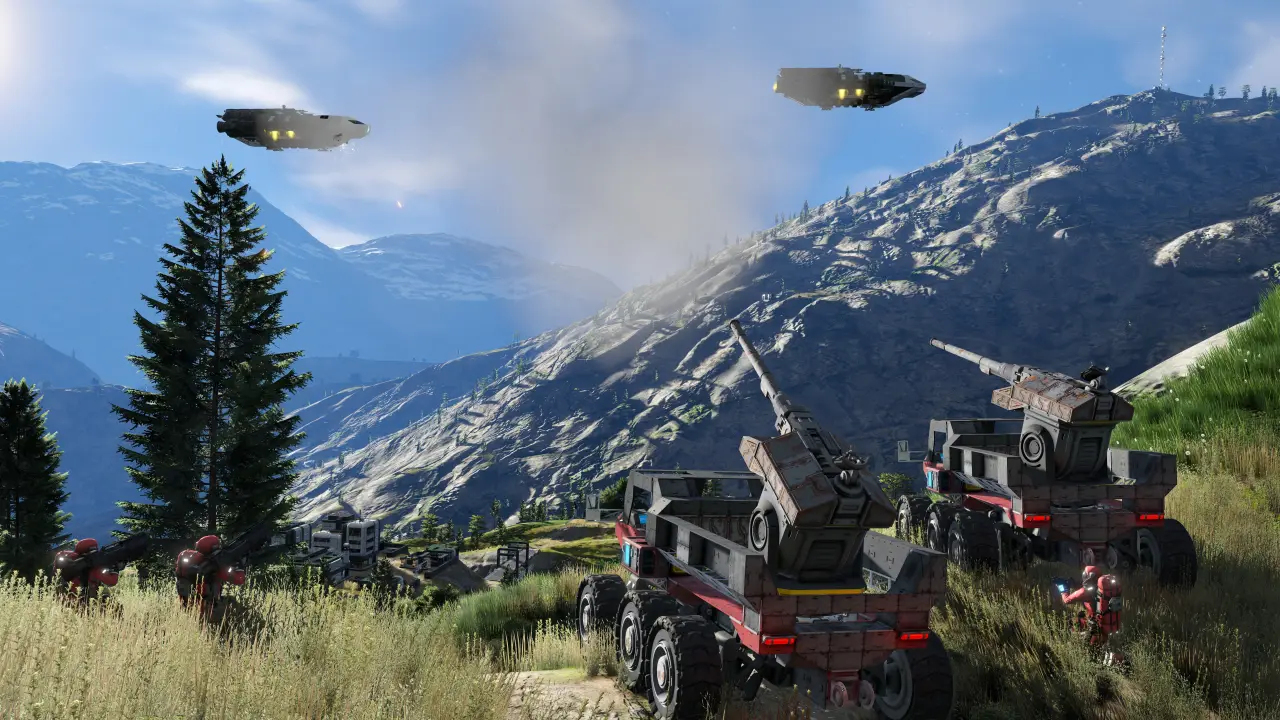
Space Engineers runs on VRAGE2, the in-house voxel physics engine Keen Software House built specifically to handle voxel physics and a huge number of objects on screen at once. The headline technologies still hold up: a voxel terrain system makes planets and asteroids genuinely voxel-based, drillable and carvable down to the block; the dual large-grid plus small-grid scheme can simulate over a hundred thousand blocks in a single frame; real-time deformation means collisions actually warp and break ships apart; and multi-threaded physics splits the simulation across cores on a multi-core CPU. When it launched in 2013 this engine was genuinely ahead of the field, capable of stable simulation of thousands of blocks of complex physics on ordinary hardware.

But VRAGE2 is also the single biggest weakness of the visual dimension. The engine supports none of the newer rendering technologies — no DLSS, no FSR, no ray tracing. Build a five-thousand-block capital ship and your single-player frame rate can sag from 60fps down to 20fps; throw ten players plus several large vessels into one multiplayer scene and the sync problems pile up while frame-time variance gets ugly. This is precisely why Keen decided to develop SE2 in the first place — VRAGE3 exists to rebuild this engine from the ground up. The fact that graphics lands at 7.5 rather than higher comes down chiefly to that engine aging.
On art direction, Space Engineers commits to a hard sci-fi industrial look. The palette runs grey-white plus space black plus warning orange, with ship designs that nod to real NASA spacecraft and industrial equipment. There are no flashy effects; the visual punch comes almost entirely from sheer scale — the menace of a thousand-meter hull passing the camera is genuinely irreplaceable. This low-saturation, real industrial-texture aesthetic still reads well in 2026, and it is the core reason the dimension can still earn a 7.5.
Eleven planets, platform coverage, and the LCD canvas
The full planet system arrived in November 2015, with eleven explorable bodies by default: a temperate Earth, a thin-atmosphere iron-rich Mars, a hazardous-atmosphere alien world, a low-gravity airless Moon, an icy Europa, a liquid-methane-ocean Titan, a far-orbit Triton, the two Martian moons Phobos and Deimos, and the high-gravity desert world Pertam added by DLC. Each carries its own gravity field, atmospheric density, ore distribution, and visual tone, so you genuinely have to design different ships and bases for different planets. Mars's red storms, Europa's frozen blue-white, and Earth's green-blue oceans carry the strongest visual identity the game has.
Platform coverage is the other thing that touches the graphics dimension. Native Windows support is the most complete experience; Xbox One arrived in April 2020 with later Xbox Series compatibility, but programmable blocks are unsupported on console and the feature cut is obvious; PlayStation has never been supported; there is no native macOS or Linux build (Linux works via Proton); the Steam Deck is rated Playable with some small UI text but a playable core; and there is no VR. This strategy of chiefly serving heavy PC players means console owners struggle to experience the game's core depth in full.
The UI leans hard into engineer territory, with a great deal of data presented through LCD screens that you are expected to design yourself. For veterans this reads as a plus — the realism evokes a real spacecraft interior — but for newcomers it is a towering barrier, and anyone who has never touched a space-engineering sandbox can get bounced straight off by the UI's information density. That double-edged effect is a big part of why the game has never broken past its niche engineer audience. Worth singling out is the programmability of the LCD screens: scripts running on programmable blocks can generate their content dynamically, drawing radar sweeps, inventory levels, engine parameters, and fleet formation diagrams onto the panels in real time — a custom-dashboard experience unique to this game's visual layer. The community has a whole LCD art branch, with people scripting live star-field navigation charts, pixel-art animation playing on panels, and even players using an LCD as a ship-bridge main display to cosplay a commander on RP servers. These community creations make the lived graphics experience richer than the raw engine tech alone would suggest.
Combat | 9.3/10
Gameplay: 9.3/10Programmable blocks and a full C# scripting ecosystem
The ceiling of the gameplay dimension is the programmable block system. You write C# scripts inside a programmable block and automate any subsystem of a ship or station you like. The API reaches across nearly every controllable element in the game: reading sensor data such as radar, temperature, pressure, and gravity; controlling thrusters, steering, and autopilot; managing inventory by auto-sorting ore into the correct cargo holds; operating door locks, airlocks, and lighting; driving LCD screens with dynamic data or imagery; scheduling production lines for automatic welding, grinding, and assembly; and communicating with other programmable blocks for ship formations and multi-vessel coordination.

This full C# .NET subset scripting system is genuinely one of a kind in the sandbox space. Minecraft's command blocks only execute a limited command set; Scrap Mechanic offers logic gates but no full scripting language; Besiege has no programmable elements at all. Space Engineers drops a near-IDE-grade programming environment inside the game. For programmer-minded players this is effectively a space simulator stacked on top of a coding IDE, with a depth ceiling far above an ordinary sandbox. Classic community scripts can orchestrate coordinated fleet maneuvers across more than thirty ships at once, and that is the central reason gameplay earns a 9.3.
The learning curve is brutally steep. A player who has never touched C# might need 20 to 50 hours just to get a foothold; a mid-level programmer can write simple automation in 5 to 10 hours; and a high-skill coder can produce a complete AI-piloted ship running over three thousand lines. Official tutorials are relatively thin, so players mostly learn from YouTube guides and open-source GitHub script libraries. That steep climb is one of the reasons the dimension stops short of a 9.5.
Dual-grid building, planetary design pressure, and multiplayer
Large grid is for stations, capital ships, and planetary bases, with a single block occupying 125 times the volume of small grid; small grid is for compact craft, support machinery, and drones; and subgrids are movable substructures linked through rotors and pistons. This dual-layer-plus-subgrid build system lets you mount components of different scales on one mothership — picture a large mining mothership carrying dozens of small mining drones, with programmable blocks sending the drones out to harvest autonomously and return. That combination of scale and precision in one build is, again, one of a kind in sandbox construction.

The eleven explorable planets each carry their own gravity field, atmospheric density, and ore distribution, so you genuinely design different craft for different worlds. The low-gravity Moon lets you get away with low-thrust drives; reaching Earth orbit demands high thrust to punch through atmospheric drag; the high-gravity desert world Pertam needs heavy suspension and a serious heat-dissipation setup. This "redesign your vehicle for every planet" loop pushes survival-mode variety well past what a flatter sandbox offers.
Survival hazards include space radiation (unshielded exposure kills within thirty seconds), meteor showers that randomly batter your base, hostile NPC raider vessels, atmospheric entropy on some alien worlds with corrosive air, and gravity traps near planets that can send a craft tumbling into the ground. The 2019 economy update added the contract system, Space Credits currency, and neutral trading stations, giving survival mode a "no campaign but money to earn" goal loop.
Dedicated multiplayer servers are another bright spot for the gameplay dimension. The PC version supports 16-player servers, and the community runs dozens of long-term RP servers such as the Imperial Star League. But the networking code for online play has been a chronic weak spot — large-scale player-versus-player clashes routinely show sync problems, and that is the other reason the dimension cannot climb to a 9.5. Set against Kerbal Space Program, this game leans toward voxel construction and multiplayer cooperation while KSP leans toward realistic orbital mechanics and solo simulation; the two cover different sub-fields with no direct substitution between them. For engineer-minded players, the depth on offer here remains the ceiling of the sandbox category — and even with SE2 already in Alpha, this game's mature programmable-block ecosystem is still the best answer in 2026. The practical takeaway is that the gameplay loop scales with your own investment: a casual builder gets a competent voxel construction toy, while a player willing to climb the scripting curve unlocks a depth almost no other sandbox can offer, and that breadth of ceiling is exactly what the 9.3 is trying to capture.
Content | 8.8/10
Content: 8.8/10The playtime curve and twelve years of accumulated DLC
The playtime curve offers players three tiers. Clearing survival mode and unlocking all the base content runs around 35 hours. A full run that includes creative building stretches to 300 hours. And producing a high-skill programmable-block automation piece — a single project can eat 50 to 100 hours without anyone blinking — pushes your global playtime to 500 hours or well beyond. Set against Scrap Mechanic's roughly 200-hour ceiling, the content depth here roughly doubles it.
The DLCs rolled out across twelve years form the core of the content dimension's expansion: decorative packs 1, 2, and 3 of purely cosmetic blocks; the Sparks of the Future skin set; the free economy update bundling trading stations and the contract system; the Frostbite ice-planet rescue scenario; a heavy-industry block pack; the Warfare 1 and 2 packs of armaments and turret systems; a desert-themed Wasteland pack; the Automatons AI-robot block pack; and the Contact story-flavored scenario set. Each DLC runs around 3.99 US dollars, and the 2024 Ultimate Edition bundles every one of them, with the current mainstream purchase version listed at 59.99 US dollars. That DLC volume is genuinely generous for an independent sandbox — buying every DLC separately tops 40 dollars, while the Ultimate Edition packages all of it into a 60-dollar bundle that includes the base game, a purchase-friendliness built up across twelve years of running.
A twelve-year Workshop and the community's own content
The Steam Workshop is the content dimension's central expansion. Twelve years on it remains active, with cumulative blueprint shares past one million. The content-type breakdown runs roughly like this: complete ship blueprints make up about 40 percent (everything from interceptors to capital ships to freighters); stations and bases around 25 percent; programmable-block scripts about 15 percent; single-block mods around 10 percent; and skins plus decorative mods the remaining 10 percent.

The in-game script ecosystem is the most distinctive long tail this game has. Using the type:InGameScript filter you can surface a vast pile of automation scripts in the Workshop: subgrid wheel control, rotor and piston hotkeys, slide steering, unified inventory management, dynamic lighting, autopilot, radar alerts, and automated mining where a ship navigates itself to an asteroid, harvests, and returns to base. This script ecosystem pushes the game's de facto content far past the range the official DLCs deliver.
Community-run servers are another distinctive expansion for the content dimension. The Imperial Star League has run for over seven years, with players taking roles as engineers and commanders across rival empire factions and coordinating long-arc storylines, fleet engagements, and diplomatic alliances through Discord. Dozens of comparable long-term RP servers exist in the community, each with its own worldview, economic system, and diplomatic rules. This kind of community-driven content is an extra dimension that other sandbox-building games almost entirely lack.
In January 2025, once SE2 Alpha launched, this game entered maintenance mode: no more major version content updates, with Keen Software House shifting its team's bandwidth toward SE2. The original now only takes critical bug fixes and server-stability patches, and while the Workshop stays active, the share of new blueprints the studio actively drives has dropped. That is the core reason the content dimension lands at 8.8 rather than higher. Set against other independent sandboxes, though, this maintenance mode is remarkably gentle — over a million Workshop blueprints serve as a long-tail backbone, so even with no new official content players can keep going for ages. Leading video creators keep putting out fresh build demos, domestic Bilibili creators stay active too, and the result is a relatively healthy self-sustaining content loop. Worth a special mention: the official Discord server tops a hundred thousand members, the forum section sees players sharing engineering pieces and script snippets every single day, and a newcomer posting a question on the forum generally gets a detailed answer from veterans within hours. That density of community interaction is hard for other long-running Early Access sandboxes to match, and it is the key factor keeping user activity alive through maintenance mode. This state of "product in maintenance but community still rolling" is a real asset built up over Keen's twelve-year run, and it means anyone joining in 2026 need not worry about finding resources or company.






Comments 0
Share your game review
Join the discussion and share your review of this game.
No comments yet. Share your thoughts on this review.