























Opening
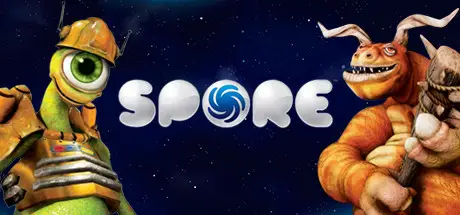
Six legs, two antennae, a tail fin bolted onto the back end like an afterthought. You hit confirm, and the thing stands up and walks — no stutter, no skating feet, those six legs falling into a gait that has never existed before and never will again.
That single moment is the whole of Spore distilled. The game is not playing back an animation an artist drew; it is solving, on the spot, how a creature nobody designed should move. You are not steering a character somebody built for you. You are the one who built it, and the game's job is to make your invention breathe.
When Will Wright — the man behind The Sims — wheeled this machine onto the stage in 2008, the press fell into a peculiar, affectionate bind: it was plainly an astonishing thing, but was it actually a great game? More than a decade on, the answer depends entirely on what you want from a game. If what you want is the godlike kick of conjuring a creature out of nothing and watching it draw its first breath, Spore still has no real replacement.
Story | 6.0/10
Story: 6/10There is no script — your evolutionary trail is the story

Set your expectations straight first: Spore has no story in the conventional sense. No protagonist with a name, no cutscene dialogue, no central mystery waiting to be unraveled. What it hands you instead is a trail that runs from a single cell adrift in the primordial soup all the way to godhood at the galactic core — and the shape of that trail is written by every choice you make along the way.
That sounds like a cop-out until you actually play it. In the Cell stage you decide whether to eat meat or graze, and that choice trails your species for the rest of the run. In the Creature stage you decide whether to grow your kind through fists or friendship. Each fork quietly stamps a temperament onto the species you are raising. By the end you have not read a story someone else authored; you have raised a species from pond scum to a spacefaring civilization, and that exact trail belongs to your run alone — no other player's will look like it.
There is a lineage here, straight from Wright's earlier work on The Sims. Both refuse a main plot; both let the player's own behaviour generate the narrative. The difference is one of substitution. The Sims builds its sense of story out of domestic incident — marriages, fights, a new house. Spore swaps incident for scale, leaning on the sheer span of "cell to cosmos" to manufacture an epic feeling no other game of its year could touch. It is a trade with real teeth: you give up the intimacy of a story about somebody, and in return you get the vertigo of a story about everything — your everything, traced across four billion years of make-believe time.
The one true goal sits at the center of the galaxy
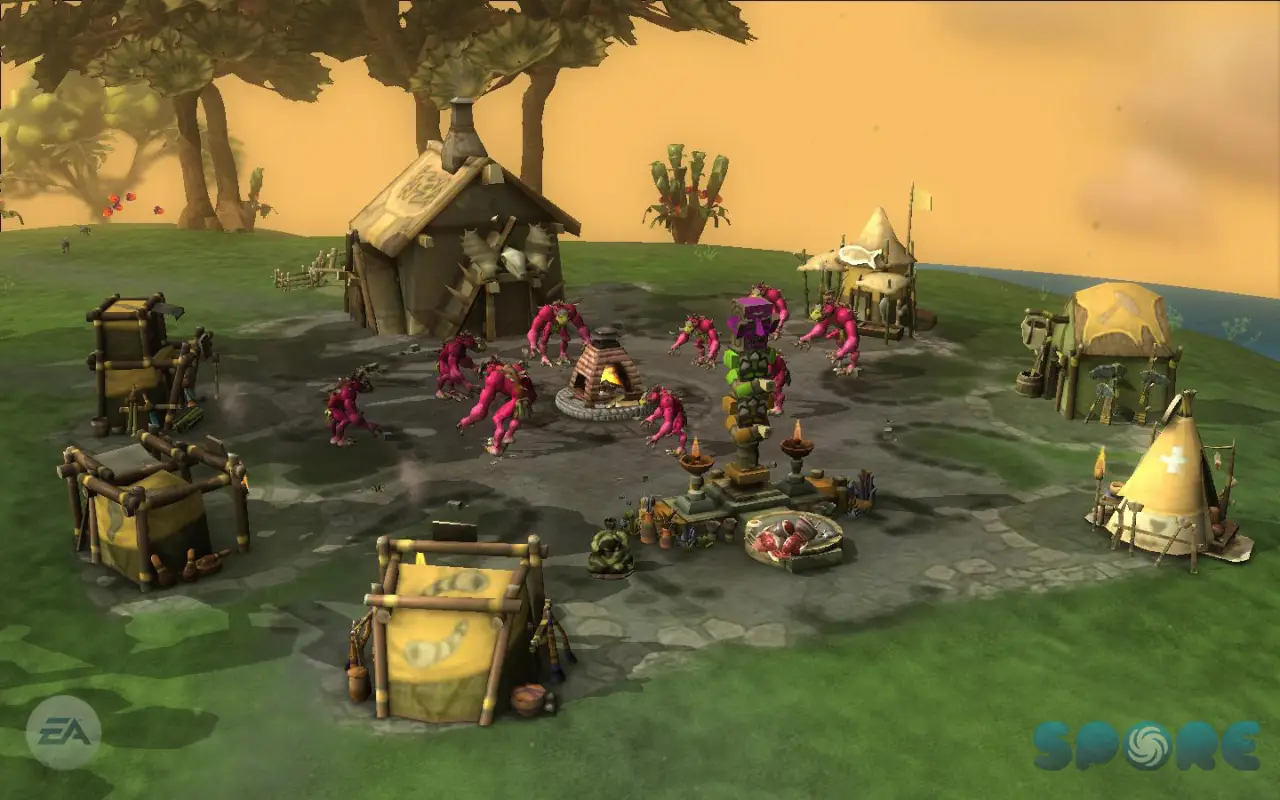
If Spore has anything resembling a traditional climax, it waits at the far end of the Space stage. When your civilization finally has the reach to fly toward the dead center of the galaxy, it slams into a machine race called the Grox — entrenched at the core, hostile to everything, the single hardest wall in the game. Punch through their blockade and you claim the Staff of Life, an artifact that can seed life onto barren, dead worlds out of nothing.
This is the only stretch across all five acts with a clear objective, a clear antagonist, and a clear reward. It is also one of the rare moments where you feel like you are cracking a level rather than fiddling with a toy. Its presence matters: it gives this long evolution a visible finish line, because the Space stage is otherwise so open it can drift into aimlessness.
But that very singularity exposes the soft underbelly of Spore's storytelling. A game spanning five full stages musters exactly one proper narrative goal, and it sits at the very end. For the four acts before it, the story is something you have to supply yourself.
Why the critics docked the narrative
That famous IGN line — an amazing product, but not quite an amazing game — was aimed in large part right here. Narrative is the part of Spore that holds up worst under scrutiny. It turned "no main plot" into a selling point, but the cost of no main plot is that no stage ever gives you a reason to ache for anything. Your creature can be as adorable as you like; it will never speak to you, never carry a fate, never twist a moment so it catches in your throat.
It is not that Maxis cannot write. The Sims proved they understand exactly how to let players grow their own feelings. The trouble is that Spore staked everything on creation and scale, and narrative was the chip it was willing to push off the table. For anyone who buys a game first and foremost for its story, that is a painful cut — which is precisely why this dimension can only earn a bare pass. The world is wide enough to get lost in, but it never once asks you to care, and that distinction is the whole of its narrative ceiling.
Audio | 8.5/10
Audio: 8.5/10Hiring Brian Eno was, by itself, a statement of intent
An EA blockbuster scored by Brian Eno. The name may mean nothing to a lot of players, but Eno is more or less shorthand for the entire genre of ambient music — the man who produced Radiohead and U2. Handing the soundtrack of a video game to an artist like that was a genuinely unorthodox move in 2008, and it set the tone for Spore's audio in one stroke: this game was never going to give you a fist-pumping main theme. It wanted to build a sound environment that breathes and shifts.
Cliff Martinez, a composer best known for film work, joined him. Neither man is a typical game musician, and it shows — the Spore soundtrack sounds nothing like the standard game score of its era.
There is none of that orchestral swelling-for-the-sake-of-swelling. What you get instead is restrained, weightless, spacious electronic texture, more inclined to leave room than to fill it.
That choice is of a piece with the whole game's temperament. Spore wants to wrap you in the feeling of watching life and a universe slowly assemble themselves, and a rousing melody would only puncture that hush. Eno's brand of ambient music — built on tone and texture rather than hummable hooks — turns out to be the ideal fit, never grabbing the spotlight yet always holding you inside something vast and calm.
The music grows into a different shape depending on how you play

This is where Spore's audio plays its real technical card. Eno and the Maxis audio team built a piece of software they called the Shuffler. Rather than playing a fixed track, it stitches fragments of music together procedurally, in real time. The upshot: shape your creature into an aggressive carnivore and the music you hear is audibly different from what you'd get nursing a placid herbivore. The score develops and mutates alongside your style of play, as unpredictable as the game itself.
The same logic runs all the way into the planet editor, whose generative music was built on an engine Eno made with Peter Chilvers — one that later spun off into standalone generative-music apps. The whole audio system runs on a modified open-source sound-programming environment underneath. Turning composition from "write a good piece of music" into "design a system that writes its own music" was strikingly forward-thinking for 2008, and it locks cleanly into Wright's overarching philosophy of designing rules and letting the content grow itself.
Even the creatures' cries are computed
Procedural generation isn't confined to the music. The creature you build gets its calls and its movement effects derived from the model you assembled. A wide-mouthed beast and a sharp-beaked one give different audio feedback; every step, every bite, every howl has a matched sound bolted on. Which means every misshapen thing you create is not just visually one of a kind but audibly its own as well.
That throughline — sound that follows creation — is the root of why Spore's audio earns a high mark. There is no single track here you'll loop on repeat, but it folded sound into the creation system itself: you are not just sculpting a model that moves, you are sculpting a life that makes noise. In 2008, no other game tied its audio to player creation this tightly.
Pull it all together and Spore's audio is a thoroughgoing exercise in the generative: music spun up from rules on the fly, cries deduced from a model on the fly, even the mood mixed live to match how you play. It doesn't win on a handful of melodies you can whistle; it wins with an entire sound system that bends around you, so that every run of Spore sounds like yours alone — an approach that still reads as avant-garde a decade and a half later.
Visuals | 8.0/10
Graphics: 8/10The cartoon look is a strategy, not a compromise
Spore never reached for realism. Every creature, planet and building is rounded, exaggerated, faintly comic. That wasn't a 2008 hardware ceiling — it was a shrewd decision. Once you let players bolt on any number of eyes, mouths and limbs, realism simply collapses under the weight of it. A realistic monster with seven eyes is merely revolting; render the identical shape in a cartoon idiom and it becomes a goofy little beast you can't help grinning at.
It is exactly this visual language that makes "any anatomy looks fine" achievable. However badly you mangle a design, the game renders it into something coherent, cute, and not the least bit off-putting. That backstop for player creativity is the root of Spore's visual identity. More than a decade later you can still pick out that pudgy, unmistakable Spore-creature texture at a glance.
What's more impressive is how the style threads a needle between two contradictory demands: it has to welcome almost limitless shapes, yet keep everything that comes out feeling like it belongs to one world. Whether you've sculpted a darling or a horror, they share a soft palette, rounded silhouettes and faintly humorous proportions — so even a universe crammed with bizarre species reads as visually unified. That balance between freedom and coherence is the most underrated piece of craft in Spore's art.
The real technical centerpiece is the animation that computes itself

If there is anything in Spore you could call wizardry, it is the procedural animation. This is the one technical point I most want to hammer: how your creature walks, eats, and howls — not a single frame of it was hand-authored by an artist. The instant you hit confirm, the game solves a gait at runtime from the number of legs you placed, where you placed them, the angle of the joints.
So a three-legged creature and a six-legged one both walk convincingly — not because Maxis pre-built an animation set for each case, but because the system can generate movement for any limb arrangement you can dream up, live.
It is Spore's single greatest technical achievement, and the magic moment nearly every player and critic singles out: the half-second your creature takes its first step, everybody freezes, then can't help laughing. And it isn't only walking — the same runtime rig drives eating, dancing, mating, drumming, dragging things around. Bolt parts onto your monster in any configuration and it knows how to use them, which is the quiet miracle the whole editor rests on. Nothing about a seven-legged dancer should hold together, and yet it does.
Five stages, five visual languages

Spore's visual ambition also lives in its restlessness. Five stages, and almost five entirely different art styles: the Cell stage is jelly-like life drifting through a 2D micro-world; the Creature stage is the vivid surface of a primordial planet; in the Tribal and Civilization stages the camera pulls back to look down on whole settlements and cities; by the Space stage you're staring at an entire star-strewn galactic map.
That leap in visual scale — zooming from a single cell out to a whole galaxy — is the most unforgettable thing about how Spore looks. Add the four editors for creatures, vehicles, buildings and planets, which hand the keys of art direction straight to the player, with a UI approachable enough that you need zero artistic training to sculpt something presentable. By the standards of 2008, that kind of procedural rendering — any creation taking shape and moving instantly — was genuinely tech-demo-grade visuals.
Pick at Spore's graphics with today's eyes, of course, and the texture resolution and lighting are long obsolete, the polygon counts modest. But visuals were never purely a contest of resolution. Spore wins on style and on function: it props up the full span from the microscopic to the cosmic with one self-consistent cartoon aesthetic, then drops the barrier to creation low enough for anyone to clear. Winning on style and system rather than on spec sheets is the real reason it still doesn't look shabby, and the reason a fresh screenshot of a Spore creature reads as charming today rather than dated.
Combat | 9.0/10
Gameplay: 9/10The creature editor is the real star of this game

Strip away every flashy stage and Spore has exactly one soul: the creature editor. You drop torsos, limbs, eyes, mouths and claws into a 3D space however you please, and no part is mere decoration — each one tangibly changes what the creature can do. Another mouth and it eats faster; another pair of claws and it fights harder; a pair of wings and it flies. The act of building a creature is, in itself, a loop you simply cannot put down.
How addictive that loop is — that's the strongest case for Spore's high gameplay mark. You sit down meaning to throw together something that'll just survive the next stage, and two hours later you're still in there, nudging the angle of one leg and the size of one eye, all so the thing looks a touch more handsome, a touch more imposing. That "I am creating a living thing" payoff is something a lot of triple-A blockbusters can't hand you, because they only ever let you inhabit a character somebody else designed. Spore makes you the designer.
One evolutionary line, five wholly different games strung along it
Structurally, Spore's boldest trick is bolting five barely related kinds of gameplay onto a single evolutionary timeline. The Cell stage is Pac-Man-ish 2D foraging; the Creature stage is third-person action exploration; the Tribal stage cuts to real-time strategy, where you're commanding not a single creature but a whole tribe — up to twelve — wielding tools and weapons; the Civilization stage abstracts further into conquering a planet through economy, religion or war; the Space stage becomes a full-blown 4X game, expanding across half a million worlds.
From microbe to galactic god, no other game in 2008 dared stretch the span that wide. The bare experience of "I was a worm a moment ago and now I'm colonizing other star systems" is worth the price of admission on its own.
Better still, every stage transition arrives with a little ritual of "your species has grown up" — you're not switching levels, you're witnessing a life-form molt through layer after layer. Wiring "game genre" to "stage of life" gives those switches a narrative reason rather than leaving them a mechanical sampler platter. Even where the later stages run shallow, the sheer cleverness of the architecture is the sort of thing you remember for life.
The honest part: every stage was deliberately kept shallow
But the price of that evolutionary line has to be laid bare. GameSpot's verdict at the time — "individual gameplay elements are extremely simple" — was not the slightest bit unfair. Pull any of the five stages out on its own and it loses to the focused benchmark of its genre: the real-time strategy is nowhere near the depth of an actual RTS, and the space 4X gets put on the floor by Civilization IV.
The crucial thing is that this was Wright's deliberate trade-off, not a failure of ability. He wasn't after depth in any single genre; he was after the all-spanning sense of scale and freedom that runs from cell to galaxy. Grasp that and you stop measuring it with the wrong ruler — you didn't come here to master one combat system, you came to play god and watch your species evolve. Put another way, Spore swapped depth for breadth: it can't linger long in any one room, but the procession of rooms it walks you through outnumbers what most games give you in a lifetime. It's a peculiar bargain — those it suits feel they've made out like bandits, those it doesn't feel everything's a shallow dip. Both reactions are correct.
Stage by stage, where the sweetness and the repetition sit
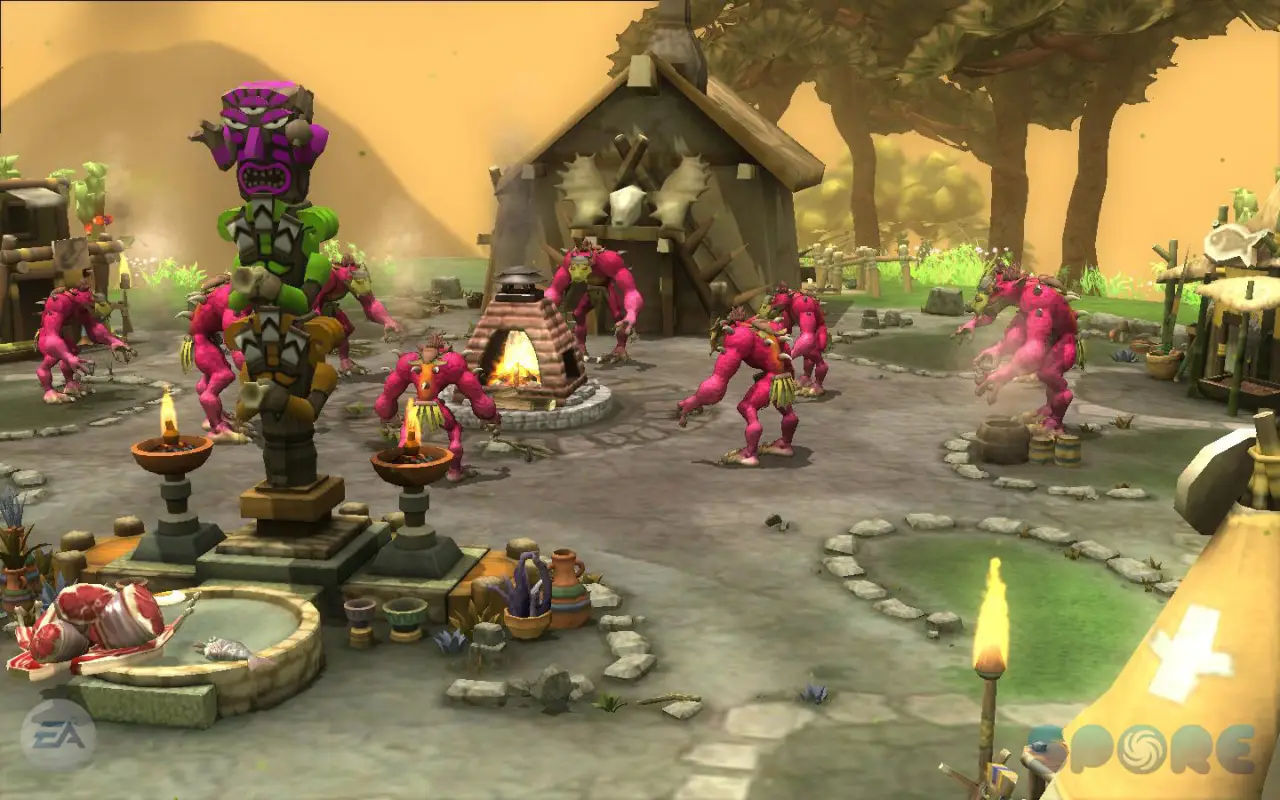
Down at the level of feel: the Cell and Creature stages are where the sweetness is thickest, the nurture-and-grow pull strongest — sculpting a creature, growing parts, watching the species inch toward strength is an experience that's near flawless. By the Tribal and Civilization stages, the thinness of "reskinned RTS" starts to show: the inputs turn repetitive, the strategic depth can't keep pace. The Space stage splits the room — some lose themselves in the freedom of half a million planets for a hundred hours, others can't stomach how the late game decays into repetitive resource management and interstellar errands. The map is huge, no question; pity it's hollow.
So Spore's gameplay is a curve that starts sweet and fades. If you came for the creation and the early nurture, it hands you a joy you won't find elsewhere; if you expected every stage to hold up like a standalone blockbuster, you'll feel a distinct slackening by the back half. That's why its gameplay rates high yet keeps one reservation that nobody gets to walk around.
Content | 7.0/10
Content: 7/10The campaign is short, but look up and the content is endless
By the campaign clock, walking through all five of Spore's stages runs about 19 hours (the HowLongToBeat median); chase down the achievements and every gameplay route and you can stretch it past 60. On that number alone, its bulk for 2008 is respectable, nothing extraordinary.
But that number captures almost nothing of Spore's real content mass, because the bulk of it isn't in the campaign at all. The game's true content pool is that infinite loop where players create and then share with each other — more on that below. First, the matter of how much the studio itself packed in.
And honestly, "time to beat" is a non-question for Spore. It doesn't carry the clean notion of "done" that a linear narrative game does — you can squat in the Creature stage refusing to leave, sculpting fresh species for a dozen hours; or sprint to the Space stage, then start a brand-new save and run it all again with a wholly different temperament of species. That 19 hours is merely the time for your first walk through the five acts, while what Spore actually wants from you is to restart again and again, playing a different kind of god each time. By that measure, campaign length is simply the wrong ruler for its content.
The Space stage: an explosion of scale, with density that can't keep up

On paper, the Space stage is the bulk-content blowout of the whole game: 500,000 planets, 100,000 stars, each one a place you can fly to, explore, colonize, terraform. The figure would still raise eyebrows today; in 2008 it was unheard of.
The catch is that the density can't keep pace. Plentiful as the planets are, you quickly find them much of a muchness, the things you can do on them cycling through the same short list — scan, harvest, negotiate, fight. "Big map, empty map," that chronic ailment of the open worlds to come, claims Spore as one of its earliest victims. So the Space stage's scale is double-edged: it can pour out a hundred hours, but a sizeable chunk of those hours is repeated labour.
Worse, the Space stage piles on some genuinely vexing design — your colonies are forever harassed by ecological disasters and hostile empires, forcing you to ping-pong across the galaxy like a firefighter. The early rush of expansion gets ground down by that endless maintenance. It's why opinion on the Space stage splits clean in two: some revel in the freedom of lording over the stars and treat it as a space sandbox to play forever; others burn out on the repetitive errands and firefighting and quit early. Which camp you land in turns largely on your tolerance for that breadth-for-depth bargain.
Two expansions, one feeding play and one feeding creation
Spore got two expansions worth mentioning. One is Galactic Adventures (2009), which gave the Space stage — until then a matter of pointing and directing from inside your ship — the option to drop down onto a planet yourself and play through a mission. You beam a creature you built straight onto a planet's surface and run an adventure. Plenty of veterans count it the patch that "made the Space stage worth the ticket," because it backfilled exactly the close-up, goal-driven play the late game lacked most.
The other is the Creepy & Cute Parts Pack, which, true to its name, dumped a heap of either grotesque or adorable new parts into the creature editor. It adds no new play, but it fed the creative appetite of Spore's most devoted audience straight to the bone — for people who truly love to sculpt, more parts simply means more possibilities. An extra pair of horns, an uncanny new eye, a set of cartoonish limbs: each one quietly widens the border of what you can make. Set the two side by side and they map neatly onto Spore's twin foundations — one shoring up play, one shoring up creation. EA knew exactly where this game's appeal lived.
The real "infinite content" hides inside Sporepedia

When all's said and done, Spore's largest content mass is the part players produce themselves. The game ships with an online server called Sporepedia: every creature, vehicle and building a player sculpts can be uploaded, and anyone can pull down other people's creations to populate their own galaxy.
Not long after release, players had heaped over 25 million original creations onto it. Which means the alien species drifting past in your universe are quite possibly the handiwork of a stranger on the other side of the planet. That asymmetric design — Maxis ships the editors, millions of players generate the population of an entire galaxy — is the truth of Spore's content mass: the official campaign is just a skeleton, and what actually props up its endless replay value is that community pool you can never finish building or downloading.
It's clever on a technical level too: sharing a creature is, in essence, sharing its genetic template, and the game "grows" that template into a full creature live on each player's machine. So a creation's file is tiny, upload and download alike are blisteringly fast, and only that lets millions of players fill the same galaxy for one another. Seen from today, this notion of player-built content is the very seam that Minecraft and Animal Crossing would mine again and again — and Spore was one of the earliest, most aggressive, industrial-scale stabs at it. Its content ceiling was never Maxis's to set; it belonged to the players' imagination.




Comments 0
Share your game review
Join the discussion and share your review of this game.
No comments yet. Share your thoughts on this review.