






















Opening
Terraria gave players a single world to dig through; Starbound gave them an entire universe. Chucklefish's 2D sandbox takes the familiar pixel-art loop of mining, building, and survival and stretches it across a procedurally generated galaxy of effectively infinite planets, then hands you one of seven distinct alien races to explore it as. It is the genre scaled up to interstellar size, and that ambition is both its greatest strength and the root of its few real flaws.
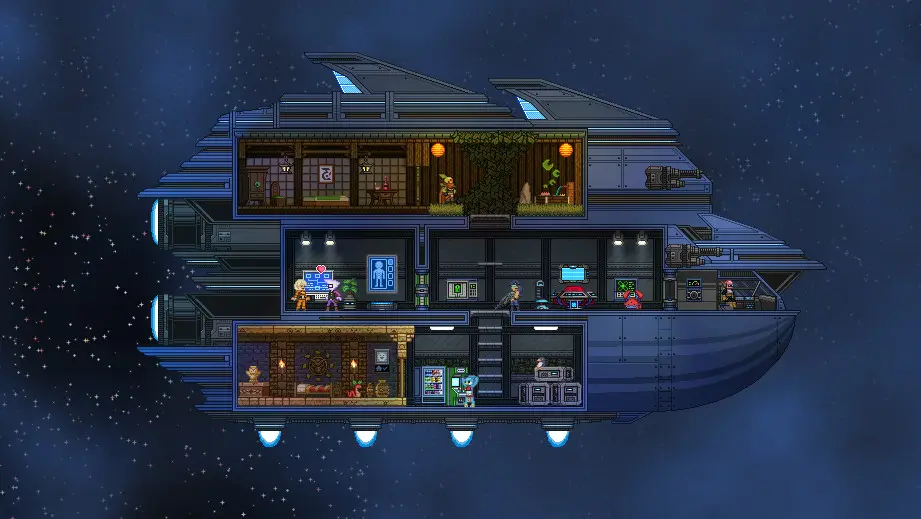
You begin fleeing your homeworld aboard a damaged ship, then upgrade it into a mobile base from which you hop between star systems, touching down on frozen moons, jungle worlds, and toxic wastes to gather resources, build outposts, and chase the threads of an ancient story. The seven playable races — humans, the simian Apex, the avian Avians, the plant-like Florans, the robotic Glitch, the aquatic Hylotl, and the gaseous Novakid — each come with their own worldview, architecture, and origin, giving the sandbox a sense of identity that few of its peers attempt.
It is not flawless. The combat and boss fights are widely judged the weakest part of the package, Chucklefish largely stopped major updates after the 1.0 release, and the studio's reputation took a hit over an unpaid-volunteer controversy. But a vast modding scene — led by the colossal Frackin Universe — has kept the game thriving nine years on. This review breaks down where Starbound's interstellar sandbox earns its marks, and who it is for.
Story | 7.5/10
Story: 7.5/10Starbound tells more story than most sandbox games bother with, and far less than a dedicated narrative game. It frames its infinite universe with a loose mythology, seven race-specific arcs, and a quietly charming web of NPC interactions, then leaves the rest to you. The story score reflects a game that offers real authored content as scaffolding, but lets its deepest tales emerge from exploration and play.

Seven Races, Seven Ancient Histories
The backbone of the authored story is the cast of seven playable races, each with its own culture, aesthetic, and ancient history. The Florans are a savage, plant-based people; the Glitch are a robotic society trapped in a perpetual medieval age; the Hylotl are a refined aquatic civilization; the Apex live under a totalitarian regime; the Avians worship a sun deity; the Novakid are gunslinging beings of living gas; and the humans are the displaced everyman. Choosing a race shapes your starting ship, your aesthetic, and your flavor of the opening, and the lore poured into each one gives the universe a genuine sense of depth and texture.
The main questline threads these races together through a shared mythology involving an ancient cosmic threat, carrying you across worlds toward a series of climactic confrontations. It is competent, light-hearted, and occasionally genuinely funny — Chucklefish's writing has a wry, affectionate tone throughout — though it is also fairly thin, a frame to hang exploration on rather than a story that demands to be followed. The race lore is the real reward, and players who dig into it find a richly imagined universe beneath the sandbox.
The Quiet Stories of the Colony
Some of Starbound's most charming storytelling hides in its tenant system. Build a suitable room, hang a colony deed, and NPCs of various races will move in, and these tenants are not just mechanical fixtures — they chatter, react to their surroundings, offer quests, and occasionally produce delightful little vignettes of their own. A colony you build slowly fills with characters, and the implicit narrative of the community you are assembling becomes one of the game's quiet pleasures.
This is emergent, player-driven storytelling of a gentle kind. The game does not script these moments; it gives you the tools and the cast and lets the stories of your particular colony arise from who moves in and what they say. For many players the anecdotes of their settlements — the merchant who set up shop, the guard who defended the gate, the odd alien who wandered in — are more memorable than the main quest, and that homemade quality is a real part of the game's appeal. Each tenant you recruit carries a little personality and the occasional surprise, so a colony grows into a cast of familiar faces that you come to feel responsible for, and that sense of stewardship gives the building loop an emotional weight pure decoration never could.
Mod-Expanded Lore and the Honest Limits
The community has extended the game's narrative reach considerably, and Frackin Universe in particular layers in an enormous amount of additional lore, races, and progression that effectively rewrites and deepens the universe far beyond Chucklefish's original frame. For players who want more story and more world, the mod scene supplies it abundantly, turning the base game's sketch of a universe into something far more densely realized.
Still, the honest assessment is that storytelling is not why most people play Starbound. The main quest is serviceable rather than gripping, the boss-driven climaxes are undercut by the game's weak combat, and there is no emotional arc that will stay with you the way a dedicated narrative game's might. What Starbound offers instead is a beautifully realized setting and the freedom to write your own journey across it — a universe to inhabit rather than a tale to be told. That trade of authored narrative for sandbox breadth is exactly what this score weighs, and it lands the game in solid, unspectacular territory. The writing's saving grace is its warmth — Chucklefish clearly loved this universe, and that affection shows in the small jokes, the flavor text on items, and the personality of the races, so even when the plot is thin the world never feels lifeless. It is a setting you grow fond of through accumulation rather than one that grips you through drama, and for the right player that slow-building attachment is its own quiet reward.
Audio | 9.0/10
Audio: 9/10The music of Starbound is its single most acclaimed element, a soundtrack that punches so far above the game's weight class that it alone justifies the experience for many players. Where a 2D sandbox might be expected to offer simple chiptune loops, Starbound delivers a sweeping, RPG-tier score, and the audio as a whole is tuned to make a vast, lonely universe feel wondrous rather than empty.
A Soundtrack Built for a Universe
The score, led by composer Curtis Schweitzer, runs to well over a hundred tracks of lush, atmospheric, fully orchestrated and ambient music. The defining achievement is its scope and variety: different planet types and biomes carry their own distinct musical identities, so the hush of a frozen world feels different from the menace of a toxic one or the calm of a verdant garden planet. This gives the act of exploration a constant emotional accompaniment, the music shifting to match the wonder, danger, or serenity of wherever you have just landed.
Crucially, the soundtrack captures the precise tone the game needs — a sense of awe and gentle melancholy fitting for a lone traveler drifting through an infinite cosmos. It is music that makes you want to linger on a planet just to listen, and it lends even routine resource-gathering a contemplative, almost meditative quality. The races and major locations carry their own audio signatures too, so the sonic world is as differentiated as the visual one, reinforcing the identity of each corner of the universe.
Sound Design, Atmosphere, and Platform Notes
Around that score, the sound design does solid, functional work. The effects for mining, building, combat, and the chatter of NPCs are clear and satisfying, providing the feedback a sandbox needs without ever competing with the music for attention. The ambient audio of each biome — wind, wildlife, the hum of machinery in a built-up base — layers in to deepen the sense of place, so a planet feels inhabited and alive rather than a blank canvas. It is a restrained, well-judged mix that knows the music is the star and gives it room to shine.
Across platforms the audio is consistent, with the soundtrack and effects carrying over intact to the console version, and on PC the modding community has produced music and sound packs that expand or swap the audio for players who want even more variety. The soundtrack's reputation extends well beyond the game itself, frequently singled out as one of the finest in the indie space and enjoyed as standalone listening by a devoted audience. It is the kind of score that becomes inseparable from the memory of playing, and it is exactly what earns this dimension its high mark — a small studio reaching for something genuinely beautiful, and grasping it. More than any other element, it is the music that converts skeptics; players who came expecting a simple Terraria clone often stay for the way a single track on a quiet alien beach makes the whole universe feel meaningful. That emotional lift, sustained across a hundred-plus tracks, is the game's secret weapon.
Visuals | 8.6/10
Graphics: 8.6/10Starbound is a gorgeous pixel-art game, and its visuals do an enormous amount of work to make an infinite procedural universe feel handcrafted rather than algorithmic. The art direction is detailed, colorful, and full of personality, and it is a big part of why the game has aged so well — pixel art does not date the way more realistic styles do. The score reflects a presentation that is consistently lovely and impressively varied.

Detailed Pixel Art With Real Personality
The foundation is the quality of the spritework. Every race, creature, plant, block, and piece of equipment is rendered with care and a distinct visual character, so the world is dense with detail despite its 2D simplicity. The seven races are especially well realized — the Glitch's medieval-robotic aesthetic, the Florans' tribal botanical look, the Hylotl's elegant aquatic architecture each read instantly and feel like the product of a genuine culture. This commitment to giving every faction a coherent visual identity is what elevates Starbound above a generic sandbox; the universe looks designed, not assembled.
The animation and visual feedback are equally strong. Characters, monsters, and machines move with charm and clarity, and the little touches — the way a Floran bristles, the glow of a Novakid, the chunky satisfaction of terrain crumbling under your tool — give the world a tactile liveliness. It is pixel art used not as a budget shortcut but as a deliberate, expressive style, and the craftsmanship shows in nearly every frame. Even the smallest objects — a piece of furniture, a stray plant, a discarded tool — are drawn with the same attention, so the world feels dense and intentional wherever you look rather than thinly populated with reused assets.
Infinite Worlds That Still Feel Distinct
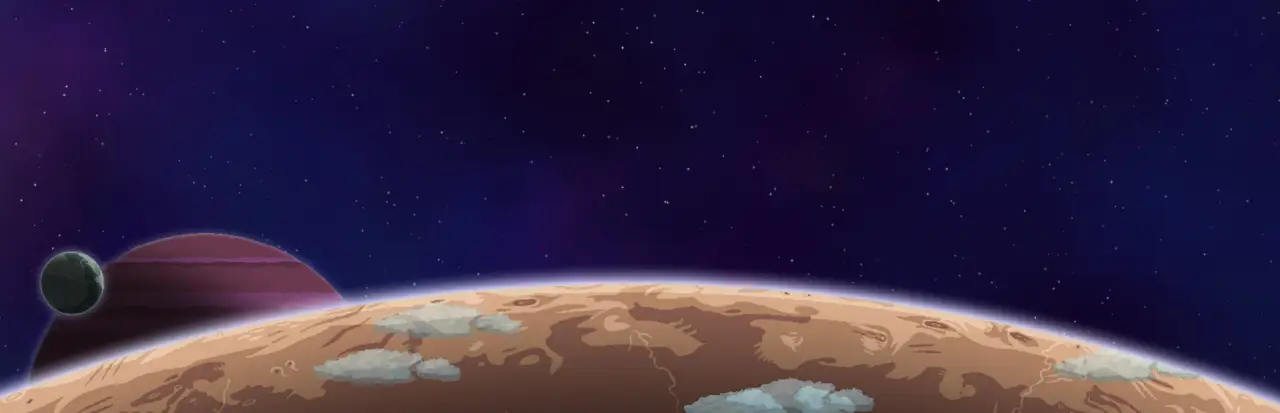
The hardest visual problem a procedural game faces is sameness, and Starbound largely solves it through an enormous palette of biomes and a smart system of combining them. Planets come in a huge range of types — lush gardens, frozen tundras, volcanic hellscapes, toxic swamps, alien jungles, barren moons — each with its own color scheme, flora, fauna, and hazards, so landing on a new world genuinely feels like arriving somewhere new. The procedural generation mixes and layers these elements so that even within a type, individual planets surprise you, and the sheer visual variety across the universe is one of the game's quiet triumphs.
The race-specific architecture and equipment deepen this further, as the dungeons, villages, and structures scattered across worlds carry the visual stamp of whichever civilization built them. Stumbling onto an Avian temple or a Glitch castle gives each exploration a sense of discovery, the art constantly rewarding you for venturing somewhere new. Combined with day-night cycles, weather effects, and dynamic lighting that shift the mood of a planet across a visit, the result is a universe that, despite being machine-generated, rarely feels repetitive to look at.
Atmosphere, Interface, and Platform Notes
The lighting and weather systems are a real atmospheric asset, with glowing caves, starry night skies, rain, snow, and the warm light spilling from a base you have built all contributing to a strong sense of place. These touches make planets feel like environments to inhabit rather than backdrops to strip-mine, and they reward the player who slows down to appreciate where they are. The interface is clean and functional, presenting the game's many systems — inventory, crafting, ship management — clearly enough to keep a complex sandbox navigable.
The main caveats are platform-bound. The PC version is the definitive one, where the community's visual mods can further enhance and expand the art, while the 2024 Xbox port, though faithful to the base presentation, cannot run those mods and so misses the upgradeability that defines the PC experience. Within its chosen style, though, Starbound is a consistently beautiful and remarkably varied game, and the score reflects pixel art deployed about as well as the form allows. The visual generosity also extends to player expression: the building tools and the huge library of blocks, furniture, and decorative objects let you create bases of real beauty, and the screenshots players share of their elaborate space stations and planet-side cities are testament to how much the art rewards creativity. It is a game that looks good both in the worlds it generates for you and in the ones you build for yourself.
Combat | 8.5/10
Gameplay: 8.5/10Starbound's gameplay is a wide, generous sandbox loop with one genuinely novel twist and one genuine weakness. It takes the proven Terraria formula of mine-build-explore and wraps it around an interstellar structure of ship travel and planet-hopping, then adds a colony economy that few of its peers attempt. The result is deeply absorbing for the right player, even as its combat keeps it from the very top tier. The score reflects that mix of real innovation and real shortcoming.

Exploring a Procedural Universe
The core loop is exploration, and the interstellar framing is what sets it apart. From your ship you select a planet, beam down, and explore a fully destructible 2D world to gather resources, fight wildlife, raid dungeons, and find treasure, then return to your ship to craft, upgrade, and travel onward. The sense of scale is the hook — there is always another planet, another star system, another biome to visit, and the procedural generation ensures you rarely know exactly what you will find when you land. Progression is gated through ship upgrades and quest milestones that push you toward more dangerous and rewarding worlds, giving the open-ended wandering a satisfying spine.
This is a loop built for the player who loves discovery and self-direction. There is no pressure to rush, and much of the joy is simply in the act of poking at a new world to see what it holds — a hidden mini-dungeon, a rare crafting material, an NPC settlement with its own flavor. For those who find that kind of open exploration soothing rather than aimless, Starbound offers an almost bottomless well of it.
The Tenant Economy and Race Quests
The standout mechanical innovation is the colony and tenant system, which transforms building from pure decoration into a feedback loop. Construct rooms that meet certain criteria, hang a colony deed, and NPCs move in as tenants who pay rent, sell goods, and dish out quests. This gives your construction a tangible purpose beyond aesthetics — you are not just building a pretty base, you are building a functioning settlement that rewards you, and tailoring rooms to attract specific kinds of tenants is a genuinely engaging design puzzle. In the 2D sandbox space this reactive building economy is close to unique, and it is the system that most distinguishes Starbound from its inspirations.
Layered on top are the race-specific main quests and the ship-upgrade progression, which give the sandbox direction. The questline carries you through a series of objectives and dungeons across the universe, and advancing your ship and gear provides a steady sense of growth. It is a solid progression structure that keeps the open world from feeling purposeless, channeling your exploration toward meaningful goals without ever caging it.
The Combat Problem and the Frackin Universe Fix
The honest weakness is combat. Multiple reviewers have flagged it as the soft spot, and they are right: melee and ranged fighting feel imprecise and floaty, enemy variety leans on reskins, and the boss battles meant to cap each race's questline lack the mechanical depth to feel like climaxes. In a game where the main story builds toward these fights, that shallowness genuinely discounts the payoff, and players coming from the tight, demanding combat of Terraria will feel the difference keenly. It is the clearest reason this dimension sits below the game's strongest scores.
The community's answer, as so often with Starbound, is mods — and Frackin Universe above all. This sprawling overhaul functions as a spiritual expansion whose code volume reportedly exceeds the base game, adding vast new tech trees, races, planets, and systems that deepen nearly every loop, including combat and progression. For PC players it is close to essential, transforming Starbound from a charming-but-shallow sandbox into a dense, near-endless one. The base game is a good, distinctive experience held back by its fighting; with the right mods, it becomes a great one — which is exactly the nuance this score reflects. It is also worth noting that multiplayer adds another dimension entirely, as exploring the universe, building a shared colony, and tackling the questline cooperatively with friends smooths over many of the solo game's rough edges and turns the relaxed loop into a genuinely social one. For a group, Starbound's weaknesses matter far less than its breadth.
Content | 9.0/10
Content: 9/10Content is one of Starbound's strongest scores, and for good reason: an infinite procedural universe is a near-bottomless well to begin with, and the community has poured years of additional material on top of it. Between a substantial base game, an overhaul mod larger than the original, and a workshop of thousands, the practical content here is effectively limitless for the engaged player.

The Base Game's Generous Scope
The official game alone is substantial. The main questline runs anywhere from fifty to a hundred and fifty hours depending on how much you explore, and that figure barely captures the open-ended nature of the experience, since the procedural universe offers an endless supply of planets to visit, build on, and mine. Seven races, a deep crafting system, the colony economy, ship progression, countless biomes, dungeons, and creatures give the base game enormous breadth, and a completionist or a dedicated builder can sink hundreds of hours in without ever installing a mod.
Much of that content is self-directed, which is both its strength and the source of its one structural criticism. The game hands you a universe and a light questline and trusts you to make your own goals — building an elaborate base, collecting every codex, populating a sprawling colony, or simply seeing what is on the next planet. For players who thrive on that kind of freedom, the well never runs dry; for those who need authored structure, the open-endedness can feel directionless once the main quest is done.
Frackin Universe and a Massive Workshop
The defining content story, though, is the modding scene. Frackin Universe is the crown jewel — a community overhaul so vast that its code volume reportedly exceeds the entire official game, functioning as a spiritual expansion that adds new races, planets, biomes, technologies, and entire progression systems. It does not just add content; it reshapes and deepens nearly every part of the game, and for a huge segment of the player base it is the definitive way to play Starbound. That a free fan project rivals and arguably surpasses the official game in scope is a remarkable testament to the community's devotion.
Beyond Frackin Universe, the Steam Workshop hosts more than six thousand mods spanning new races, ships, items, quests, visual tweaks, and quality-of-life improvements. Whatever you want to add to your universe, someone has likely built it, and the ease of installation means assembling a personalized version of the game is straightforward. This combination of an essential overhaul and a colossal workshop is what pushes the content from "generous" to "effectively endless," and it is the main engine of the game's longevity.
Nine Years of Life and the Abandonment Asterisk
The clearest proof of the content's depth is the game's staying power. Nine years after launch, Starbound still draws several thousand daily players, sustained almost entirely by its mod ecosystem and the sheer replayability of its sandbox — an impressive feat for a 2D indie title. The 2024 Xbox port brought the base experience to consoles and introduced the game to a new audience, broadening its reach even further, though console players are notably cut off from the mod layer that makes the PC version so deep.
The one real asterisk on the content record is official support. Chucklefish largely ceased major updates after the 1.0 release, a decision the community has long criticized as abandoning the game with its potential only partly realized, and the studio's reputation was further damaged by a controversy over unpaid volunteer labor that left lasting distrust among some veterans. The result is a strange situation where the game's enormous content owes far more to its community than its developer. But owe it to the community or not, the content is genuinely there in abundance — and measured by sheer volume and longevity, this dimension earns its high score honestly. The practical takeaway for a buyer is simple: there is far more game here than the price suggests, and the only real cost of accessing its deepest content is the modest effort of installing a few mods. For anyone who enjoys the core loop, the worry will never be running out of things to do, only finding the time to do them all.



Comments 0
Share your game review
Join the discussion and share your review of this game.
No comments yet. Share your thoughts on this review.