
























Opening
A customer leans across the counter and asks for nothing more specific than "a plant that helps people rest, without doing too much harm." You squint at the leaf veins printed in your guidebook, the cross-section of a petal, a description that refuses to commit to anything precise. You weigh two near-identical specimens, second-guess yourself, and finally slide one across the wood. That single hesitant moment is where Strange Horticulture quietly announces what it really is. The fun here was never about running a plant shop; it is about taking something as unhurried as identifying a sprig of greenery and lacing it with the small, page-turning compulsion of a good detective story.
The surface is calm. Genuinely calm. A counter, a book, a visitor, a map, a sealed letter: the gestures are tiny and the thrills never arrive as spikes. Yet once you settle into its cadence, the game behaves like a cup of tea that opens bitter and finishes sweet. The field guide, the customer requests, the esoteric mystery, and the rumors drifting through the town all interlock, until you are memorizing leaf shapes with one part of your brain while the other keeps circling back to what that letter was really hinting at.
Strange Horticulture does not win you over with spectacle. It wins with the soft pull of "one more page before bed." Accept that premise and it hands you something rare: reading, recognition, and deduction reshaped into play that genuinely has tactile weight in your hands.
Story | 8.4/10
Story: 8.4/10Strange Horticulture does not belong to the school of storytelling that flings a hook in your face the instant you sit down. It starts you off simply running a slightly peculiar plant shop, and only then, through customer commissions, letters from a friend, dreamlike hints, and scattered discoveries pinned to a map, does it gradually unfold its esoteric mystery. The pacing is fragmented. And precisely because it is fragmented, it carries the flavor of an old serialized novel: each installment gives you a little, never quite enough to be full, but exactly enough to keep you preoccupied.
A Mystery Told in Fragments
That opening image, a dim pool of light falling over enigmatic cards and lines of narration, sets the tone with real precision. It is not mystification for its own sake; it is deliberate, conscious negative space. The game knows that what it withholds is doing as much work as what it shows. Later, the character dossiers, those personnel cards padded with background detail, keep reminding you of the same uneasy fact: this town looks placid on the surface, and underneath it is anything but.
The fragmentation is a feature, not an accident. By rationing its revelations, the game keeps you in a permanent state of mild anticipation. You are rarely handed a scene to watch; instead you are handed a fragment to hold, and the holding is what makes the next fragment land. It is a story you assemble in your peripheral vision while ostensibly minding the shop.
That structure also forgives a wandering attention in the best way. Because each fragment is small and self-contained, you can step away for days and return without losing the thread, yet the moment a new piece slots into place, the larger picture sharpens all at once. It is the rare narrative that rewards both the obsessive who races ahead and the dabbler who lets the mystery steep slowly between sessions.
Daily Work as a Narrative Doorway
The smartest thing the story does is turn "running the shop" into the doorway through which all the narrative enters. You are not watching the plot happen at a distance. You are piecing it together inside the act of greeting, identifying, and delivering. The clue arrives folded into a transaction. The revelation is something you earn by getting an identification right, not something a cutscene grants you on a timer.
The upside of this approach is that immersion comes naturally and the fragments stay chewy, rewarding the careful player rather than the impatient one. The downside is equally clear: this delivery style does little for raw momentum. The main thread advances only because you keep reconnecting the loose ends yourself, and if your rhythm breaks midway, the suspense thins out. The effect is real, but again, not fatal.
The trade is worth naming precisely. A more conventional game would seize control at key moments, marching you from beat to beat so the story could never stall. Strange Horticulture refuses that comfort, and in exchange it makes you the engine of its own plot. When it works, the sense of authorship is intoxicating; when your concentration lapses, the machinery can idle. It is a deliberate gamble, and the game is honest enough to let you feel both sides of it rather than smoothing the difficulty away.
Choices That Bend the Ending

What rescues the slower stretches is that the choices carry weight. Critical consensus notes the game offers different endings and divergent paths, and your decisions genuinely change the outcome. That single design fact retroactively reframes everything the earlier hours were building toward. The setup is no longer just material you "watched"; it is material you participated in steering.
This is the quiet ambition tucked inside such an unassuming premise. A plant shop and a guidebook turn out to be the instruments through which you don't merely receive a story but help decide which way it leans. The town's secrets are not a fixed monologue waiting to be heard; they are a branching structure that responds to the kind of shopkeeper you choose to be, the specimens you choose to hand over, and the threads you choose to chase.
By the end, the fragmented, withholding, dossier-strewn approach reveals its logic. It was never trying to overwhelm you. It was trying to make you complicit, to ensure that the mystery you finally understand is one you had a hand in shaping. For the right player, that complicity is far more memorable than any front-loaded twist could have been, and it is the strongest argument for the game's quiet, patient way of telling a tale.
Audio | 5.6/10
Audio: 5.6/10Audio is the area where Strange Horticulture is least in command. The feedback from critics is fairly uniform on this point: most reviews simply do not treat the music, the sound effects, or the voice work as anything central to the discussion. The atmosphere, when it lands, is carried almost entirely by the writing, the art, and the structure of the puzzles. To put it plainly, the game's mood is real, but the credit does not belong to its sound.
Useful, but Easy to Forget

That is not to say the audio does nothing. A handful of small details, the chime of a shop bell among them, genuinely reinforce the feeling that you are tending a strange little botanical store. The touch is light. It is also adequate. The problem is that "adequate" sits a long way from "memorable." You will rarely finish a stretch of play and find yourself recalling a particular melody, or pausing to savor a piece of sound design the way you might pause over a clever clue.
The consequence for the experience is straightforward. Unlike the art and the gameplay, the audio never becomes a reason you would recommend the game to someone. It supports the work quietly from the back of the room, and it is competent at that supporting role, but it never steps forward into the light to claim a moment as its own. It is the kind of sound design you notice mainly by its absence of impact.
To be fair, restraint is partly a stylistic choice here. A score that demanded attention might fight the hushed, reading-heavy mood the rest of the game works so hard to build. The ambient quiet does leave room for concentration, and there is a case that anything more assertive would intrude. But there is a wide gap between unobtrusive and forgettable, and the audio lands closer to the latter than a game this atmospheric deserves.
Not Fatal, but a Missed Opportunity
Is this a fatal weakness? It is not. The core pleasure of Strange Horticulture was never built on its audio in the first place, so a soft spot here does not bring the whole house down. The pillars holding the structure up are reading, looking, and deducing, and those pillars are sound. A thinner audio layer is a flaw the design can absorb without buckling.
Still, it is hard not to feel the missed opportunity. This mysterious, hushed, faintly chilling atmosphere could have been thicker if the sound had been willing to step forward even a little. As it stands, it resembles a well-made dish that is short one pinch of spice. Nothing about it is unpleasant; the seasoning is balanced and the result goes down easily. You simply know, the whole time you are tasting it, that it could have been more fragrant, and that small awareness lingers after the plate is cleared.
Imagine a low, uneasy motif that crept in whenever a darker commission arrived, or a subtle shift in the ambient texture as the town's secrets deepened. None of that exists in any memorable form, and its absence is the difference between an atmosphere that is merely intact and one that genuinely haunts. The game survives the gap comfortably, but it is the one place where you can clearly picture a better version of itself.
Visuals | 8.3/10
Graphics: 8.3/10The art in Strange Horticulture is not the "it's pretty and that's all" kind. It is the "you can read it, you can identify by it, and it happens to have real character" kind. The plant portraits, the illustrations, and the page layouts of the guidebook are all rendered with fine detail, and the crucial point is that this detail is not decoration. It is a working component of the puzzle. Leaf shapes, the cross-sections of flowers, distinctive coloration: all of it is pressed into service as actual identification evidence.
Art That Doubles as Evidence

Here the visuals behave less like a flourish and more like an understated director of photography. The camera language never shows off, yet every clue you uncover depends on its accurate expression. When you stand at the guidebook trying to name a stem and then answer a customer's need, you are not really looking at a UI. You are looking at a series of functional exhibits, each one a piece of physical evidence with a job to do.
That distinction matters more than it sounds. In a lesser game, the same scene would be a menu. Here it is a tableau you genuinely have to interpret, and the interpretive act only works because the illustration is precise enough to support it. The art is not asking for your admiration; it is asking for your scrutiny, and it has been built to reward that scrutiny consistently.
Crucially, the precision is consistent enough that you learn to trust it. Once you understand that a particular curl of a leaf or a specific gradient of a petal genuinely means something, you start reading the illustrations the way a naturalist reads a real specimen, slowly, deliberately, with the assumption that no detail is idle. That trust is hard-won and easy to break, and the art never breaks it.
Building the Town's Atmosphere
A separate yellowed page, inscribed with the shop's backstory and flanked by a hand-drawn architectural sketch, does something different but equally important. It establishes the hushed, faintly mysterious air of a Victorian-flavored town with almost no fuss. The aesthetic is not technical muscle on display; it is visual identity in service of mood. The browns and ambers, the worn paper grain, the careful penmanship: together they make the world feel old, lived-in, and quietly withholding.
This restraint is precisely the point. A setting this dependent on reading and observation cannot afford visual clutter. If the interface, the pages, or the illustrations were even slightly chaotic, the entire pleasure of deduction would collapse under the noise. Strange Horticulture sidesteps that trap with discipline, keeping every surface legible so that your attention always lands where the puzzle wants it.
You can feel how much craft went into that legibility precisely because you never have to think about it. Type is sized so the guidebook never strains the eye, the contrast between specimen and background is calibrated so distinguishing features pop, and the color palette stays muted enough that the few moments of vivid bloom carry real weight. These are invisible decisions, the kind that only announce themselves when they are done badly. Here they are done so well that the world feels less designed than simply found, an old shop you stumbled into rather than a screen you are reading.
Quietly Striking, Not Explosive

The criticism has to be stated honestly too. The game's visual impact is not the kind that detonates on first glance. It skews quiet, restrained, interior. A screenshot may not look more dazzling than the act of actually playing; in fact it often looks less so, because so much of the appeal lives in the slow accumulation of looking rather than in any single hero shot.
So what the art delivers is not "I am stunned." It is "I am willing to keep staring at this." That pull is slower to arrive, and considerably more durable once it does. It does not exhaust itself in a moment of spectacle; it keeps paying out across hours of patient attention. For a game whose entire loop is built on careful looking, that durable, legible, evidence-bearing art direction is not a nice-to-have. It is load-bearing, and it carries its weight beautifully without ever raising its voice.
If there is a fair caveat, it is simply that this style asks something of you. It will not reach out and seize a player skimming for fireworks, and it makes no concession to the screenshot economy that rewards instant dazzle. But for anyone willing to slow down and look, the reward is a world that deepens the longer you sit with it, which is a far rarer achievement than a single arresting frame.
Combat | 8.7/10
Gameplay: 8.7/10The first thing Strange Horticulture does well is make research stop feeling like research. When a visitor walks in, they rarely hand you a clean answer. They hand you a vague, sometimes deliberately misleading impression, and it falls to you to leaf through the guide, study the physical shape of each specimen, cross-check the loose clues, and only then decide which pot to part with. There is none of the mechanical "key into lock" satisfaction of traditional puzzle design. It feels closer to seasoning a dish from memory: every ingredient is already laid out on the table, and the thing that actually decides success or failure is whether you can smell the difference.
Identification as the Real Puzzle

The identification loop is the spine of the whole experience, and it earns that position. You are not clicking through a menu of correct answers; you are reading a description, then reading a plant, and trusting that your eye can reconcile the two. A leaf with a particular serration. A bloom whose cross-section matches one diagram and not the three that sit beside it. The guidebook never simply tells you what you are holding. It gives you criteria, and the act of matching criteria to specimen is the puzzle in its purest form.
What makes this sing is restraint. The game resists the urge to over-explain, so a correct call feels earned rather than handed over. When the workbench finally confirms a successful identification, the small jolt of validation is real out of all proportion to its size. It is never loud. It is, against the odds, faintly addictive, the kind of confirmation you start chasing without quite noticing you have begun.
When the Counter Pushes You Outward
The clever structural choice is that shop work and puzzle-solving are not stitched together with visible seams. They are genuinely continuous. A single judgment at the counter does not end at the counter; it pushes you toward the map, toward a letter that needs decoding, toward a riddle that wants chasing, and slowly draws out the supernatural threads running underneath the whole town. You are rarely told to go anywhere. You follow a clue because the clue made you curious, and the world quietly expands to meet you.
That continuity is what keeps the shop from calcifying into a static order-filling machine. The counter is a hub, not a cage. Each delivery you make is also a small narrative deposit, and each piece of correspondence you decode hands you another reason to step out into the wider, stranger geography of the region. The loop never feels like two systems taking turns; it feels like one system breathing.
It helps that nothing here is purely busywork. A trip to the map is never just a fetch; it usually resolves a riddle, unlocks a new specimen, or reframes a customer you thought you already understood. Because each action threads back into the identification core, the outward push and the inward study reinforce each other rather than competing for your time. You return to the counter slightly smarter than you left it, and that accumulating competence is its own quiet reward.
Who the Slow Burn Will Lose

There is a real catch, and it is worth being honest about. If you do not enjoy reading, do not enjoy holding clues in your head, or simply prefer a higher feedback frequency, the opening hours can feel sluggish, even like everything is happening on paper rather than in your hands. The effect on the experience is direct: this is not a game that fails to be fun, it is a game that is selective about who it is fun for, and it makes no apology for that.
But the slowness is not a fatal flaw, because the moment your rhythm syncs with its rhythm, the pull becomes surprisingly strong. "Let me check one more entry." "Let me fill one more order." That continuous drive is the quiet engine underneath everything, and it is sturdy enough to carry the patient player a very long way. The plants do not change, but your relationship to the act of looking at them does, and that shift is where the hours disappear.
By the time the systems have fully unfolded, you stop thinking of identification, shopkeeping, and exploration as separate activities at all. You think of them as one continuous habit of careful attention, and Strange Horticulture trusts you to find the pleasure in attention itself. That trust is rare, and it is the single biggest reason the gameplay holds up.
Content | 8.1/10
Content: 8.1/10The volume of content in Strange Horticulture is not built the way so many games build it, by carpeting a map with question marks. It is closer to a notebook that grows thicker the longer you keep it. The roster of plants steadily expands toward roughly eighty species, and the act of collecting and learning the guide is itself a stable progression line. Running alongside that, map exploration, clue-based puzzles, and supernatural incidents keep pulling you out from behind the counter, so the shop never settles into a static space where you simply repeat the same orders.
A Guidebook That Keeps Thickening

The interface of an aged map laid out with a magnifying glass and an incoming letter is a fair emblem of how the content unfolds. The system does not hurl tasks at you. You follow a clue and chase it down on your own initiative, which makes the discovery feel like something you reached for rather than something you were handed. That distinction keeps the pacing self-directed, and it keeps the exploration from feeling like a checklist.
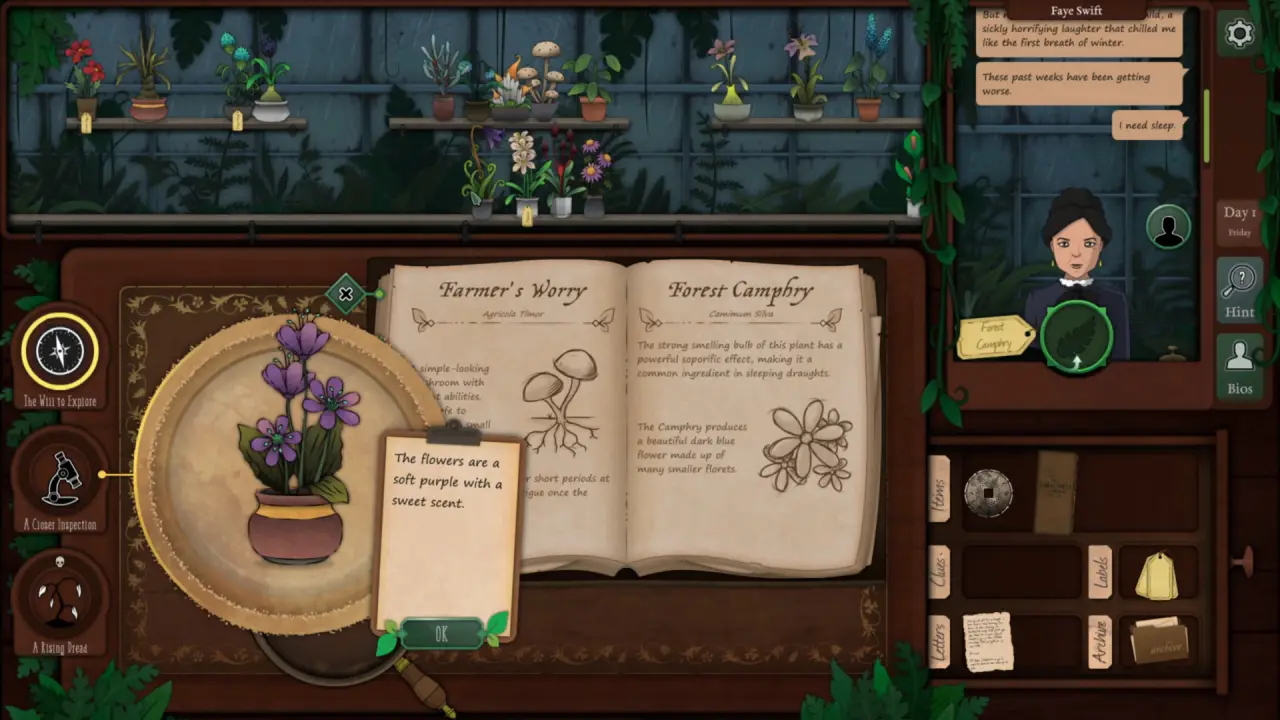
And when the greenhouse pops up a prompt for a newly acquired plant, presenting a row of strange mushroom specimens, the satisfaction of "the guide just got one page thicker" is concrete and immediate. It is a small reward, but it is a tactile one, and it accrues. Each new entry is both a collectible and a tool, which means the progression never feels purely cosmetic; the thing you just unlocked might be the answer to tomorrow's customer.
That dual nature, collectible and instrument at once, is what keeps the guidebook from becoming a trophy case. You are never merely hoarding entries for completion's sake. You are expanding your own vocabulary of the world, and every addition slightly changes how you read the next request that comes across the counter.
Freshness Through Interlocking Parts
The content's real strength is that it keeps staying fresh. New plants, new commissions, new clues, new directions: they mesh together fairly tightly, so the experience rarely decays into mechanical repetition. One thread feeds the next. A specimen you collect enables a delivery, a delivery surfaces a clue, a clue reroutes you across the map, and the map turns up another specimen. The loop is dense enough that boredom struggles to find a foothold.
Layered on top of that, the multiple-ending design supplies a genuine reason to replay. This is not replay value bolted on as an afterthought; it is woven into the same branching logic that governs the story, so a second run is not a chore of repetition but a chance to steer the whole thing somewhere new. For a game of this modest scope, that is a meaningful amount of durable content.
What stops the loop from wearing thin is that the parts are interdependent rather than parallel. A weaker game would offer plants, puzzles, and exploration as three separate piles you work through in turn. Here they are gears in the same mechanism, so progress in one almost always opens something in another. That meshing is the quiet reason the hours keep flowing: there is rarely a dead stretch where you are grinding one system in isolation, waiting for the next thing to begin. The next thing is already implied by what you just did.
Single-Source Stimulation, Slow but Not Empty

The criticism, when you go looking for one, lives mostly at the level of form. This body of content is built almost entirely on reading, identification, and deduction, which makes its source of stimulation relatively singular. You will be thinking the whole way through, but you will not necessarily be exhilarated the whole way through. The intensity is even, and it is low; the game does not modulate into peaks of action because action was never its currency.
For someone who loves quiet puzzle-solving, that is exactly right, a steady and absorbing rhythm. For someone who wants high-density events and strong tactile feedback, the staying power may feel thinner, and the back half can read as undernourished. But the honest framing is this: it is not empty, it is simply slow. The content is there, in real quantity; it just asks to be metabolized at a patient pace rather than gulped, and it rewards the player willing to set that pace.
Judged on its own terms, the package is generous. A first run comfortably fills its intended length without padding, and the branching gives a second run real purpose rather than hollow repetition. The honest expectation to set is one of breadth at a measured tempo, not a relentless cascade of set pieces.





Comments 0
Share your game review
Join the discussion and share your review of this game.
No comments yet. Share your thoughts on this review.