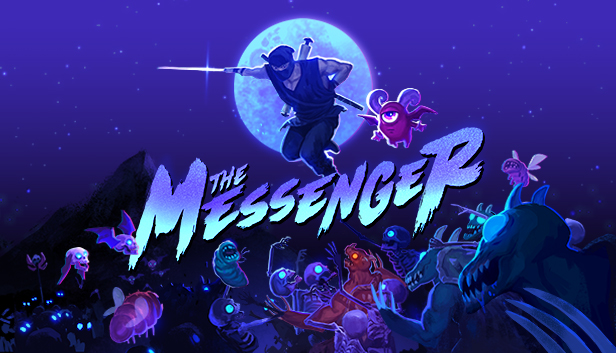
For precise platforming and a journey through changing eras, The Messenger offers a focused solo adventure with controller support. At ≈ $2.24 from GOG, it is available at the site’s tracked historical low. The player rating of 92% across 10,756 reviews offers another point of reference, while the game’s acrobatic action and hidden paths remain its own strongest appeal.At $3.99 from GOG, The Messenger is at the tracked historical low; its 92% positive rating across 10,756 reviews adds useful context.
GGselThe Messenger РФ+СНГ+ВЕСЬ МИР Steam КЛЮЧ·Platform:Steam·Credit/Debit Card~ RUB 710.00-63%~ RUB 265.72Buy now
All-time low ~ $3.36across Steam & third-party storesat the recorded all-time low
Loading store offers
Wishlist price
Set a target to receive an email when an eligible offer in your selected region is at or below that amount.
Price History
Past 36 months · Updated daily
Historical Low~ $3.162026-07Current Low Across Stores~ $3.99Kinguinvs. Historical Low+26%
Prices cover Steam and 39 authorized stores; only legitimate offers are counted. The chart shows weekly market-wide lows and Steam's official price across the past 36 months.
As demons besiege his village, a young ninja sets out to deliver a scroll essential to his clan’s survival. The Messenger begins as a classic action platformer, then opens into a time-traveling adventure built around acrobatic movement, new abilities, and hidden routes.Steam player reviews: 92% positive from 10,756 reviews.The Steam PC version supports single-player and full controller support.
Credits
Developer
Sabotage
Publisher
Devolver Digital
Steam player reviews
92%positiveVery Positive10,756 Steam reviews
Lowest recorded in 36 months
$3.162026-07-30 · KKinguinBase game · same records as the chart above; USD history, not a regional Steam low.
Language support
Language
Interface
Subtitles
Audio
Simplified Chinese
Yes
Yes
—
Traditional Chinese
Yes
Yes
—
English
Yes
Yes
—
Show 7 more languages
Language
Interface
Subtitles
Audio
French
Yes
Yes
—
German
Yes
Yes
—
Spanish
Yes
Yes
—
Japanese
Yes
Yes
—
Korean
Yes
Yes
—
Portuguese-Brazil
Yes
Yes
—
Russian
Yes
Yes
—
Steam PC edition data · 2026-10-19
02Before you buy
Mode and controls
The Steam PC version supports single-player and full controller support.
Languages
Interface languages include English, Simplified Chinese, Traditional Chinese, and others. Listed languages have subtitles; none has full audio.
03Frequently asked questions
What is the premise?
A young ninja must deliver a scroll vital to his clan while demons besiege his village.
What kind of adventure is it?
The classic action-platformer premise unfolds into a time-traveling adventure.
What can I discover?
Discover character upgrades, new abilities, hidden levels, and branching paths.
Popular Steam reviews
Native-language selection · 10 reviews
Selected helpful reviews in this language show both recommendations and criticisms. This selection does not represent the overall positive rating; opinions reflect the version reviewed.
RecommendedSteam player
I normally hate "retro" platformers, I never liked Mega Man, only Mega Man X, didn't care much for Shovel Knight but loved Hollow Knight, things like that. The Messenger IS a platformer, even though the second part of the game makes it less linear, and I loved it.
Devs could take a lot of notes here - checkpoints are frequent, boss fights are short and creative and you don't have to go through 2 easy phases to retry a hard 3rd phase, most rooms and even most trick rooms have multiple ways to approach them given your fairly simple moveset. You never have to do anything pixel-perfect to get through but doing things well is massively rewarding. It constantly surprised you with new things but doesn't overstay anything, and completely foreign mechanics introduced are not punishing (Skylands, for example).
A lot of people comment on how great the writing is, and well... it is great. It's sparse but fantastic throughout, with more personality in what amounts to a few pages than most games can give with 10 times as many words (and lore pickups).
For reference, I completed it with all the challenge collectibles in 14.5 hours, but did not get all achievements nor go through NG+. It is well paced and hard to put down, but easy enough to play in chunks, and I felt like I was learning new tricks up through the end of the game.
Do the thing!Show moreShow less
14.5 hours at review117 people found this helpful
Not recommendedSteam player
This game is solid and mechanically sound, with charming retro 8/16-bit graphics, a good soundtrack, fun platforming and a really clever twist.
So why am I not reccommending it?
Simply put, the game makes a promise and hypes up a second-half change of genre that it COMPLETELY fails to deliver on.
!!SPOILERS AHEAD!!
At some point, the game changes radically from a level-based classic sidescroller into a metroidvania. It's revealed that every level you've completed thus far was part of a larger map structure and you can go back with newfound abilities to continue the story via exploring secondary routes.
The problem is it's a crappy metroidvania. From that point in the game onwards, you find a grand total of ONE new ability. Every other objective is simply a macguffin that arbitrarily unlocks a different area. Bosses are once in a blue moon. Plot threads and characters that were teased during the first half are abandoned, ignored, or underutilized. NPC conversations, which were quite common at rest points in the first half of the game, are also incredibly sparse and brief in the second half.
Basically, the game feels unfinished as soon as it turns into a metroidvania. There's barely any actual new content and you're going to spend most of your time running back and forth needlessly due to the lack of a convenient travel system.
Also, I would like to bestow the Most Disappointing Upgrade award on the much-hyped-up contents of the green treasure chest, which requires you to find something like 50+ tokens across the whole world. Contained inside is... an upgrade that makes your shuriken bouncy. That's it.
Overall, this game would be great if the devs had put the same amount of love into the second half as they did the first half. But they didn't.Show moreShow less
9.4 hours at review488 people found this helpful
RecommendedSteam player
The First "Fun" game, after a long time
Hours upon hours have I tirelessly spent on games I didn't thoroughly enjoy. Needlessly competitive games like MOBAS and PvP games leaves an emotional toll of helpless frustration and unfullfillment that makes it feel mentally unhealthy to be a part of.
Only after playing The Messenger did I realise how long It's been since I played a game for the genuinely fun and exciting experience it was meant to be.
And how much I've missed it.
The Messenger offers an adventure with controls running as tight and comfortable as the spandex pants worn by Ryu Hayabusa. Accompanied by "unexpectantly likable" characters, the shopkeeper in particular. With his selfdepricating/ 4:th wall breaking/ life advising humour about us being the main character and should probably be out saving the world instead of spamming his "chat" 30 times just to see if the dialogue changes. Only to punish us with a long, "boring" and unskippable dialogue.
I didn't regret a single second I spent bothering him and it still amazes me how self-aware the game is and how It uses the knowledge in a way that makes the game all the more fun to play. Like putting less emphasis on the story and more on entertaining dialogues and scenarios.
The levels are varied with enemies being used as both obstacles and tools to help manuvering through levels that gradually gets more difficult, as they're pushing the boundaries on how the game can be interacted with.
Visually and auditory, The Messenger presents itself in a pixelated format, all 16-bits included, but It doesn't stop there. The game takes place in two seperate timelines that you'll easily travel to through portals scattered about. Moving though one timeline could present a path unavailable in the other. This mechanic is sometimes included to get through certain areas. But my point is, not only does the game look and sound great. The different timelines are also created with a seperate artstyle. Yes, both the looks and sound instantly switch when going through a timeportal. Creating cool moments were you'll have to go though the flow of the levels, even through time.
So the game turned out to be about a time traveling Ninja who needs to deliver a message in order to save the world.
I had a great time playing this and there's no doubt you'll feel the same. It's just a shame how easily it is to overlook it as something less than what it truly is, how it can easily go unnoticed among the thousands of titles here on steam.
One last thing.
I'd like to thank the passionate people who crafted this game and I appreciate the publisher for signing it which helped them get noticed. You people have made something truly awesome and I'm looking forward to anything you'll do next.Show moreShow less
20 hours at review108 people found this helpful
Not recommendedSteam player
I just finished The Messenger with all items/upgrades. I am a fan of action platformers like Mega Man and Shovel Knight, and Metroidvanias like Cave Story and Hollow Knight. I enjoy a moderate-to-high amount of challenge. Based on the exciting trailer and positive reviews I had high hopes for The Messenger. If this sounds like you, then I'm sad to say I do not recommend it. I would like to, because it has great ideas, but I can't because it fails to assemble them into a cohesive whole. It's a good action platformer and average Metroidvania in one, but instead of enhancing each other these two half-games end up in conflict. Lacking in focus, The Messenger never becomes more than the sum of these parts.
The game begins as a linear action platformer, with different areas and bosses one after another. Hitting something in the air gives you an extra jump. This one of The Messenger's great ideas, used throughout the game in platforming and combat, letting a skilled player get extra hits on bosses as you hit-jump-hit-jump in succession. There are upgrades to buy and some new abilities provided along the way, but there is no backtracking and no map. I wanted to explore. This felt a little weird because I was sure I saw these things in the trailer (and those portals too, where are those?), but I ran with it, trusting the game to reveal itself in due time. Maybe this is like a long intro or tutorial. Four or five hours in, I was having fun, but still waiting for that missing piece. Turns out that was half the game.
Finally, the Metroidvania half begins. You get a map and are allowed to go back through the levels, with a twist. Here, The Messenger reveals its best and most ambitious idea: time travel portals, swapping between an 8-bit past and 16-bit future. The seamless transition between the two, including the art and music, is really well done. It's instant, sometimes happening mid-jump, and it never interrupts the flow of gameplay. I want to recognize this, and appreciate the effort to create double the art/music assets for one game.
(Side note: I feel like the whole time travel mechanic has major missed opportunities. Gameplay-wise, it never feels like time travel-- more like an A-side and B-side, or maybe light/dark side, but not past/future. Walls and obstacles change position, and some areas can only be accessed in one side or the other, but that's it, there is no cause and effect (outside of a couple plot events). Enemies are exactly the same. What if enemies got stronger in the future? What if you could avoid a difficult encounter by killing that same enemy in the past? Or when you see a bunch of time shards (money)-- what if you could "outsmart" the game by grabbing them in the future, then going to the past and grabbing the same shards again? Not that I was ever short on money-- I wasn't-- but it would be a nice touch. It rarely matters what side you're on, because pickups and enemies exist simultaneously in past and future. Nothing clever going on, they just change appearance. Oh well.)
It's fun to re-explore the updated portal areas, but that's only part of the map. The portals are in fixed positions so the player has little choice of when and where to swap. It's never "oh, should I try time travel here?" It's always "I clearly have to go through these portals, but in what order?" and it's often "whoops, turns out I'm in the wrong time, guess I'll backtrack five screens to that portal."
And there is so much backtracking. Limited warp points leave you retracing your steps a lot. You collect more items in the second half, but they are not new abilities, just keys. You get a cryptic hint to find item A so you can access area B. Repeat several times. You get one new ability to run on water that is pretty cool, but it happens so late and is used so infrequently that it also feels like a key, used only to finish that area and access one more.
See, the best items in a Metroidvania let you explore the same world in a new context. You revisit areas to find items or paths that were just out of reach, or find the same zones have become easier with your new abilities. But the movement upgrades in The Messenger are all handed to you in the linear portion just before you need them: here's the glider because you need it now; grappling hook section is next, here, take the grappling hook. You never have a chance to explore areas with and without the items, so that sense of progression and growth is gone. When you finally backtrack through these areas, they are re-defined more by the time portals than your abilities.
And so it went that I spent the first half of the game waiting for the cool part to start, and the second half wishing that it all tied together better with more natural exploration and fewer backtracking fetch quests. Even the story feels lost for direction, struggling to find a balance between "epic quest" and 4th-wall-breaking humor. And it takes a big turn near the end, not in the form of an interesting reveal or twist, but more like "uh, we almost forgot to wrap this up, so here's what's REALLY happening." It dumps a bunch of exposition on you in the 11th hour, including characters you hadn't even heard of.
Lastly, I never really felt challenged. I died a fair amount, but most of those were being squished by a moving platform or falling in a pit. I beat most of the bosses on the first try, despite making mistakes. If you've played the games I mentioned-- the same games The Messenger is trying to emulate or pay homage to-- you'll have an easy time. Maybe it could use a Hard Mode up front. Maybe I shouldn't have bought all the upgrades.
The Messenger is full of fun moments and great ideas, but overall it didn't resonate with me like I hoped it would. If you're looking for a fun 10-15 hour ninja game, give it a shot, but if you're hoping for the next modern-day classic, look elsewhere.Show moreShow less
10.3 hours at review81 people found this helpful
RecommendedSteam player
I don't want to spoil a single thing about this game. All I'll say is this: This is that game you reserve a 10/10 rating for. A once in a lifetime experience that manages to pull off everything it tries to do flawlessly and weaves everything together in a melodious fashion. I literally cannot even think of one thing I don't like about this game.Show moreShow less
12.4 hours at review103 people found this helpful
Not recommendedSteam player
I guess the first thing I want to go ahead and stress is that this is not a terrible game by any means. It's serviceable. It doesn't really do anything truly awful, but...
I think every praise I could give this game comes with a caveat.
It smoothly mixes retro action-platforming with a metroidvania setup, BUT this fusion results in very linear map design with little room for proper exploration and too few warp points to make backtracking feel like anything other than a chore. Especially when you have cases like the astral seed puzzle that requires you to go to one place that takes a few minutes to get to, figure out where next to go and go there, and then after that go back exactly the same path as before to where you can turn in the quest. That's like, the most egregious example, but another notable example is an area that has a point of no return, unannounced, about 90% of the way into the level, so if you missed anything before that and need to backtrack to get it, have fun literally replaying at least half the level to get back to where you need to be.
The core gameplay mechanics are pretty smooth and polished, BUT while the game does do some kind of interesting things with them, too much of the platforming and combat feels really samey, especially with how frequently enemy types are reused across all the different terrains. And while each area has its own gimmick or two, they're neither original gimmicks nor used cleverly enough to excuse the lack of originality. It's completely serviceable but pretty uninspired platforming, and add in the mandatory backtracking forcing you to see large chunks of the game a second time, and it gets stale especially quickly.
The boss battles are generally well design, BUT about half of the fall into the trap of forcing you to play a waiting game to even be able to hit the boss, rather than an active fight where you have to make calls about when to attack and when to focus on dodging attacks. It's the laziest and most unfun kind of boss design and it's especially sad seeing bosses like that when some of the other bosses are really well designed and genuinely fun to fight.
The story is kind of clever and has its moments, BUT the game's sense of humor is... irritating, to say the least. Mostly it's Quarble. That flavor of "insult the player every time they fail" is about a decade out of date, and especially when you have modern-day platformers like Celeste that exist to do the exact opposite, it's really infuriating to see this newgrounds-tier uncomedy still in use. The story also happens primarily in two large chunks, once at the end of the "platformer" part of the game and once right before the final level. It's a pretty large infodump and cutscene sequence each time compared to the rest of the game and it feels like the game could've easily given stuff more in snippets rather than dump it all at once.
The presentation is pretty good - both the 8-bit and 16-bit graphical styles are pleasant enough to look at while still emulating the style of older games well. And the soundtrack is at the very least well-produced in both cases. BUT. I find a lot of the music really grating, moreso in 8-bit than 16-bit but there's some tracks I don't like either version of. And the graphical style, while pleasant, is also really generic. It doesn't really stand out much. None of the areas look particularly unique except maybe the last area - you've got your requisite forest area, sewer area, desert area, ice area, lava area, sky area, the gang's all here. And an entire sequence that just reuses assets from other areas in a bit of a mishmash.
Oh, and this probably doesn't bother just me, so - there is at one point a powerup that lets you walk on liquids if you're holding a specific button. Cool right? Well I mean it's only used in two places but sure. But then the thing is, there is another area with an instakill liquid... that this power, for some arbitrary reason, just does not work on. Way to go with the consistency there, guys.
Oh and also! There is, for whatever reason, a brief sequence after the final boss, but it feels... unfinished. They go "oh no we're all doomed now" and you have an out-of-place QTE and then you win like it was nothing. Like. It feels like something bigger was planned for this but got cut at the last minute.
I don't really want to be so down on this game because I did have some amoutn of fun with it, but by the last few hours of gameplay I was just completely bored and ready for the game to finally end - and thankfully it does end with one of its stronger levels and bosses, but a lot of the game's exploration elements feel more like padding than actual substance, a fair few of the "challenge" rooms felt particularly janky and not that well-executed, and at the end of the day I don't expect this game to stick in my memory for very long when there are so many better platformers and metroidvanias out there.Show moreShow less
11.3 hours at review62 people found this helpful
RecommendedSteam player
At 100% and about 16 hours in, here's an old-school Ninja Gaiden fan's opinion.
First off, don't come into this expecting it to play like the NES games. The physics are closer to NG3 than NG1 or 2. If you ever played the version of Ninja Gaiden that came to the Sega Master System, you'll find it has a similar feel to the controls.
So yeah, the game is a very loving homage to classic Ninja Gaiden, and unashamedly so. As is typical of retro-modern indies, the aesthetic is "what your nostalgia tells you the old games looked like." The trailer revealed the game's biggest secret, but it's nice to see it's not just an audiovisual gimmick. The shifting back and forth is not a function you control, but you cross certain thresholds or touch "zones" to swap between 8- and 16-bit style, and the transition has a minor effect on the geography of the stage, but never enemy placement. Transitions are quick, snappy, and most importantly -- seamless. You'll be switching back and forth rapidly without it ever breaking your flow.
As an aesthetic note, the music and visuals bear a stronger resemblance to Sega hardware than Nintendo. The 16-bit music in particular fairly screams "Genesis." It's all rock-solid, and some of the music compositions are real earworms. The hero's look in 16-bit is also pretty badass in a late-90s sort of way.
The game is mostly very well-balanced. It lacks a difficulty setting, but for the most part, it isn't nearly as difficult as Ninja Gaiden I or III on NES. Difficulty is more in line with the second NES game. The boss fights are likely to be a stopping point for most players. In my experience, bosses took an average of 4-8 attempts to defeat each. As the fights go on, bosses will gain additional attacks, forcing you to change up your strategy. A few are very tough and two of them are shockingly easy, but all will fall to your sword with a little perseverance. This is not Souls-like difficulty. If Dead Cells and Hollow Knight are frustrating you, this will be a breath of fresh air.
When the game opens up and lets you revisit stages, it is enjoyable to revisit them to find all of the collectibles (45 in total, none extremely difficult to get) and see what the stages look and sound like in their alternate forms. That said, the game's Metroidvania influences are fairly slight. You won't be doing much item collecting to unlock new paths. Rather, you use the gems (money) you collect to purchase new abilities.
The Messenger also does away with lives and continues, but doesn't take the "corpse run" approach to punishment that Soulslikes and Hollow Knight do. Instead, when you die, you are introduced to an endearingly sarcastic little imp, who accompanies you upon respawning and hangs out for a while until you've collected enough gems to pay off his debt, or (in his words) until he gets bored. He also sasses you every time you die. Team Sabotage walked a very fine line, as this could easily have become infuriating (I estimate I died about 250 times throughout the course of the game), but it's never truly mean-spirited, and some of his lines are genuinely funny.
And on that note, don't expect a whole heck of a lot out of the story. What's there is decently done, but it's not at all the focus. The writing is more about meta-humor on the nature of the game itself. The game's plot justification for the 8-bit/16-bit switch is arguably its most impressive aspect, but the shopkeeper deserves mention. He has a ton to say, and almost all of it is entertaining and/or funny to read. Definitely keep trying to open that cabinet.
One aspect where it strays significantly from its inspirations is in subweapons: you get one. You have a basic shuriken attack, which works exactly like the basic one in the original Ninja Gaiden. If you're VERY diligent, you can find an upgrade of sorts. You'll gain a couple of additional mobility options that are unique to The Messenger, too... and the game's most interesting challenges require you to make use of them in rapid succession. It's almost always really fun, though there is one difficulty spike right before the final area that was very frustrating: a chase sequence. My advice for this is, use the rope dart as much as you can. Don't run; fly. However, even this spike only held me up for about half an hour.
If I had one legitimate gripe about the game, it's the dearth of enemy types. There are maybe 10 types of enemies in the game, and you'll encounter them over and over again in every single area. Each has an 8-bit and 16-bit variant, but this is strictly a visual change. You'll continually encounter the same slow, durable lizard creatures, the fire-spitting demons, the things that toss projectiles in an arc at you, the monsters that continually run and jump from plattform to platform, etc. The classic NES games had a similar setup, but while each type of enemy was the same, the actual sprites got a redraw for each section, so the enemies always sort of fit in with the stage. It's a very minor misstep, but one worth mentioning. More of a missed opportunity than a failing.
There's a fantastic framework in place here, and even with a couple of minor frustrations, it's a hell of a lot of fun. I certainly got my $20 worth, and I fully expect to return to The Messenger in the future. Can't wait for the next game!Show moreShow less
17.6 hours at review99 people found this helpful
Not recommendedSteam player
I think that The Messenger is something I'd label as "OK." Of course, the review system doesn't have any granularity so I'm putting a "No" recommendation because the game seems pretty overrated as it is (and I'll explain why).
The game starts off as a linear 8-bit platformer, akin to some NES games like Ninja Gaiden. It moves at a somewhat fast pace, with you unlocking new abilities in each area, and you fight bosses pretty often. But after just a few hours, the game flips around into a semi-open adventure game to explore the areas you've been through already (including a few new areas). Along with that, the game introduces 16-bit graphics and sound and allows you to flip between the "old" and "new" styles via some portals laid around areas, which occasionally will reveal closed-off pathways or affect a specific item.
A lot of people say the reversal is the "halfway" point of the game, but I'd say that it was more like only one-third of the way into the game. Granted, I found all of the Power Seal collectibles, so that may have some effect. But for me, probably two-thirds of the game time was spent in the "exploration" format.
Anyway, as said above, you had linearized levels on your first run through an area, but then having to backtrack is very boring. To give an example, there is a required part where you need to plant a seed and have it grow. The process went like the following:
The village has no fast travel, so you have to take a relatively long path from the closest fast travel portal to reach the seed.
You have to repeat the path back to the fast travel, and go to another area.
This area's fast travel is still pretty far from where you plant the seed. You have to travel to the planting spot in the 8-bit / "past" format.
You repeat the long path back after you plant the seed, then go through a portal to the future.
Now you repeat the path a 3rd time back up to the planted seed, which finally lets you go somewhere.
Stuff like that is so boring because you're literally just running back and forth between portals and certain landmarks repeatedly. If they had added more of the portals, or actually made traveling have more use to it other than ... literally traveling between screens ... then it would have been better. Instead it just felt like these types of things were wasting my time.
Further, when you have the semi-open world available, the game severely lessens the amount of boss fights you have. The boss fights are some of the game's best parts, but they are much more spread out as the game goes on.
Lastly, the game is tagged as "Metroidvania" but the exploration portion of the game isn't really like that. You only unlock the abilities to walk on water/lava during that portion of the game, and it's used in basically only one area. Otherwise, you don't unlock extra traversal abilities and everything just relies upon already available things as well as the portals.
I think that the entire 8-bit part of the game was great, and nearly all of the boss fights are such fun. But its attempt at doing a "Metroidvania" or any form of platformer exploration was pretty boring.Show moreShow less
12.8 hours at review52 people found this helpful
RecommendedSteam player
Instant classic and probably the peak of 2d platformers. I'm 5 years late to the party here and only discovered this unknown gem by accident because I liked this developer's demo for their upcoming retro RPG, Sea of Stars, enough to want to try their first game.
What you get here is an 8-bit platformer parody game that seems mostly inspired by Ninja Gaiden at first, but gradually adds mechanical and artistic homages to other classics of the genre.
The controls are tight and there's a bunch of movement mechanics. There's your standard wall climbing, a horizontal grappling hook that lets you reach enemies, ledges, walls and rings at a short range and enables sudden speed boosts, a Wingsuit that lets you glide horizontally and slow down your descent, and an underwater dash which if used near the surface can be used to give you a speed boost into the air horizontally.
There's also shoes that let the Messenger join the club of Hófvarpnir, Orion, Jesus, Morgan Freeman, Jim Carrey and co. by walking on the surface of still water (or lava or peanut butter). The limitation is that you can't stop or change direction on the surface without sinking, so you have to always terminate the walk with a jump or grapple if you need to dodge suddenly.
The Cloudstep, this game's take on the double jump, lets you gain extra height and chain the horizontal movement mechanics together being airborne for extended periods. Here you're not limited to a fixed number of mid-air jumps. Instead, you're awarded an extra one every time you hit a lantern, an enemy or even an enemy's projectile with your horizontal or vertical sword slash, or with the strongest version of the shuriken. Combined with speed boosted gliding it makes skilled speedruns of this game into truly awe inspiring shows.
This is now among my favorite movement systems across all games, only behind the likes of the Quake series.
The music is as good as it gets on the NES, the dialogue is hilarious, and the level and enemy design is interesting and varied. The early bosses are a bit too simple and easy even for newbies to this genre, but later difficulty modes fix that.
Save points are very common and deaths have very little consequence, so you're free to practice the situation you're having problems solving without having to repeat a big chunk of the level. Dying only prevents you from earning currency for movement/health/damage upgrades for a short time. But the currency is abundant (it only becomes a problem in New Game +) and you'll easily unlock everything in the shop before you beat the game, even if you're dying often.
After you've beaten 8 levels and their 6 bosses, the cutscene seems to be taking long and something big is happening, so you might think the game is done. You got your money's worth. After all, this was about as much content as each of the original Ninja Gaiden games.
But the credits aren't rolling.
Turns out you're not done. Now the music, sounds and graphics switch to the Sega Genesis Yamaha sound chip and gorgeous 16-bit visuals. You go through 2 big levels, beat their bosses and you're in for another longer cutscene.
"Ok, now I must be done, right? That last boss was tough to figure out."
Wrong. You're at less than a third of the game. Now it's no longer linear level after level. It opens up into a Metroidvania. You can now revisit the 10 levels to explore parts that weren't accessible without all the abilities you've gained by now, including the one you just earned - The Messenger's other unique contribution to the genre: the ability to shift between the 8-bit and 16-bit versions of every level, and these versions aren't just reskins of the same thing. They fundamentally change parts of the layout, making for interesting puzzles that require you to shift multiple times between modes to access certain areas. They're not too hard, just an interesting twist that adds to the richness of already having 2 versions of all levels and their music tracks.
Aside from this refresh of all the old levels, you can now reach 6 new levels with 4 bosses. One of these levels has sections, including its boss, which are a flying shoot-em-up minigame! And once you've collected all the quest McGuffins everywhere, the last non-DLC level and its boss unlock.
Then once you're done with that, the free DLC and the New Game + mode unlock. The DLC is 3 bosses on 4 levels, and they still keep getting bigger and more difficult. The first level is a surfing racer minigame reminiscent of Earthworm Jim's Andy Asteroids, or the Turbo Tunnel in Battltoads.
The last level here, the Voodoo Heart, is a series of speedrun races against a ghost image on a variety of obstacle courses. There's 25 sections and each loss gives you an easier obstacle course as your next section, and each win gives you a more difficult one. The first to reach 5 wins, uh... wins. This is my favorite level and I've spent by far the most time practicing it so far. Getting to the point where I can win all of the most difficult courses has really cleaned up my movement for the post-game challenge modes. Oh, and the boss after the last level isn't your standard platformer fight. It's a boxing minigame!
The New Game +1 option is an increase in difficulty. Basically a repeat of the whole game, but this time you take extra +1 damage from everything, bosses have more health, and deaths now incur an upfront cost in currency. You die permanently if you can't pay up. NG+1 lets you keep all your old upgrades, only losing your story/quest items that grant or ease up the access to certain areas. You get to pick just one of them to keep. Beat NG+1, and you get to pick another item and play NG+2 which is even harder.
In theory, if you live up to NG+14 or above (which means everything one shots you) and pick a new quest item each time, you start with all of them. This means the 0.01% of the players who can beat the game multiples times without ever taking damage are rewarded by basically skipping chunks of the game for a faster speedrun.
I find it lame that you can theoretically cheese your way up there as well. A less skilled player can spend absurd amounts of time farming currency to pay for their deaths, and still reach high NG+ values, which were supposed to be signs of mastery of the game, not hundreds of hours of farming. It's a perverse incentive, but that's remedied with the free DLC. Finding all the secrets on the DLC levels unlocks a HC mode in New Game +1 (or higher) called THE DEAL. This doubles your health and triples your damage, but you can no longer revive at all, so the currency becomes useless and a single death ends your run.
I won't get into spoilers here, but I really like how the story of the game is meaningful despite this being a parody game. The big plot twist and a few of the reveals gave me shivers. There's hidden Easter egg visuals in the levels that prove many of the mythical stories you'll hear and discuss with the few NPCs are literally true. There's runes scattered in the backgrounds in some places. If you learn how they correspond to the Latin alphabet, you can get extra hints about the world's history. The lore stuff especially got me excited because I found this game by getting interested in the RPG that will be this game's prequel.
Overall, this is the complete package. If you're a newbie to platformers, this game's gradual ramping of difficulty and good teaching methods will accommodate you. If you're a master of the genre and Shinesparking around Metroid games is second nature to you, you'll love the high skill ceiling here. Voodoo Heart runs and particularly speed boost Wingsuit gliding will entice you while New Game + and THE DEAL will give you endless replayability. If you just want to chill with minigames or a silly epic story with interesting lore, you're covered too. Do not miss this classic.Show moreShow less
44.2 hours at review75 people found this helpful
Not recommendedSteam player
I wish I liked this more. The first part of the game is great, solid platforming and challenging bosses. Then it all grinds to a halt. The metroidvania part of the game is half baked and unnecessary - and this is coming from someone whose favourite genre is metroidvanias.
There are four bosses in the metroidvania section and three of them are gimmick fights, unsatisfying and completely unlike the ones in the first part of the game.
The story follows a similar trend, the start is intriguing but it splutters out with the music box conclusion. Introducing a major new character that close to the end was perplexing. The very final boss was defeated with a button mashing QTE and the ending was disappointing, it didn't feel like I was ending the curse cycle at all.
The Cloudstep technique was different and enjoyable, but adding the glide move makes it much worse and harder to perform. Following the trend of starting with something good and then ruining it.
I quickly ran out of things to purchase from the ingame shop. There is a second merchant that then unlocks, but to unlock him it costs ALL of currently collected shards. I didn't know how to unlock it before I had thousands of shards collected, all of which were then wasted. Even if I had those shards back, the prices are so high that buying everything would take considerable grinding.
The DLC starts with a mandatory minigame and ends with one too! Why? Neither were particularly enjoyable and were radically different from the rest of the game.
Overall I have mixed feelings. There was a lot to enjoy, but it was ultimately lacking. It really needed someone in development to course correct on the many bad ideas.Show moreShow less
24.5 hours at review41 people found this helpful
Source: original Steam user reviews. Helpful votes are an archived snapshot, not live data. Last collected: 08/15/2026.






 GOG, it is available at the site’s tracked historical low. The player rating of 92% across 10,756 reviews offers another point of reference, while the game’s acrobatic action and hidden paths remain its own strongest appeal. At $3.99 from