
























Opening
Most games flatter you with the fiction of freedom. The Stanley Parable strips that fiction off and hands it back to you, still warm. It hires a British Narrator to trail half a step behind, announcing what you are about to do — and then waiting, with a faint smile, for you to refuse. The harder you push against him, the clearer it becomes that even your rebellion has lines already written for it. This is a 2013 first-person exploration game built on the Source Engine by Galactic Cafe. No combat, no stats, no fail state. You are Stanley, employee 427, and your one job is to argue with an unseen voice inside an empty office block.

It is absurdly short. A single run lasts forty minutes to ninety; the developers peg the average at two hours. Yet those two hours keep turning up on decade-best lists, and they seeded a whole bloodline of games that play tricks on the player's expectations. It will not win everyone over — anyone craving punchy combat or an open world will frown and leave within half an hour. But if you have ever wondered what it sounds like for a game to talk back, to call your bluff about choice to your face, this is still required reading.
It is worth saying up front that this review is about the 2013 original on AppID 221910, not the 2022 Ultra Deluxe, which is a separate product with its own scores. Keep that distinction in mind as you read, because the two get conflated constantly. What follows breaks the whole tug-of-war down across six lenses: story, audio, graphics, gameplay, content, and the verdict — and by the end you should know exactly whether this odd little office is for you.
Story | 9.5/10
Story: 9.5/10The real protagonist here is not Stanley. It is the voice that will not stop talking about him. The story holds up not because the plot twists, but because it makes the relationship between you and the Narrator the story.
Employee 427 and an office that empties out overnight
Stanley is employee number 427, a man whose entire job is to watch a screen and press the buttons it tells him to press. One day the orders stop. He looks up, and every colleague on the floor has vanished. It is a flat little premise, and that flatness is exactly why it works: you have no idea what happened, only that you will have to walk out and find out yourself.
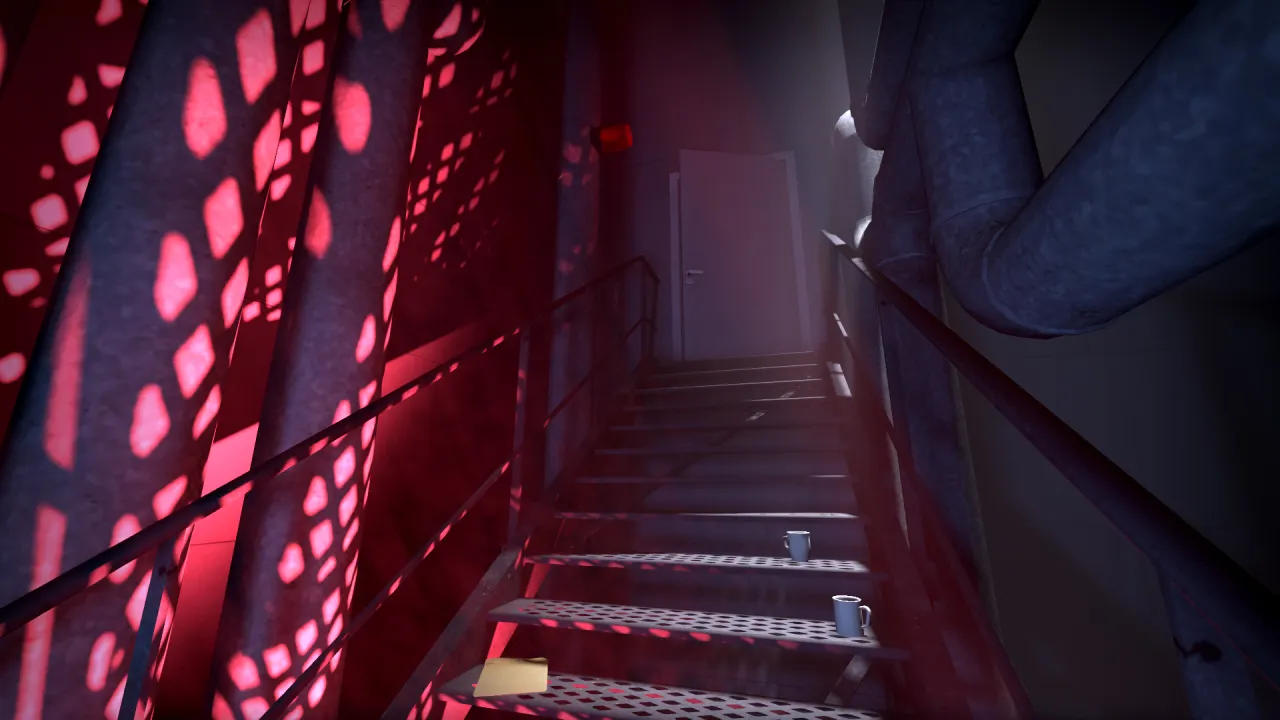
The trick lands the moment you step out of your cubicle. The Narrator begins describing, in advance, what you are "supposed" to do next — "Stanley came to a set of two open doors, and he entered the door on his left." And there it is, the itch: what if you take the right one instead? The entire story grows out of that single impulse. It does not grip you with rising action; it grips you with the most ordinary urge there is, the urge to be contrary.
Every act of rebellion already has its lines written
The cleverest thing this game does is turn the illusion of choice into its actual thesis. When the Narrator says go left, a good portion of players feel an instant flare of defiance and pivot right — and that defiance, of course, is also in the script. You think you are breaking free, but the developers paved the rebel path long before you found it. The game has been waiting for your "no."

As you stray further, the Narrator's tone curdles by degrees. First he covers for you, gracious — "Stanley must have gotten lost." Then he explains, patiently. Then he pleads. Then he drops the act entirely and starts laying obstacles, even sealing you inside a loop. That slow slide from narration into control is the most praised stretch of the whole game. There is no villain manufacturing conflict; there is only a supposedly neutral voice slowly revealing how badly it needs to keep its hands on you.
The Freedom Ending and the Museum Ending: two punchlines that say the quiet part out loud
Among the dozen-plus branching endings, two are worth singling out. The Freedom Ending is what you get by obeying every word: Stanley destroys the mind-control facility, walks out of the building into a green field, and the Narrator proclaims him finally free to do whatever he wishes. The irony is precise — the one who controlled Stanley the entire way, who even arranged this "freedom" for him, is the Narrator himself.
The Museum Ending is blunter. It kills the player, then drops you into a museum displaying models of every character in the game, where the Narrator delivers a monologue: every choice you thought you made was preset by the developer. It is one of the few moments in any game where the curtain is pulled back this far and this deliberately. The game says the quiet part out loud. It is not just performing meta-fiction for the trick of it; it states, plainly, that free will inside a linear game is a lie — and tells you so to your face. That candor is what sets it apart from its peers.
One more thing than Gone Home: a voice that talks back
Set it back in 2013 and you find walking-sim landmarks like Gone Home sharing the year. Gone Home is excellent: you reconstruct a hidden family story from letters, notes, and objects scattered through an empty house, quiet and restrained. But Gone Home has no voice watching you, no one to argue with — you are a silent observer, going through someone else's drawers.

The Stanley Parable takes the other road. It gives you an opponent. The Narrator is not ambient sound; he is a living, irritable character who loses his composure when you disobey, and that changes everything about how the story feels.
That single move lifts its storytelling from "I read a story" to "I had a fight with the storyteller." And precisely because of that, even though it is shorter and far thinner on plot than Gone Home, it leaves a far longer aftertaste in the one department that counts here — the writing.
Audio | 8.5/10
Audio: 8.5/10If this game has a load-bearing wall, it is unmistakably the sound. Take the Narrator away and you are left with an empty corridor; because of him, that corridor became one of the most discussed hallways in the medium.
A single voice carrying every laugh and every idea
Kevan Brighting's Narrator is the soul of the whole thing. His clipped English register swings from gracious to unraveling to passive-aggressive — obey and he congratulates you, oily, on being "such a dutiful employee"; disobey and he plays magnanimous for a second before sulking and scolding you in the next breath. Nearly every moment that makes you laugh, every moment that makes you willing to start over again, comes out of that mouth. There is no second character to share so much as a line of the performance with him.

The English press of 2013 bet the whole verdict on him almost in unison: one outlet called him endearing and verbose, another said most of the enjoyment came from sparring with this dry, witty Narrator. That is not hyperbole. A game with no combat and no puzzle difficulty earned scores like 8.8 from IGN and 9.0 from GameSpot on the strength of a voice, and an 88 on Metacritic across 47 critics who could agree on little except that the narration was the reason to play. It is proof that voice work need not be garnish; it can be the engine of an entire work. Strip the Narrator out and there is no comedy left, no argument left, nothing to make you reach for the other door.
Silence, variation, and the hum of an empty building
A voice alone is not enough, and the game's treatment of its environment is just as deliberate. The score, from composers including Blake Robinson, mostly sits low, matching the cold, mechanical mood of the office and refusing to upstage anything. But the moment you make some outrageous choice, the music can suddenly accelerate, change key, or drop into total silence, pushing the absurdity of that instant to its peak.

The emptiness of the building is itself sound design. Footsteps ringing down a vacant hall, the low drone of keyboards and machines, the occasional phone — these fine-grained ambient details stack on top of the Narrator's chatter to build a constant, low-grade sense of being watched. The music here is no wallpaper; it moves with his rhythm. When he is smug, it is light. When he loses control, it scrambles with him. When he gives up trying to talk you down, it goes quiet. That interlock between music and narration is the other half of why the game stands up on audio.
A spiritual cousin to that sardonic computer in Portal
Talk about adversarial game voices and you cannot skip the sardonic artificial intelligence from Portal, the one that hands you puzzles while needling you with veiled threats. The Stanley Parable's Narrator is a spiritual cousin — both are single voices that run the whole length of a game in opposition to the player, both built on dry, character-defining wit.
The difference is the route. That computer's humor carries a black malice, a knife slipped in between puzzles, the threat always just under the joke. The Narrator is more a director with too much need for control and no real power over you, his aggression accruing and slipping loose by slow degrees rather than arriving as outright menace.
Both prove the same point, though, and it is worth ending on: a voice written and performed this well can become, all on its own, the most unforgettable character a game has, the thing players quote back at each other for years. Strip the visuals, strip the systems, and the voice would still carry the work.
Visuals | 6.5/10
Graphics: 6.5/10Let us get it out of the way: visually, this game was not a looker in 2013, and it looks plainer still in 2026. But its plainness is not a corner cut — it is a choice. It wants to be dull.
An office block built on purpose to bore you
Almost the entire game unfolds inside a soul-crushingly ordinary office: grey-white cubicles, identical corridors, dutiful little meeting rooms. That flat art direction is part of the point. Stanley's life is the regimented, eventless grind of a salaryman, and the more monotone and standardized the space, the stronger your urge to break off the rails. A handsome office would have undercut the whole joke; the blandness is doing real work, setting the baseline of tedium that your first act of defiance gets measured against.
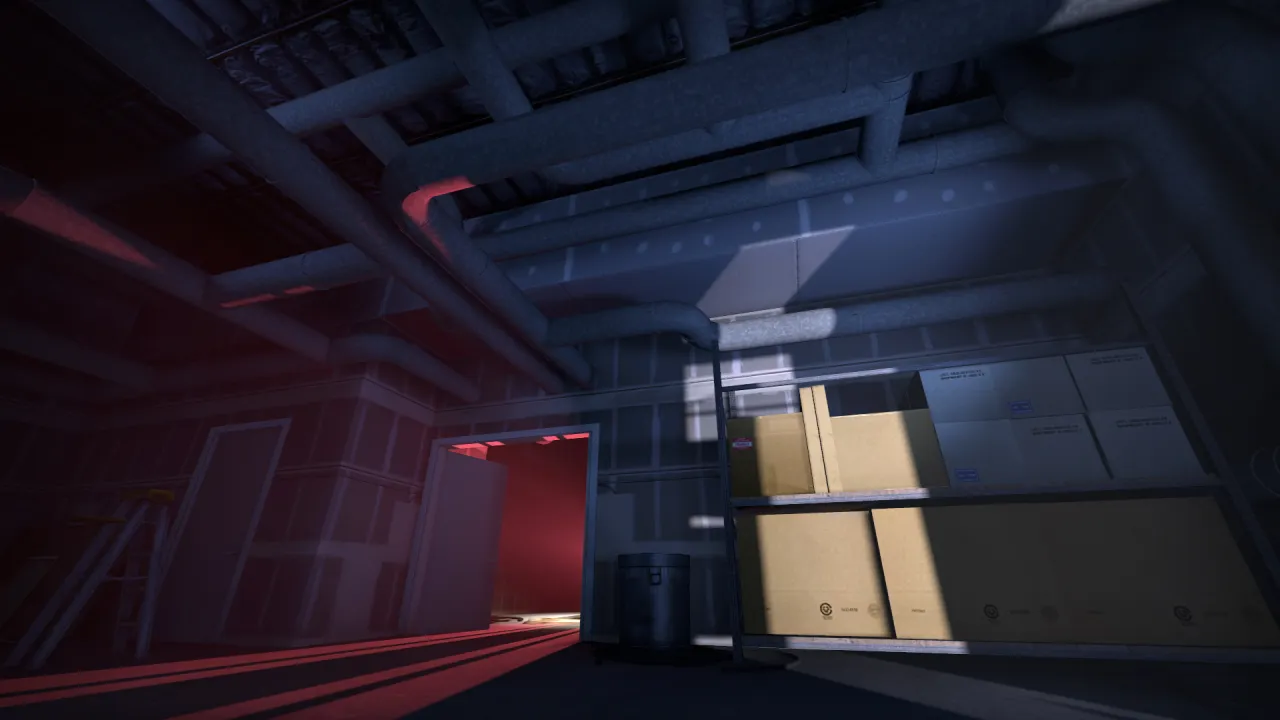
It runs on the Source Engine, which was already old by 2013 and only ever delivers a workmanlike image. But for a game that tells its story through text and voice, fidelity was never the pitch.
You do not get pulled out of the moment by a low-res wall texture, because your attention is entirely on the Narrator's next sentence. That trade — flatten the visuals on purpose, let the writing take the lead — is a wholly different philosophy from the big-budget games piling on light and shadow.
What you remember is the design, not the resolution
Even with humble graphics, the game is full of unforgettable spaces, and the credit goes to design wit rather than raw horsepower. That famous yellow line painted on the floor will openly drag you toward a particular ending, forcing you to flip-flop between dutifully following the official route and stubbornly wandering off. The 4-3-2-1 doors turn the act of branching into a visible ritual. And then there is the broom closet — duck in and refuse to leave, and the Narrator will nag you out with mounting impatience.

These spaces stick not because they are pretty but because each of them is playing with you. A plain yellow line, a plain door, a plain utility closet, each reengineered into a device that works in tandem with the Narrator: you take the yellow line for helpful guidance until you realize it is the leash he is using to walk you. Duck into the broom closet and stay, and watch how quickly his composure frays. The knack of turning the dullest setting into something that talks back is more memorable than any glossy texture, and it is the reason people who finished this game years ago can still describe its rooms from memory while forgetting far prettier ones.
The interface is minimal too, with almost no HUD, leaving the first-person immersion fully intact — your eyes have only the building and the voice, nothing in the corners chirping at you for attention. With Windows, macOS, and Linux versions all running effectively the same, there is no "this platform got shortchanged" problem either, and for a small narrative game that restraint is exactly right. None of the budget went into chasing a graphical arms race it was never going to win. Every resource it saved went, instead, into the one voice that runs the whole way through, and that is the trade the whole presentation is built around.
Combat | 9.0/10
Gameplay: 9/10Gameplay is the easiest column to misread. Some will tell you this game has none — no combat, no stats, no fail state. Yet it takes the most slippery thing of all, choice, and turns it into a genuine core mechanic.
Obey or don't: that is the only verb you get
There is, at bottom, only one thing to do here: listen to the Narrator, or not. He says go through the left door; you can go left, or you can turn and take the right. What matters is that whatever you pick, the story absorbs it in real time — comply, and it runs along his script; defy him, and he improvises on the spot, backpedaling, justifying, raging, weaving your derailment into the telling too.
The mechanic sounds trivial and is anything but. It takes the line "the player thinks they are choosing, but every choice was written in advance" and makes it something you operate with your own hands. You are not watching an argument about free will; you are stepping on it, probing its edges with your feet. Every fork you take runs another experiment on the thesis, and the Narrator is the control group that always sits half a step ahead of you. The genius is that the verb and the theme are the same act: to play is to choose, and to choose is to discover the choice was anticipated. No other game of its era folds its message and its controls into a single gesture this cleanly.
Starting over is itself the mechanic
In most games "restart" is a menu function with nothing to do with the fiction. The Stanley Parable inverts it: the dozen-plus endings are strung together by restart loops. Some endings throw you back to the start automatically; others ask you to reset by hand. So the act of "playing again" stops being something outside the game and gets woven into the story — every restart is another return to that button-pusher's desk, ready to spar with the Narrator once more.
Because there is no failure and no punishment, the barrier to entry is effectively zero. Anyone can sit down and start at once, no skill required.
Its difficulty is not in the hands but in the head — whether you are willing to keep returning to the start to map out the fork you have not yet walked. Building the whole drive out of pure curiosity is where it parts ways completely with the traditional gameplay loop.
How it differs at the root from Dear Esther and Gone Home
As fellow walking sims, Dear Esther from 2012 pioneered the form, narrating over a walk across a desolate island, and Gone Home from 2013 has you rummaging through an empty house for objects that assemble a story. Both are fine work, but they share one trait: you are a quiet receiver, and the world does not change just because you decline to cooperate.
The Stanley Parable goes the other way. It makes disobedience itself the mechanic — refuse to play along and the world, in the shape of the Narrator, reacts instantly, bickers with you, schemes to drag you back. That is the step Dear Esther and Gone Home never took, and it is the genuinely singular thing about it as a piece of gameplay.
The cost is plain too. Once you have mapped every fork and heard every reaction the Narrator has, that first-run thrill of being toyed with is hard to recover, and replay value falls away fast. What was a live duel the first time becomes a known script the third time, and the game has no deeper system underneath to keep you busy once the surprises are gone.
Content | 6.5/10
Content: 6.5/10Before you buy, the matter of size has to be put plainly: this is a very short game, short enough that you will need to adjust your expectations of how much "content" a game owes you.
Two hours a run, with the content hidden across a dozen endings
Walk a single line and you hit the credits in forty to ninety minutes; the developers themselves put the average at around two hours. If all you want is to finish once, it really is startlingly brief. But its true content does not live in the length of any single run — it lives in those dozen-plus branching endings. You have to keep returning to the start, mining one fork at a time, and seeing them all takes roughly two to four hours.
That bundle of endings grew over time. It began as a free Half-Life 2 mod in 2011 with only six endings; when Wreden and Pugh remade it into the standalone of 2013, they expanded it to more than ten branches. So what you are buying is a game that treats branching as its primary content vessel: the runtime is not propped up by hours but by the density of forks and the one-of-a-kind line of narration waiting at the end of each. Think of it less as a two-hour game and more as a dozen ten-minute short stories that happen to share a hallway, each one ending on a different punchline the Narrator has been saving for you.
No DLC, and don't confuse it with Ultra Deluxe
One thing needs flagging here so you do not buy the wrong product. This 2013 original has no paid DLC whatsoever; the single purchase is the complete thing, and there is no "now buy the expansion" hanging over it. There is, however, a confusingly similar release called The Stanley Parable: Ultra Deluxe, a separate standalone made by the studio Crows Crows Crows in 2022 that added heaps of new material and reviewed even better. Plenty of people mix the two up. Keep this straight: Ultra Deluxe is its own game, bought on its own, not DLC for this original, and owning the original does not gift it to you. The titles look alike, but the contents are two distinct sets, so check carefully which one you are clicking into.
Put another way, the original's content is exactly this much — clean, finished, with no later updates, no season pass, no paid expansion. Nothing was carved out to be sold separately, which for a small 2013 indie is entirely normal, and rather honest.
It went on to sell around two million copies, a striking figure that proves a sufficiently singular two-hour experience can snowball on word of mouth alone, with no live-service tail behind it. A good many of those owners never even played it themselves, watching others trigger the endings on video instead — a kind of long-tail reach that is itself a sketch of how magnetic the content is.
Repetition is the price it has to pay
It has to be said honestly: its content weakness is just as clear. Hunting endings means walking the same corridor and restarting over and over. Once the first run's novelty wears off, that "here we go again" sensation only grows. For an ending you have not seen, you may have to retread an opening you have already walked several times, lines you long ago memorized. For the people who love it, that is a toll gladly paid to hear the Narrator cough up a new reaction, each restart still carrying a flicker of anticipation; for those less smitten, the repetition turns into an off-ramp, and by the third pass down the same hallway their attention drifts. That is why its reception splits so hard — the same two hours of content strike some as perfectly distilled and waste nothing, and strike others as too thin to make a meal of. Its size was never meant to please everyone.





Comments 0
Share your game review
Join the discussion and share your review of this game.
No comments yet. Share your thoughts on this review.