





















Opening
The first time the Roman frontier truly fell apart in front of me, it did not happen in a battle. It happened on the campaign map, one tile at a time, as forests blackened into ash, prosperous town icons curdled into rubble, and a small cluster of refugee dots huddled along a rising snow line. That single screen told me everything: this was not the cozy map-painting loop of a normal 4X. This was a retreat drill stretched across dozens of hours.
Total War: Attila is at its sharpest not when you win fights, but when it asks you, with complete sincerity, whether you still want to be an expansionist once the climate turns cold, the soil fails, and enemies pour in from every direction. The honest answer is usually no. You start dismantling your own cities and setting fire to your own homeland, all so the tribe you have dragged south can scrape together one more turn of grain.
That is the rare thing here: a grand-strategy game that bakes survival into its skeleton rather than bolting it on. Over the following sections I will walk through how that survival pressure expresses itself across story, audio, graphics, gameplay, and content, and why a settled empire and a wandering horde end up feeling like two completely different games sharing one map.
Story | 7.8/10
Story: 7.8/10If you arrive hoping for cutscenes and numbered chapters, Total War: Attila will let you down quickly. It is a sandbox grand-strategy campaign through and through. There is no protagonist in the conventional sense and no scripted plot turning on a calendar of events. What you get instead is a historical stage already tilted toward collapse, and a roster of factions that the systems keep shoving forward whether they are ready or not.

That framing is the whole point. The drama lives in the opening situation and in the historical backdrop, not in any single authored beat. The barbarian-tribe exodus and the survival of the Eastern Roman state are not quests you unlock; they are starting conditions, postures the world hands you before you have made a single move. Because of that, the narrative is inseparable from the strategy: the moment you understand the map's pressures, you have also understood the plot. Players who treat story as something delivered to them will find this thin, while players who treat story as something they assemble from consequences will find it unusually rich.
A stage already tilted toward collapse
The campaign hands you an apocalypse on turn one. Rome has already split into a brittle Western half and an overstretched Eastern half; the Western frontier is buckling under pressure while the East keeps a tired imperial machine running on momentum. The Sasanian empire sits relatively secure in the east, yet everyone at the table can see that the western structure is going to crack, and the shockwaves will reach them eventually. Up north, the tribal peoples are being pushed south by failing soil and a cooling climate, turning migration from a choice into a sentence. None of these openings promise a clean victory. From the moment you sit down, the game tells you plainly that this is an era nobody escapes intact, and that the Western Roman collapse campaign exists precisely so you can feel that weight first-hand. Your job is no longer to color the map; it is to decide what you are willing to lose, and in which order. That is a fundamentally different story prompt than "grow from weak to strong," and it colors every decision that follows across the long campaign.
Two factions, two completely different tales
What gives the sandbox its narrative teeth is how sharply the opening situations differ. Play the Western Roman collapse campaign and your story becomes a triage drama: which borders do you abandon, which core provinces do you defend to the last, and how do you keep paying an army you can barely afford. Every retreat reads like a confession that something has been given up for good. Switch to the Hunnic great-migration script and the register flips entirely. Now you are not defending a dying empire but embodying the force that overruns its walls, growing from a squeezed minority into the pressure that finally cracks the settled world. The same map, the same timeline, yet the two campaigns feel like different novels because the systems frame your goals so differently. Diplomacy is part of this too: every uneasy truce you sign with a faction that nearly defeated you last turn becomes a small, sour chapter in your head. The game never narrates these moments for you, but the mechanical context is so loaded that your mind supplies the voice-over automatically, turn after turn.
Self-generated narrative, with a catch
This is the signature move of sandbox strategy: a self-generated narrative stitched together from migrations, rebellions, and the slow erosion of a frontier. Players willing to lean in will read genuine drama into every uprooted horde and every province lost to the cold. The catch is that it asks a lot of you. If you never fully grasp the difficulty gradient and the information feedback, you can finish a campaign knowing the empire decayed without ever being able to say why, remembering only how many neighbors you defeated rather than a coherent arc of rise and loss. For some players the absence of clear chapters makes the whole thing feel fragmented, a material library rather than a finished film. That is the honest cost of the freedom on offer. The story here is never forced into your mouth, and it is never edited into a tidy movie on your behalf; it is raw footage, and how much of a tale you extract depends entirely on how much imagination and system literacy you bring to the table.
Audio | 8.5/10
Audio: 8.5/10Grand-strategy games tend to treat sound as pure utility: a few notification beeps, some ambient noise, job done. Total War: Attila clearly walks a step further than that. Its music and battlefield audio work together to make the phrase "dark age" land as something you feel rather than read.
The result is a soundscape that pulls double duty, carrying both atmosphere and information at once.
Every culture sounds like itself
The most useful thing the audio does is give each cultural faction a distinct sonic identity. Take the helm of an old empire like the Eastern Romans and the underscore leans solemn and faintly weary, like a military band that has been playing for too many decades; it never gets loud, but it quietly insists that the empire is still holding on. Move to a nomadic people and the accompaniment shifts to something rougher and more percussive, the rhythm of hooves and wheels hammering through a long migration. That contrast is more than flavor. When you switch factions you register the change of perspective through your ears before you ever read the UI, which matters in a game where you might run several wildly different campaigns back to back. The audio essentially labels which civilization's eyes you are looking through, reinforcing the asymmetric-faction design without a single line of tutorial text and keeping each fresh start from blurring into the last. It is a small touch with an outsized payoff, because in a game where you may juggle the Eastern Roman survival campaign one evening and a Hunnic migration the next, that instant audible signature stops the cultures from collapsing into a single grey blur in your memory, and it quietly raises the production ceiling of a genre that usually settles for far less.
Battles you can hear collapsing
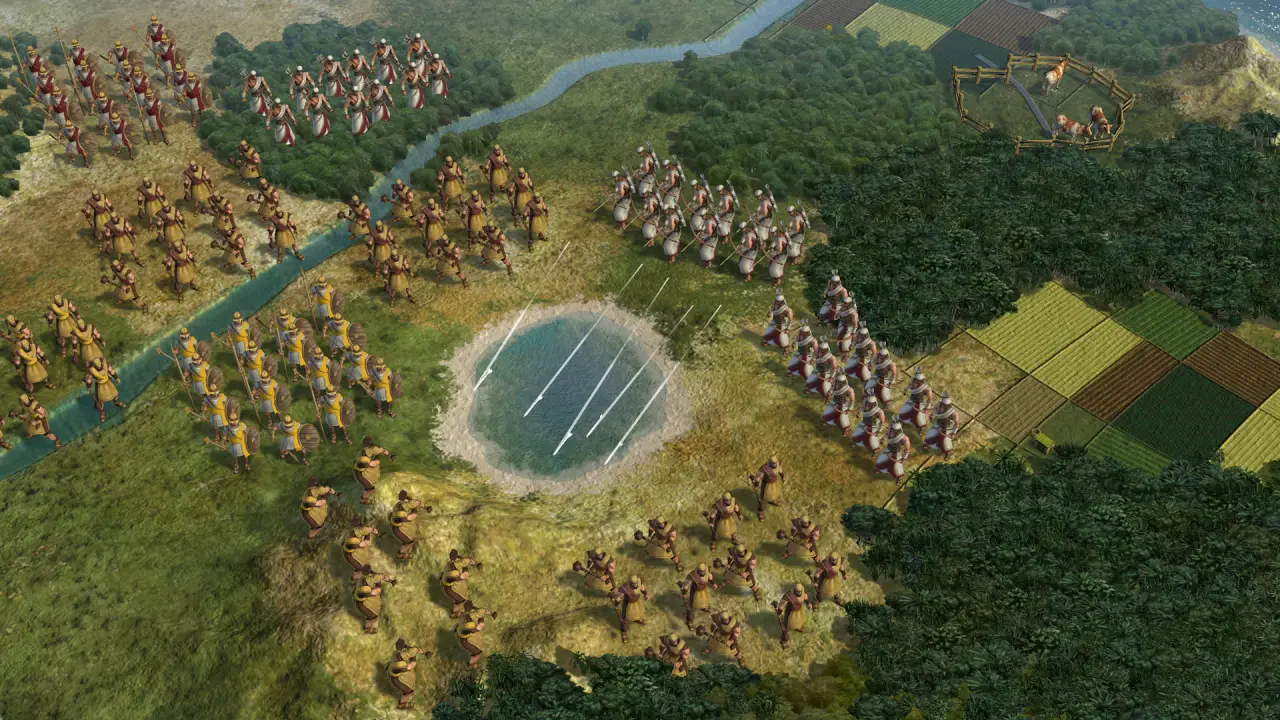
Combat is where the sound design really earns its score. In a siege you hear the groaning creak of engines rolling forward, the whistle of fire-pots dragging their tails through the air, and the layered roar and crumble as a wall takes a hit and gives way. That tiered crash makes the sensation of a wall coming apart genuinely tangible, so you flinch a little even when you are the one doing the breaking. The instant two infantry lines crash together, voices flood in as a single mass: shouts, cries, and barked orders blurring into one sound. It is not built so you can pick out specific words; it is built to press a wall of chaos against your chest, the way a war documentary does when you cannot tell who is yelling what but you know for certain this is not a quiet place.
At the campaign level the music shows real restraint. During long stretches of turn-clicking the score stays out of your way rather than clamoring for attention, then offers a small melodic swell at the genuinely important inflection points: a decisive battle, the rise or loss of a major power. Those moments tug you out of pure calculation mode and remind you that this particular step actually mattered. For a game that may have you staring at the same map for dozens of consecutive hours, that refusal to over-stimulate is exactly right. You never reach the point of musical fatigue where you just want to hit mute, which is a quietly impressive achievement for the genre.
Visuals | 7.5/10
Graphics: 7.5/10Stand inside a dusk siege, watching fire-pots and arrow volleys braid together as they slam into a wall, and the spectacle still holds up today. The visuals here are not chasing photorealism; they are chasing legibility and mood, and on those terms Attila knows exactly what it is doing.

What follows is a look at where the presentation shines, where it merely keeps pace, and where it actively gets in your way. The short version is that Attila spends almost all of its visual budget on two things: the spectacle of a large battle and the slow transformation of the campaign map. Everything else, from menu polish to character detail, is functional rather than dazzling. That is a deliberate trade, and whether it works for you depends entirely on whether you read a strategy game's visuals as set decoration or as a working instrument you stare at for hours.
When the climate becomes a visual system
The standout visual idea is the climate-deterioration system, and it works because it is wired straight into your strategy rather than sitting on top as decoration. As a hard winter pushes south across the campaign map in widening rings and warfare scorches great swaths of forest into blackened ground, you can watch an apocalypse physically occupy the surface of the world. This is not effects for their own sake. That charred stretch of border is very likely the territory you decided you could not hold and gave up on purpose, so the visual change is a record of your own choices made readable at a glance. Few strategy games let you see your strategic concessions written directly onto the terrain. The cooling map is simultaneously a weather event, a difficulty signal, and a piece of environmental storytelling, and the fact that all three readings land at once is what makes the system memorable long after a campaign ends. It turns the map itself into the game's most expressive piece of art, which is a smart bet for a title that was never going to win on raw fidelity.
A clear step up from the previous entry
Compared with the earlier Rome II, this entry shows obvious gains in the stability of its battles and sieges. Unit sizes are larger, animations are more uniform, and the city defenses are more three-dimensional, all of which eases the visual-parsing load during a chaotic melee. In a medieval town brawl, the narrow streets, the burning houses, and the soldiers slipping between shadows can give you the pleasant illusion of watching a war film made on a limited budget but with real conviction. The camera is not lavish, but it gets the scene across, and that clarity matters more than polygon counts when fifty units are converging on a single gate. The improved siege staging is the headline: ladders and engines behave more predictably, formations read more cleanly against the walls, and you spend less time squinting to work out who is winning a given corner of the fight. For a strategy player, presentation that reduces confusion is worth more than presentation that merely looks expensive, and Attila understands that priority well.
The UI is the real weak point
The problems concentrate in the interface and the overall texture rather than the battles. To carry the campaign's enormous information load, the UI turns into what many players experience as a dense ledger of numbers: small fonts, a dense cluster of icons, and a level of abstraction high enough that newcomers routinely stop in the first few dozen turns just to confirm what a given cluster of symbols is trying to tell them. In a strategy game whose pacing is already taut, that extra reading cost amplifies fatigue rather than relieving it, and it is the single thing most likely to bounce a curious newcomer off the early game. Set against the visual standard of other big PC releases from its era, Attila is the solid-but-unremarkable student in the class; it never drags the experience down, but it is hard to imagine the graphics alone closing the sale. The real visual memory points are the large-scale battles and the burning towns, not pore-level character models or hyperreal materials. If you want a next-generation benchmark, it will not get there. If you simply want a strategy game that hands you a few genuinely screenshot-worthy moments, it delivers that without much trouble.
Combat | 8.8/10
Gameplay: 8.8/10The best design in this game is not any single battle. It is the counterintuitive move it forces on you: collapsing a capital you have nurtured for dozens of turns into a mobile camp with one click, then dragging your whole people away from a fertile river valley and racing toward unknown southern plains. It feels a bit like liquidating a long-held position in a single order; reason says run, but your hand resists the confirm button.

That tension is the engine the entire campaign runs on. Almost every system in Attila exists to put you in front of decisions that are correct and miserable at the same time, and the more you understand the rules, the more the game asks you to act against your own instincts. The sections below trace how the horde mechanic, the asymmetric factions, and the tightened battle layer combine into a loop that punishes comfort and rewards nerve, turn after grinding turn.
The horde system breaks the old loop
The nomadic horde mechanic takes the settled empire's familiar build-farm-expand cycle and shatters it outright. You are no longer the mayor laying roads and raising buildings; you are the convoy captain hauling an entire people along with you. The tents are your city, the army is your population, and the city slots become a string of mobile wagons that can be burned down or chased across the map. Paired with this is the long-term pressure of a cooling climate and increasingly barren soil. You would rather not migrate? Fine. A few turns later, as you watch once-green farmland tick down into negative yields square by square, you understand exactly what the system is pushing you toward. This is the rare strategy loop where staying put is itself a slow defeat, and the game trusts you to read that signal instead of spelling it out. The horde turns settlement from a default state into a deliberate, reversible gamble, and that single inversion reshapes how you think about territory, supply, and time across every faction that can use it.
Asymmetry that feels like a dozen rulebooks
What gives that pressure so many flavors is how aggressively asymmetric the factions are. Run the Western Roman collapse campaign and it feels like patching an old ship that leaks everywhere at once: a rebellion here, a barbarian landing there, expansion long since off the menu, the win condition reduced to "don't lose ground this turn." Take a nomadic power like the Huns and you become a forest fire moving through the dark, every settled people along your route turning into fuel for the advance. Each faction's economic logic, army composition, and tempo of advance is genuinely different; this is not a reskinned opening but something closer to a dozen separate board-game rulebooks handed to you on the same map. The notable mechanics stack on top of each other here, because the horde, the climate, and the asymmetry all interact rather than sitting in isolation. The result is that learning one faction teaches you surprisingly little about the next, which is precisely why the campaign sustains so many replays without feeling repetitive.
Tighter battles, brutal onboarding
On the battlefield, Attila continues the series tradition of real-time tactics: infantry charges, cavalry flanking, fire-throwing engines hammering walls. The highlight is that sieges and AI are steadier than in the previous entry. Assault ladders no longer glitch out as often, units are less prone to jamming at the gate, and the orders you issue are carried out roughly the way you imagined. Combined with a tighter feedback loop on the campaign screen, a tactical win often translates immediately into a real strategic advantage, buying you breathing room or letting you pull out a troublesome thorn for good. The catch is the difficulty curve, which is merciless toward newcomers. Pick the Huns or a small tribe straight away and complex systems plus a high-pressure board can flatten you fast, not by losing a fight or two but by discovering, a dozen turns in, that your economy has collapsed, your grain is gone, and your diplomacy screen is wall-to-wall red. For a strategy veteran, though, that very pressure is the draw: every turn feels like surgery against a chess clock, exhausting yet impossible not to start one more.
Content | 8.7/10
Content: 8.7/10Judged only by the length of its main campaign, Total War: Attila could pass for an ordinary big-map strategy game, a few dozen hours spent playing through the decline of Rome. That description is not unfair on paper. Once it sinks its hooks in, though, you realize it behaves less like a single script and more like a whole box of board games, each with its own rules.

The breadth comes less from raw mission count and more from how differently each faction plays. Two campaigns can share the same map, the same timeline, and the same victory screen and still feel like separate games, because the problems they hand you barely overlap. That is the lens to keep in mind across this section: Attila measures its content not in hours of filler but in the number of genuinely different strategic puzzles it can pose with one historical setting. The factions, the reverse-curve campaign structure, and the expansions all feed that same idea from different angles.
A box of board games, not one script
The number of playable factions is respectable, but the real value is how drastically their playstyles diverge. The split Western and Eastern Romans feel like a tower-defense RPG cranked to hard mode, where you patch financial holes with one hand while plugging gaps along an absurdly long frontier with the other. The relatively stable Sasanians hand you a reasonably intact empire, with the catch that pressure from the north and west is coming sooner or later. Add the barbarian tribes forced into a southward march, each one starring in its own exile-route road movie, and you simply cannot apply a single standard of play across them. That spread alone props up a considerable amount of replay value. The pacing wears the words "long-term change" from the very first turn. Where a typical 4X runs cautious-opening, satisfying mid-game expansion, late-game cleanup, this is structured more like a disaster film, and that reversal of the usual power curve is something many peers in the genre never offer. You begin by calculating how to grow and end by calculating how to survive, which keeps even a familiar map feeling unsettled.
Reverse curves and multiple endings
From defending a decaying empire to personally leading a tribe through a great migration, that reverse curve is an experience a lot of similar games never deliver. The DLC and expansion factions thicken the cake further, letting you replay the age of Attila on the same map from completely different vantage points. You can be the battered frontier garrison absorbing blow after blow, the besieging army knocking on the walls of Rome, or the opportunistic small state slipping through the cracks to grab what it can while everyone else burns. At the level of the play loop, every faction can reach several distinct outcomes through different strategies: hold to the end, migrate out, or simply scrape by, each with its own systemic feedback. That variety gives "just one more campaign" a genuine reason to exist, because the ending you reach is a product of the choices you actually made rather than a fixed cutscene. It is the kind of content density that rewards experimentation, since the map keeps producing new stories as long as you keep changing how you approach it.
Density that demands time
Naturally, this much content comes with a threshold. The complexity stacks high, and a newcomer without the right mindset can get lost in an information downpour: the diplomacy matrix, public order and stability, religion, climate trends, each of them shaping the whole board at once. You have to invest enough time before you can truly read the rhythm of this map, which makes it a poor fit for a relaxed weekend game. For strategy obsessives, though, this is exactly the kind of single purchase you can gnaw on for a very long time. The depth that frustrates a casual player is the same depth that keeps a dedicated one coming back, and the game makes no apology for choosing the latter audience. If you measure content by hours of meaningful decision-making rather than by mission count, Attila is unusually generous, provided you are willing to meet it on its own demanding terms. The barrier to entry is real, but it is also the price of admission to a strategy space that very few games even attempt, and once you have paid it, the map keeps repaying you for a long time afterward with situations you have never quite seen before.



Comments 0
Share your game review
Join the discussion and share your review of this game.
No comments yet. Share your thoughts on this review.