























Opening
The first time I sent a planet on a head-on course toward Earth, the screen did not reward me with anything resembling a victory. It looked more like a science experiment that had quietly slipped out of my control. The point of impact brightened first, then the whole world seemed to ignite from the inside, debris flung outward in a widening spray, and the once-tidy orbit unraveled into something jittery and wrong. That single moment told me everything I needed to know about Universe Sandbox. Its best quality is not the destruction itself but the chance to watch, in plain sight, exactly why that destruction unfolds the way it does.
This is not a toy box presented as a cosmos. It behaves more like a well-lit, expensively equipped physics laboratory that happens to have an open door. You walk in, and your first instinct is not to look for an exit or a finish line. Your hands simply start itching to touch something, to nudge a number, to ask what happens if.
And that is precisely where the friction lives, too. There are no missions, no characters, nobody up ahead tugging you toward the next beat. Giant Army handed the entire steering wheel over to you. Some players will read that as freedom. Others will read it as an empty room, and both reactions are entirely fair responses to the same design.
This review is about holding both readings at once: a simulator that can absorb dozens of hours of genuine fascination, and one that can lose another player completely inside half an hour. Where you land says as much about you as it does about the game.
Story | 3.0/10
Story: 3/10There is very little to dance around here. Universe Sandbox has almost nothing in the way of a traditional plot, character arc, or narrative progression. It is not a game that tells you a story. You will not meet anyone, you will not be escorted to the next node by some guiding hand, and you will certainly not be handed an answer at the end. The narrative space is empty. Genuinely, deliberately empty. The interesting question is whether that emptiness is a void you fall into or a blank page you get to write on yourself.

No Characters, No Quests, No Ending
If you come looking for the usual scaffolding of a story-driven title, you will find none of it. There is no protagonist whose motives you inherit, no antagonist whose plans you unravel, no cutscene that sets a stage or closes a chapter. The list of things you can do in Universe Sandbox reads like a set of experiments rather than a set of quests: collide two planets, heat the Earth until its oceans boil away, disrupt a stable solar system, build a star system from nothing. None of those carry a script. None of them resolve into a moral or a revelation. They simply happen, governed by physics, and then they keep happening until you decide otherwise. For a player who needs a thread to follow, this absence is not a minor shortfall tucked into one corner. It is the whole architecture, exposed and unapologetic, and on a dimension literally labeled story, that exposure costs points whether you sympathize with the design or not. There is no codex to read, no log of events filling in behind you, no slow drip of context that gradually makes a world feel inhabited. Every session begins and ends inside the same blank, indifferent void, and the game makes no apology for it, which is honest but unmistakably costly here.
Knowledge Instead Of Story
What the game offers in place of narrative is something closer to the feeling of learning. The clearest example is the Titan data view. When you pull up that moon and watch the methane liquid depth resolve into readable figures, with Saturn hanging in frame beside it, what you receive is not a plot beat but a quiet jolt of understanding. You are not moved by a character's fate; you are moved by the realization that this is roughly how the place actually works. That is a real and underrated kind of payoff, but it is important to be honest about its shape. Knowledge is not story. The satisfaction of grasping a system does not give you the emotional handholds that a narrative provides, the sense of someone to root for or a destination to reach. It rewards curiosity rather than investment, and those are different muscles. Some players flex one happily and never miss the other; some feel the missing one as a constant, low ache. The information is genuinely affecting in its own quiet way, but it asks you to supply the wonder yourself rather than handing it to you on a scripted plate, and that is a meaningful difference in how the experience lands hour after hour.
The Arc You Author Yourself
The closest thing to a personal arc in Universe Sandbox is the one you construct without being asked to. Take the build-a-star-system scenario: you begin with a blank field and add bodies one at a time, tuning mass, density, and velocity until, against the odds, a stable configuration holds together. That slow climb from chaos to something that survives a few orbits is, functionally, a progression. It has tension, setback, and a payoff you earned. The catch is that the game never frames it as such. It will not tell you that you have accomplished anything, will not mark the moment, will not ask you to care. Whether that emergent, self-authored arc lands as profound or simply evaporates depends entirely on what you brought through the door. Set this beside something like Minecraft's creative mode, another goalless sandbox, and the same fault line appears: the people who relish writing their own reasons to continue thrive, and the people who wait to be given one drift away. The missing narrative is a choice, not an accident, but choices still have a price, and on this dimension Universe Sandbox pays it in full.
Audio | 5.0/10
Audio: 5/10Audio is the hardest section of this review to stretch out, and not because the sound is obviously bad. It is because there is so little to grab onto. The overwhelming majority of coverage barely mentions the music, the effects, or any voice work at all, and the one thing that silence makes clear is that sound was never meant to be a selling point for Universe Sandbox. It has no headline feature here. It barely has a presence. Working out what that means for the experience is more interesting than complaining about it, because the absence is not random noise; it is a window into how the whole design prioritizes what it wants you to pay attention to.

A Presence You Barely Notice
The low profile of the audio has a subtle effect on how you actually play. In a title built around free experimentation and watching physical outcomes resolve, sound that does nothing to reinforce your feedback loop simply steps aside, and your attention concentrates even harder on the visuals and the shifting parameters. You will not stop because a melody caught you off guard. You will not remember a particular experiment because some effect punctuated it. The closest analogy I can offer is the white wall of a laboratory: it does not get in the way of your work, but it does not lend you any mood either. Every cue that might have stamped an emotional mark on a collision or a near-miss is simply absent, and so each result has to earn its weight on screen alone, which, to the game's credit, it usually manages to do. Think about how much a single rising drone or a low impact thud could do to sell the moment two worlds meet, and then notice that Universe Sandbox declines to reach for any of it. The silence is consistent, not careless, but it does mean the most dramatic events on screen arrive without the sonic punctuation that would let them truly resonate in memory.
Serviceable, Never A Draw
Is this a serious problem? Not really, and pretending otherwise would be dishonest. Universe Sandbox was never built to hook you through narrative rhythm or auditory momentum, so the thin soundscape is consistent with the rest of the design rather than at odds with it. The trouble only surfaces if you arrive hoping for sound that could push the sense of cosmic scale higher, the kind of sweeping design that makes the vastness feel vast. That is the one ambition the audio leaves on the table. It never noticeably drags the work down, but it almost never lifts it either, and so it lands in that familiar middle ground: adequate, unremarkable, present without being felt. Judged against what sound design can do for a game today, this is the textbook definition of good enough but never standout, and the score reflects exactly that ceiling rather than any real failure. If you tend to play with your own music running in the background anyway, you will lose almost nothing, and many players do exactly that. But if you wanted the simulation itself to sound as immense as it looks, that experience is simply not on offer here, and no setting will conjure it for you.
Visuals | 6.5/10
Graphics: 6.5/10You cannot judge the visuals of Universe Sandbox by the usual checklist of sharp textures and finely modeled characters. The standard simply does not apply. What this game does beautifully is something else entirely: it presents physical outcomes with enough clarity that you read them instantly. When several planets detonate in deep space at once, fracturing and trailing brilliant arcs of glare and debris, the impact is genuinely fierce. It is not cinematic in the Hollywood sense. It feels more like a moment of perfect accident captured in lab footage, and because you know it was not posed for the camera, it carries a strange and persuasive authority.
Visualization Over Spectacle
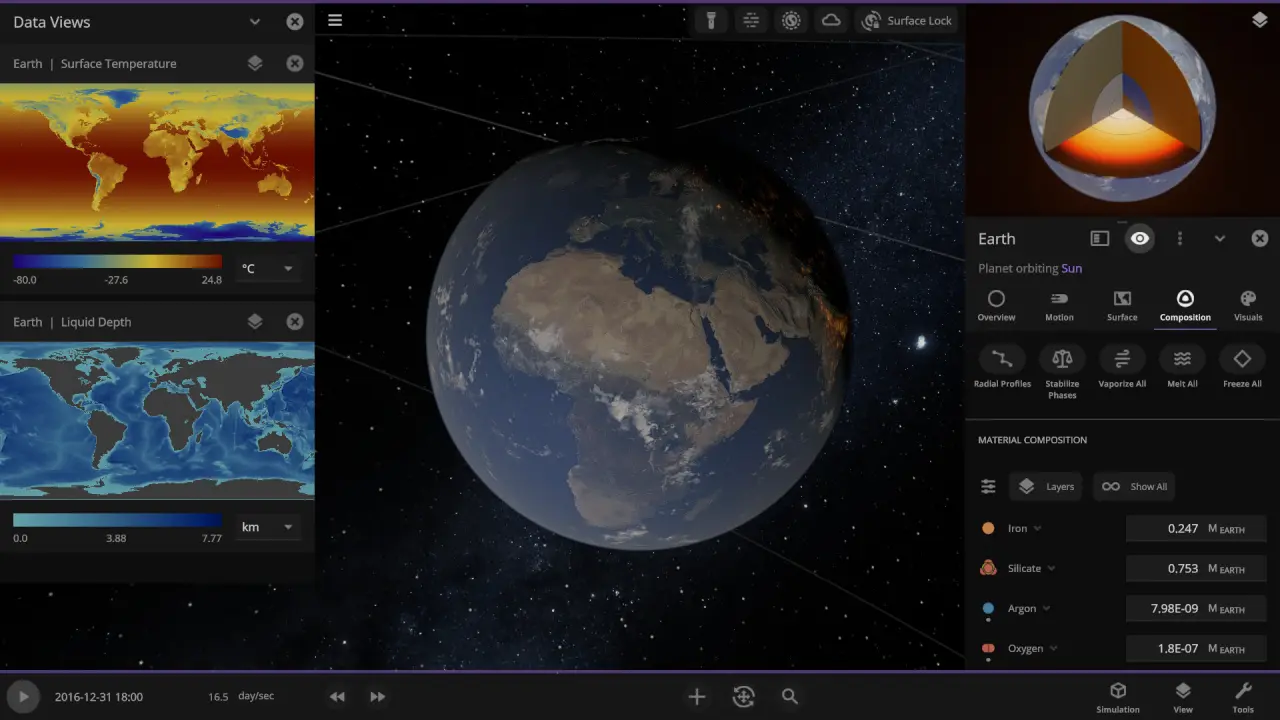
The thing that works is legibility. Orbital changes, body collisions, the whole process of disruption: none of it is buried in abstract numbers. It is laid out directly in front of you. When a moon-sized body takes a violent hit and melts and breaks apart, that transformation does not exist merely to look impressive. It exists so that you can see, at a glance, that the system is tipping out of balance. This matters enormously, because the visual value of Universe Sandbox is fundamentally information made visible rather than artistic showing-off. The graphics are doing a job, and the job is comprehension. Every flash and fracture is a sentence in a language of cause and effect, and once you learn to read it you stop noticing that the underlying art is fairly plain. Color shifts on a heated surface, the glow of a body straining under tidal forces, the slow reddening of a star you have meddled with: each of these reads as data first and decoration second. You are never left guessing what just happened, because the screen already told you in a language your eye can parse instantly, and that clarity is worth far more here than any amount of polish would have been.
Reading The System At A Glance
Push that idea further and the strength becomes obvious. Set three planets side by side and let them sit there with completely different surface colors and atmospheres, and the screen becomes a comparison chart you can actually feel. You find yourself wondering, almost involuntarily, what would happen if you nudged one of them closer to the star. That curiosity is manufactured entirely by what you can see. Real Newtonian gravity drives every body, and because the consequences are rendered rather than tabulated, the visuals turn into the primary interface for understanding the simulation. The rendering of climate and surface, the temperature gradients, the internal cross-sections, all of it exists to let your eye do the work your intuition wants to do. It is restrained, but it is precise, and precision is the entire point. There is a real elegance to watching an internal composition diagram update in real time as a world heats, or seeing ice coverage retreat across a globe like a tide going out. None of it is flashy, yet all of it is informative, and the longer you sit with it the more you appreciate that restraint as a deliberate choice rather than a limitation the developers settled for.
Where The Ceiling Sits
The weakness lives in exactly the same place. How good this looks depends heavily on whether you are interested in the physical processes themselves. If you are hoping for richer staging, more varied scenery, a broader aesthetic range, Universe Sandbox cannot give you much of that. The split among critics on this dimension is easy to understand: some are genuinely moved by celestial motion and the choreography of disruption, while others glance at it and think is that all. Hold it next to something like a flight simulator built to render gorgeous, sprawling skies, and the contrast clarifies the ceiling here. This affects the experience, but it is not fatal. The game never set out to be a scenic picture book. It set out to take the machine of the universe apart and show you the gears, and on that specific ambition the visuals deliver with quiet, unglamorous confidence. If you measure it by sheer prettiness, it will always sit a tier below the showcase titles built to dazzle. If you measure it by how much it helps you understand, it leaps ahead of nearly everything in its niche. Knowing which of those two yardsticks you actually care about is the single best predictor of whether this dimension will delight you or leave you cold.
Combat | 7.5/10
Gameplay: 7.5/10The core pleasure of Universe Sandbox is refreshingly direct: drop a celestial body into the scene, change its velocity, its mass, its density, and then watch to see whether the whole system starts to lose its mind. Reduced to its essence, you are running experiments. The clever part is that the game hides its dry equations behind impacts, meltdowns, decaying orbits, and cascading collapse, so an hour vanishes before you notice it has gone. You see the solar system's orbits laid out against a wash of galaxy, the panel for adding a planet sitting right there, and you naturally want to place one more, push it a little faster, and find out what comes next.

The Experiment Loop
Real Newtonian gravity sits underneath all of it, which is what gives the loop its credibility. Because every body genuinely pulls on every other body, you do not need to finish a course in astrophysics before you can read the results. You place something, you watch the orbit warp, and the causality is right there to be understood. The two-planet collision is the classic addictive opener: send two worlds toward each other, watch the contact point flare and heat, watch the fracture spread and the debris scatter, and you immediately want to run it again with one number changed. That immediacy is the engine of the whole thing. The satisfaction is fast, it is legible, and it loops back on itself, because every outcome poses a fresh what-if that you are powerless not to test. What makes this so sticky is that the simulation never lies to you and never cheats. The same inputs really do produce the same physics, so when you change a single variable and the result diverges, you trust that the difference is meaningful rather than arbitrary. That trust is what turns idle tinkering into something closer to genuine inquiry, and it is the quiet reason an afternoon can disappear into a single chain of experiments.
Tools That Lower The Barrier
What keeps the loop accessible rather than intimidating is a thoughtful set of tools. The starter models library hands you ready-made scenarios, the solar system, prebuilt collisions, chaotic configurations, so you are never staring at a blank void wondering where to begin. Time control lets you accelerate or slow the simulation to catch the moment you care about, and scale zoom lets you swing between a single moon and an entire star system without losing your bearings. These are not flashy features, but together they let you direct the experiment instead of merely watching it. It is worth saying plainly that this is not Minecraft-style building, where you are here to construct things. It is closer to standing in a kitchen full of scorching pans and strong spices, where the whole question is how recklessly you are willing to mix. The presets matter more than they might seem, because they double as tutorials by example: load a chaotic configuration, watch it fall apart, and you have already learned something about why stable orbits are stable. By the time you start a scenario from a truly blank field, you are no longer guessing, you are applying intuitions the game quietly taught you through its own ready-made playgrounds.
The Flaw At The Root
The problem is just as plain as the pleasure. There are no traditional quests, no upgrades, no bosses, no clearly stated goals. The experience rests almost entirely on your own curiosity. If you are wired to fiddle with parameters, this becomes an addictive toy you cannot put down. If you are used to being pushed forward by designed challenges, the first half hour can curdle into staring at the screen waiting for something to tell you what to do. This shortcoming matters enormously, because it is not a local weakness in one subsystem; it is the root of the entire work. Whether it is fatal depends on the person. For a player who leans hard on a sense of purpose, it very well might be. Watching a star system erupt into a chain reaction of crisscrossing orbits and bursts is genuinely gripping, but once you are gripped, the game takes no responsibility for telling you what to do with the high. There is no scoreboard to chase, no unlock to grind toward, no next thing dangled in front of you to keep the momentum going. The momentum has to come from inside you, and when it does the game soars; when it does not, it simply sits there, patient and inert, waiting for a curiosity that may never arrive.
Content | 7.0/10
Content: 7/10The volume of content in Universe Sandbox is not propped up by a checklist of tasks. It rests on the unpredictability of outcomes. One day you can watch the surface of an Earth-like planet get hammered into a pockmarked ruin by meteor strikes; the next, you can go study the differences in atmosphere and terrain across a handful of distinct worlds. The feeling is like opening the fridge meaning only to grab a bottle of water and somehow ending up cooking a full meal. Is there a finish line here? No. The hard part is making yourself stop.

Depth From The Unpredictable
When three planets sit side by side with completely different surfaces and atmospheres, you cannot help but keep testing: what happens if I push one of them closer to the star? The replay value comes mainly from custom parameters, from the multiple starting models, and from the steady supply of new questions that grow out of repeated experimentation. When the interface shows you Earth's temperature, its ocean depth, and a cross-section of its internal composition, the thickness of the content reveals itself. This is not simply watching things explode. It is being allowed to keep drilling down. As long as you are willing to investigate, the game can hand you far more hours than its surface appearance would ever suggest, and that hidden depth is its quiet trump card. The crucial detail is that the questions are not authored by the developers, they are generated by the system itself in response to what you do. Each experiment leaves a residue of curiosity, a small itch about one more variable, and that itch is effectively an infinite content generator for the kind of player who lets it run. No two sessions need ever look alike, and that is content of a sort no quest list could ever supply.
Scenarios You Can Re-Run Forever
Part of what sustains all of this is that the marquee scenarios are endlessly repeatable rather than one-and-done. Disrupting a stable solar system is a perfect example: toss an extra body into a settled arrangement, watch the orbits begin to cross and interfere, and follow the system as it slides into chaos. Run it again with a slightly heavier intruder and the whole sequence diverges. The climate sandbox behaves the same way, letting you reshape temperature, ocean depth, and ice coverage and then watch the cascading consequences ripple through the model. Nothing here resets to a fixed script, so the same scenario keeps generating fresh results, and a setup you thought you understood can still surprise you on the tenth attempt. Five-plus years of free updates have kept widening this toolbox, expanding the body data and simulation features without ever carving the experience into paid pieces, which means the content has only grown denser over time. That update history deserves a moment of credit on its own, because plenty of simulators of this vintage have long since gone quiet. Here the steady stream of additions means the version you play today is materially richer than the one early adopters first opened, and the value keeps compounding for anyone who returns to it.
The Threshold Of Curiosity
This content structure comes with a threshold, though, and it would be unfair to hide it. Unlike a traditional title that keeps prodding you with new levels, new enemies, and new story, Universe Sandbox stakes its replay value on a single question: are you willing to keep asking. The trouble is that this kind of drive is intensely personal. For people who love free experimentation, the content runs deep and rewards every hour. For people who just want steady, predictable feedback, no number of models will stop the whole thing feeling scattered. Set it beside a systems sandbox like Oxygen Not Included and the same pattern emerges, where the richness only opens up for the player who leans into the system rather than waiting on it. The impact is significant, but it is not a true defect, because this was always a deliberate trade-off baked into the design rather than a sign of anyone cutting corners. The honest way to frame it is that the content is conditional. It is enormous for one kind of player and nearly invisible to another, and the same library of models and parameters can read as a treasure trove or as clutter depending entirely on the temperament of the person sitting in front of it. Knowing which one you are is the whole game.





Comments 0
Share your game review
Join the discussion and share your review of this game.
No comments yet. Share your thoughts on this review.