

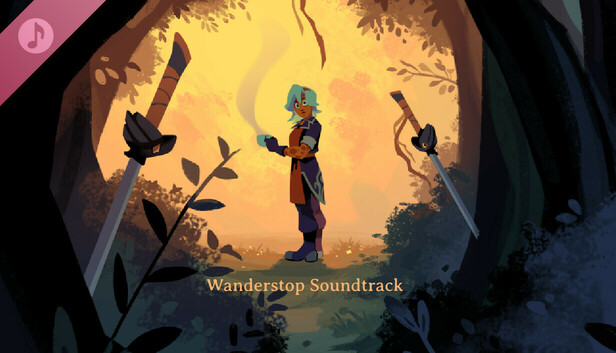

Wanderstop
Price History
Past 36 months · Updated dailyPrices cover Steam and 39 authorized stores; only legitimate offers are counted. The chart shows weekly market-wide lows and Steam's official price across the past 36 months.

01About Wanderstop
Wanderstop follows Alta, a fallen fighter reluctantly running a tea shop in a magical forest. Grow and harvest ingredients, then mix them into tea for travelers using an unusual contraption. Conversations reveal the visitors’ stories, while quieter moments let you tidy the clearing, decorate the shop, or sit with a cup and your thoughts. Steam player reviews: 92% positive from 3,019 reviews. The Steam PC version has full controller support. English voice acting and subtitles in multiple languages are available.
Credits
Lowest recorded in 36 months
$9.902026-07-30 · KinguinBase game · same records as the chart above; USD history, not a regional Steam low.Language support
| Language | Interface | Subtitles | Audio |
|---|---|---|---|
| Simplified Chinese | Yes | Yes | — |
| Traditional Chinese | Yes | Yes | — |
| English | Yes | Yes | Yes |
Show 8 more languages
| Language | Interface | Subtitles | Audio |
|---|---|---|---|
| French | Yes | Yes | — |
| Italian | Yes | Yes | — |
| German | Yes | Yes | — |
| Spanish | Yes | Yes | — |
| Japanese | Yes | Yes | — |
| Spanish-Latin America | Yes | Yes | — |
| Korean | Yes | Yes | — |
| Portuguese-Brazil | Yes | Yes | — |
Steam PC edition data · 2026-11-22
02Before you buy
Controller
The Steam PC version has full controller support.
Language
English has full audio; supported languages include subtitles. Interface support includes English, French, German, Italian, Japanese, Polish, Portuguese, Simplified Chinese, Traditional Chinese and others.
03Frequently asked questions
What is Wanderstop about?
Alta, a fallen fighter, reluctantly runs a tea shop in a magical forest and meets travelers who stop by.
What do you do in the game?
Grow and harvest ingredients, mix them into tea for customers, and spend quiet moments tidying or decorating the shop.
Does it support controllers?
Yes. The Steam PC version lists full controller support.
Popular Steam reviews
Native-language selection · 10 reviewsSelected helpful reviews in this language show both recommendations and criticisms. This selection does not represent the overall positive rating; opinions reflect the version reviewed.
*BEFORE YOU BUY* Understand that this is a story game about trauma and feelings of inadequacy in the framework of a cozy game. This is not a cozy game where you achieve all your goals. This is therapy, not catharsis. You will regularly have to face the simple truth that you cannot optimize gameplay. You can't "level up" and get better results. There's no growing in skill. This is about rest and healing. Not figuring out the shortcuts. The more you fight against this, the less you will enjoy this game. And it is a game. I really enjoy it. I think there's interesting mechanics I've never seen before. I like them. There is an endless supply of things to do like sweeping and weeding. You'll never "finish" doing all the things. Just like you'll never "finish" brushing your teeth, or doing laundry. This is the game trying to communicate that there are things not in your control. You don't get to decide to eliminate weeds as a thing that happens. Just like you don't get to decide whether or not you'll need to take out the garbage. This game is bitter medicine. But it IS medicine... but... it is bitter. This game won't lie to you and tell you that the world makes sense or that you can preserve something forever. It's not going to give you vapid achievements that encourage you to collect 100 seeds. It treats you like an adult who doesn't need keys jangled in front of you to keep you amused. It's a unique narrative you'll never see anywhere else. And it requires a game to experience. This game, like Davey Wreden's other works, cannot be translated to film or novel. I appreciate that this game respects me, and is made from a place of love. This game landed exactly where it was aiming. And that is something I almost never see in game makers today. Applaud this game.Show moreShow less
This is a difficult review for me to write, because much of the issues I feel I have with this game are to do with the nuance, or really, lack thereof. Spoiler Warning, if you want to play the game for yourself, don't read past here: So, first off, I get the main thesis of the game, because the game spends a large amount of time directly telling you what its' thesis is. From the trailer, to the outset, the game is about burnout, and its consequences. It opens with Alta telling the story of how she became the best Fighter. (And as a weird nit-pick, it's Fighter. Not Warrior, not Gladiator, Fighter, even though she does so in an arena and, to my knowledge, does not put on any sort of personality for the people, she just goes in and fights. AND she does it with a weapon too, so like.... Look, it's a weird nit-pick.) Alta spent years honing her craft, fighting her way up to the top, and then spent three years up there one day, until eventually she started to lose, and lose *badly*. She describes how she lost fights she should have won, how her body wasn't listening to her, and how ultimately, when she went out and trained even harder, she didn't get the results she wanted and just became unable to put up any sort of fight. So she decides that she needs some *serious* training, to go out and learn from the best of the best, and we meet our main character as she is running through the woods. From there, Alta eventually collapses, unable to even lift her sword, and is brought to the Wanderstop, a tea shop in the middle of the forest. Boro, the owner of the Wanderstop, introduces himself, and what he does, to us. Alta attempts to leave, but finds that every time she attempts to leave, she passes out, leaving her, and you, with no choice but to remain at the Wanderstop for the foreseeable future. With no choice but to remain, Alta learns how to manage running the Wanderstop, there is no trade here, you just make sure to brew tea for people, and that is it. The process of making tea requires you to dry leaves, heat water, add in leaves and fruit, then pour the tea. In theory, all of this makes for a calming, repetitive gameplay loop. However. The issue with this is that even the 'at your own pace' genre is objective-oriented, even if you are the one to decide what you want to do. It is unfortunate that it's very early on in Wanderstop that you learn that nothing you do actually matters. I know other people have spoken on this mechanic, so let me explain. At the end of every chapter, the season changes. With the season changing, everything resets essentially, the only thing that is saved is what you put in the portraits. Let me reiterate that: Unless something is in a portrait frame (Or book frame) it is LOST, you cannot regain it, re-find it, it is gone, forever. This includes photos, keepsakes, cups, plants, crops, everything. This is framed as allowing yourself to let go of things, that *all* things are temporary, which is true in a case, but if everything is temporary, why should I care about it? Certainly I can enjoy my time with something, but if I work to gain something, or if I feel sentimental attachment to something and have it taken from me, that is different feeling all together. The game chooses not to save things you put down yourself, and as such, the item isn't so much 'lost' as it is 'taken' or even 'stolen'. At least, to my interpretation. This itself is off-putting, but then there is the... Other part of the game. You get visitors to the Wanderstop every chapter, these people are quirky, somewhat charming, and add a personality to the shop as they walk around. You are supposed to feel *something* towards these characters, they are there to endear themselves to you in one manner or another. And this is the one part of the game that actually angers me. When the chapters change, all the people in the shop change, and you *never* see them again (save for Boro and Granny). Every single person has something going on with them, something that might, or might not interest you. You serve them tea and they tell you about themselves, and almost all of them has one problem or another. From a 'knight' that accidentally cursed himself, to a Warrior who actually knows you, to a woman from a very restrictive culture experiencing something new for the first time. These are interesting characters that you might want to know more about, or see what's happening to them to the end.... But you never will. Due to how the game changes, people that appear in one chapter will not appear in another (Save for Boro and Granny, again). This is the part that is most infuriating to me. There is no sense of closure, and the game, again, tells you that you're not guaranteed closure on everything. You may not see everyone's story to the end, and heck, your own story may leave certain things unresolved. This links back to the feeling of stuff being taken from the player. Because, yes, real life is often filled with moments that will never come again, chances that are missed, you might not resolve everything in your life... But those are not facts of life, those are choices. You always have a choice to continue, or leave something. However, this is a game, YOUR choices are limited to what the developer PUT into the game. There is no reason to leave someone's story behind after introducing them, as a game developer, besides either constraints, or not wanting to. So when you meet these characters, especially after the rug pull, you realize that nothing you do for them matters. I mean, even serving tea doesn't matter, because there is only one correct tea serving per customer, and anything else will not progress the game. The ultimate goal, in my opinion, is to progress the game, so even if you choose NOT to engage in the game, you are left stuck in a single area with no means of progressing, or changing. Which, honestly, there is probably something to be taken away in THAT thought. Regardless, I felt that these interactions were stolen from me, taken by the devs and replaced with something as impermanent all the way up to the ending of the game, because really, the only thing that matters in the game is to actually complete it. At the end of the day, I felt tired the more I played this game, forcing my way through interactions and often going to the guidebook in the shop to know what I needed to make for someone. Interacting with customers was unfulfilling, the end story was unengaging, and we are left ultimately to speculate what happens to Alta after she leaves the shop. This game actually made me feel burned out on it, the repetitive motions that first seemed calming became tedious, the interactions that felt charming became superfluous, and all in all, I got what I needed out of the first hour of the game. All I can say is that I am disappointed. I regret buying this game, even at a discount, and ultimately I can only tell people that if you are looking for a cozy game, there are much better pieces in this genre.Show moreShow less
First of all, thank you to the devs for making Wanderstop. The game is gorgeous. The soundtrack is fantastic. And the story... I went into this game knowing the story is about burnout. As someone still recovering from burnout, I hoped it would speak to me. If you've ever struggled with mental health, the things you witness in this game will strike you as familiar. Wanderstop is about burnout. It's about trauma. It's about understanding yourself. It's about recovery. It's about learning to be patient with yourself during that recovery. And finally, it's about accepting that things might change; that you might come out of recovery a changed person. The game not only spoke to me, it helped me accept some part of myself. You might get frustrated along with or at Alta, wonder why you she can't just get better, why you she can't just find an instant fix, why you she can't just excise what's "broken" (despite that part being a part of you), why you she cannot just keep going as you were - pushing yourself to the edge, operating at 200% 24/7, working hard forever to achieve your goals: because you hit the breaking point, physically or mentally. Boro is the person I wish I had when I was at my worst point. Someone who might not understand but was willing to be patient. Someone who would not judge me for not being myself. Someone who could strike at the things I couldn't put into words. When Boro said "Miss Alta being so 'productive' is causing her great harm," I felt that in my soul. It's relaxing. It's painful. It's catharsis. Wanderstop is a cozy game. There is no rush to do anything. You progress at your own pace, there is nothing pushing you to finish something this instant. You will be planting seeds, watering plants, and making tea. You can decorate the space how you wish with various trinkets and plants. You will get to meet many different characters, each with their own quirks. You will run around the space looking for things to do, and sometimes there is truly nothing to do. And that's okay. Wanderstop is not a cozy game. There are set tasks you have to do. All the decorating and placement you spend time on will reset. All the little trinkets you collect are ephemeral and will vanish. It will ultimately feel pointless. People will approach you and you might identify they need help. But you might not fix their problems. And that's okay. Much like real life, people will come in and out of your sphere with no satisfying conclusion or clean wrap up. You may never know how you impacted someone. There are people and things you will never see ever again, no matter how much you want to. There will be regrets - things you wish you did differently, things you wish you knew the outcome to. Closure exists in stories, but it doesn't always exist in real life. Learning to let go and accept change is another part of life. I love Wanderstop. Thank you. Thank you so much.Show moreShow less
Beginning words of my review: Wanderstop is a game with certain charm to it. The character designs are wonderful, the responses the player can choose when talking to the characters are funny. And the story about burnout is certainly an important topic, and very personal. My opinion of the game should not invalidate or take over the love fans of Wanderstop have for it. Too, my heart goes out to the writer, who poured their very personal feelings on to this game, and I understand the difficult development this game had. My feelings: I am burned out from Wanderstop. Coming into Wanderstop, I had bought the game knowing beforehand that for some, they could describe it more of a chore than a game. But there is always a matter of personal taste, I thought. Even if a game's core mechanic was meant to be repetitive and easy, then I'd be fine with it. I mean, my favourite game is a timeloop game of 20 hours, where repetition is part of the narrative. If Wanderstop offered occasional changes with different characters and story beats, like that game, then I could surely love it too. But it didn't... Well, kind of? The most polarizing aspect I would say is the trailer. It's a good trailer. A hooking trailer, but more misleading than anything. Many people, including me, got the impression that the main character would be a warrior from a fighting game stuck in a farming sim. It's actually a really good concept for a plot. However, that's not what the game is about at all. And if I had not watched gameplay of the demo, then my misintepretation would have led me to a huge letdown immediately. So yeah, that misconstruction had been cleared, but I still expected there to be some sort of deeper character development. The trailer focuses heavily on Alta's mental health state. There are side characters who enter the tea shop. Maybe they would serve some sort of purpose or foil, as we learn about them? No. The characters' purpose in Wanderstop is to move on. Nothing they share affects Alta's character. I understand why they were included like that. Like the plants and trinkets, you aren't supposed to get attached to them. You aren't supposed to obsess over them to the point of burning yourself out, so they are taken away from you after each chapter. You need to move on. Does it feel meaningless? Maybe you're supposed to know everything is meaningless, so just have fun. I accepted how the game was. I acknowledged the intent. I understood the decision. But it was boring. The narrative made sense, but it was boring. 7 hours in, with the salesmen, I confessed it. As cool and important as the concept of burnout could be, the execution was not gripping me. The characters don't get under the protagonist's skin for interesting exchanges, the tea-making has no mechanics for improvement, the inner dialogue of the mc is mostly in self-governed tea-drinking sessions that don't amount to much. It simply takes way too long to get any presence of the themes of burnout in the gameplay itself. Instead of the game showing burnout, I was the one feeling the burnout. That review I saw calling the game a chore, was right. What had gripped me at the beginning, didn't. Because it wasn't there enough. I can ignore slightly clunky UI for the keyboard and how the game barely recognizes the detached mouse when trying to pick up or drop items, having to use E and R instead. I can ignore the character only interacting with stuff in front of the character's view and not where my camera is angled to. I can ignore me accidentally speaking to a character when trying to use an item. I can ignore constantly accidentally dropping my items instead of stashing them into my inventory. I can ignore having to stop to use my items. If only the gameplay had gripped me. But it wasn't that kind of game. I really really wish I could have enjoyed it for what it is. I certainly don't hate the game or dislike it. Nor do I want to sound overly mean. The developers went through a lot, and it isn't their fault. I just feel underwhelmed.Show moreShow less
Wanderstop is an emotional narrative story in which you run a tea shop. You'll meet all types of people and brew the kind of teas for them they like. No missable achievements and completion takes around 12 hours. Approximate amount of time to 100%: Around 12 hours Estimated achievement difficulty: 1/10 Minimum number of playthroughs needed: 1 Is there a good guide available: You don't need a guide. You don't need a guide. I highly recommend playing this game blind. Multiplayer achievements: No Missable achievements: No Grinding Achievements: No DLC-Only achievements: No Speedrun achievements: No Time-gated achievements: No RNG-achievements: No Does difficulty affect achievements: No difficulty setting Unobtainable/glitched achievements: No This review for Wanderstop is hard to write. Not because it is a bad game, not at all, but because I don't want to spoil anything. I think the surprise of some things adds a lot to the impact this game can have, and the message is such an important one. Wanderstop is kind of like a therapy session; it is hard to hear but comes with valuable live lessons. In Wanderstop, you play Alta, a fighter. She is a fighter in every vessel in her body. Nothing else is more important in her life than being a fighter and winning every fight, so the losses are heavy on her heart. What happens when you are so passionate about one thing and one thing only and fail one too many times? What if you feel you can't continue because you're failing at what you're supposed to be? This is the situation Alta finds herself in when she encounters a Tea shop in the middle of a thick forest. Boro, the shop owner, will welcome you and ask you to drink tea with him, but you don't feel up for it; you can't sit and do nothing; you have to continue; you have to fight (literally and figuratively). Alta's body and mind are worn out, so she has no choice but to take her time and stay at the Wanderstop tea shop while helping run it for a short time. She'll meet all kinds of people; some will like her, others will look down on her once they get to know her, and some push her buttons, but all the visitors of the Wanderstop tea shop have a life lesson in stock for her (and in that way for you). Wanderstop has so many life lessons for the player. As someone with close friends who are burnt out, this gives a glimpse into their struggles. As well as it challenged my own way of life. Sometimes, Wanderstop forces you to slow down and take your time, which I struggled with. This was positive as it is clear why the game asks you to take your time, and it fits the narrative so well, but that didn't make it any easier for a person like me who isn't good at slowing down irl either. So it kinda was confrontational in a good way. Before I could really enjoy the game and its whimsical and wonderous visitors, I had to complete the tutorial. It involved a bit too much hand-holding for my liking, but I didn't dare turn the tutorial off, too afraid of missing something important (I never turn off the tutorial; I'm always afraid of missing important stuff). You had to go back to Boro after each step. I would have loved to have a few steps lined out and then go back. However, I can see how this makes Wanderstop accessible to everybody. They don't drown you in information and take the time to explain everything. A great thing is that there is this book that spells out what each visitor exactly wants, so if you're stuck figuring it out or just don't like that puzzle, you can use that book to look up what you need to make. It is so nice that the developers gave you the choice of whatever game style fits you. What made me really happy in Wanderstop were the beautiful flowers, the cute Puffins who love your tea and will take every opportunity to steal it from you, the beautiful posters you'll find along the way, and the many unique mugs. It always felt so great when I found a new mug that I loved, and I would use that for every visitor after finding it. There were so many of those I would love to have in real life; the designs were great! It is so clear how much love and passion went into making Wanderstop. None of the achievements are missable, as they are all part of the story. Completing the game takes around 12 hours. So please do yourself a favor, don't read up too much, but dive into this whimsical therapy session and maybe with a cup of tea next to you irl. I give Wanderstop 4 out of 5 stars. If you like this review, feel free to check out my website: Missi the Achievement Huntress: Reviews & guidesShow moreShow less
I am someone actively recovering from burnout. Having played the demo of the game during Next Fest, I thought it was interesting enough to be worth a try. The game promises a relaxing safe haven where players can take their time, work at their own pace, and sit to drink tea and stare at the beautiful landscape, and learn to finally, just breathe. But in practice, the game does the exact opposite: it gives me anxiety attacks. I don't think I've actually played 6 hours of this game. Rather, most of that time is from me getting an anxiety attack and having to walk away, leaving the game running. The game's world AGGRESSIVELY spawns chores to do: weeds that spread faster than middle school gossip, piles of leaves that emerge literally from the earth itself, seconds after you sweep them away. Walking away for a few minutes, I return to freshly cleaned areas which are completely overrun again, demanding an endless cycle of cleaning and pruning over and over and over and over, an impossible wall of tasks to complete. Even better, the reward for doing these chores are endlessly spawning dirty teacups, trinkets and seeds, all which you don't have enough inventory space to store, so you now additionally have the task of running back and forth from the store to the outside to clear the space, during which NEW LEAVES AND WEEDS HAVE SPAWNED. (Even describing it, I literally had to take a break because I felt too overwhelmed by the sheer scope of trying to keep these tasks in check.) I don't know if I'm missing "the point" of the game, some subtle reverse psychology point about tasks and games and burnout. But the demo led me to believe that this was a game that would be calm, meditative and restful. And I can't even think about this experience without starting to hyperventilate.Show moreShow less
this game is beautiful and I absolutely love the writing and the music ♥♥♥♥♥ SO HARD and you should go buy this. I can also confirm that the writer of this game is bald, and that his brother is not bald. This is not a joke the game is really really good. And I am not bald.Show moreShow less
After playing the demo, I was eagerly looking forward to the full version of Wanderstop. Unfortunately, the final game does not offer much more than what the demo already provided. It feels like a beautiful digital playground with an interesting story but lacks the depth of a proper game. One of Wanderstop’s strongest aspects is its writing. The dialogue is well-crafted, sometimes touching, sometimes humorous. However, there is an overwhelming amount of it, and it is not fully voice-acted. Additionally, the way conversations are presented is stiff—characters simply stand across from each other and display simple emoticons to express emotions. The game touches on the theme of burnout, which is rare in gaming. The topic is important, but the way it is handled (many therapeutic clichés and unengaging presentation) lacks the emotional weight needed to make a lasting impact. Wanderstop is supposed to encourage relaxation and mindfulness by avoiding traditional objectives and challenges, but ironically, it often does the opposite. The sheer number of chores required to run the tea shop can feel more like a burden than a calming experience. Tea preparation is a multi-step process that quickly becomes monotonous. You need to gather leaves, dry them, plant and water seeds to grow fruit, and collect everything one item at a time. Then, you must fetch water, heat it via a mini-game, pour it into the teapot, add ingredients, and transfer the brewed tea to a carafe. Finally, after carefully filling a cup without overflowing it, you can serve the tea or drink it yourself. The sheer number of steps, with little variation, makes the process feel more like a chore than a calming ritual. Theoretically, figuring out which tea each guest wants could be an engaging puzzle, but the game almost directly tells you what to do, removing any challenge or satisfaction. This leads to a gameplay loop that feels more like going through the motions rather than engaging with meaningful mechanics. Despite the beautiful art and cozy atmosphere, the game’s world feels incredibly limited. The entire experience takes place on a single meadow. There is no real sense of exploration or discovery, making the game feel static. Many cozy games thrive on progression—unlocking new areas, decorating a space, or building relationships with characters—but Wanderstop lacks these elements. I didn’t finish Wanderstop. To be honest, I didn’t even get close. While the game’s aesthetics and writing are charming, it doesn’t offer enough depth or engagement to keep me invested. If you’re looking for a relaxing game, there are better options that manage to be both peaceful and engaging.Show moreShow less
This game is a masterpiece and I can’t recommend it enough but I’m mainly here to say it runs brilliantly on Steam Deck, fyiShow moreShow less
I’m honestly sad I can’t give this game a “mixed” or “split” review, because I don’t regret buying it and there's some fun to be had despite my gripes. The TL;DR would be that, despite it capturing a certain charm and visual style that resonates with me, as well as having fun and memorable moments, I felt there was a lot to be desired in terms of story, which feels quite open-ended and has little to take away from it that hasn’t been stated in the promotional material. Gameplay, when focused on progressing the narrative, is quite fun, yet you’re encouraged constantly to relax and do nothing, which does nothing to benefit Alta (our protagonist) or the player. In a game, you need stimulation, and doing minute, unrewarding chores does not offer that. So you progress the story, only to find not much to be seen. The characters are (usually) fun and engaging, until you realize they are also open-ended with little resolution to their arcs. Now, for a more in-depth review: ART AND VISUALS: First off, I applaud the fantastic art direction for this game. Wanderstop successfully captures moments that range from cozy and safe to dangerous and contemplative, and the whole game is eye candy from start to finish. Same goes for the cutscenes, which, despite simply being still illustrations, they succeed in conveying the emotion and mood of the story. The artists did great capturing a memorable and pleasing style. I can say the same for C418’s work on the music, which compliments the scenery and gameplay wonderfully throughout the entire experience. Nothing much else to add. The graphics on higher settings did make my PC hot enough to cook a frozen ham and cheese Hot Pocket, but you can adjust the graphics to your preference. STORY: As for the story, it centers around burnout. Specifically, how to recover after falling into it and how to accept the changes that you must make in order to manage it. Though I personally don’t suffer from it, I found the topic intriguing, so I was quite interested to see how this game would handle it. To my disappointment, the game doesn’t offer much to say outside of what the trailers conveyed already: be easy on yourself, and accept change. Though not a bad lesson in and of itself, the game doesn’t exactly do much with it. It’s brought up many times, and Alta even challenges and questions it, but by the end of the game, she doesn’t even end up feeling much better despite going through with the advice. We’re given an ambiguous ending where we don’t see what she does once she leaves Wanderstop to go back to her life. To the game’s credit, there is an attempt to convey growth in that Alta is able to refuse her inner voice that hates change, but even so, you have the option to embrace the voice’s advice, and doing either doesn’t affect the ending. Boro even says that it’s easier to refuse the voice in the forest because of the magic at work, so Alta’s triumph of overcoming her rage amounts to little. This still leaves us with a story that has no conclusion. If anything, the game actually leaves on the same note it started on: Alta being in a place of doubt. Her dialogue doesn’t even change depending on what narrative choices you make. You can still choose to have Alta embrace her hatred of change even up to the very end of the game. I think it would’ve been better if we had a hint towards her experience at Boro’s shop having been beneficial. Maybe show a timeskip of her fighting someone, only for her to lose, but, after some contemplating, she gets right back up and congratulates her foe on their win. (maybe it could be a grown-up Monster, adding more thematic growth since she’d be losing to her own sword!) Or, maybe to lean more into the change idea, she could choose a different occupation. At least something that shows she’s not the same Alta that walked into the clearing at the start. I think the open-ended nature is something the devs intended, so that we’re forced to speculate like I am now, but if anything, I speculate out of wanting more from the story and being unsatisfied. GAMEPLAY: The gameplay revolves around helping maintain Boro’s tea shop. In a sense, it’s like the gameplay is simply a segue or an intermission for the story, which I didn’t mind when I was working towards progressing things. Activities like brewing tea, gathering materials, and serving people (and pluffins) were simple, yet not boring enough to make me want to do something else. It’s a fun gameplay loop that keeps you busy. Some of the button prompts are wonky and you need to position yourself in very specific ways to do simple tasks, such as watering flowers or pouring tea into a mug, but this wasn’t too distracting and could be fixed in an update. Aside from these, there is no goal or objective in this game that you can do outside of progressing the story. Yet, even so, the game encourages you to do minute chores, relax, or even do nothing at all. Though this advice might work for someone struggling with this in real life, in-game it offers nothing to the player or Alta. In fact, time practically stops in Wanderstop if you don’t move forward with the story. While you’re doing nothing, the game waits for you to interact with NPCs. Because of that, I don’t think a game was the best medium to use if they wanted to promote this particular message. I ended up looking for anything that could amount to working towards something anyways. Also, the game’s achievements are gained at random intervals based on your progression through the game’s story, so there’s no reward there, either. Trinkets are also erased after each season change, creating little incentive to go after them. CHARACTERS: I thoroughly enjoyed meeting the characters, getting to know them, learning their stories, and serving them tea. Each character’s designs and dilemmas make each one distinct from one another, and I felt an excitement when seeing a new one enter the clearing. Even so, the game does something that leaves these fun characters feeling pointless: they all leave just as their stories reach a climax, and you never see them again. There’s only one character that actually physically returns to the shop after leaving and, to the game’s credit, I did get a letter from a character you meet early on in the game towards the very end, but nothing more. It’s possible that you receive more letters if you play the game longer, but I felt no incentive to boot up the game again knowing that the only closure I’d get was in the form of text that Alta can’t engage with. Also, your choices don’t actually matter much to the characters’ fates. They will simply end up the same with an open-ended arc. There are also some characters that appear for very, very short amounts of time only to never show up again, almost making me forget about them completely. These characters have designs just as fleshed out as the more story-heavy characters, yet are used for only a few minutes worth of dialogue. It feels quite wasteful. One of them shows up only to announce the same lesson the trailers and Steam description already gave, and they never show up again. Like I said, I don’t regret buying the game since, at the end of the day, I had fun and I think that counts for something. But, I likely wouldn’t recommend it. For a game that wants you to relax, it’s quite objective-centered, and, for a game that’s primarily a narrative, Alta’s (and the NPCs’) open-ended stories offer little to no closure. If anything, I’d say watch a playthrough or a friend play it, or invite some friends to watch you play when the game goes on sale. There’s fun to be had, but there’s also little to take away.Show moreShow less
Source: original Steam user reviews. Helpful votes are an archived snapshot, not live data. Last collected: 08/15/2026.