If sorting data flows and exploring machine-learning ideas appeal to you, while True: learn() turns them into approachable visual puzzles about translating cat speech. At ≈ $3.03 from Kinguin, it is available at the site's recorded low for this game. You can use a controller thanks to full controller support, and the description says no coding experience is needed. Its Steam player rating is 91% across 7,397 reviews.At $12.99 on Steam, this offer at Kinguin costs ≈ $9.96 less, making it a timely way to try its visual machine-learning puzzles.
GGselwhile True: learn() РФ+СНГ+ВЕСЬ МИР Steam КЛЮЧ+2·Platform:Steam·Credit/Debit Cardfrom~ RUB 313.73Buy now
All-time low ~ $4.89across Steam & third-party storesat the recorded all-time low
Loading store offers
Wishlist price
Set a target to receive an email when an eligible offer in your selected region is at or below that amount.
Price History
Past 36 months · Updated daily
Historical Low~ $5.682026-07Current Low Across Stores~ $12.99Kinguinvs. Historical Low+129%
Prices cover Steam and 39 authorized stores; only legitimate offers are counted. The chart shows weekly market-wide lows and Steam's official price across the past 36 months.
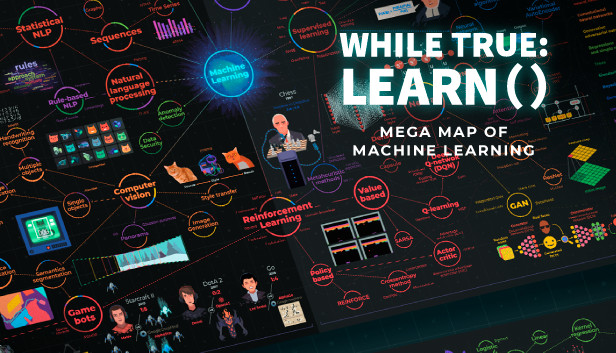
In while True: learn(), arrange visual components and connections to route data through puzzles and build a cat-to-human speech system. Its challenges draw on machine-learning ideas, from expert systems to neural networks.Steam player reviews: 91% positive from 7,397 reviews.English is supported as an interface language on Steam PC.The Steam PC version has full controller support.
Credits
Developer
Luden.io
Publisher
Luden.io
Steam player reviews
91%positiveVery Positive7,397 Steam reviews
Lowest recorded in 36 months
$5.682026-07-30 · KKinguinBase game · same records as the chart above; USD history, not a regional Steam low.
Language support
Language
Interface
Subtitles
Audio
Simplified Chinese
Yes
—
—
Traditional Chinese
Yes
—
—
English
Yes
—
—
Show 26 more languages
Language
Interface
Subtitles
Audio
Russian
Yes
—
—
German
Yes
—
—
Hungarian
Yes
—
—
Korean
Yes
—
—
Greek
Yes
—
—
Portuguese-Brazil
Yes
—
—
Polish
Yes
—
—
French
Yes
—
—
Italian
Yes
—
—
Spanish
Yes
—
—
Czech
Yes
—
—
Japanese
Yes
—
—
Spanish-Latin America
Yes
—
—
Turkish
Yes
—
—
Vietnamese
Yes
—
—
Arabic
Yes
—
—
Bulgarian
Yes
—
—
Danish
Yes
—
—
Dutch
Yes
—
—
Finnish
Yes
—
—
Portuguese
Yes
—
—
Romanian
Yes
—
—
Swedish
Yes
—
—
Thai
Yes
—
—
Ukrainian
Yes
—
—
Norwegian
Yes
—
—
Steam PC edition data · 2026-10-22
02Before you buy
Puzzle-driven learning
Solve visual puzzles based on machine-learning ideas, arranging objects and connecting them to route data. The description says no coding experience is required.
Controls and language
The Steam PC version has full controller support. English is among the supported interface languages; audio support is not specified here.
03Frequently asked questions
What is the game about?
You play a coder whose cat is better at coding, and build a cat-to-human speech recognition system through visual puzzles.
Do I need to know how to code?
No. The description says the puzzles use visual programming and require no coding experience.
What kinds of projects appear?
The described challenges include building a self-driving car and taking on the role of a startup CTO.
Popular Steam reviews
Native-language selection · 10 reviews
Selected helpful reviews in this language show both recommendations and criticisms. This selection does not represent the overall positive rating; opinions reflect the version reviewed.
RecommendedSteam player
Hi, Associate Professor in Software Engineering here.
I had hoped I could use this game to teach my children about programming, and while I will definitely recommend the game for its entertaining puzzles, I fail to see much connection to any of the traditional C-syntax programming languages, including Python, and even less in the way of teaching/showing the fundamental aspects of Artificial Intelligence, Machine Learning and Neural Networks, though it is advertised. As example, the “while True: learn()” title hints to the traditional C-syntax concepts of program iteration, boolean evaluation, and call to a function, but none of these are really present in the game and definitely not in a way, that you would be able to identify them unless you know them already.
When it comes to Machine Learning I do not see any relation to actual data processing, training and classification. A real-world predictive system would have no problems classifying a red circle from a green square when it has been trained with those exact shapes and colors. The real “fun” would have happened if it had to classify a purple star instead.
Furthermore, processing time and transmission speed are major elements in the game, but are not given the credit to their importance in real world applications maybe because they are not tied directly to Machine Learning. I am really lacking a way to track transmission speed in the designs I make in the game, especially as it seems to be very important for the “startups” puzzles.
In short, I will recommend the game for its puzzles, but the talk about demonstrating programming and Machine Learning principles I classify as “hot air marketing speech”.Show moreShow less
18.2 hours at review1,785 people found this helpful
Not recommendedSteam player
I love programming games. Sadly, this is not a programming game. I struggle to even call this a puzzle game when so many of the levels are putting a single piece in the middle of the board and connecting its ins-and-outs to the board.
Buying better hardware means you'll run the same solution you had on an earlier level and upgrade from a silver star to a gold star - not because you made anything better, but just because "your computer is now faster".
Levels randomly restrict which nodes you can use so while they added the ability to reuse your solutions from previous levels, odds are that level used a node you're not allowed to use and you'll just have to do everything from scratch. Except for that one level where it forces you to use a previous level's solution.
Late game pieces are not fun to play with - because the game grades you on "processing time" you get faster pieces with small error chances. The game expects you to briefly hook these up to your system with an extra "gradient descent" node to "teach it", but once you do this, just copy that node to all the places you need it to avoid "retraining" them.
The worst offender is, sadly, the driving simulations levels. They claim to use a genetic algorithm to evolve the AI. The solution to all of them is to just click the evolve button once and everything's done. Each level adds more sliders which tune the way in which your AI evolves - but you just ignore them and click the evolve button. Later levels add side-facing LIDAR so your car's AI has more information about when you pass another vehicle! Except this only confuses the poor AI and removing the side LIDAR solves everything.
I played it to the end to try and see what it had to offer. I'm sad to say that past the first hour or two, you'll have seen everything of value in the game.Show moreShow less
9.9 hours at review269 people found this helpful
RecommendedSteam player
Started as a simple game to kill time, 3 hours later I'm diving into articles on how to improve ANN.
Great game mechanics, simple to get you started, hard to get it mastered, easy to get hooked on Machine Learning!
Also, great graphics. Smooth 60fps on any PC =pShow moreShow less
16.2 hours at review196 people found this helpful
Written during Early Access
Not recommendedSteam player
The programming in this game is only present in its theme. You will not learn anything about machine-learning, programming, or algorithms. Watching the shapes fly past can be satisfying, but this game heavily boasts that it teaches machine-learning. If it didn't pretend it was more than a shape-sorting game, I probably wouldn't be leaving a negative review.Show moreShow less
7 hours at review265 people found this helpful
RecommendedSteam player
TL;DR It won't make a Data Scientist out of you, but it's still pretty fun :)
Let's start by talking about what this game won't do (despite promises by the developers on the contrary):
- It won't teach you new coding concepts.
- It won't "keep you brain busy". At least not more than any other game that requires minimal planning
- It won't improve your problem-solving skills
- It won't teach you machine learning, neural networks, big data and AI (at least not directly)
Now let's talk about what the game can do:
- It can give you some starting point from which to start reading and learning about machine learning and AI.
- It can teach you a bit about logical thinking (as can any similar game, for example any Zachtronics game).
- It's fun
I would say this game teaches you about machine learning, as much as a Civilization game teaches you about world history.
It may motivate you to learn on your own.
You may learn some by reading the text description and expecially following the "further read" links shown.
But the game itself (solving puzzles) won't do anything in that regard.
All in all, as fun as any Zachtronics game, and as educational.Show moreShow less
8.3 hours at review186 people found this helpful
Not recommendedSteam player
This is not a true logic/programming/puzzle game, not in the same way any of the Zachtronics games are, or things like 7 billion humans or their games.
This game involves a lot of trial-and-error of swapping inputs and outputs around, hoping the right number comes out. All you ever seem to be doing is sorting shapes and colors and that's it. Each 'puzzle' is started by request in email form from some meme/joke/parody account, all with the grammer and spelling of a LOLcat (one time literally) or nigerian prince.
I think the two things that killed the game for me is the upgrade system and the 'DLL' system.
1) The upgrade system lets you actually upgrade your parts so that things move faster, process faster, etc. In my opinion, you can never have viable puzzles if you can just upgrade your way past them, and it raises the question "Can I only gold medal this once I get more upgrades? I can't solve this correctly yet?" There are a lot of puzzles I got silver on. If I progress further and upgrade further, I'm quite sure that same exact solution would then get gold.
2) The 'DLL' system is a pretty neat idea that absolutely murders the game, once you realize what it does. At the main mission table, you can create what is called a 'DLL' file, which is basically just a module with a set input, set outputs, and set modules inside it. Then you can place that in your puzzles as its own little module alongside all of the prebuilt ones. This is supposedly for convenience, but it's not. The internal workings of a DLL are instant, so there is zero delay going through the DLL, meaning these are required, not a convenience. I re-edited a number of puzzles to use DLLs instead of my solution by slapping the already existing solution into a DLL, and increased my ratings across a lot of puzzles. I did no more logical work or puzzle solving, I just slapped my solution in DLL wrapper.
So after a while, I got stuck on a puzzle, hit the internet, saw a steam post asking for help, and the dev said "Visit our discord for help!". Joined discord, found a lot of complaints similar to the above, never found any help, lost interest, uninstalled.Show moreShow less
2.6 hours at review258 people found this helpful
RecommendedSteam player
Funny thing, that as a developer, I took a break from coding to play this game, which is basically coding.Show moreShow less
1.4 hours at review96 people found this helpful
Not recommendedSteam player
I spent seven hours getting to the end of this game, and I'm of mixed feelings about it.
At its core, While True Learn is a puzzle game: given bins of input objects (red/green/blue circles/squares/triangles), move them to the output bins that want them (like, one bin might want red circles and blue squares). You do this by building a flowchart made of conditional blocks: a "Decision Tree: Color" can send one color to the top output and another color to the bottom output (the third color is sent randomly to either output), a "SIFT" sends one shape to the top and the other two shapes to the bottom, a "MARK-1 Perceptron" can divide the colors across its three outputs but requires training (and misidentifies some objects), and so forth. The challenge is to send the inputs to the correct outputs using a minimum of blocks and within a time limit, so you may have to spend some time optimizing your approach.
At the same time, though this game is all about machine learning. "Learn how machine learning really works!" says the game's blurb, and the puzzle descriptions sound right up this alley. Predict a presidential election! Sniff out industrial espionage! Optimize roadway traffic! Write a chess bot! Recognize UFOs! The blocks you use all are named after real-world machine learning algorithms and have similar strengths/drawbacks. As you progress through the game and are introduced to new kinds of blocks, the game provides you with links to Wikipedia articles and YouTube videos explaining them and their history.
Problem is ... none of that actually has any bearing on the puzzles, which are still only about moving red/green/blue circles/squares/triangles from input bins to output bins. Whether you're identifying viruses or writing a movie rating system, you wouldn't know it from the puzzles themselves, which all look the same. Some of the puzzles (even in later levels) are trivially simple; others are too complicated to be fun. The only puzzles that really stand out are the ones about teaching a car to drive by writing a solution for it and adding LIDAR to the front and sides, but these still confused me - the car would accelerate until it rear-ended someone and then it would tailgate that car until the test was up, at which point I'd usually get a passing grade because the car's average speed was above the requirement.
On top of this are a strange array of features. You can buy hardware upgrades (after which simply re-running your earlier solutions can make them finish faster and get you more points), decorations for your office (the menu screen, which you don't spend much time on and you can only display a few decorations at a time anyway), and different kinds of cats (I didn't understand that at all). You can invest in startups, which means writing a solution for them and then clicking "Next Day" over and over again until the company stops making money. You can unlock "DLLs," which appear to be a way to re-use your previous solutions (I never used these because it was easier to write each solution from scratch), and "CatHub repos," which are just a notepad where you can try different approaches. There appears to be a well-developed "secret code" system where you can enter codes and unlock cosmetic items in the game.
All in all, it's really uneven. This could have been a much more fun puzzle game if it had focused on the puzzles, or it could have been a much more educational game about machine learning if it had made the puzzles resemble real-world problems. (Think of Kerbal Space Program.) It's enjoyable, but I don't think it stands out. This game teaches machine learning as well as Civilization teaches politics - which is not at all; you only get to use the end results. There are better puzzle games out there, and there are better simulator games.Show moreShow less
7 hours at review237 people found this helpful
RecommendedSteam player
On first glance this is just another program algorithm" game. However, once you get into it, the solutions become increasingly complex and you will accidentally learn things. What I like most are the links to YouTube videos and websites to learn more about the math behind it all. I haven't finished the game yet, so I can only hope it will get increasingly more complex and the goal for the game (teaching people machine learning) will be fully achieved. The cheeky story behind it all is a cherry on top of it all.Show moreShow less
8.3 hours at review82 people found this helpful
Written during Early Access
Not recommendedSteam player
Pros:
- The graphics and sound are clean. The production quality feels high.
- The visual editor for solving puzzles is easy to use. It's also easy to use solutions from past puzzles as nodes in your current solution.
- The game gives useful links to those interested in learning more about machine learning.
Cons:
- After a short time, the puzzles become very uninteresting. Most of them fall under the "load balancing" category, which means that you spend most of your time figuring out how to allocate output symbols to output streams to match the volume dictated by the puzzle.
- The test run does not always terminate when the test is unsolvable, for example if all inputs have been sent to output streams, but the current accuracy and / or volume in the streams is not adequate. In these cases, if you want to see what went wrong, you will have to wait for the test to time out until you can view the stats for each output stream. This is annoying in combination with the prior point, when you are trying to debug which stream is getting too many nodes so that you can balance the output.
- Most of the machine learning concepts introduced in the game end up being irrelevant to the puzzles. In particular, the reinforcement learning puzzles and RNN puzzles don't let you use the ideas to come up with clever solutions. The RL puzzles give you a lot of knobs to play with, but the puzzle doesn't require anything other than sending some inputs to the output stream. The RNN puzzles give you the idea of RNN, but don't allow you to connect the nodes in any interesting or meaningful way: each node has memory, but you are forbidden from doing anything with it other than feeding it back into the same node that produced it.
Overall I don't recommend this game. The puzzles stop being interesting very early, and those that attempt to introduce more complicated machine learning topics avoid the hard task of introducing it in a way that the user can learn about the topic via the puzzles.Show moreShow less
12.4 hours at review156 people found this helpful
Source: original Steam user reviews. Helpful votes are an archived snapshot, not live data. Last collected: 08/15/2026.





 Kinguin, it is available at the site's recorded low for this game. You can use a controller thanks to full controller support, and the description says no coding experience is needed. Its Steam player rating is 91% across 7,397 reviews. At $12.99 on Steam, this offer at