
























Opening
Few games have ever lived up to their title with such cruel precision. Wolcen: Lords of Mayhem promised mayhem, and on launch weekend it delivered — just not the kind anyone wanted. The mayhem came from the servers, which folded a day after release and stayed down for the whole weekend, locking even solo players out of a buy-to-play game they had every right to grind alone.
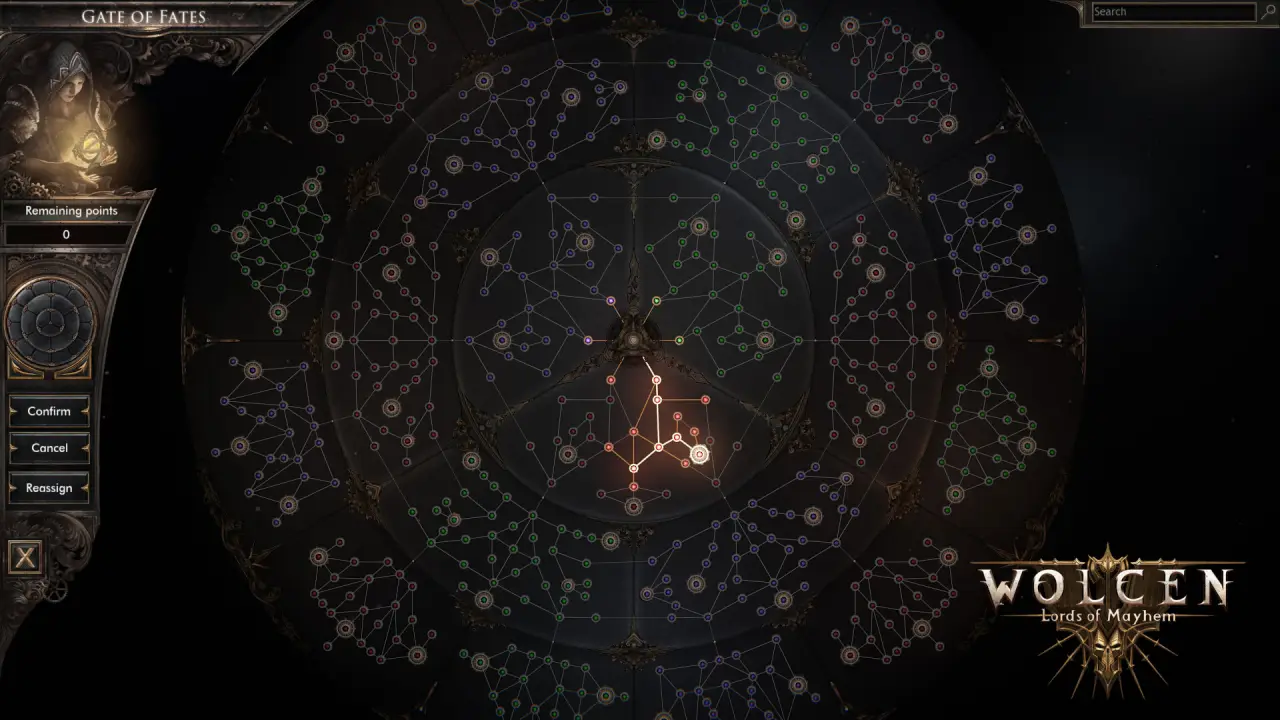
And yet writing it off as another broken cash grab misses the one thing WOLCEN Studio genuinely got right. The Gate of Fates — three concentric rings that each spin independently — does something no rival had tried: it turns build-crafting from picking nodes along a fixed line into a rotating puzzle you solve yourself, aligning rings until a build nobody designed snaps into existence.
So the question this review wrestles with is not whether Wolcen is good. It is messier than that. When a clever skeleton wears badly-tuned flesh and still sells a million copies in its first month, how should we remember it — by the weekend that crashed, or by the wheel that spins? Wolcen earns a serious post-mortem precisely because it nailed having ideas and botching the execution at the same time.
Story | 4.5/10
Story: 4.5/10Wolcen has a good stage and no storyteller standing on it. The campaign is the weakest of the six dimensions here, and it is weak in the saddest way — by neglect rather than incompetence.
A gothic opening that the rest of the campaign cannot keep

The setup has real bite. You serve the Inquisition, sent to purge a continent torn apart by Corruption, peeling back forgotten horrors as you go. That grim, gothic mood carries an old early-Diablo chill, and the first act — your order's collapse, the first bloom of Corruption — is the most charged stretch of the whole game. Comrades fall, faith curdles, and you tumble from enforcer to fugitive. It is the kind of opening that could have anchored a story worth finishing.
It cannot hold. Past the first act the plot loses its grip fast: motives blur, the villain never quite stands up, and by the back half the seams of a rushed finale show plainly. Four years of development went somewhere, and it clearly went into systems rather than into landing a narrative. You will probably forget why you are fighting long before you forget how many items you have farmed. For a game that hopes to pull players in with its campaign, that is a structural failure, not a stylistic one.
What makes the slump sting is how much groundwork the opening lays and then abandons. The Corruption is a strong central conceit, a rot that could have grown more personal and more horrifying with every act, but the writing never compounds it. Threads that promise a payoff — the collapse of your own order, the nature of the Primordials, the price of the power you keep absorbing — get raised and then quietly dropped, as if the script ran out of budget at the same time the art team was still cranking out spectacle. The result is a campaign that peaks in its first hours and coasts, then stumbles, the rest of the way to the credits.
Choices that change nothing, and a transformation that says nothing
Wolcen carries no real branching and no multiple endings. The "choices" you make barely nudge the tale; this is not The Witcher, where a decision boomerangs back forty hours later. Replay value therefore rests entirely on builds, never on story. You will roll a fresh character to test a new Gate of Fates path — never to glimpse a different ending.
The deeper waste is dramatic. Awakening an Aspect and unlocking Apocalyptic Form should be a peak moment, the sort of beat a writer kills for. Instead it is a pure mechanical unlock. The screen erupts as you become a Primordial, yet the story registers nothing — it is one more skill slot, no more. Mechanics and narrative simply divorce here, and the instant most likely to make a player feel something is left feeling only powerful. That divorce runs through the whole design philosophy: whenever a choice arose between feeding the systems and serving the fiction, the systems won, every time.
It is a shame, because the raw ingredients for stakes were all on the table. A fallen holy order, a corruption that spreads, a hero who grows more dangerous the more power they swallow — that is a recipe for moral unease, for a player who second-guesses their own escalation. Wolcen never cooks it. The escalation is only ever a number going up, and the corruption only ever a backdrop, so the campaign asks nothing of you beyond clicking the next pack of enemies to death.
Serviceable text, a tale served once
Localisation does the prose no favours either. The official translations are serviceable and you will never lose the thread of the plot, but skill and interface wording drifts into ambiguity often enough that immersion keeps snagging on a sentence you have to re-read. Just when the corrupted continent has you under its spell, an unparseable tooltip yanks you back out, and it happens more than once.
Against Path of Exile — a rival whose plot is also no selling point — the gap is instructive. Both are looters that do not live or die on story, yet one treats its tale as a cup it keeps topping up with league narratives and scattered lore, and the other whisks the cup away the instant the credits roll. A 4.5 is not the mark of a bad story. It is the mark of a game that barely tried to tell one, and you can feel the wasted potential most in that gripping first act — proof Wolcen could have done better, had anyone been minded to.
Audio | 6.5/10
Audio: 6.5/10Wolcen's soundtrack is a clocked-in shift: everything that should show up does, and not a single track follows you home.
Epic strings that set a mood but leave no melody behind

The score works the standard epic-symphonic seam — strings underneath, brass for the swells — and it props up the gothic, end-of-days fatalism well enough. Crossing the corrupted continent or kitting out at the Stormfall hub, the music does press you down into that cold world. What it never manages is a hook. Dozens of hours in, you cannot hum a single theme back. It serves the atmosphere and forgets the memory, and that exact line is what separates competent scoring from the real thing. The best ARPG soundtracks give you a signature motif you carry out of the game; Wolcen gives you a mood that evaporates the moment you alt-tab, and not one bar that survives the session.
English voice work covers the main dialogue, and it is professional in the dullest sense — skilled, soulless, never once memorable. No character's delivery sticks, and the cast reads lines rather than plays people. Given a story that already cannot stand on its own legs, with barely a character whose name you will retain, the actors have little to work with. The result is a feedback loop of mediocrity: thin writing starves the performance, and the flat performance leaves the thin characters paler still. You finish the campaign unable to recall a single line of dialogue, which for a game with full English VO is its own quiet indictment.
Combat thuds land, ambient design quietly fails
If anything in the audio deserves a solo bow, it is the combat. CRYENGINE earns its keep on impact: the crack of a weapon biting into an enemy, the burst of a skill connecting, and above all the roar of the Apocalyptic Form transformation all hit with genuine weight. That tactile, satisfying punch is the invisible engine that keeps a looter loop turning, and Wolcen nails it. There is a reason you keep swinging — the sound tells you, every time, that the swing landed, and in a genre built on repetition that feedback is worth more than any sweeping orchestral cue. Wolcen understood, at least, that a looter is felt through the hands and the ears before it is felt anywhere else.
The trouble is the silence between fights. Ambient design is flat, dungeon and overworld soundscapes blur into one another, and long farming sessions sink into a dull aural fatigue. In a game built on grinding the same kinds of spaces for dozens of hours, ambient sound should be the first line of defence against tedium — and Wolcen leaves that post empty. Set it beside Diablo III, whose layered effects, beefed-up crit feedback, and sharply distinct zones still set the genre's bar, and Wolcen only reaches the edge of that standard on the strike sound alone. A 6.5 is the honest split: the swings feel great, and everything around them merely passes muster.
Visuals | 7.5/10
Graphics: 7.5/10Visuals are Wolcen's high-water mark, and the truest measure of what this small studio could pull off: a big-budget look conjured on a fraction of a big-budget purse.
CRYENGINE muscle, indie price tag
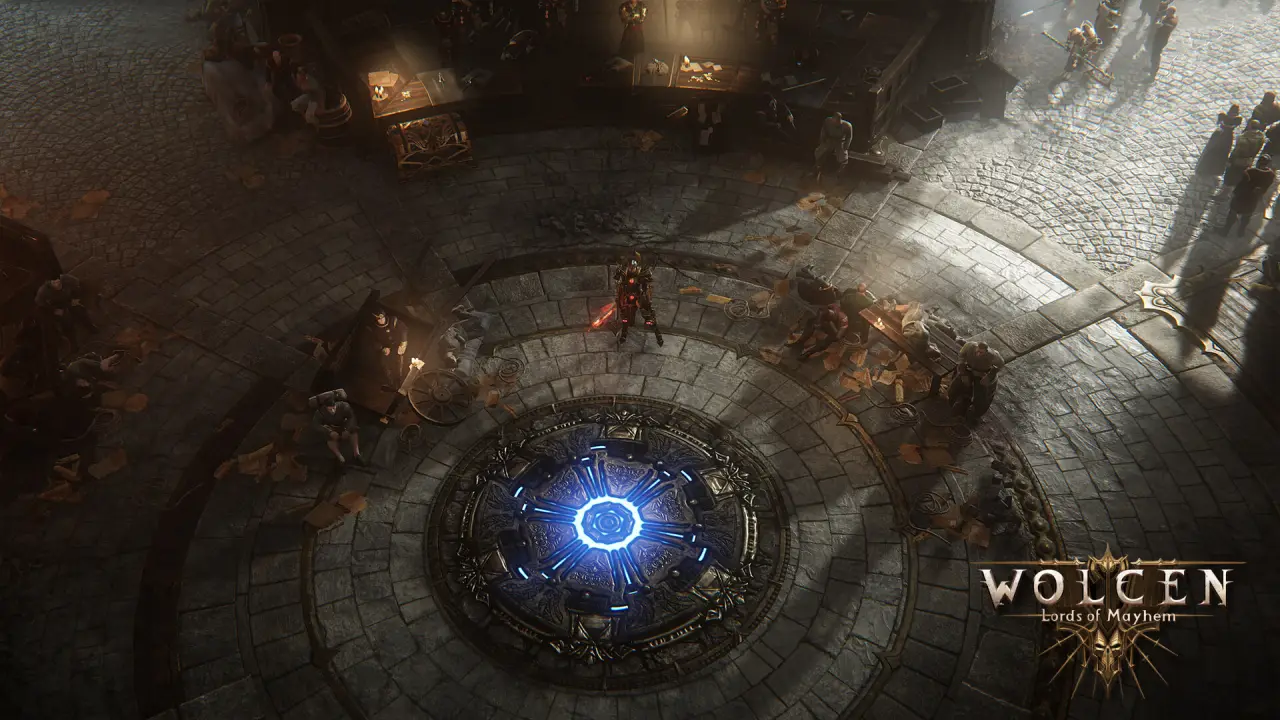
Wolcen runs on CRYENGINE, an engine famous for spectacle and rarely chosen in the looter space, where most studios trade gloss for frame rate with lighter in-house tech. The price is brutal optimisation; the payoff is plain on screen. Material detail, dynamic lighting, the particle storm of a skill going off — all of it sits at the top tier of indie ARPGs. Plant yourself on a corrupted plain, throw out an area spell, watch the screen tear open with fire and energy, and the presentation genuinely impresses. It is the rare looter where you might actually pause to look at what just happened rather than immediately scanning the floor for drops.
And this is not a beauty propped up by a handful of polished cutscenes; it lives in every second of actual fighting. Hit feedback, the way enemies come apart on death, the scorch the ground keeps after fire and energy wash over it — all of it carries weight and texture. For a game whose visuals you will stare at across a hundred hours of similar scenes, that "every thrown skill looks good" foundation is the most concrete asset it owns. An independent team grinding the moment-to-moment combat to this polish is, frankly, something to respect.
The Apocalyptic Form transformation is where the engine flexes hardest. Fill the Primordial Essence meter, press the key, and your character erupts into the chosen Primordial's shape — a piece of art design with high recognisability and real punch. It is one of the rare places where Wolcen wins on both mechanic and spectacle at once, and every transformation quietly reminds you that the artists and effects team behind this game had genuine chops. Few looters this size manage a signature visual moment; Wolcen has one, and it earns it.
Reused maps, a hostile interface, and an engine that bites back
The art direction is gothic-realist end-times, and it lands: the torn continent, the gloomy dungeons, Stormfall as a late-game seat all carry atmosphere. The catch is repetition. Deep into the grind you keep bumping into layouts and assets you have seen before, and that same-soup fatigue slowly thins the early awe. It is a looter-genre disease, but Wolcen's level variety is genuinely below par, and the contrast is sharpest precisely because each individual scene is so handsome — you notice the recycling more when the parts being recycled looked this good the first time. A richer pool of biomes and set-pieces would have let those visuals breathe instead of looping.
The real liability is the UI — overloaded, muddled in its hierarchy, and worst of all on the very Gate of Fates wheel that headlines the game. Three rings crammed with nodes you align by spinning; just parsing "which ring do I rotate now" turns away newcomers in droves. A game that sells build freedom should not bury the screen that displays builds, and yet here it does — a design contradicting itself.
A gorgeous face and a heavy tax
Optimisation pulls the same self-defeating trick. CRYENGINE hands Wolcen a gorgeous face and a punishing performance bill, and at launch crashes, frame drops, and high VRAM use were common enough that weaker rigs could not hold a steady line. The contradiction is almost poetic: the best-looking game in its corner of the genre is also one of the hardest to run in it. No amount of material fidelity survives a slideshow or an outright crash to desktop, and early adopters paid the price in both.
Patches later eased the worst of it, but the launch-window damage was already booked. A 7.5 docks nothing for how the game looks — on a still frame it is stunning — and everything for how unstable those frames could be and how unfriendly the menus remained. Compared to Diablo IV three years later, Blizzard's nine-figure budget bought higher, steadier fidelity, yet Wolcen reached a comparable look earlier and on pocket change, and that value-for-money is honestly the thing to celebrate. Beauty was never Wolcen's problem; holding that beauty steady, and letting players actually navigate it, was.
Combat | 6.0/10
Gameplay: 6/10Gameplay is Wolcen's soul and its most maddening contradiction at once — clever enough to make you sit up, sloppy enough to make you throw the mouse.
The Gate of Fates turns build-crafting into a puzzle

The Gate of Fates is Wolcen's one truly irreplaceable idea. It is not a linear talent tree but three concentric rings that each spin on their own — the inner split into 3 segments, the middle into 6, the outer into 12, every layer themed around archetypes from soldier to sorcerer. The genius lives in that rotation: turn a ring and nodes that were never neighbours line up into a fresh path. Building a character stops being a multiple-choice quiz down a fixed road and becomes a jigsaw you assemble yourself.
What makes it sing is that it hands the authorship back to the player. A poison war-hammer or a lightning archer is not born because some branch happened to grant the right bonus; it is born the instant you spin three rings into alignment — a combination space the developers themselves may never have charted. In the looter scene of early 2020, that was a design language genuinely Wolcen's own, and nothing has quite copied it since.
There is a tactile pleasure to it, too, separate from the theorycrafting. Rotating a ring and watching a previously dead node suddenly bridge into your path feels less like spending points and more like cracking a lock. The early hours of experimentation, before the meta calcifies, are the most purely enjoyable stretch of the whole game — a sandbox of "what if I connect these two" that few rivals offer in such a hands-on form.
If Wolcen had only protected that promise downstream, it would be remembered very differently. The wheel is the kind of idea other studios should have stolen by now, and the fact that nobody has is part flattery, part warning: brilliant on the whiteboard, brutal to balance once a thousand players start torturing it for exploits.
Classless freedom and a dual-resource rhythm
Wolcen drops the class concept entirely: your weapon dictates which skill types you can use, so swapping a weapon swaps your whole combat logic, and no class label ever fences your progression in. Paired with the Gate of Fates, that freedom rivals main rival Path of Exile on paper. Nothing ever pops up to tell you "a mage cannot do this" — only your gear and your spun-up nodes set the rules, and that openness is genuinely liberating in the early hours when anything still feels possible.
The combat feel adds another clever wrinkle — the Resource Opposition System. Two bars tangle together: purple Willpower and yellow Rage, filled by hitting with melee or with a staff respectively, and spending one slowly refills the other. Skills draw on each, so you are pushed to cycle between rage-building and willpower-spending in a dual rhythm with more texture than the single-resource competition. Rather than mash one ability until a cooldown blinks, you are nudged into a back-and-forth — spend Rage, bank Willpower, swing back — that keeps your hands busier and your attention more engaged than the genre's spam-one-button norm. Tuned well, it lifts the combat a clear tier, and for the stretch before the meta hardens, it genuinely does.
The burst that broke the math
Then the imbalance arrives and collapses all of it. The Apocalyptic Form — fill the Primordial Essence meter by killing, hit R, become a Primordial and unload — is the burst payoff, a visual and tactile high and also the single most broken number in the game. It launched absurdly strong, forcing the 1.0.4.0 patch to land "a huge nerf," and got re-tuned for months after. That same imbalance is the rock dragging gameplay down to a 6.0. The very problem GameSpot named in its 4/10 was build viability: a handful of broken builds white-screen the room and clear a pack in an instant, while the overwhelming majority can't keep pace. The "freedom" the Gate of Fates promised collapses in practice into a binary — copy the broken build, or struggle to kill anything. A game that sells build freedom strangles it with its own numbers, and that is its cruellest irony. The wheel invites you to invent; the balance sheet punishes you for inventing anything off-meta. Spend an evening spinning rings into a poison hammer you are proud of, take it into a high-difficulty run, and watch it bounce off enemies a copy-pasted lightning build would have vaporised — that gap between what the system promises and what the math allows is the whole tragedy in miniature. Against Path of Exile, the Gate of Fates reads far friendlier than that spiderweb passive board, but on depth, balance, and the maturity of long-term support, Wolcen still trails by a wide margin.
The co-op layer compounds the picture rather than rescuing it. Wolcen supports online multiplayer, and grinding with friends does smooth over some of the early roughness, but it also drags the very server fragility that wrecked the launch straight into your living room. When the build sandbox is at its best — three of you spinning wildly different Gate of Fates loadouts at the same pack — the game flashes the co-op looter it could have been. When the connection hiccups or one player's broken build trivialises every encounter, it flashes the unbalanced mess it usually is. The 6.0 is the average of a 9-point idea and a 6-point execution, and almost every hour you spend with it swings between those two poles.
Content | 6.5/10
Content: 6.5/10Wolcen's content is the tale of a thin launch slowly backfilled by free updates — a stingy start, but a studio that, to its credit, did not run.
A short campaign and an endgame that arrived late
The main path is brief — HLTB puts the median run near 17 hours — and front-loaded, the first act taut and everything past the third visibly rushed. In a looter, the campaign is really just the tutorial before the endgame, and the endgame is what decides whether you stay. Wolcen leans on two pillars: the Champion of Stormfall hub, where you sink resources into upgrading the town and unlocking output, and the Endgame Operations loop added in the 1.1.7.0 "Chapter IV: Endgame" update, which supplies repeatable high-difficulty runs. Patched and polished, that endgame finally cohered and handed hardcore farmers a long-term goal.
The launch wound, though, was a shallow loot pool, called out by PC Gamer and others. The core thrill of a looter is the gambler's pull of "one more run, maybe the godly drop lands," and the moment the pool runs shallow and affixes thin, that "one more" drive is anaemic by birth. You farm, you find little worth coveting, and the engine of the genre quietly stalls. For a game whose entire downstream loop depends on chasing upgrades, a thin pool at launch is not a cosmetic flaw — it is a hole in the floor.
Worse came the economy disaster. An item-duplication exploit plus runaway gold output broke the in-game economy within days. A looter's most valuable asset is scarcity — gear excites because it is rare, gold matters because it is hard-won — and Wolcen leaked that scarcity away in week one, flooding the world with copied top-tier gear while honest farmers watched their effort lose all meaning. The damage runs deeper than any crash, because it shakes the foundation a looter stands on; it is exactly why Bloodtrail later had to reset the whole economy rather than balance atop a polluted one. Few wounds a looter can suffer are more existential than the loss of scarcity, and Wolcen suffered it before most players had finished the campaign.
The endgame that grew up in public
The Champion of Stormfall hub and the Endgame Operations loop deserve a closer look, because they are where Wolcen quietly clawed back respectability. Stormfall lets you pour resources into a town that gives back — upgraded production, unlocked services, a tangible sense that your farming compounds into something. Endgame Operations, bolted on in Chapter IV, supply the repeatable, escalating runs a looter needs to justify a build you spent dozens of hours assembling. None of this existed in a satisfying state at launch; all of it arrived and matured through patches. A player arriving today inherits an endgame; a player who bought on day one watched it being built around them, often with the scaffolding still showing. That difference matters enormously for how you should judge the game in 2026 versus how reviewers judged it in 2020. The launch critics scored a game whose endgame was a promise; you would be buying a game whose endgame is a delivered, if modest, reality. It is not the deepest loot loop in the genre — it cannot touch Path of Exile's sprawl of maps and mechanics — but it is a real, repeatable reason to keep a character alive past the credits, which is more than the launch build could honestly claim.
Free updates, an honest price, and a bigger plate than it could carry
Here Wolcen earns real praise. It is buy-to-play, no microtransactions, and every major update since has been free. The first milestone, Chronicle I: Bloodtrail, reset the exploit-poisoned economy and dumped more than 120 fresh nodes into the Gate of Fates — the studio's "fix it first, then build" promise made good, and a genuine expansion of build space. Stack that pricing against the genre's paid DLC, season passes, and cash shops, and the generosity is obvious: you pay once, and the content that follows costs nothing more. Set beside the similarly-sized Torchlight II — both lean, single-player-minded looters — Wolcen reached for far more, a deep Gate of Fates construction system, a hub, a long endgame loop, but landed rougher, much of it rounded out by patches after release. Torchlight II carried a small plate steadily; Wolcen hoisted a bigger one and spilled plenty on the way. Neither approach is wrong, but Wolcen's road was always going to be bumpier and harder on a player's patience. The 6.5 is what you get when ambition, a thin launch, and genuinely generous updates pull against each other — judged on launch alone it would not earn the grade, but fold in a year of free updates, a reset economy, a hundred-plus nodes, and a finished endgame, and 6.5 is the fair read of a curve that started shabby and ended passable.




Comments 0
Share your game review
Join the discussion and share your review of this game.
No comments yet. Share your thoughts on this review.