






















Opening
Some betrayals only count when your own hand pulls the trigger.
A Way Out spends six hours teaching two friends how to move as one body. One of you keeps watch while the other works the lock; one of you scales the wall while the other waits below to catch the fall. You dig the tunnel together, you cast a fishing line together, you lean out of a speeding car together and spray the road behind you. The game trains your trust shot by shot, scene by scene, until handing the controller's worth of faith to the person beside you feels like muscle memory. Then, in the last half hour, it tears the whole thing down — two health bars, one rooftop, and the man you broke out of prison with becomes the boss you have to kill bullet by bullet. There is no cutscene that does this to you. You do it to yourself.
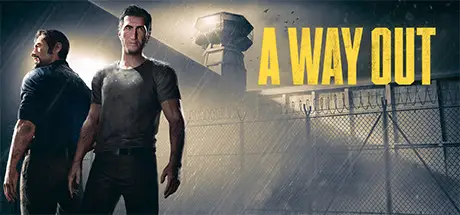
This was Hazelight's answer in 2018. Director and writer Josef Fares took three and a half million dollars from his publisher and a team of roughly thirty-five people, and built a prison-break movie with no single-player mode — a game that simply does not start unless two real human beings sit down together. The faces are stiff, the textures are a generation behind, and the individual mechanics are barely deeper than a box of minigames. It still walked off with the BAFTA for Best Multiplayer, still sold north of thirteen million copies, and to this day nothing else has reproduced the exact ache of its final scene.
So the question this review answers is a narrow one. When a game ties its mechanics and its emotions to the same fuse — when it makes you trust on purpose just so it can make you destroy that trust — is it worth pulling a friend onto the couch for a run that someone is not coming home from?
We will take it apart one piece at a time: story, sound, visuals, play, content, and the final verdict.
Story | 9.0/10
Storia: 9/10Two convicts, one escape that was always going to end in a funeral
It is 1972. Vincent is inside for fraud and murder; Leo has been doing months for robbery, assault, and a list of charges that runs long enough to explain the chip on his shoulder. They meet behind the same walls, bound by a shared target named Harvey, and they break out the only way the game will allow — by needing each other. They pick locks, dig through concrete, push a wheelchair past hospital orderlies in plain disguise, and finally go over the fence on a night loud with rain. For the first two hours this is a clean genre piece, and you trust your partner because the design leaves you no other option.
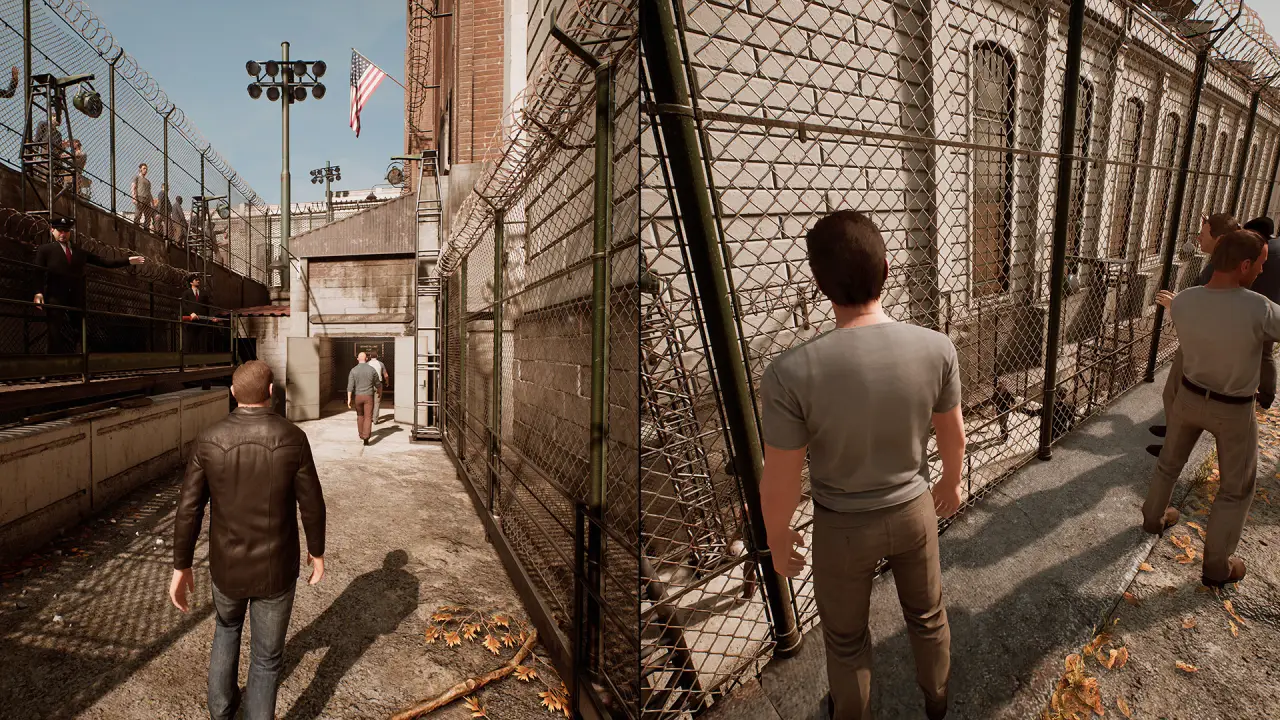
That coercion is the point. Half the actions in any given room are impossible alone — someone has to hold the vent while someone else slips through, and the two halves of the split screen are forever glancing at each other to stay in sync. Fares is laying foundation here, and he knows exactly what he is building toward: he wants you to treat the man on the other couch as crew on the same sinking ship, lashed as tightly as the rope will hold. The tighter the knot, the deeper the later cut goes. Leo and Vincent are not especially three-dimensional for most of the runtime — one reckless, one calculating, the contrast drawn in thick lines — but that flatness reads as deliberate negative space. You and your friend pour yourselves into the gaps.
A diamond deal and the reveal that flips the whole table
Breaking out is only the opening act. The hunt for Harvey leads, eventually, to a deal over a notorious black diamond, and right at the moment you expect a revenge story to pay off clean, the game flips the table.

Vincent, it turns out, was a federal agent the entire time, and so was the woman waiting on the outside — the diamond deal a sting, the whole partnership a long con run on Leo to reach the real prize. You broke out beside this man, you put yourself in harm's way for him, you trusted him for six straight hours, and he was the one sent to put you away. What gives the twist its weight is not the writing, which is honestly a little hoary; it is the fact that it detonates between two real people. The friend who was slapping your palm a second ago is suddenly your adversary, and neither of you scripted that.
One critic nailed the mechanics of it: for the last half hour the game "brilliantly shapeshifts from a cooperative game into an adversarial one," each player holding a health bar the other whittles down until you become the final boss of your own partner's playthrough. This is the same authorial instinct that drove Fares' earlier Brothers — teach the player one grammar of play, then smash it in the moment they are most invested. The mechanic is the message; it always was.
The two endings, and the guilt the survivor carries home
There is no happy version of the rooftop. Two health bars, and whoever dealt more damage across the run is the one more likely to walk away — which means the ending is not handed down by a script. You shoot it out for it. Your aim, your hesitation, your half-second of mercy all get written into who is still breathing when the smoke clears.
If Leo wins, Vincent asks him to carry a letter to his wife, and the camera cuts to Leo reuniting with his family and driving off while, in the same beat, Vincent's funeral plays out. If Vincent wins, Leo crumples, and Vincent holds the hand of the partner he betrayed and watches him go, then knocks on the door to tell Leo's widow and gets thrown out of the trailer by a grieving family. Whichever path you take, the one left standing does not get off easy — he goes home to his own family carrying a body and a debt that will not clear.
You do not have to replay the whole thing to see the other version; reloading the final chapter is enough. Most players never bother, because the first ending already hurt plenty and a second viewing only sands the edge off. Detroit, released the same year, also trades in branches and choices — but Detroit's decisions are ultimately made by one person staring at a screen. A Way Out wedges the choice, and the dying, between two real human beings, and no amount of single-player elegance weighs that much.
Audio | 7.5/10
Audio: 7.5/10Wall-to-wall voice work, holding two screens together
A Way Out never wins you over with a swelling orchestral score; its heaviest lifting happens in the dialogue. Leo and Vincent talk almost without pause — bickering on the run, scheming over their target, trading the occasional unguarded confession in the dark — and that constant back-and-forth is the glue binding the two halves of the split screen into one journey. Your character is heads-down doing a task, but your ears are always tracking two voices crossing the gap, and the continuity of the whole production rests on that uninterrupted chatter. The second the pair goes quiet, the seam down the middle of the screen starts to show; it is the small talk that stitches the split back into a single road.

That lived-in texture is rare in a co-op story. This is not Uncharted 4, with its polished cinematic score and top-shelf performance capture papering every scene — three and a half million dollars simply does not buy that kind of indulgence. So the game takes the other road: two ordinary men talking in rough, real, occasionally clumsy cadences, the performance dialed down until it lands somewhere close to the actual distance between you and your friend.
You listen to them needle each other and recognize a hundred conversations of your own. The accents are uneven, the delivery sometimes lands a beat late, and none of it is the kind of work that wins an acting award — but it is precisely that roughness that sells the bond. Polished line reads would have made Leo and Vincent feel like characters; the scuffed ones make them feel like the guy holding the other controller. When the game needs you to believe these two men actually mean something to each other before it tears them apart, the voice work has already quietly done the convincing.
When the music becomes a button two people press together
There is one moment where the soundtrack stops being a soundtrack and becomes the game. The two leads sit down for a duet — one plays, one sings — and the pair of you carry a song from the first note to the last. As a mechanic it could not be shallower; there is no skill ceiling to speak of. But because it asks two living people to lock into the same rhythm and cover for each other's timing, the music stops sitting in the background and turns into a thing you made and remember together. It is the "shallow mechanic, anything-but-shallow experience" thesis of the whole game, replayed in the key of audio.
The environmental work pulls its weight on tension. Thunder cracking over a flooded prison yard and boots splashing through standing water; an engine's roar and shots skimming past the window in a chase; the metallic ring of rounds chewing into scaffolding during the construction-site shootout — each set-piece gets its own acoustic weather, and the mix shifts character fast enough that no two chapters sound alike.
And on the rooftop, the score finally turns the corner it had been hiding: away from the cooperative warmth it spent the whole game building, toward a tragic close with no triumphant fanfare, just a low register that presses the ache of the broken bond all the way down. There is no swell, no victory cue, nothing to let either player feel like a winner. The music here is never decoration. It is part of the telling.
Visuals | 6.0/10
Grafica: 6/10Look away from the faces: a generation behind on models and textures
Let us get the ugly part out first: the visuals are the lowest score on this card, a flat six, and there is no flattering angle on it. The game runs on Unreal Engine 4, yet the facial animation is stiff, mouths rarely match the emotion underneath them, and the environment textures sit roughly a console generation back. Just about everyone in the Chinese community who played it mentions the dated models in the same breath, and Gamersky's review names the problem without ceremony. Stand it next to a 2018 visual ceiling like Uncharted 4 and the gap is plain, naked, impossible to hide — the kind of gap you notice in the first cutscene and never quite stop noticing.

But the weakness has a clear lineage, and it does not deserve a lazy charge of corner-cutting. Three and a half million dollars and a team of thirty to thirty-five people is a featherweight in the triple-A co-op-narrative bracket, the kind of figure a major studio might spend on a single marketing beat. The real question is where Hazelight chose to spend it — and the answer is on staging and set-piece density, not on the physics of a single strand of hair. It is a clear-eyed trade, and an honest one to make. The studio knew it could not out-render the giants, so it poured its limited budget into the one place nobody else had bothered to go, and accepted dated faces as the price of admission.
The real visual lead is the split screen that keeps changing shape
If anything here belongs in a design textbook, it is not a single model. It is the dynamic split screen.

Most of the time the frame is carved cleanly down the middle, two parallel threads running side by side. The trick is that the division reshapes itself around whatever is actually happening: in a car chase the driver's view swells while the man leaning out to shoot gets squeezed into a narrow strip; at a key cinematic beat the two panes merge back into one full screen.
PlayStation Universe singled this out, noting that the split "shifts and changes depending on the action, and remarkably, it works almost every time." That last clause is the achievement. Plenty of games have tried dynamic split-screen and tripped over the moments where one player's framing strangles the other's; A Way Out keeps the seam legible through dozens of wildly different scenarios, and the camera always seems to know which player deserves the larger window. This is not a screen mechanically sawed in half — it is a camera language permanently in service of the story's rhythm, and it does more characterization work than the actual character models manage.
Outrunning the texture budget by changing the scenery
Scene design is the other half of the cover-up. Prison, hospital, construction site, highway, small town, docks — across six hours you are rarely parked in the same kind of space for long, and the constant churn of environments manufactures a steady drip of novelty. You never get close enough to a wall to clock how muddy the texture is, because you have already been shoved into the next, wholly different room.
The logic mirrors the game's whole philosophy: never dig deep into one point, always grab your attention with breadth instead. A handful of moments even land as genuinely striking despite the budget — the prison yard under sheeting rain, the headlights of a chase strobing across a dark highway, the washed-out dawn over the final rooftop. Composition, not fidelity, is doing the heavy lifting, and composition is cheap if you have a director who knows where to point the camera.
Across PC, PS4 and Xbox One the visual showing is close enough to call even, and there was never a dedicated next-gen edition. None of that matters much, because the game was never trading on its fidelity to begin with. You will remember the oppressive grey light over the rooftop duel; you will not remember the blurry brickwork — which is exactly what Hazelight was counting on.
Combat | 7.0/10
Gameplay: 7/10No single-player mode — its iron law and its entire identity
The first rule worth stating plainly about how A Way Out plays: there is no single-player mode at all. Local split screen or online, you have to find a second living person and stay in lockstep the whole way through. This is not a bonus checkbox; it is the bedrock the entire design rests on, because every set-piece, without exception, assumes two people acting at once. One keeps watch while the other picks the lock; one pushes the wheelchair in disguise while the other scouts ahead; one works the gas while the other works the trigger. Pull the second player out of the equation and the game ceases to exist — not as a metaphor, but as a literal fact of how it boots.
Friend's Pass softens the cost of that law considerably: as long as one of you owns a copy, the other gets pulled into the full online run for free, no second purchase required. One ticket, two seats. The system was generous enough that its spiritual successor, It Takes Two, inherited it wholesale — but the source of the idea is right here.
Mechanics as thin as minigames, an experience that is anything but
Be honest about it: pry A Way Out apart and inspect any single mechanic and it is shallow. The core interactions are mostly quick-time prompts, lock-picking, stealth wall-hugging, and the odd situational puzzle, none of which carry real depth that rewards practice. The lowest score among the major outlets was a six, and that is exactly the line it docked — "a unique, enjoyable adventure that has a number of problems." Another review flagged the controls as "a touch woolly at times," with the wall-adhesion in stealth segments refusing to cooperate often enough to break immersion.
And here is the paradox: drop those thin mechanics into a two-player context and the experience is suddenly not thin at all. Arm wrestling, Connect Four, horseshoes, balancing a wheelchair — alone, in front of a screen, they are pointless. Across from a real friend, they curdle into memories.
One critic went as far as saying that a single round of Connect Four produced "an unprecedented level of player connection." The depth was never in the inputs; it was in the person on the other end of the line. That is the quiet sleight of hand running under the whole game: it offloads the depth onto the relationship in the room, so the code only has to supply the occasion. A solo player benchmarking these mechanics against anything would find them hollow — which is precisely why there is no solo player.
Almost zero repetition — six hours carried on breadth
If the thinness of any one mechanic is the unavoidable weakness, the sheer variety of situations is the headline strength. The runtime almost never reruns the same idea: this chapter is digging a tunnel, the next is a hospital disguise, the next is crane-climbing, a window-leaning shootout, a lazy afternoon casting a line into a river. One moment you are reeling in fish; the next you are flung into a firefight with your torso out the window, the pacing surging forward and never doubling back.
Threaded through it all is a system of two-player votes: at certain junctions, you and your partner have to talk it out and jointly decide whether to take Leo's reckless route or Vincent's cautious one. These votes carry real weight; they genuinely reshape where you go and what you see next, and they double as tiny character tests for the two people on the couch — who pushes for caution, who itches for the loud option.
Set it against Portal 2, which deepens a single teleportation idea down into ever-trickier co-op puzzles, and A Way Out runs the opposite direction entirely — it never drills one well, it lays dozens of unalike experiences out flat and holds you with width instead of depth. Whether that breadth reads as generous variety or restless shallowness is the whole argument over this game, and your answer probably comes down to whether you are grading the mechanics or the company you are keeping while you push through them.
Content | 6.5/10
Contenuti: 6.5/10Six hours, paid out in density rather than length
The main path of A Way Out runs about six hours, and even if you sweep up every optional minigame and side interaction, the total struggles to clear ten. In an era where games routinely demand dozens or hundreds of hours, that figure looks conspicuously short. The most common note the Chinese community hands new players is exactly this: full price for a six-hour run is a value calculation you should make for yourself, eyes open, before you buy. It is a fair caution, and one the game does little to soften on length alone.
But what holds those six hours up is not length — it is density. Across thirty-seven chapters the set-pieces almost never repeat; every step forward swaps the mechanic, the setting, the mood. There is no padding fetch quest stretching the runtime thin. Every minute gets honestly filled with a fresh situation, and that short-and-dense shape reads far more like a tightly cut film than a game you are meant to slowly grind down. You never go bored in the middle, because the game never leaves a gap for boredom to settle into.
Put another way: six hours is close to the perfect length for this particular design. Run it longer and those already-thin core mechanics would start showing fatigue, and players would begin scrutinizing how shallow the play really is.
Because it wraps up fast and runs dense, your attention stays dragged along by the next set-piece, with no time left over to nitpick. Set its scale beside the marathon blockbusters and it is plainly walking the opposite road: they compete on how long you can keep playing, it competes on how full these few hours are. There is a discipline in knowing when to stop that most modern releases have forgotten, and the brevity is the closest thing this game has to elegance.
No paid DLC — but a buy-one-bring-one pass
There is no paid DLC of any kind here. The content is this one complete main path: no season pass, no expansion, no trickle of added chapters. What it has instead is something more useful than most DLC — Friend's Pass. One purchase lets you invite any friend into the full online run, and that friend never has to spend a cent. For a co-op game this is genuinely generous, and it is one of the quiet engines behind sales climbing past thirteen million worldwide, because buying it usually means dragging a second person in alongside you. One copy moves two players.
That pass also quietly rewrote how the game spread. A typical release has to convince players to pay one at a time; A Way Out only has to convince one, and the other gets carried in for free. Plenty of people met this game not by buying it but by getting yanked into a lobby by a friend — and that buy-one-mooch-one diffusion is the invisible motor behind a six-year climb that still has not stalled. The milestones tell the story plainly: one million copies inside two weeks, nine million by its sixth anniversary in 2024, past eleven the following spring, and over thirteen by 2026. Those are not the numbers of a flash in the pan; they are the numbers of a game that keeps getting handed from one player to the next.
It is worth weighing all of this honestly rather than pretending the brevity is purely a virtue. As for replay value, it lives almost entirely in the dual endings. To see the one your first run missed, you do not have to grind back from the start; reloading the final chapter and replaying that stretch is enough. Honestly, though, most people never go back for the second ending — the first one hit hard enough on its own, and a repeat viewing only dilutes the sting of it. Against the multi-route, branch-heavy bulk of a same-year title like Detroit, A Way Out is clearly the other kind of game: it never holds you with "how much is left to unlock," it simply bets you will get hit once, hard, by a single emotional gut-punch and remember the escape for years.





Commenti 0
Ci interessa la tua opinione
Partecipa alla discussione e condividi la tua opinione su questo gioco.
Ancora nessun commento. Dicci cosa pensi di questa recensione.