

















Opening
Drive a longsword into a soldier's collarbone and the game does not roll a canned execution animation. The blade simply stops where the body stops it, buried and stuck, and you have to clench the trigger and haul it back out. That single tug of resistance is the whole pitch of Blade & Sorcery in one motion. No combo strings, no flourish reels — just an engine that does the honest math, letting the angle and force of your own arm decide whether a swing connects, glances, or lodges.

That is not a quirk of one fight; it is the texture of every encounter, and it is why people keep coming back. After almost six years in early access, WarpFrog's medieval VR fantasy finally reached its 1.0 release on June 17, 2024. It has sat at 96 percent positive on Steam across more than 58,000 reviews — Overwhelmingly Positive — and gets named in the same breath as Beat Saber, Half-Life: Alyx and Boneworks, one of the most iconic VR games ever made. The headline of 1.0 is Crystal Hunt, a progression mode that, for the first time, hands this open sandbox a goal, a growth curve and a proper ending. Here is where the blade cuts deep, and where it goes blunt.
Story | 6.0/10
Storia: 6/10Crystal Hunt finally gives the sandbox a reason to exist

For years this was an arena with no door at either end. You walked in, you carved people apart, you walked out, and the only narrative was whatever you invented between swings. Crystal Hunt changes the arithmetic. The 1.0 campaign threads a genuine through-line behind it all: peel back the secrets of the Dalgarian Tower and the strange storm coiled around it. You are no longer dropped into a fight from nowhere. You are climbing toward something, and for the first time the violence has a shape and a destination instead of being its own reward.
The telling is deliberately quiet. There are barely any cutscenes. Instead the story is smeared across a chain of linked maps, surfacing through environmental detail, scraps of lore, and intel you pry loose at faction-held Outposts. You earn currency, you gather Crystal Shards, and you spend them down a skill tree — narrative and growth pushing forward in the same stride rather than one stopping to lecture the other. It is roughly a seven-hour run, enough for a beginning and an end. It is not enough to break your heart.
The upside of that restraint is that nothing breaks the rhythm of the fighting. The downside is that the story never builds much presence. You will hold onto one vicious skirmish or one improbable comeback long after the credits, and yet you will fumble if asked to retell the actual plot. To its credit, Crystal Hunt never drags the pace down to cram lore in. It chops the world-building into small parcels and scatters them across maps and outpost chatter, so the curious can stop and assemble the puzzle while the impatient can blow straight past it. For a game built on combat, that "offered, but easy to dodge" density is the smart call.
The characters are nearly transparent

Come for an unforgettable cast and you will leave empty-handed. There is almost no character writing in the traditional sense. Factions, merchants and enemies are functions more than people — nobody whose name you will carry out of the session. The fragmented delivery makes the world feel mysterious while leaving the emotional hooks threadbare. You will remember a brutal skirmish or a last-second reversal; you will struggle to recount a single coherent plot.
Set it beside the genre's narrative high-water mark and the gap is plain. The cinematic staging, the camera grammar, the characters of a tier-one linear VR story sit in a weight class this game never enters. That is the product of a whole team agonizing over a script, performances and level pacing; here the narrative is more a thin skin stretched over a sandbox. That is not an insult, just a different bet — one studio spends its budget on a story, another spends it on the feel of a swing, and neither needs to embarrass itself by borrowing the other's yardstick.
Read it as a growth line, not a tragedy

So the fairer reading is this: Crystal Hunt's story does not exist to move you, it exists to give every kill a destination and a curve to climb. It hands aimless physics brawling its first real why and its first real sense of getting stronger. Read that way, a 6 is not a disappointment. It is an honest trade.
Do not walk in expecting a prestige narrative. Treat Crystal Hunt as a rope that pulls you from novice to master, treat the tower as an excuse to keep sharpening yourself, and the mode delivers exactly what it wants to: a stretch of play that gets freer and nastier the longer you stay. The plot is plain, but it never pretends to be the reason you are here — and that self-awareness keeps the whole thing refreshingly clean. There is something disarming about a game that knows precisely what it is. It does not stall you in dialogue you did not want, and it does not ask you to mourn strangers you barely met. It points you up the tower, hands you a sword, and trusts that the climb itself is the story worth telling. For this kind of game, that trust turns out to be exactly right.
Audio | 7.5/10
Audio: 7.5/10Impact sound is the invisible weight behind the physics

Half of whether a physics system feels real is settled by your ears, not your eyes, and this is a truth most action games quietly bank on without ever saying out loud. The impact audio here is the quiet workhorse holding the whole illusion together: the bright clang of metal on metal, the wet thud of an edge sinking into flesh, the dull drop of a body losing its balance and folding to the ground. Together those sounds give every blow its mass.
Picture the alternative. Ram a longsword through someone and hear a thin little plink, and the most exacting physics simulation collapses on the spot. The game does the unglamorous work instead — the harder you swing and the cleaner you land, the thicker and heavier the report, so the sound tracks the force in your hands. That agreement between what you do and what you hear is what makes parrying, lodging a blade and dismemberment land as true to the ear as they look to the eye. There is texture, too: the same weapon biting cloth, plate or a wooden shield rings three different ways, and a distant melee separates cleanly from a parry happening at your nose. Strap on the headset and let that sound wrap around you from every side, and the spatial cues sharpen the illusion that you are genuinely standing in the middle of the fray — which is the most precious thing a VR experience can hand you. You start flinching at noises behind your shoulder, turning toward a footfall before you have seen its owner, and that reflex is the soundscape doing its quiet, convincing work.
The score is a supporting player, by design

Set against that impact work, the music keeps a low profile. There is no theme that lodges in your skull the moment it starts; the soundtrack hangs back, dressing the arena's menace or a dungeon's gloom rather than stealing the scene. If you arrived hoping for a score you would loop on its own, you will land on "fine, not memorable" — pleasant in the moment, gone from memory the instant you take the headset off — which is the main reason this category settles at a 7.5 instead of climbing higher.
Magic and slow motion give the sound design more to chew on. The crackle of a cast bolt, the low pull of space warping as a black hole forms in your bare palm, the way the entire field stretches and bends the instant you slow time — all of it gives the spellwork a fuller body. Dismemberment and blood can be switched off in the options, and the audio softens to match, a small courtesy to squeamish players and streamers alike. Set against a game like Beat Saber, which parks music dead center and orbits the whole design around rhythm, this soundtrack stays a supporting player — its job is to prop up the weight of the combat, not to take the lead. Grasp that division of labor and you will not reach for the wrong measuring stick. The fair test for this game's sound is not whether it gave you a track to hum; it is whether every kill sounds correct. On that count it is more than competent — always glued to the action, never grandstanding, never dropping the ball. It will not be the reason you remember the game, but it quietly guarantees that every swing you take feels real.
Visuals | 6.5/10
Grafica: 6.5/10Functional, never dazzling

Pulled out on its own, the visuals are the weakest link in this review, and a 6.5 is exactly where they belong. The art direction runs a clean, consistent medieval-fantasy line; the arenas, dungeons and outdoor stretches are competently built and the weapon and character models do their job. But "do their job" is roughly the ceiling — you will rarely point at a vista and call it unforgettable, and you will never load the game to admire the scenery. It looks like what it is: a serviceable stage dressed well enough to keep out of the way of the fighting.
Under the hood it is a Unity build, and the texture work and lighting sit clearly south of next-gen. More tiresome is the old wound that never fully healed: distant pop-in, with scenery still snapping into view at the edges of your sight even at the highest settings. For a game polished across nearly six years, that one stings a little, and no amount of squinting at the graphics menu makes it vanish entirely; it is the sort of blemish you learn to ignore rather than one that ever gets properly fixed. In fairness, presentation was never where the studio placed its chips. The overwhelming share of the technical budget went into the physics — letting every body be shoved, sliced and flung for real is brutally expensive, and every joint, every breakable limb, every weapon with honest weight is compute you do not get to spend twice. Forced to choose between a prettier picture and a believable one, they took believable without blinking. For a game built around the feel of a kill, that was unmistakably the right call, and you feel the dividend on every swing.
Gore, and why feel outranks fidelity

The most distinctive thing on screen is actually the violence. Dismemberment, blood and run-through wounds are rendered plainly and bluntly — not stylized, not softened, just matter-of-fact carnage — both the hook that pulls hardcore players in and the wall that turns others away. It is handled with care, though: dismemberment and blood toggle off independently in the options, so whether the reason is personal discomfort or streaming compliance, you can dial the carnage down to your own comfort without surrendering the underlying physics that makes the combat sing.
What is striking is how little the plainness matters in the act of playing. VR presence and the physical interaction paper over most of the visual shortfall — when you actually raise an arm to catch an incoming edge and put someone down with a backhand, nobody pauses to audit the texel count on a cliff face. That is feel outranking fidelity: it wins on your body's involvement, not on pixels. The effect is sharper in VR than on a flat screen, where a weak frame stays nailed to your gaze; here the headset drags you inside, and your attention slides to what you are doing rather than how the frame reads. When an enemy charges with a raised hammer and you instinctively twist aside and feed your sword into his ribs, the rush of adrenaline leaves no spare cycle to fret over a low-res texture. Immersion is the best graphics filter this game owns, and it applies it for free, on every encounter, without a single line in the options menu.
One platform note before you buy. The PC build on SteamVR and the standalone Nomad build on Quest are not the same tier — the hardware gap forces a separate port, and the mobile version trades down on fidelity, frame stability and on-screen enemy counts to stay smooth. If you have a PC capable of driving it, that is where the game looks and runs its best; if you are headset-only, know going in that you are paying for portability with a softer image. Set your expectations to "fantasy, good enough," picture that spared compute buying you the irreplaceable feel instead, and the visual shortfall is far less glaring than the number suggests. This is the dimension that most deserves your leniency: it is not pretty, it is sometimes rough, but it never set out to win you with its looks — it set out to win you with the moment your own muscles join the fight.
Combat | 9.5/10
Gameplay: 9.5/10No animation, only force

This is the ground Blade & Sorcery stands on, and the entire case for its 9.5. The combat has not a single frame of canned animation — only physics. Every weapon carries real mass and momentum, so a gentle tap means nothing; you have to truly drive a swing or a thrust, the way you would in the flesh, before it does any damage.
The detail that hooks deepest is location-based harm. A sword through the skull drops a foe on the spot; a dagger in the shin just leaves them limping toward you; a shield bash, blunt by nature, cannot kill at all, only stagger and shove. Nothing about that is a damage number tucked behind a menu — it is geometry and force playing out in real time, so the same enemy can fall a hundred different ways depending on exactly where and how hard you strike. And then there is the lodge — drive a blade in hard and it genuinely sticks, forcing you to grip and wrench it free. No scripted string gives you that resistance. Because everything is handed to the simulation, fighting becomes real tactics: you raise a blade to block with precision, parry an incoming weapon, vault clean over a head to take a back, slow time to set up the next strike at your leisure. You play with your head and your body in sync, not with memorized inputs.
Magic turns every fight into a short film of violence you direct
If melee is the foundation, magic is what lifts the ceiling. You bend gravity to drag a knot of enemies together, throw lightning to char one black, fuse two charges into an electric blade that lops a limb clean off, even cup a black hole in a bare hand that pulls bodies and props into a single writhing clump — moments that pull an audible gasp out of you. Stack magic, slow motion and the physics melee on top of one another and combat stops being "killing things" and becomes staging your own short film of violence: slow time, hoist a foe on gravity, take the arm with a swing, close with a bolt — improvised whole, never the same twice.
Crystal Hunt then bolts a steady growth curve onto all that freedom. You do not start holding everything; you unlock down a skill tree one Crystal Shard at a time and buy better arms and armor with currency earned at faction Outposts. That curve hands newcomers a clear goal and veterans the room to cook up builds — a pure-melee brute who lives and dies on parry timing, or a battlefield mage who keeps three spells juggling at once, each playing wildly differently. The progression never strips away the sandbox's freedom; it simply gives that freedom a direction to flow in, so that even your hundredth fight can feel like a fresh experiment rather than a repeat.
Rivals and mods: deeper, and wider
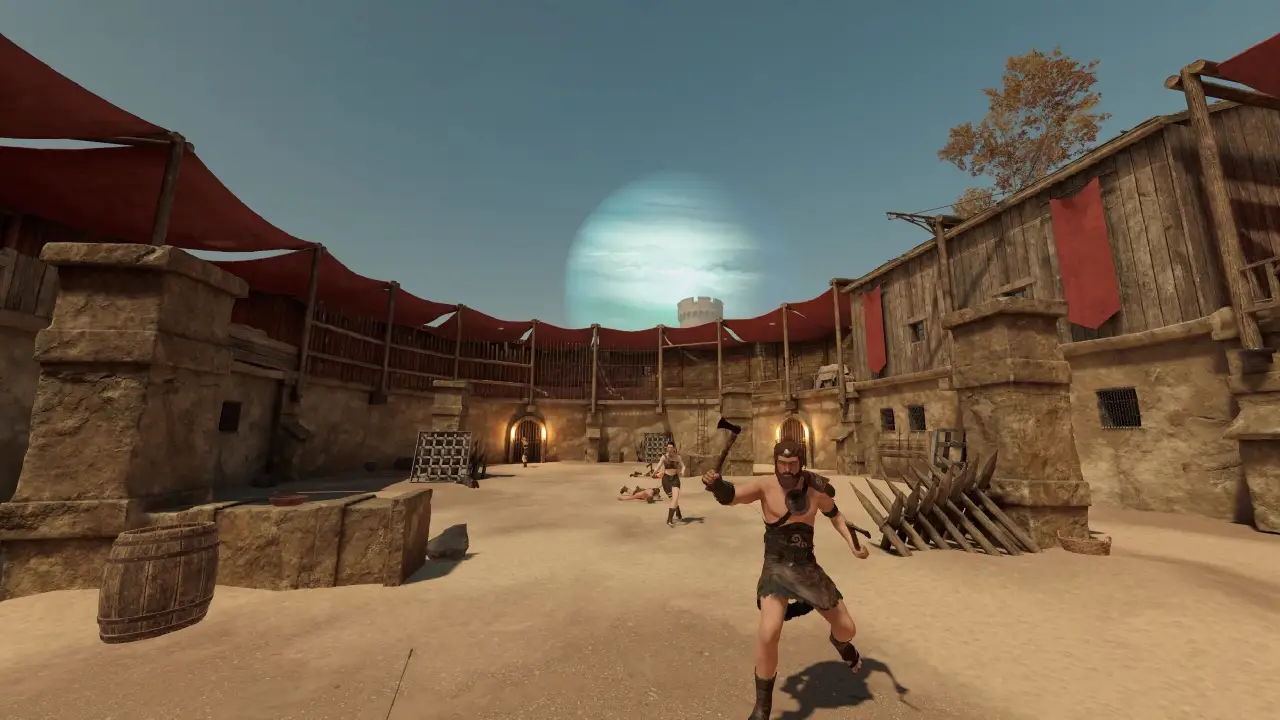
In the VR melee field the most direct rival is Gorn, the gloriously daft gladiator sandbox. Gorn's physics are sillier and built for a quick laugh, but on combat depth, breadth of magic and long-term replayability it is simply not in the same division. Blade & Sorcery throws all of its resources at one thing — melee plus magic plus ranged — and lands a visceral, true-to-weight kill feel that few can copy.
What stretches the playbook to infinity is the mod support: a single lightsaber, becoming Kratos, total-conversion builds, nearly anything the community could dream up. Tire of the official content and there is always something new to tinker with — the ceiling is not set by the developer but by the appetite of the people building for it. Bundle the core feel, the magic, the growth curve and the mod sprawl, and the 9.5 explains itself: no one system blinds you, but "killing by hand in VR" is taken nearly as far as it goes. It does not lean on a single dazzling gimmick; it takes the simple, primal act of swinging a blade with your own arm and refines it until almost nothing in the medium can stand against it head-on. In the arena it built for itself, it has no real equal.
Content | 8.5/10
Contenuti: 8.5/10Sandbox and campaign: two legs to stand on
Two slabs of content hold the game up now, and they cover for each other. One is the long-running sandbox: free-roam slaughter in the arena with every weapon and spell on tap, no goal but near-limitless replay, fought however you please. The other is the Crystal Hunt progression mode new to 1.0 — a roughly seven-hour spine that organizes the scattered fighting into a journey with linked maps, faction Outposts and a skill tree.
The split is clean: the sandbox owns breadth and freedom, somewhere to vent on a whim with no scorekeeping and no stakes; Crystal Hunt owns depth and direction, a reason to keep pushing and a ladder of growth to climb. Neither would carry the game alone, but together they cover the two appetites VR players tend to swing between — the urge to mess around, and the urge to make progress. For newcomers the smoothest on-ramp is to build your controls and your growth inside Crystal Hunt first, then go cut loose in the sandbox. The campaign itself is sturdier than it looks — not one straight line but a web of connected maps studded with faction-held Outposts where you gather intel and resupply before choosing a direction, an explore-fight-restock loop that keeps the seven hours from flattening into a kill conveyor.
1.0 also takes things away. It cut familiar legacy sandbox waves — Relentless, Warzone — and for the nostalgic that is a real loss, the kind of subtraction that stings precisely because those modes had years to become muscle memory. The common verdict is "hopefully the community mods them back," and given this game's mod scene, it almost certainly will. That, in a way, is the quiet superpower of the whole package: even its losses come with an asterisk, because the community tends to backfill whatever the developer removes.
Mods and version traps: a near-bottomless tank
What truly makes Blade & Sorcery unfinishable is its mod ecosystem. Nexus alone hosts a curated 90-mod collection and a dedicated 22-mod spell collection, and mod.io carries a flood of compatible content — relic bounty systems, full custom Bladedancing skill trees, gems that conjure magic weapons, on and on. It may not have the highest content density per hour, but on sheer "how long will it last," the sandbox plus mods leave it almost without a ceiling, and the library only grows as the community keeps building.
Before you start modding, one version trap deserves a flag, and it is the single most common pitfall new modders hit: early-access U12-era mods are not compatible with Crystal Hunt 1.0, so authors had to re-port and you must match a mod to your current build or risk crashes. The standalone Nomad build on Quest also leans on mod.io with a different install path than PC, so check your platform's method first rather than loading a stack you cannot launch. The barrier is not high, though — mod support is built in, most content just drops into a folder, and there is a deep well of written and video guides for every platform and skill level. The first time you successfully load a favorite and watch yourself cleave a foe in two with a lightsaber, that "I bent this game into the shape I wanted" rush is itself part of the content.
On updates and price: Crystal Hunt 1.0 shipped free to every existing owner, while leaving early access bumped the Steam price from $20 to $30 for newcomers. Long-time players paid nothing to receive the entire haul of new content, which is the kind of goodwill that buys a studio years of loyalty. Against the content on offer and that near-endless mod runway, it is an honest tag — and that bottomless longevity is exactly what so many slicker, quickly-finished games can never match. The 8.5 here reflects all of it: the official run is not especially long and the cut waves sting, but freedom plus community turns a one-time purchase into a long companion. As long as you are willing to pour time in and willing to fiddle with mods, this game can keep you company almost indefinitely — and that near-bottomless staying power is something a lot of more polished, quickly-abandoned titles simply cannot offer.



Commenti 0
Ci interessa la tua opinione
Partecipa alla discussione e condividi la tua opinione su questo gioco.
Ancora nessun commento. Dicci cosa pensi di questa recensione.