














Opening
Doki Doki Literature Club Plus! launched on June 30, 2021, masquerading as a polite high school romance while functioning as a psychological trap. Its 8.5/10 aggregate reflects a deliberate split: Rock Paper Shotgun awarded a 9/10 for its meta-writing, whereas IGN and PC Gamer scored it 8/10 and 82/10 for pacing quirks. The true hook arrives the moment you type your first poem and notice the system has already stopped following your input.
The poetry minigame acts as controlled bait. You pick preset phrases, but the framerate plummets, character names scramble, and the app crashes straight to the desktop. This isn’t a technical failure. It is the core design loop. The interface hides sharp narrative knives behind a soft aesthetic, literally burning the fourth wall for fuel. That initial crash leaves you staring at a dark screen until the dread settles. You think you are playing a dating sim. The software is actually profiling you. It remains essential for players who enjoy psychological horror and meta-fiction, but it actively frustrates anyone expecting conventional romance progression.
Story | 9.5/10
Storia: 9.5/10The main storyline delivers a passable slice-of-life school routine: decent enough to watch, but easily forgotten the next day. There is, however, a twist centered on the protagonist discovering anomalies in the game files—no spoilers, you'll have to uncover it yourself. The multi-perspective narrative feels like assembling a puzzle with missing corners. Each additional playthrough lets you recover another fragment. The exploration of mental health and escapism isn't forced upon you through heavy-handed preaching. Instead, it simply lets the characters' dialogue boxes drift into incoherent rambling, while the background laughter fades ever further away.
This narrative approach is like biting into a sugar-coated chili pepper. The moment the shell cracks, the heat shoots straight up your nose. It has no interest in literary pretension; it only deals in control. Players may think they're standing on the sidelines, but they've long since become variables in the script. The payoff for hidden text is executed with remarkable precision. Not a single wasted word. Every seemingly casual exchange quietly lays the groundwork for the final breakdown.
Two girls in school uniforms sit on the classroom floor, with the pink-haired girl comforting the one with purple hair.
You can't fast-forward, because doing so means missing crucial foreshadowing. This mandatory reading pace paradoxically becomes part of the narrative itself. It forces you to slow down. It leaves you no choice but to confront what you'd rather look away from. The heart of the story isn't "what happened," but "what you're willing to accept." When you finally piece the full picture together, you'll realize you were written into the script from the start. This isn't interaction. It's judgment.

Sound | 9.0/10
Audio: 9/10I added two tracks to my playlist: one is the "Classroom at Dusk" BGM, and the other plays during the final confrontation. One makes me want to zone out, while the other sends my blood pressure through the roof. For the first time, the Plus version features full voice acting, and the dramatic tension in the dialogue is immediately dialed up to the maximum. Emotions that once relied on your imagination are now delivered, word by word, by the voice actors straight into your ears.
The sound design is like a refrigerator compressor humming late at night. You normally don't notice it. But once the environment grows quiet, it starts to fray your nerves. Sound effects at key moments don't rely on loudness to startle you. They rely on abrupt shifts in frequency. The instant the fan stops spinning. The friction of tearing paper. These details give concrete form to a sense of psychological pressure.
The in-game music player interface, displaying "Lavender Mist" currently playing along with the track list.
The integration of music and narrative is exceptionally tight. During warm moments, the melodies are light; when the atmosphere turns twisted, the pitch is deliberately dropped. There’s no redundant buildup. Every single note speaks on behalf of the characters. The moment you put on your headphones, the reality of your room is stripped away, leaving only the breathing sounds emanating from the screen. Full voice acting isn't a selling point. It's a necessity. It bridges the biggest emotional gap left by pure text. The volume knob is rendered useless here. It forces you to listen to every single gasp.

Visuals | 8.5/10
Grafica: 8.5/10The first time the scene shifted from an everyday setting to a surreal space, it actually jolted me. It wasn’t about high brightness; it was the deliberate scrambling of color saturation. The 2D anime-style character portraits were already polished, but when layered with dynamic UI and environmental effects, they became a form of camouflage. The more normal the visuals looked, the more glaring the subsequent breakdown became.
The visual presentation resembles an old CRT television suddenly breaking into static. The outlines are clear, yet the focal point remains elusive. The HD remaster in the Plus version avoided a hyper-realistic approach. It preserved the roughness of the hand-drawn lines, giving the distortion effect a raw, hand-torn quality. It’s a clever choice. An overly polished look would only dilute the authenticity of the psychological horror.
Four female characters stand in the classroom, with a dialogue box at the bottom displaying Monika’s lines.
The background details warrant a closer look. The clutter on the desks, the shifting weather outside the windows, and even the subtle trembling of the dialogue box all serve to convey information. It doesn’t aim for cinematic-grade lighting; it prioritizes emotional resonance. The moment you notice an extra note in the background that shouldn’t be there, the visuals are already telling a story. The art direction avoids showy techniques; its sole purpose is to lay the groundwork. It is precisely this restrained visual language that makes the final collapse all the more painful.

Content | 8.0/10
Contenuti: 8/10Beating the main story takes less than ten hours. But I've started over multiple times, and my completion rate has only climbed to 60%. The game's "check one more time" loop is addictively compelling. The sincerity of the paid upgrade lies entirely in its added content. The photo studio lets you swap outfits and pose for shots, the gallery unlocks concept art, and the short stories flesh out the background lore. The content volume isn't massive, but every piece is seamlessly integrated into the core gameplay loop.
The multiple playthrough mechanic isn't just about grinding achievements. Each time you restart, the memories you carry alter the weighting of your choices. Hidden endings are like old keys at the bottom of a drawer. You rarely use them, but knowing they're there brings peace of mind. The extra content isn't padded. Wallpapers and artbooks are value-added bonuses, not filler.
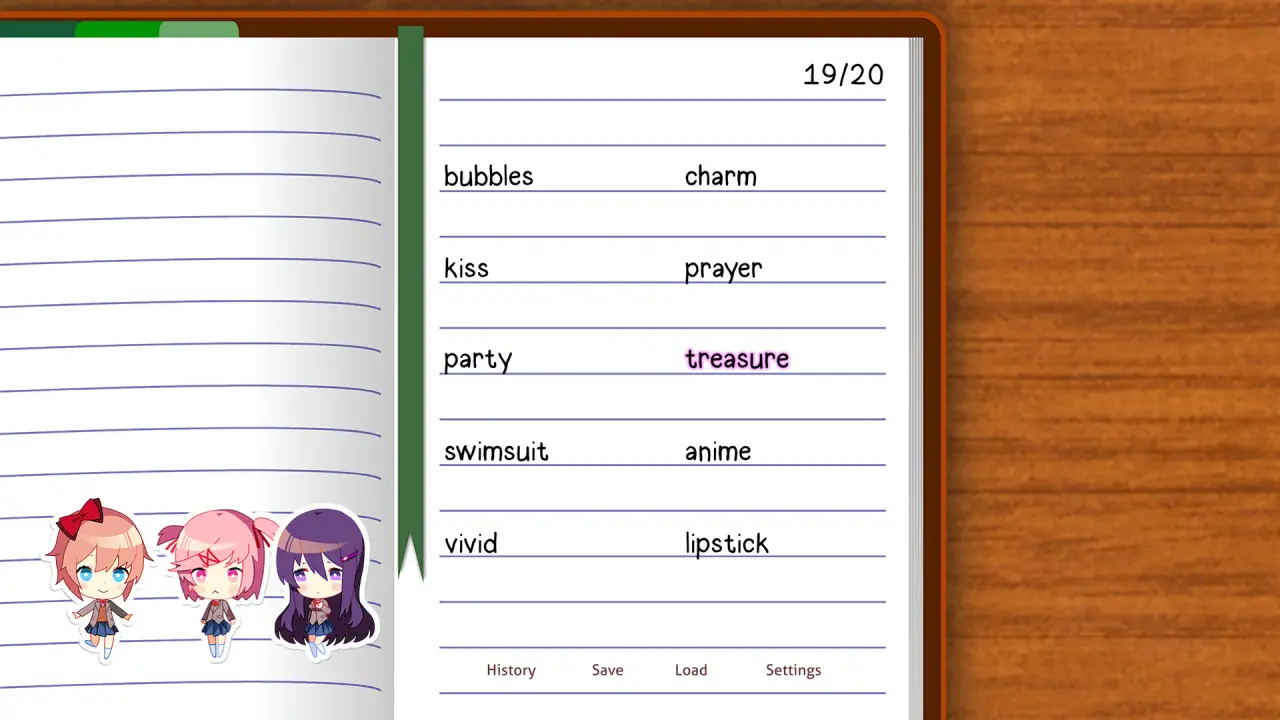
The notebook page showcasing collectibles, featuring a list of English words and three chibi character stickers.
You'll spend a few extra hours just to complete the collection. It's not the system forcing you; it's curiosity driving you. While this design trope is common in indie games, here it serves narrative completeness. The content volume is just right. Neither dragging nor sparse. It's perfectly paced to let you fully absorb and process the emotions. Bigger package, same price. Veterans can appreciate the sincerity, while newcomers receive the complete experience.
Gameplay | 6.5/10
Gameplay: 6.5/10For the first ten hours, you’ll feel like you’re reading a digital manual. By the twenty-hour mark, you’ll start to savor that precise, high-stakes feeling where every wrong choice carries a cost. The traditional text-adventure framework remains intact. Poetry mini-games and branching dialogue options form the core. Meta-narrative mechanics break the usual pacing and can occasionally feel a bit abrupt.
Gameplay depth is limited. You can’t freely explore a map; you’re locked into a predetermined path. The photo studio and mini-games added in the Plus version serve primarily as pacing tools. They’re enjoyable, but they don’t offer any real challenge. The control scheme is incredibly straightforward, allowing controller players to jump right in without a learning curve.
Close-up of a purple-haired girl's profile, with a pink dialogue box and game menu displayed below.
But that’s exactly what it needs. The gameplay doesn’t have to be complex; it just needs to be quiet enough to direct your full attention to the writing and presentation. Once you stop worrying about “how to play” and get swept up in “what happens next,” the system has already done its job. It’s simple, but it hits the spot. Limited interactivity is true, but it channels every bit of it precisely where it counts.
Is it worth a fifteen-hour commitment? Absolutely, provided you’re open to its unconventional approach. It squeezes every ounce of potential out of the visual novel format. Poetry serves as the hook, glitch text delivers the twist, and full voice acting lands the final blow. When compared to The Song of Saya and Omori, it avoids the route of extreme grotesquery. Instead, it wraps psychological horror in the guise of everyday youth life. That contrast lingers far longer than a cheap jump scare.
Gameplay is indeed its weak point. Lacking interactive depth, the progression leans heavily toward linear reading. If you're chasing hardcore mechanics or open-world exploration, it simply won't deliver the feedback you're looking for. However, the sheer execution of the narrative and audio is so tight that it completely overshadows the system's simplicity. Historically, meta-narrative games like this were niche experiments a decade ago; today, they've become a mature genre. It didn't blaze a new trail, but it paved the existing one flawlessly smooth.
It’s best played alone, late at night. Close the door. Put on your headphones. Don’t quit halfway through. The experience is a self-contained loop; breaking any part of it will dilute the final impact. Picking it up at full price is a solid investment, and it’s an even better deal on sale. You aren’t just buying a game. You’re buying a forced confrontation with yourself.



Commenti 0
Ci interessa la tua opinione
Partecipa alla discussione e condividi la tua opinione su questo gioco.
Ancora nessun commento. Dicci cosa pensi di questa recensione.