


















Opening
Some games end when the credits roll. Grim Dawn ends when you finally admit you have a problem. The main campaign runs a tidy twenty-odd hours, yet the people who truly love this game are usually three, five, eight characters deep — each one a fresh excuse to chase a build they have never tried before.
That is the trap Crate Entertainment laid back in 2016. A few of the studio's hands had cut their teeth on Titan Quest, so they kept that game's dual-class bones, hung a sky of 105 constellations above it, and then buried the whole thing under a loot system with no visible floor. Three layers, locked together — and the result is a freedom of character-building that no buy-once solo looter has fully copied in the decade since.
It is not a game that tries to please everyone, and it never pretends otherwise. The story is restrained, the on-ramp is steep, the visuals chase no trends, and all of that is written plainly on its face. But if what you want is the specific pleasure of growing stronger inside a dying world — one build, one drop, one hard-won upgrade at a time — then Grim Dawn is still the name you cannot walk around, and the years have only widened the gap between it and the games that tried to copy it. This review unpacks exactly how it earned that standing, dimension by dimension, and where the seams still show on a game that is now closing in on a decade old yet refuses to act its age.
Story | 6.5/10
Storia: 6.5/10A world where iron outvalues gold
Grim Dawn unfolds in Cairn, a world being pulled apart by two warring powers while humanity quietly runs out of room to stand. It is a setting that does its heavy lifting before you have killed a single thing.

On one side are the Aetherials, who covet human bodies as vessels to wear. On the other are the Chthonians, who want flesh and sacrifice. Caught between them, what is left of human civilization has shrunk to a few fortified holdouts where iron is worth more than gold and a stranger's trust has to be earned the hard way. The official opening states it without flinching: a world on the brink of extinction where iron is prized above gold and trust comes dear. You play a survivor who was possessed by an Aetherial and then, against every odd, clawed their own body back. From the first minute you stand on the seam between the human and the otherworldly, and that origin keeps a low, persistent unease running under the whole journey — a quiet question of whether you are still entirely yourself, and a strange flicker of kinship with the corrupted things you put down along the way.
Lovecraft meets the smokestack
The clever move is the fusion. Cairn welds Lovecraftian dread to a steampunk industrial collapse, and the seam barely shows. Other games reach for one register or the other; this one holds both at once and makes them feel inevitable together.
You read the notes of the dead in corrupted villages. You restore ancient shrines in the dark bellies of ruins. You meet things in the swamps that the writing pointedly refuses to name, and the refusal is the point — what you imagine is worse than any model could be. The whole place carries a heavy, lonely, near-hopeless air, yet it is never flatly grey, because every small step you take toward rebuilding a settlement or reopening a road feels like scraping a sliver of light out of the ink. This is not the look of any one Diablo entry; it is the spirit of the original Diablo II, that sense of one figure against an endless dark. Plenty of later games have tried to bottle that exact mood and come away with something thinner, brighter, and less convinced of its own dread. Grim Dawn never blinks.
Atmosphere over plot, and the honest cost
Now the hard part. If you came for a main story with rising stakes and sharp dramatic turns, Grim Dawn will probably let you down, and it would be dishonest to soften that or bury it in qualifiers.

The storytelling leans almost entirely on environment and fragments: survivor notes, a line or two from faction handlers, the wordless testimony of a ruined street where you can read what happened but never quite who it happened to. As mood-building this is first-rate. As a story that grabs you by the collar and refuses to let go, it simply lacks force — you are carried by the atmosphere of the world rather than pulled along by any one thread, and no character's fate is going to keep you up at night. The expansions push the map and the lore outward, with Forgotten Gods relocating to a desert beyond the empire and seeding new factions and god-myths, but the register never changes. It is atmosphere-driven, full stop. PC Gamer said as much alongside its 83, noting the game is hobbled by some old-school habits and that the story could be better. Against Diablo III, which at least frames a cleaner cinematic spine with proper cutscenes, Grim Dawn loses this round — not because it fumbled the narrative, but because it spent its ambition somewhere else entirely, and you can feel exactly where that somewhere is the moment you open the skill trees. The story is the price of admission to a build sandbox that has no equal, and most players pay it gladly, treating the plot as ambient texture while the real drama plays out in their character sheet. That is a strange thing to say about a role-playing game, yet here it is simply true, and pretending otherwise would do the reader a disservice.
Audio | 7.5/10
Audio: 7.5/10Music that knows when to disappear
The score never tries to sweep you up in a swell of strings. Its job is narrower and smarter: press you down into a dying world, then step back and let the silence do the rest of the work.

The music runs low and restrained throughout. Walk alone into a corrupted swamp and what rises behind you is not a stirring melody but a faint, uneasy wash of sound that never grabs the spotlight, yet never lets you forget the place wants you dead. Push deep into an abandoned town and the music drops out almost entirely, leaving the room's own breathing to carry the dread, and that restraint is far harder to pull off than a big theme. That choice — atmosphere first, always — is the whole game's design philosophy in miniature: everything serves immersion, nothing is spent on surface flash. Set it beside Diablo III, whose themes are louder and far more hummable, and you see two opposite bets. Grim Dawn does not want you whistling the tune on your way out; it wants you to forget tunes exist and sink into Cairn's dark. Neither approach is wrong. They simply aim at different things, and this one aims dead at immersion.
Feedback that nails the tension to every detail
If the score handles the broad mood, the sound effects pin that mood to every surface until it has nowhere left to hide. This is where the audio quietly earns its keep.

The solid thud of a skill landing, the distant growl of something otherworldly out in the black, the crunch of rubble underfoot, the dull boom of a shrine flaring to life — pull any one of these out and it is nothing. Woven together they form an airtight net of atmosphere that holds for hundreds of hours. Exploring those grim ruins and corrupted villages keeps a wire pulled taut in you, because you never quite know what the next corner spills out, and that uncertainty is the fear itself, not the payoff. Then a zone goes quiet and you let out a breath you did not know you were holding. That tightening-and-release rhythm is an easily overlooked but genuinely vital part of how the looting feels, and it is the kind of thing you only notice when a worse game gets it wrong. To be fair, this is not a soundtrack you queue up on its own — it scores low on spectacle and on memorable hooks, which is the honest reason I did not rate it higher. But in its own context, this quiet, inward, immersion-first audio is precisely what conjures that one-of-a-kind end-times atmosphere. It is not flashy. It is right, and right is by far the harder thing to land. A louder soundtrack would have fought the world it sits inside; this one simply sinks into it, and after a hundred hours that restraint reads as confidence rather than thrift.
Visuals | 7.5/10
Grafica: 7.5/10A grim, grounded isometric apocalypse
Grim Dawn has no wallpaper-grade money shot, but it has something rarer: a look you will remember after a couple of hours, the kind of identity no high-spec effect can buy and no marketing screenshot can fake.

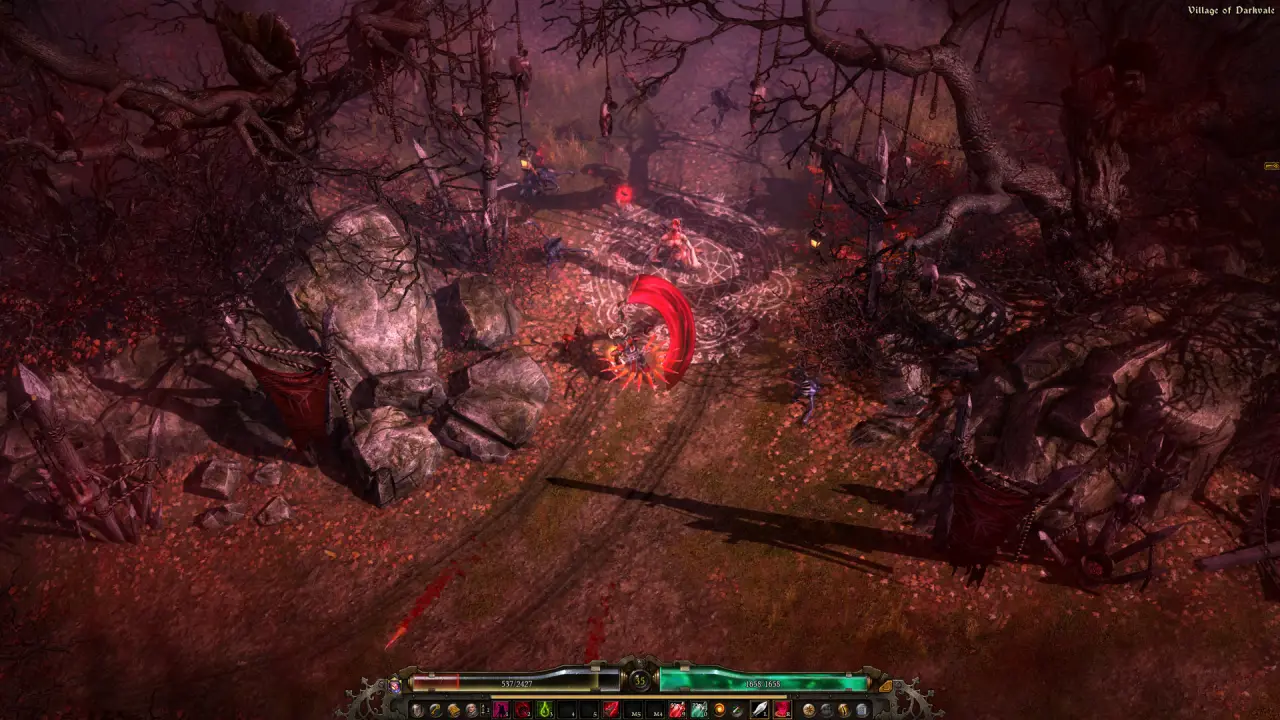
It runs on Crate Entertainment's in-house engine, a lineage that traces back to Titan Quest, and the art direction is grounded, gloomy, and seen from that classic isometric angle. Ruined villages, miasma-choked swamps, ruins being devoured inch by inch, and those scattered, strangely shaped ancient shrines together compose a steampunk-industrial end of the world. The recognizability is total: pull a random screenshot and a veteran names it on sight, never once mistaking it for anything else on the shelf. Against the bright, cartoon-saturated palette of Diablo III, the two sit at opposite poles — that one a grand magical pageant lit like a stage show, this one a lonely trudge into the gut of despair. Both have their fans, and neither is objectively correct, but on sheer purity of mood, Grim Dawn's gloom is the one hardcore players keep coming back to year after year. It commits to a feeling and never breaks character to chase a trend.
Modest tech, smart spending, and a long polish
Take the visuals apart and the technical spec is not aggressive at all — yet the sheer completeness of the scene work and atmosphere carries the whole category with room to spare. That is a deliberate trade, not a shortfall.

It chases no cutting-edge real-time lighting and pours no memory into dazzle. Instead it spends its limited budget with care on one task: making this world look hopeless enough to believe. A stretch of land glowing wrong with Aetherial corruption, a half-collapsed church, a knot of otherworldly creatures easing out of thick dark — no single frame stuns, but stacked together under that gloomy palette they press down on you until the air itself feels heavy. There is, in fairness, an old-school tail trailing behind it. Some interface and map-navigation logic is stuck a generation back, and the perennial complaint is that rift-gate markers read poorly, leaving newcomers circling a huge map to learn its shape the slow way. None of this is fatal, but it quietly costs points on first impression, and it is the honest reason the visuals did not score higher for me. Worth noting too: this was never a one-shot deal. Early crash and stability issues under certain GPU settings stung players at launch and dented the early word of mouth, but Crate kept patching for the better part of a decade rather than walking away, and that stability is long since a solved problem. For a game built on hundred-hour grinds, where nobody wants a stutter or a crash breaking the spell mid-run, that long-haul care matters enormously. Add it all up and the verdict is a clean, satisfying win of style over spec — a game whose mood outlasts its hardware.
Detail that rewards the second look
The deeper you go, the more the art direction reveals it was thought through rather than thrown together, and that consistency is half of why the world holds up over hundreds of hours.
There is a coherence to Cairn that cheaper apocalypses miss. Corruption does not just recolor a texture; it warps architecture, twists the silhouettes of the creatures it claims, and leaves a visual logic you start to read intuitively — you learn to tell at a glance which districts have fallen and which are merely besieged. The faction hubs feel lived-in and defended in a way that makes the wilderness between them feel correspondingly dangerous, so the map's mood shifts as you travel rather than smearing into one grey wash. Item visuals matter too: as your gear improves, your character visibly changes, and in a game where you stare at one figure for hundreds of hours, that slow visual ascent is its own quiet reward. None of this is technically showy, and none of it would survive a spec-sheet comparison with a modern blockbuster. But it is exactly the kind of craft that makes a world feel authored, and it is why so many players describe the look not as dated but as timeless — a style chosen on purpose, executed with care, and aged remarkably gracefully because it never staked its identity on effects that would inevitably go out of fashion.
Combat | 9.5/10
Gameplay: 9.5/10Two masteries, and a different game each time
The first pillar of Grim Dawn's play is its dual-mastery system, the core it inherited from Titan Quest and then pushed much further.

You pick one class mastery, unlock a second once you hit the right level, and weld the two into a brand-new hybrid. Occultist with Necromancer leans into poison and a summoned horde that soaks the front line for you; Inquisitor with Demolitionist becomes a ranged gun-and-fire line that wins on suppression. The base game alone offers six masteries to pair, and the expansions kept adding more — once Forgotten Gods shipped the Oathkeeper, the total combinations jumped to thirty-six. The pinch is that your skill points have to be split across both trees, which forces real decisions: do you double up on active skills for multi-stage chains, or commit one side to damage and mine the other purely for passives? The same pairing, pointed differently, feels like a different character. That is why veterans keep saying a new combination is a new game — it sounds like hyperbole until you are in it, at which point it stops sounding like hyperbole at all.
The devotion sky, stacked on top
If dual masteries are the first pillar, the devotion system is the second — the one that drives build depth straight through the ceiling.

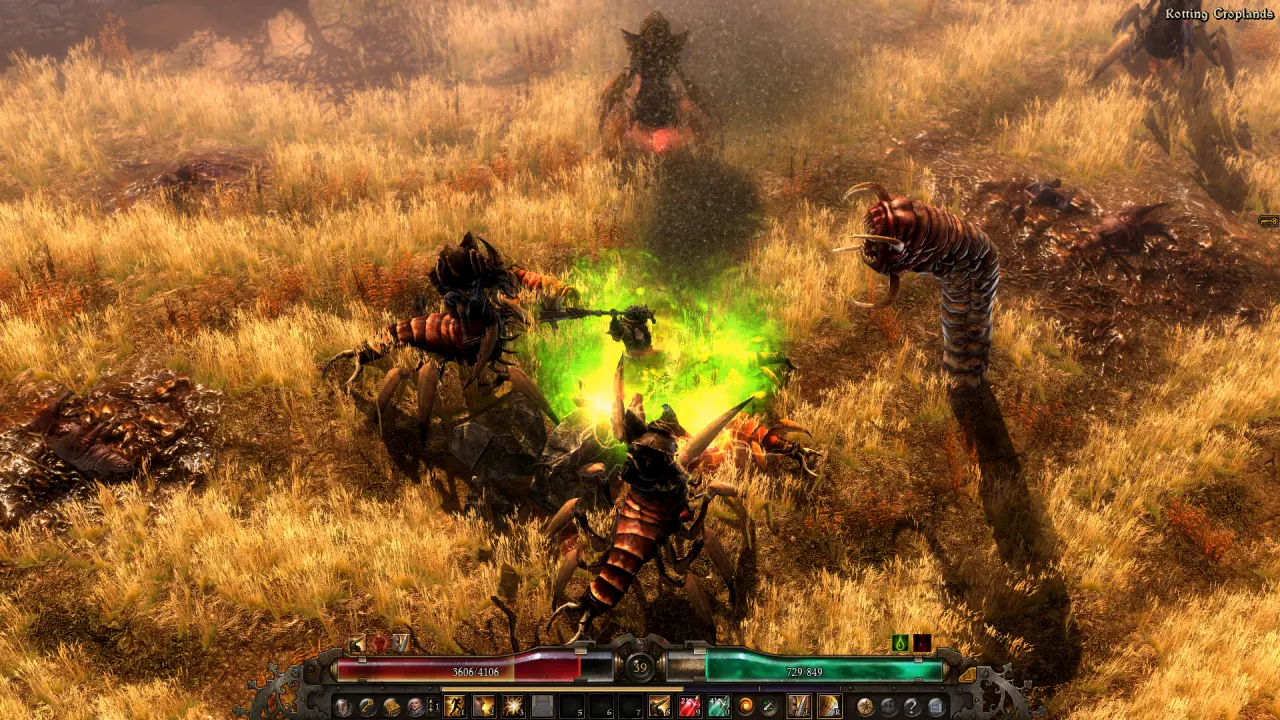
Here is the loop. You hunt down and restore shrines across the world to earn devotion points; ruined ones demand rare materials, corrupted ones demand you trigger them and clear the wave of otherworldly things they spit out, a small ritual of paying before you are paid. Across three difficulty runs you bank up to fifty points, fifty-five with an expansion. Those points feed a sprawling map of 105 constellations, each built from three to eight stars and sorted into three tiers, the higher ones costing more affinity and handing back rarer, stronger rewards. The masterstroke is the celestial power carried by fifty of those constellations: a secondary skill you bind to a frequently used ability and proc on a chance. Hang an area-damage star on your most-spammed active and it fires constantly — a second damage loop conjured out of nothing. Bind a different celestial power to the same class and the rhythm changes again, which is why the community calls devotion the game's second lifeline.
Difficulty: a hardcore sweet spot with a real gate
Lock those three layers together — class skills, celestial powers, item affixes — and Grim Dawn's build depth has almost no rival among buy-once solo looters. That depth, however, comes gated, and the gate is not low.
Ultimate difficulty runs on a single law: resistance reduction is king, and a mature build almost always leans on specific constellations to supply it. A newcomer who does not plan ahead and stack resistances slams face-first into a wall at some difficulty step and grinds to a halt, half-convinced they wrecked their own character. Early combat is a stand-and-trade affair too, won on stats and numbers rather than flashy footwork, and on that count it is genuinely less welcoming than Diablo III, whose difficulty ramp is gentler and kinder to a learning player. The saving grace is free respeccing, which all but erases the cost of experimentation — you can chase a wild idea without dreading a single misplaced point, and for a game this deep that forgiveness is everything. It does not bolt builds into set pieces the way Diablo III does, nor push complexity to the wall-of-spreadsheets extreme of Path of Exile. It parks dead-center in a sweet spot that is deep, self-teachable, and wide open to invention. That sweet spot is exactly why generation after generation of hardcore looters treats it as the benchmark, and why the community has produced such a staggering library of skill calculators, devotion planners, and build guides — a volume of player-made tooling that is itself proof of how far the rabbit hole goes. A game only earns that kind of homework when its systems reward the study, and Grim Dawn rewards it relentlessly, hour after hour, build after build, with a generosity that has kept its theorycrafting scene alive for the better part of a decade.
Content | 9.5/10
Contenuti: 9.5/10The campaign is just the ticket stub
On paper the campaign is no monster — a single run clocks around twenty-seven hours, a perfectly ordinary length for an action RPG, neither padded nor short, and certainly not the number you should be judging this game by.

Because "finishing" barely means anything in a looter. What actually decides the bulk here is the long tail you cannot see the end of: chase a full clear, assemble a dream set of endgame gear, take every build you fancy out for a real spin across all three difficulties, and the hours sail past a hundred without effort, with heavy players banking several hundred as routine and thinking nothing of it. That is the whole seduction of the genre — the campaign is a ticket stub, and the world that actually hooks you only starts unfolding once you are through the gate and rolling your second, third, fourth character. For Grim Dawn, the length and quality of that tail is precisely the part worth praising loudest, because plenty of looters have a campaign and almost none have a tail this rich. The twenty-seven-hour figure is, if anything, a polite understatement of the real value on offer — it measures the doorway, not the house behind it. Players who judge the game by that number alone have, in a very real sense, not played it at all; they have toured the lobby and left before the lights came up on the main floor.
Expansions and a grind that keeps its hooks
Grim Dawn owes much of its bulk to two genuinely substantial expansions, and a faction-and-affix loop with no real bottom to it.

Ashes of Malmouth picks up straight off the base story, widens the whole map, and adds two full chapters, a new mastery, four factions, and fourteen constellations, hauling the progression ceiling up a clear notch. Forgotten Gods relocates wholesale to a vast desert beyond the empire, bringing the Oathkeeper — a class built around shield throws, dual-wield whirling, and a burning charge — plus extra mobility, four new factions, nine constellations, and hundreds of fresh epics and legendaries. It also adds the Shattered Realm, an endless escalating trial that hands high-end players a stage to push their build ceiling more or less forever. Neither expansion is filler; both bodily lift the replay value and the build space another full tier, and they earn their keep several times over.
Wrapped around all of it is the loot loop itself, and this is where the hooks really sink in. Faction reputation gives the grind a side and a goal: every power has its own reputation meter, siding with one automatically pits you against its rival, and high standing unlocks that faction's blueprints and dedicated store, so the long grind always points somewhere concrete rather than spinning in place. The gear depth is the showpiece — white, epic, legendary, and affixed magic tiers, with legendaries gated by a minimum drop level and a true endgame piece demanding several strong affixes stacked on top of high base rolls before it counts as finished. Magic greens, meanwhile, are a lottery of prefix-and-suffix rolls you keep pulling for that one perfect line. Magic greens, meanwhile, are a lottery of prefix-and-suffix rolls you keep pulling for that one perfect line, and the version updates have spent years rebalancing so that epics and legendaries both stay worth hunting rather than one tier trivializing the other. What makes the loop sing is how its three strands — class build, devotion, and gear — keep feeding one another: a new affixed drop suggests a new constellation, which suggests a different mastery split, which sends you back out hunting for the gear to make it real. There is always a next thread to pull, and that, more than any single feature, is what keeps players opening fresh characters years after their first clear.
Pair every layer of that with nearly a decade of patches, polished all the way to the 1.2 milestone, and you get a grind ecosystem that simply refuses to die — the firmest, least arguable evidence behind its standing as the looter genre's benchmark, and the reason a 2016 release still sits in active rotation in so many libraries today.




Commenti 0
Ci interessa la tua opinione
Partecipa alla discussione e condividi la tua opinione su questo gioco.
Ancora nessun commento. Dicci cosa pensi di questa recensione.