
























Opening
# Opening
On August 15, 2024, Crytek slapped a version number — 1896 — onto a five-year-old work called Hunt: Showdown, upgraded the entire CryEngine pipeline from V to 5.11, cut off PS4 and Xbox One players, and force-migrated everyone to PS5 and Xbox Series X. This "I redid it, follow me or do not" mode of upgrade has, in the past decade among mainstream publishers, only been matched by CS GO turning into CS 2. It was Crytek's boldest operational move of 2024.
Hunt: Showdown 1896 carries on the PvPvE extraction shooter core — 12 players in 3 squads enter a 1000-by-1000-meter map of swamp, mountain, or mine, tracking boss clues, killing supernatural monsters, banishing the target for bounty, dueling rival hunters who come to claim the same prize, and finally extracting. Each match runs 30 to 45 minutes, far tighter than Escape from Tarkov, while the tension and permadeath stakes remain undiluted.
Across 5 years it has sold over 6 million copies. 227,000 Steam reviews hold 78% positive. OpenCritic 78 with a Strong verdict. Eurogamer compares its tension directly to Rainbow Six Siege. Edge 9/10. Gamersky's 1896 review awarded 8.5. The game has not relied on famous IP, AAA art, or scripted story — it has stood firm in the hardcore shooter category on three pillars alone: PvPvE tension, one-hour condensed match length, and permadeath.
Story | 7.2/10
Storia: 7.2/10# Story
Worldview architecture: 1895 Louisiana to 1896 Colorado
Hunt: Showdown 1896's narrative is set at the end of the 19th century. The original 2019 release locked into 1895 Louisiana — wet cold swamps, abandoned towns, monsters crawling out of bog pits, hunters from around the world converging on the region. The 2024 1896 upgrade pushed the timeline forward one year and the geography westward to Colorado's Rocky Mountains — dry mining country, burnt-out towns, an intricate underground tunnel network, and a new supernatural threat called the Hellborn lurking in the air.
That single-year time skip looks small, but it fundamentally changed how the game world feels. The wet, oppressive bayou is replaced by the dry, expansive mountain air. Sneaking through trees and sneaking through mine tunnels demand completely different tactical thinking. The exhaustion of humid climate is replaced by the thin-air fatigue of high altitude. Crytek used that one year of in-game time to re-tell its core story of "hunters chasing supernatural monsters on the American frontier," but with every detail rendered fresh.
The worldview core remains "late-19th-century American frontier crossed with supernatural horror." That period is rich with folk mythology — indigenous lore, European immigrant ghost stories, anti-elite populism, industrial-revolution anxiety. On this real historical base, Crytek added the in-game American Hunters Association — a secret organization that dispatches hunters to frontier regions to clean up supernatural threats. The player is one of its members.
Side density: boss lore plus hunter archetypes
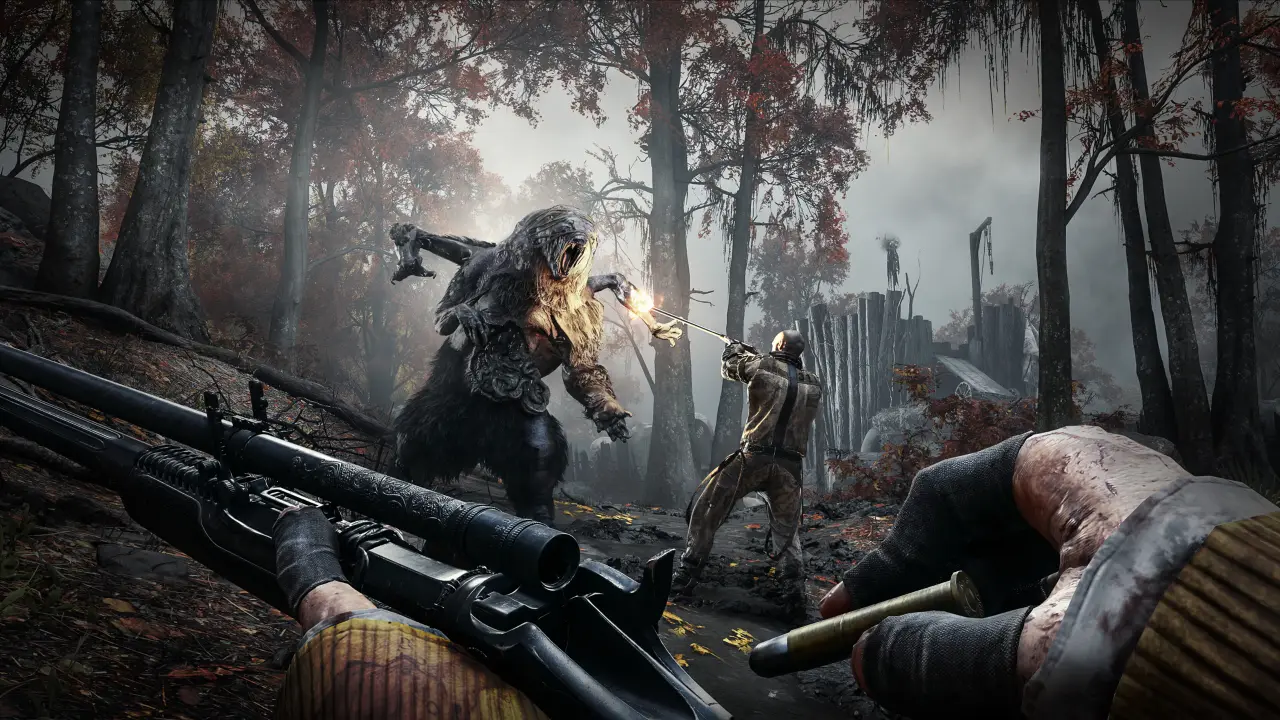
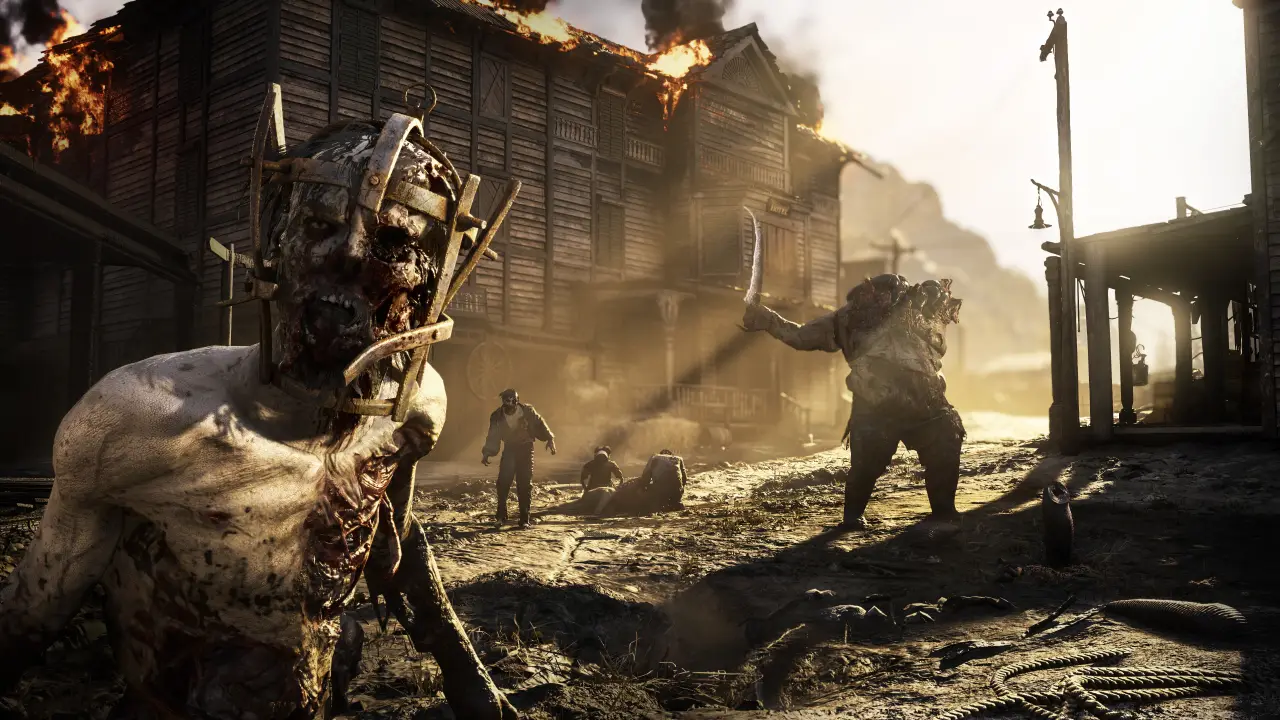
Beyond the main path, every boss carries an independent backstory. The Butcher is a Louisiana butcher who failed an experiment and turned into a hook-wielding, drooling monster. The Spider is a scientist's wife transformed by her husband's failed experiment into an eight-eyed, eight-legged wall climber. The Assassin is a sorceress who splits into multiple shadows. Scrapbeak is an aged raven-man. Rotjaw is a mutant crocodile lurking underwater. Hellborn, added in 2024, is a flame demon clawing up from deep mine shafts in Colorado.
Every boss story is told through environmental artifacts — torn newspaper clippings, half-pages of diaries, graffiti on cabin walls. The player picks up a scrap of paper mid-mission and discovers a backstory clue. This "environmental narrative" approach carries over Crytek's design language from Crysis and Ryse, giving Hunt deep worldbuilding without traditional cutscenes.
The hunter archetype system is another side line. Players accumulate experience across runs through the Bloodline system and unlock Legendary Hunters, each with their own backstory and visual theme. Some are veteran soldiers, some failed clergymen, some escaped convicts, some Chinese immigrants, some French sorcerers. The 1896 Scorched Earth season introduces a "pact" system where hunters choose one of three covenants (Wild, Lawful, Crazed) for unique traits. This "raise the character plus pick the faith" double-layer is virtually unique in multi-player shooters.
Choice systems: permadeath is the real story
Hunt: Showdown 1896 has no traditional RPG branching dialogue choices, but it has a deeper "story decision" — permadeath. Each hunter is an irreplaceable character. Once you fail to extract and get killed by a monster, headshot by another hunter, or blown up by your own dynamite, that hunter — plus all his equipment, unlocks, legendary skins, and accumulated experience — is gone forever.
This permadeath is not just hardcore difficulty, it is the work's most fundamental narrative design — you are not just playing a shooter, you are raising a hunter, watching him rise from rookie to legend, and one day you watch him end by a cold sniper round. The "individual life and death" immersion has almost no peer in mainstream shooters, and Hunt communities are filled with real stories like "my 100-level hunter died in his 200th match to a sniper 200 meters away." Many veteran players keep notebooks of dead hunter names as memorials, and the community even has a dedicated graveyard thread. This kind of permadeath weight is the reason Hunt veterans speak of dead hunters the way other gamers speak of beloved RPG party members.
Characters: voice plus equipment plus walking style
Hunt's character design is minimalist — hunters have no cutscenes, no scripted dialogue, no voice acting. All character "presence" is conveyed through gear appearance, walking style, weapon choice, and combat style. A hunter carrying a harpoon, a bow, and a Chinese-style straw hat instantly reads as "this is an eccentric." A hunter wielding double-barrel shotguns plus mud-stained boots reads as "this is a hardened old hand."
This "tools and looks define the character" design is mature in the western genre — Red Dead Redemption 2 used similar techniques. But Hunt pushed it to the PvPvE multiplayer extreme — the instant you see a rival hunter, you can judge their playstyle, risk level, and likely tactical thinking from their kit, then react. This "see-them-read-tactics" speed is one of the hidden designs that has kept hardcore players over five years. That visual language has been borrowed by many hardcore PvPvE games since, and is Crytek's unique contribution to the multiplayer shooter category. The cumulative effect is that Hunt is one of the rare multiplayer shooters where opening the spectator camera feels like watching a documentary about real cowboys.

Audio | 9.5/10
Audio: 9.5/10# Audio
Score theme: southern gothic plus American folk
Hunt's soundtrack is produced by the Port Sulphur Band, in an overall "American southern gothic plus Appalachian folk plus dark blues" style. The theme song "Rise Up Dead Man" is one of the rare PvPvE shooter scores that holds up as standalone music — female vocal layered over banjo, harmonica, and acoustic guitar, conveying the entire vibe of "late-19th-century American frontier exhaustion and dread" in a single song.
The 1896 upgrade extended the score into "American western mountain" style — adding more brass, percussion, and indigenous drumming to reflect the Mammon's Gulch Colorado Rocky Mountains climate. The new theme "Burning Hills" is by the same band, contrasting the original's "Louisiana humidity" against the new "Colorado dryness."
In-game BGM presence is intentionally restrained. Outside the server load music and extraction success fanfare, the vast majority of the time is silent. This "audio restraint" is deliberate — Crytek wants players to focus on environment audio, weapon sound, and enemy direction in their 30-to-45-minute match, building real battlefield feel instead of game-mood atmosphere. Gamersky's review captures this exactly: "pulling the trigger becomes a decision that demands careful consideration."
Voice density: minimal NPC plus community culture
Hunt has almost no traditional voice acting — the hunter himself is a silent protagonist, and NPC characters (truck drivers, shopkeepers, mission givers) have voice work compressed to a handful of lines. This design philosophy aligns with Bohemia's Arma series, Tarkov, and other hardcore works — they do not want players focused on scripted dialogue, they want focus on tactical decisions.
But in-game bosses and minor enemies all have full sound design. The Butcher's roar, the Spider's wall-crawl, the Assassin's whispering split, the Hellborn's flame howl — every boss has its own "sonic fingerprint." Players who hear a specific low rumble on the map can immediately judge "the Butcher is in that compound."
The community voice ecosystem is another Hunt pillar. Every Twitch Hunt streamer has their own unique "hunter narration" style — some imitate western veterans, some perform Victorian British gentlemen, some use Chinese dialects. This grassroots "voice performance" culture makes every Hunt stream carry inherent narrative weight, a quiet force keeping the work attracting new viewers across five years. Casual conversation around a particular streamer often spirals into discussion of the streamer’s in-character voice, blurring the line between game and performance art.
Environmental design: the sound hunt core
Sound effect design is Hunt's real strength, and the core reason PCGamesN and Eurogamer reviewers repeatedly singled it out for praise. Hunt built the entire PvPvE gameplay on sound tracking — any footstep, trigger pull, distant roar, startled crow, leashed mad dog, hoofbeat, glass shatter, board creak, holster strap squeak — all of it leaks player position.
Gamersky's 8.5 review specifically emphasized this: "the sound system is extraordinarily complex — beyond footsteps and gunshots, there are dying livestock, leashed mad dogs, and other environmental cues, making the choice to pull a trigger a deeply considered decision." The system's brilliance lies in players not just listening passively, but actively creating sound — you can deliberately spook crows as a feint, slam doors as a distraction, or release a mad dog as a sound trap.
The CryEngine 5.11 upgrade and its CrySpatial audio ecosystem represent another leap. The new engine's stereo stage lets headphone players accurately locate a footstep 200 meters away — left or right, front or back, up or down, indoor or outdoor, behind wall or tree. Shacknews's reviewer, after 350 hours, remains excited primarily because of this audio system — the ears can sense subtle opponent hunter presence before the eyes do.
Console and platform audio differences
The PS5 and Xbox Series X versions support native Tempest 3D Audio (PS5) and Dolby Atmos (Xbox), giving headphone players full stereo stage. PC players can achieve equivalent experience via 5.1 or 7.1 multichannel speakers or headphones. The Steam community has detailed "how to tune Hunt stereo audio" tutorials, and hardcore players invest in dedicated amplifiers and audio interfaces. The Chinese community has compiled a "Hunt audio gear checklist" ranging from a few hundred RMB entry to several thousand RMB flagship, now standard reading for new players.
Xbox Series S audio detail is somewhat simplified due to GPU memory limits, but the stereo stage remains intact. Controller players also benefit from DualSense haptic feedback — recoil from firing, vibration when hit, terrain texture during climbing — adding "tactile" sensation alongside audio cues. This "listen plus look plus feel" three-mode design lets the 1896 console version surpass PC veterans on certain sensory dimensions. Sound veterans treat audio setup as a piece of the game itself, with a meaningful share of the community sinking hundreds of dollars into headphones and amplifiers alone.


Visuals | 8.8/10
Grafica: 8.8/10# Visuals
Art direction: southern gothic plus western mountain double layer
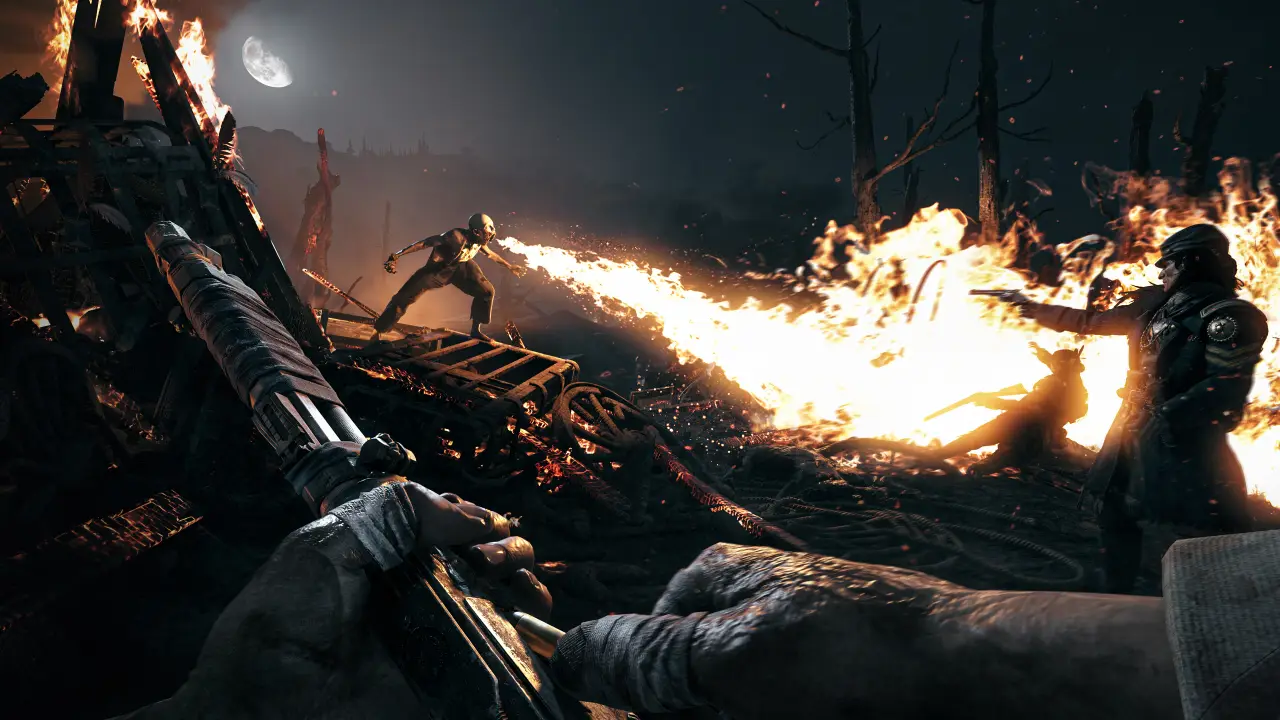
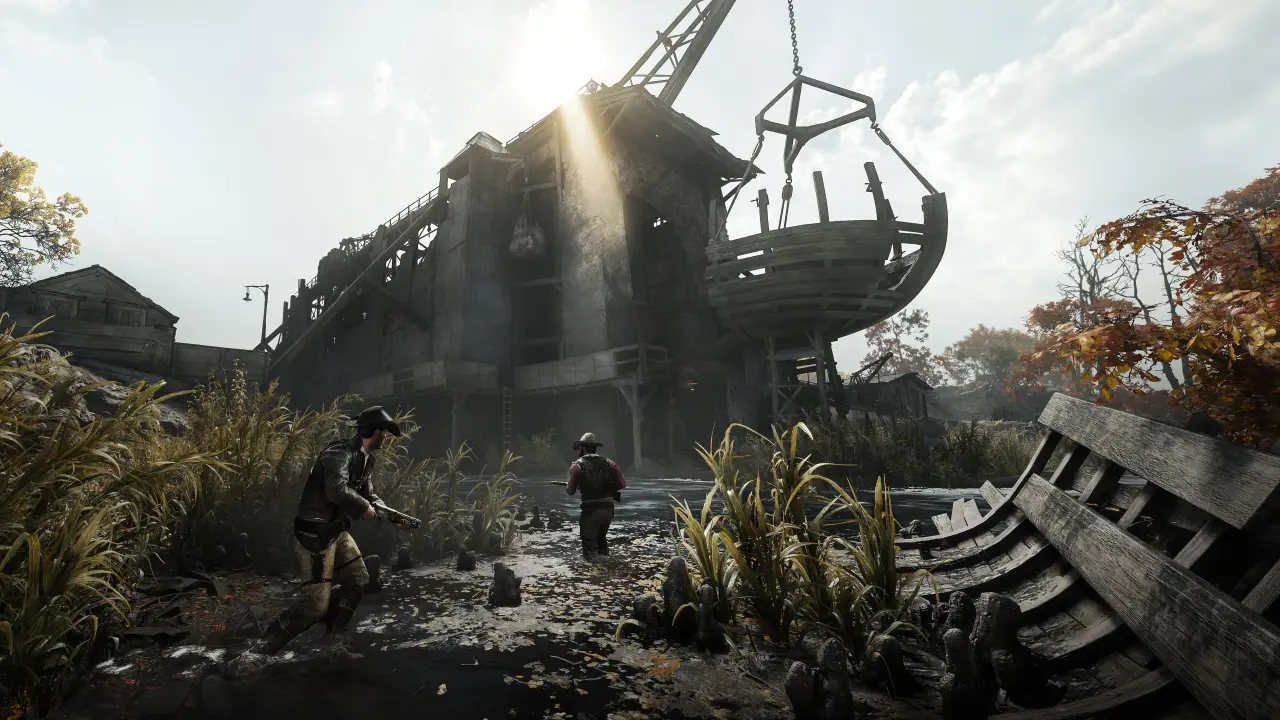
Hunt's visual ambition is "render the real late-19th-century American frontier." The original 2019 Louisiana bayou took "southern gothic" route — humid dense forests, abandoned wooden shacks, peeling-paint farmhouses, moss-grown gravestones, bodies floating in swamp water. This uncanny wet cold atmosphere is one-of-a-kind in PvPvE shooter genre, clearly distinguishing Hunt from PUBG, Tarkov, and other contemporaries.
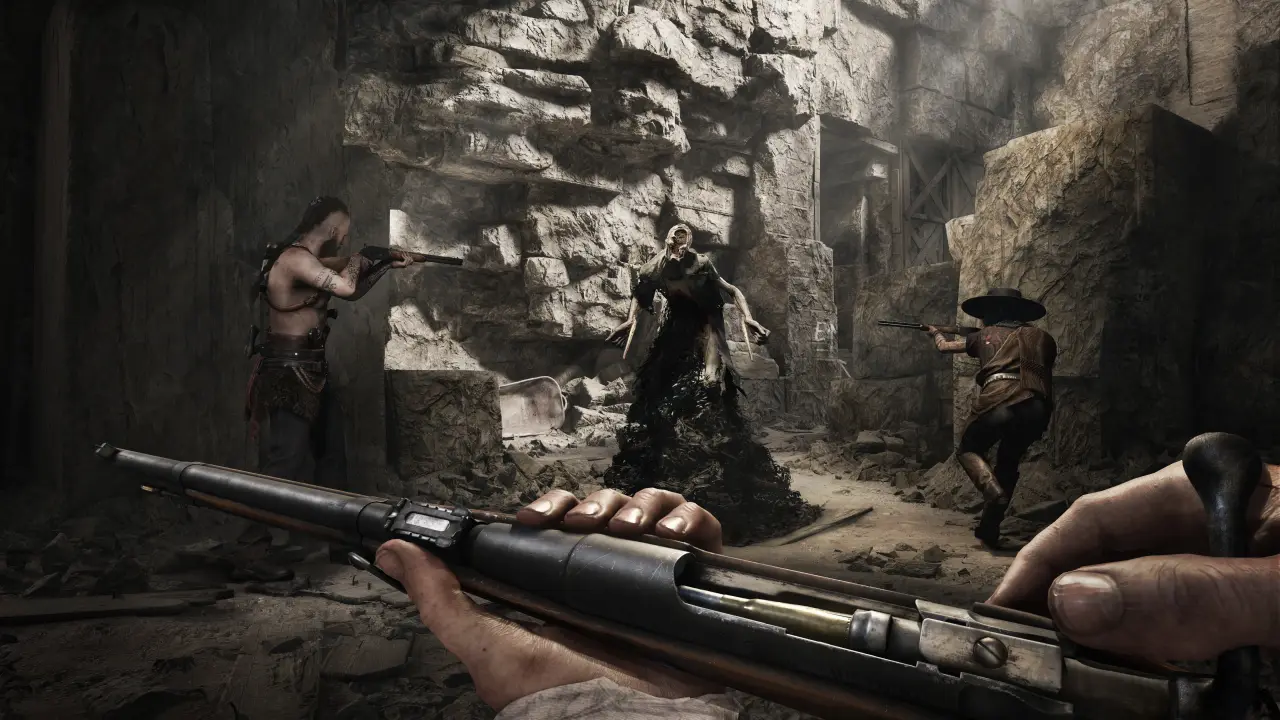
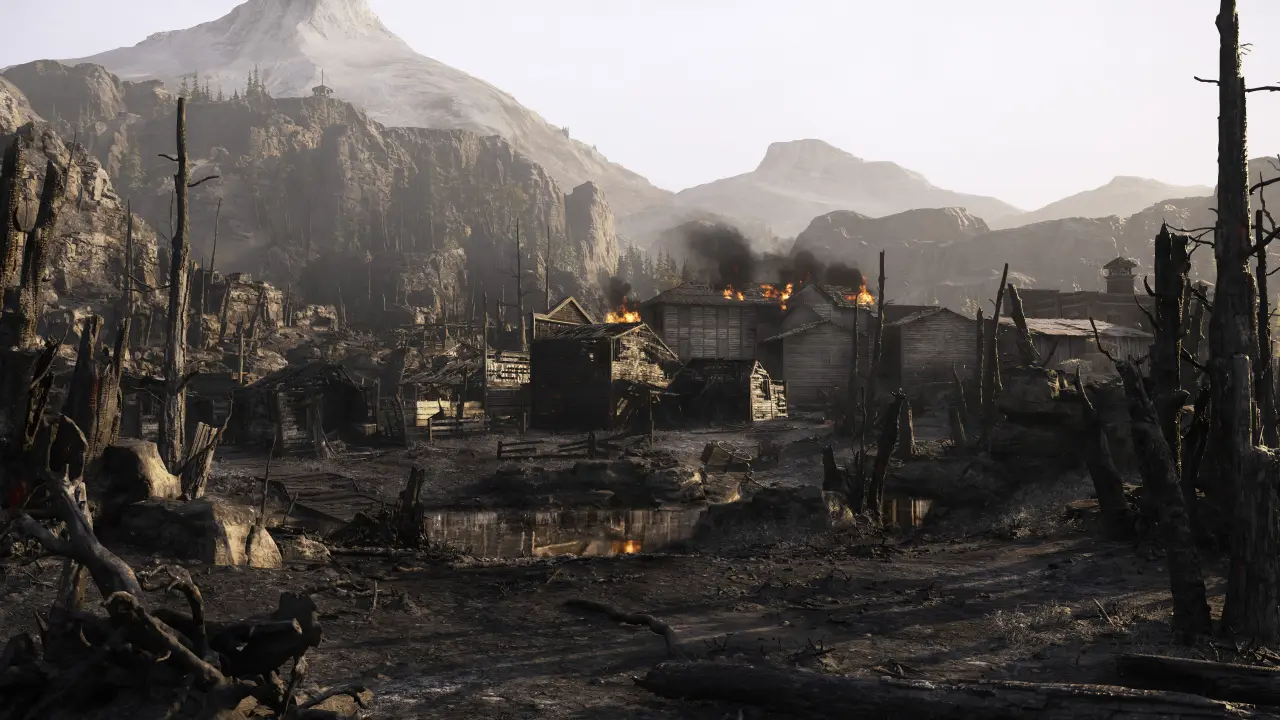
The 2024 1896 upgrade extended the visual style to "American western mountain" — dry Rocky Mountain landscapes, burnt-out mining towns, winding underground mineshafts, intertwining rails, stacked timber yards. Gamersky's review describes the new map as "deep in the Rocky Mountains, with massive open mines, narrow dark mining tunnels." This new style contrasts sharply with the original, giving 5-year veterans visual freshness atop familiar gameplay.
Character modeling and costume design are another achievement. Each Hunter has 12 legendary skins, each based on real historical research — American Civil War veterans, Victorian-era British female explorers, Mexican revolutionaries, Chinese immigrants, French sorcerers, and more. Weapon models are similarly detailed — the Lebel 1886 French rifle, Mosin-Nagant 1891 Russian rifle, Bornheim No. 3 German pistol, Sparks LRR American sniper rifle, each a digital recreation of a real historical weapon.
Engine technology: CryEngine 5.11 upgrade
The engine is Crytek's in-house CryEngine. The original ran on CryEngine V, and 2024 upgraded to CryEngine 5.11 — one of the largest engine jumps in Crytek's history. Gamersky's review specifically notes "animation, materials, and lighting are all freshly upgraded," supporting "more refined lighting reflection calculations, water effects, and hair effects."
The specific tech benefits include: DLSS 2.3.1 and FSR 2.1.2 upscaling support, letting mid-range GPUs run 4K; spatial audio stage upgrade, dramatically improving direction-by-sound precision; redesigned animation system, making hunter walking, aiming, and reloading more natural; PBR material reflection model, rendering metal, leather, and wood realistically under varied lighting; network sync rewrite, improving 12-player server latency and replay quality.
The console upgrade is even more visible. PS5 and Xbox Series X versions hit native 4K at 60 fps, Crytek's strongest console-side visual showing yet. The cost is that PS4 and Xbox One last-gen players are force-cut — they can no longer play this game on their hardware after August 15, 2024. This is Crytek's boldest operational decision of 2024, and one of the rare mainstream-publisher cases of "successful cross-gen cutoff," proving veteran players will pay for the upgrade.
Platform version differences
PS5: native 4K plus 60 fps, Tempest 3D Audio, DualSense haptic feedback. The console player's first choice.
Xbox Series X: native 4K plus 60 fps, Dolby Atmos audio, Smart Delivery auto-sync.
Xbox Series S: 1440p plus 60 fps, slightly less visual detail than X but stable frame rate.
PC (Steam): 1080p to 4K, 60 to 144 fps, DLSS 2.3.1 plus FSR 2.1.2 support. Best performance and visual platform. Minimum specs GTX 660 plus 8GB RAM, recommended GTX 970 plus 12GB RAM, flagship visuals after 1896 upgrade need RTX 3070+.
PS4 / Xbox One: support discontinued, no further play possible on original platform. Crytek's reasoning is that CryEngine 5.11's rendering pipeline cannot run on last-gen console hardware, forcing the upgrade as inevitable.
Overall, the 2026 optimal Hunt 1896 path is PS5 plus 4K HDR TV plus headphones, or PC plus RTX 4070 plus high-refresh monitor plus quality headphones. Both paths require higher hardware investment than typical FPS games, which is the cost of Hunt's long-standing "hardcore plus immersive" positioning. Cloud gaming is also viable in 2026, but lower-rank lobbies still skew toward PC local players. The cross-gen cutoff also pushed early adopters of the new consoles to finally lean into 4K HDR setups, which in turn boosted overall production quality across multiplayer shooters in 2024 and 2025.
UI and accessibility
The 1896 upgrade brought a full UI rebuild. From tile-based new interface to mission list reorder, weapon equipment page rework, and shop flow optimization, the UI system is essentially built from scratch. Shacknews's reviewer expressed "hesitation about the modernized tile-based UI" — PC veterans need to relearn, but long-term the UI experience is genuinely better than the original.
Accessibility-wise, Hunt provides complete colorblind modes, subtitle scaling, full key remapping, and aim assist tiers (from full assist to all off). This accessibility framework is what Crytek built out from 2022 to 2024, shifting from initial "hardcore to the end" style toward "hardcore plus accessible" coexisting interfaces. This rework is also a key reason 1896 has attracted more new players, since accessibility shortfalls are typically why hardcore PVPvE genres lose newcomers. Controller players on PS5 and Xbox also gained better mapping templates, letting couch players ramp up reliably. The accessibility overhaul has also been highlighted by disability advocates as a meaningful step for hardcore PvPvE genres, where these features are often missing entirely. This trifecta of accessibility, audio precision, and ballistic realism marks Hunt as one of the more mature live-service shooters running in 2026.
Combat | 8.6/10
Gameplay: 8.6/10# Combat
Core loop: Bounty Hunt 12-player single match
Hunt: Showdown 1896's core gameplay is Bounty Hunt. 12 players split into 3 squads of up to 4 each, entering a 1000-by-1000-meter map together. Each map hosts 1 to 2 boss monsters hidden in some compound. Players use Dark Sight to scan for clues (bloodstains on dirt, claw marks on walls, clothing hung in trees) to gradually locate the boss.
After finding and killing the boss, the player triggers the "banishment" ritual — a 4-minute process that broadcasts "boss defeated" across the entire server, drawing every other hunter in to compete. Once banishment completes, the bounty token can be carried out via one of 5 extraction points along the map edge. Die before extracting and the whole match's gains zero out, plus your hunter is permanently dead (permadeath mechanic).
The whole loop runs 30 to 45 minutes per match, far tighter than Escape from Tarkov (Tarkov is 1.5 to 2 hours per match). Gamersky's review highlights this: "successful simplification of the extraction genre" — Hunt compresses the same tension to 30 minutes, letting players run a couple matches during lunch breaks or after work.
Weapon system: real 19th-century historical research
The weapon system is one of Hunt's most-praised designs. All weapons are digital recreations of real late-19th-century historical firearms — Sparks LRR American sniper rifle, Mosin-Nagant 1891 Russian rifle, Lebel 1886 French rifle, Romero 1877 Spanish shotgun, Caldwell Pax American pistol, Bornheim No. 3 German pistol, Vetterli 71 Karabiner Swiss rifle. Each weapon has real ballistics, reloading, recoil, and sound signature.
Weapon slots are large, medium, and small — players choose 2 medium-slot weapons, or 1 large plus 1 small. Large slot is rifles and big shotguns, medium is double-barrel shotguns and sniper rifles, small is pistols, revolvers, blades, bows, crossbows, harpoon guns, throwables. This "slot allocation" strategic choice makes weapon pairing a core gameplay axis — do you bring 2 mid-range guns for rifle duels, or 1 long-range plus 1 face-tank hybrid?
Ballistic drop is the central mechanical change of the 1896 upgrade. The original game had straight-line bullets, the new version introduces physics-based drop — pistols start dropping after 75 to 85 meters, rifles after 120 to 140 meters, shotguns after 30 meters. This means long-range sniping requires "lead calculation," dramatically raising the snipers skill ceiling. Gamersky's review observes: "predicting lead with bullet drop and still hitting headshots is virtually impossible" — this design shifts sniping from "good aim equals headshot" to "must calculate precisely to headshot."
Boss and monster ecology
Hunt has 6 main bosses: Butcher (hook and flame), Spider (wall-crawl and leap), Assassin (shadow split), Scrapbeak (scrap throwing), Rotjaw (underwater crocodile), Hellborn (2024 new, fireballs and area denial). Each boss has unique combat mechanics, unique loot, and unique battle music.
Minor monster ecology is equally refined — Grunt (basic mob, group attack), Hive (exploding bee swarm), Meathead (faceless monster that attracts other monsters), Immolator (self-detonating flame), Hellhound (fast-moving leaping biter), Horse (running when disturbed exposes player position), Crow (flying off when startled exposes player), Dog (leashed, barks when approached).
Gamersky's review specifically emphasizes: "the sound system is extraordinarily complex — beyond footsteps and gunshots, there are dying livestock, leashed mad dogs, and other environmental cues" — these environmental monsters are not decoration, they are the core of the "sound clue" system. Players running across the map must constantly watch "will I startle a crow and reveal myself." The 1896 update added a unique reload animation library, so even seasoned players have to retrain their reflexes when picking up familiar weapons. Hunter behavior during boss fights is also a hot social topic on Reddit, with players posting screencaps of dramatic last-second escapes weekly.
Bloodline plus Hunter Prestige long-tail progression
The cross-match progression system is built on Bloodline plus Hunter Prestige. Players raise a hunter from match one — successful extractions bring back experience, gold, and Traits. Traits are Hunt's core progression mechanic — over 30 passive skills (light feet, iron skin, medical boost, night vision, etc.) need to be unlocked through in-game leveling, each trait corresponds to a playstyle preference.
Once a Hunter caps at level 100, the player can choose Prestige — reset level for a permanent prestige mark, with each prestige level unlocking new legendary skins, weapons, and badges. The maximum prestige level is 100 levels times 100 prestige equals 10000, with only a handful of players globally reaching this tier. This "long-term investment plus permadeath plus permanent mark" hybrid progression is Hunt's 5-year longevity driver, giving heavyweights enduring goals. The community has dedicated "prestige wall" leaderboards as elite player honor markers and rookie aspirational icons. Each boss also drops different banishment loot tiers, encouraging players to specialize in matchups they have practiced extensively. Some prestige hunters spend dozens of hours grinding the same loadout to compete in informal community ladders without ever cashing in for cosmetic prestige.
Permadeath: extraction genre core design
Hunt pushes permadeath to the extreme. Each hunter is an irreplaceable character — once you fail extraction and get eaten by a monster, headshot by another hunter, or blown by your own dynamite, that hunter plus all equipment, unlocks, legendary skins, and accumulated experience zero out. This "individual life and death" immersion has practically no peer in mainstream shooters.
But Crytek also provides a buffer — the "No Name Hunter" system lets the player receive a free low-level hunter after death, letting them restart. Permadeath is not absolute punishment, more "raise it again" loop motivation. This design keeps Hunt's extraction-hardcore essence while avoiding "lose once and quit" hard churn. Tarkov over the same period had stricter permadeath penalties and saw higher churn, proving Crytek's "buffered hardcore" strategy is more sustainable. Trait choices interact with one another in subtle ways, so a build with three carefully chosen traits often outperforms a build with five unconsidered ones. New trait synergies are discovered by community theorycrafters every season, so even veteran players occasionally rebuild their loadout philosophy.
Cross-genre feel comparison
Across the genre, Hunt: Showdown 1896 sits in the sweet spot of Escape from Tarkov, Rainbow Six Siege, and DayZ. Tarkov is procedurally complex with 1.5 to 2 hour matches and extreme barrier but unmatched content depth; R6S is fast-paced but lacks PvE dimension; DayZ is fully open with no objective, tension from unpredictability rather than script. Hunt fuses "tension plus 1-hour match plus permadeath plus boss-objective script" into a unique gameplay backbone, the fundamental reason it became the genre's pacing-best.
In finer comparison, Hunt's learning curve is steeper than peers — first 20 hours mostly losing to learn rules, hours 20 to 100 finally extracting reliably, after 100 hours unlocking the real tactical duels. This curve drives motivation for hardcore players and repels casual ones. Crytek's Q1 2025 MMR sorting plus newcomer protection patches eased this somewhat, letting new players ramp through their first 20 hours more smoothly, but the learning curve remains part of the game's identity. Hunt also stands apart in the way it punishes overconfidence, which is why hardcore players tend to graduate from peers and stick with the title across many seasons.

Content | 8.4/10
Contenuti: 8.4/10# Content
Main story length and pacing
How Long to Beat data shows Hunt: Showdown 1896 has no traditional main flow — it is a service-style multiplayer work where players run the same core loop from match one to match one thousand. The community-defined "main" baseline is: unlock all 6 bosses, reach Hunter level 100 with the first hunter, extract from all 4 maps, complete one Prestige reset. Hitting this baseline averages 50 hours.
Full experience requires "all 6 bosses cleared plus 4 maps familiar plus all legendary hunters unlocked plus all weapons unlocked plus multiple Prestige cycles," lifting average clear time to 250 hours. Hardcore players seeking global top-1% rank need 1000+ hours, and Shacknews's reviewer's 350-hour investment with continued enthusiasm is the proof point.
Single-match pacing is Hunt's biggest design highlight. Bounty Hunt averages 30 to 45 minutes per match, Soul Survivor battle royale 15 minutes, Bounty Clash 10 to 15 minutes. This "30-minute match with flexible length" pacing works well for working adults — 2 to 3 matches after dinner, 8 to 10 matches over a weekend. It is the core design keeping player activity high in long-tail operations. This pacing rhythm explains why the Hunt community grew steadily through 2020-2024, building word of mouth through office workers who could squeeze sessions into evenings.
4 map content matrix
Hunt has 4 maps, each with distinct terrain and tactical style. Stillwater Bayou (launch map) sits in eastern Louisiana — wet cold swamp plus dense forest plus abandoned plantations, emphasizing stealth and close-range encounters. Lawson Delta (Dec 2018 second map) at Mississippi mouth — open water plus elevated rail plus large factories, emphasizing mid-range duels.
DeSalle (Aug 2021 third map) at the US-Mexico border — dry grasslands plus windmill towns plus desert rocks, emphasizing long-range sniping. Mammon's Gulch (Aug 2024 1896 new map) in Colorado Rocky Mountains — dry forests plus large open mines plus winding mine tunnels plus lumber yards plus oil fields plus rail districts, emphasizing vertical 3D tactics plus mine stealth plus mountain sniping hybrid experience.
Each map's compound density also differs. Bayou and Delta have sparser buildings, emphasizing long movement plus wilderness encounters; Mammon's Gulch has 16 unique compounds plus underground mine networks, emphasizing dense building combat plus 3D terrain. This map design diversity keeps players from fatigue across repeated runs — each map is a different "tactical textbook." The varied map roster also helps Crytek run thematic seasons that highlight a single map, keeping the rotation feeling fresh year over year.
DLC plus seasons plus limited events
Hunt's DLC matrix is mainly "legendary hunter skins" and "seasonal events." Legendary hunter skins are paid, ranging 5 to 15 USD, each with unique appearance, exclusive weapon skins, and signature background music. From 2019 to 2026, Crytek has shipped 100+ legendary hunters spanning cultural backgrounds — Chinese immigrants, Mexican revolutionaries, British female explorers, French sorcerers, US veterans, indigenous warriors, and more.
Seasonal events are free long-tail operations. Each 3- to 4-month season introduces new themes, mechanics, and limited rewards. The 2024 "Scorched Earth" season introduced the pact system, the 2025-01 "Tide of Shadows" added underwater combat boosts, the 2026 "Endless Summer" added night-fight mechanics. Every season gives 5-year veterans a reason to reopen the game for new content.
Bounty Clash (Oct 2024 new mode) is the most important new mode post-1896 upgrade — 10- to 15-minute fast-paced PvP designed specifically for casual players, Crytek's core move to expand the user base. This mode has no bosses, no banishment, no extraction, pure player-vs-player tactical dueling. Many legendary hunter releases also coincide with regional holidays, which has helped Hunt build genuine cross-cultural fandom rather than being seen as just another Western shooter.
Engine upgrade and multithreading
The 1896 upgrade's largest technical change is the engine jump from CryEngine V to CryEngine 5.11. This upgrade delivered: DLSS 2.3.1 plus FSR 2.1.2 upscaling support, CrySpatial stereo stage, PBR material model, improved animation system, improved multithreaded CPU support, improved network sync. This stack of tech upgrades lifted Hunt from a 2019 next-gen work to a 2024 flagship tech demo.
Console-side upgrades are even more visible. PS5 and Xbox Series X native 4K plus 60 fps is Crytek's strongest console-side visual achievement. The cost is PS4 and Xbox One last-gen consoles getting force-cut, with legacy console users needing to upgrade to keep playing. This is Crytek's boldest 2024 operations decision, and one of the rare mainstream-publisher "successful cross-gen cutoff" cases. From August 2024 through 2026, migration user base exceeded expectations, proving hardcore players will pay for hardware to keep the experience. That successful cross-gen migration validated the technical risk Crytek took, and quietly set the stage for other publishers to consider similar bold cutoff strategies in 2025 and beyond. The engine jump also opened the door for richer particle effects on bullets, smoke, and fire — which materially improved how the bosses look in motion.
Steam Workshop and community content
Hunt has relatively less Steam Workshop content than other Crytek works — primarily because this is a multiplayer game and mods would break server fairness. But there are still many UI mods, weapon skin mods, map marker mods, and audio pack mods. Twitch streaming culture is Hunt's other content ecosystem — for 5 years Hunt streaming watch time has held PvPvE category top 3. Every top streamer has their own unique "hunter style," constituting Hunt culture's flowing waters. In Chinese-speaking spheres, hundreds of long-term Hunt streamers on Bilibili and Douyu maintain average viewing sessions over 1 hour, proving this work suits streaming naturally. This "watching streams is like watching a western" atmosphere has kept the player community expanding for 5 years, and is a major channel attracting new players after 1896 upgrade. Twitch tournaments hosted by community organizations have also kept top-tier streams viable as a path for talented players to convert hours into a small full-time income. Hunt content creators often run dedicated newcomer-friendly hours on weekends, giving fresh players a chance to learn from veterans in less stressful matches.






Commenti 0
Ci interessa la tua opinione
Partecipa alla discussione e condividi la tua opinione su questo gioco.
Ancora nessun commento. Dicci cosa pensi di questa recensione.