
























Opening
Marvel’s Spider-Man: Miles Morales is a shorter, sharper Spider-Man spin-off about a kid becoming Harlem’s hero, and it absolutely nails the feeling of being claimed by your neighborhood. If you want a warm, high-impact superhero story — even a brief one — it’s worth your time. Just walk in with the right expectations: this isn’t a full sequel, it’s not Marvel’s Spider-Man 2 before Marvel’s Spider-Man 2. The main story runs about eight hours, the map is mostly Peter’s Manhattan dressed for winter, and if you’re hunting for a massive pile of brand-new stuff, you’ll feel the edges fast.
Here’s where it wins you over anyway: Miles just feels different to play. The Venom attacks make fights snap harder, and camouflage finally makes stealth feel useful instead of a box you tick before the punching starts. The best part isn’t even the powers, though — it’s Harlem. People know him. They shout his name across the street. His mom Rio’s council campaign, his roots on the block, the whole tangled Phin Mason mess — it gives the suit somewhere to belong, the way the first game’s glossy Manhattan never quite did for Peter.
On PC, with Nixxes handling the port, this is comfortably the cleanest way to swing through it today: DLSS 3, unlocked frame rates, ray-traced reflections, and it still runs on a 6GB GTX 1060. Steam sits at 93% Very Positive, and honestly, that tracks. It’s thin — no argument there. But it lands where it counts.
Story | 9.0/10
Storia: 9/10Harlem Isn’t Just a Map Here
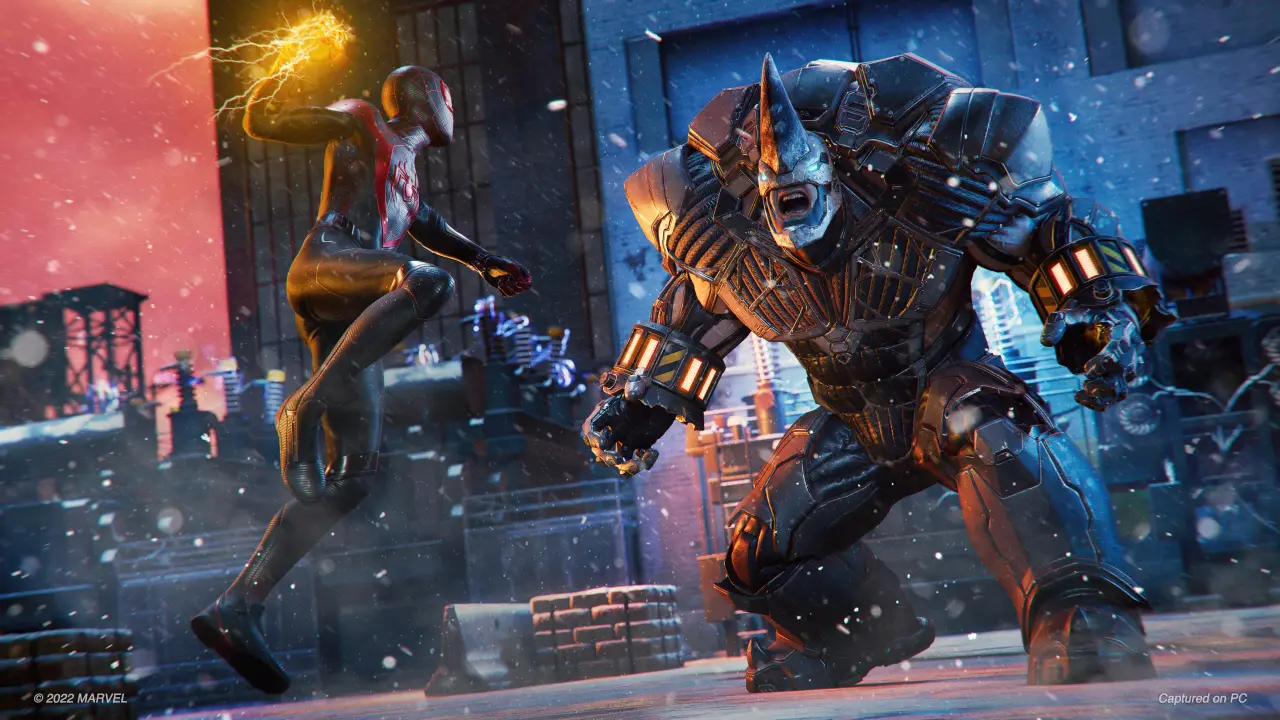
Here’s the big thing this game gets right: Miles doesn’t just swing through Harlem, he belongs to it. That sounds simple, but it’s the difference between a decent superhero story and one that actually lands. In Marvel’s Spider-Man: Miles Morales, the city isn’t just background noise like it often was in the first game for Peter. Here, Harlem feels like home, and the people in it treat Miles like one of their own. That matters. When neighbors call him by name, when the whole block knows who he is, the hero fantasy gets way more personal.
And the game keeps grounding that feeling in everyday life instead of staying stuck in giant comic-book spectacle. Rio Morales running for community council isn’t some random side note — it’s the story reminding you that heroism isn’t only about punching guys off rooftops. It’s about what’s happening on the block, who’s getting heard, and who’s getting ignored. That’s why the cultural identity stuff hits. Miles being Black and Puerto Rican isn’t window dressing. It’s baked into how the story sees him, and into how Harlem sees him back.
Phin Mason Carries The Emotional Weight

The main plot is pretty straightforward, honestly. Miles steps into the Spider-Man role while Roxxon and the Underground start tearing up Harlem over energy and power. You can see the shape of the story coming from a mile away, and yeah, that’s one of the weak spots. It’s not messy in a good way. It’s tight, it’s focused, and it moves fast, but it doesn’t exactly surprise you. Still, I’d rather have a short story with a clear pulse than a bloated one that forgets why I care.
What keeps it from feeling flat is Phin Mason. That friendship-turned-conflict dynamic is the heart of the whole thing. Phin, as the Tinkerer, is one of the best-drawn villains in the series because she isn’t just “bad guy with a plan.” She’s Miles’s childhood friend, which means every argument, every reveal, every fight has baggage behind it. That’s where the story gets its weight. It’s not about saving the city in the abstract. It’s about what happens when the person standing across from you used to know you before any of this Spider-Man stuff existed.
A Clean Story, But Don’t Expect Branching Or Bloat

If you’re here expecting a giant sequel with tons of extra story systems, this is where the game’s going to feel small. There isn’t much room for choice or branching here, because the whole thing is built as a compact, single-player run. That’s not automatically a bad thing, but it does mean the story is very locked in. You’re riding one path, and the game wants you to feel the emotional beats it picked for you. Most of the time, that works. But it also means replay value on the narrative side is pretty limited.
And yeah, the runtime tells the same story. The main campaign is only around eight hours, and even if you do a fuller sweep, you’re still looking at something in the mid-teens. For a standalone-priced spin-off, that’s thin. The side content is decent, but there’s less of it than in the first game, so the world doesn’t keep throwing new story bits at you for long. Once you get past the Harlem-specific warmth and the Phin drama, you do start to feel how much of the map is still Peter’s Manhattan under winter paint. It works fine, but it also means the story’s strongest idea is the neighborhood bond — not a massive leap in scope.
Audio | 8.5/10
Audio: 8.5/10Miles Sounds Younger Because the Score Stops Acting Like Peter’s

The music does a lot of the heavy lifting here, and honestly, that’s one of the smartest things the game gets right. John Paesano doesn’t just recycle the big, bombastic superhero vibe from the first game. He leans way harder into hip-hop and rap textures, and that fits Miles immediately. You can hear the difference in the attitude. Peter’s theme always felt like a bigger, flashier “here comes the hero” kind of deal. Miles gets something looser, cooler, and more local. It feels like a kid trying to figure out how to be Spider-Man while still sounding like himself.
That choice matters because this isn’t just background music. It helps sell the whole identity of the game. Miles is younger, more uncertain, and still growing into the role, so the score doesn’t swagger in like it owns the place. It moves with him. It has energy, but it’s got a neighborhood feel too, like the music knows these streets before the mask comes off. That’s why the short runtime works better than you’d think. The game isn’t trying to be huge. It’s trying to be personal, and the soundtrack backs that up every step of the way.
Nadji Jeter Makes Miles Feel Like a Real Kid, Not a Superhero Poster

Nadji Jeter is a huge reason this thing lands emotionally. He plays Miles with this mix of nerves, jokes, and genuine heart that keeps the character from turning into just another slick superhero clone. You get the awkward teenage energy. You get the humor. You get the little cracks in the confidence when the weight of the mask starts to hit him. And because the story is shorter, that performance has to do a lot fast. It does. No wasted motion. No dead air. He makes Miles feel like a real person first, hero second.
That works especially well because the game keeps tying Miles back to Harlem in a way the first Spider-Man game never really did with Peter and Manhattan. Here, the street knows him. People call him by name. His mom Rio is tied into the city-council campaign, so the whole superhero fantasy is grounded in actual neighborhood life. That makes the voice work matter even more. He isn’t just chatting over radio calls or cracking jokes while swinging around a generic open world. He sounds like someone who belongs there. And when the emotional stuff hits, especially around Phin, Jeter sells the hurt without making it melodramatic.
Winter Manhattan Feels Alive, and the Controller Makes It Hit Harder

The sound design is doing more than people give it credit for. The winter holiday version of New York has its own audio identity, and that’s a big part of why the game feels warmer than its setting might suggest. You hear the street-level atmosphere. You hear the city breathing under the snow. You hear the little details that make Harlem feel lived in instead of just decorated. That neighborhood vibe is one of the game’s best tricks, because it makes the world feel smaller in the best possible way. Less “massive open-world checklist,” more “this is your block, and these are your people.”
And on PC, with the DualSense support, the combat and swinging feel even better when you play wired. The haptics and adaptive triggers add a lot to the moment-to-moment feel of punching, dodging, and web-slinging through the city. It’s the kind of tactile stuff that makes Miles’s Venom-powered melee land harder, too. The shock hits, the dash closes distance, and the controller helps sell the impact in a way that makes the whole thing feel more immediate. That matters because the gameplay itself can be thinner than the first game. So when the audio and controller feedback are this good, they do a lot of work carrying the experience.
Visuals | 8.5/10
Grafica: 8.5/10Snowy Harlem Does More Than Look Pretty

The best thing about Miles Morales visually isn’t that Manhattan is technically bigger or flashier, because honestly, it isn’t. This is still mostly the same New York map you swung through as Peter. The trick is the winter makeover, and more importantly, how Harlem feels like Miles’s actual home instead of just another district with collectibles sprinkled on top.
Insomniac’s engine does a lot of heavy lifting here. Snow sits on rooftops, streets glow under holiday lights, shop windows throw warm color onto icy sidewalks, and the whole city has that sharp, cold, late-December look. It’s not subtle. The game wants you to feel Christmas in New York, and yeah, it works. When you’re swinging between buildings and the sunset catches all that glass and snow, it’s gorgeous in a very clean, comic-book way.
But here’s where it gets good: Harlem has a sense of belonging that Peter’s Manhattan didn’t quite have. In Marvel’s Spider-Man Remastered, the city was Peter’s playground. Here, Harlem is part of Miles’s identity. People know him. They shout his name. Rio’s city-council campaign is on the ground, in the neighborhood, not floating somewhere in superhero-land. That makes the visuals feel warmer than the tech alone would suggest. You’re not just looking at a pretty winter skin. You’re looking at a place the game keeps telling you matters.
And when you’re moving? Still ridiculous. The vertical flow of this city, the way Miles cuts through streets, dives between towers, flips over rooftops, and threads traffic from above, is still some of the best visual motion you can get in an action game. The catch is, if you played the first game hard, some of that magic wears thin. The skyline is familiar. The routes are familiar. The snow helps. Harlem helps more. But don’t expect a whole new visual world.
PC Is Where The Image Finally Gets To Breathe

On PC, this game looks better because it’s allowed to stop holding back. The PlayStation 5 version already looked strong, but ray tracing there came with the big tradeoff: 4K with ray tracing meant living around 30 frames per second. On PC, you can push past that. You can unlock the frame rate and aim for 120, 144, or just let it run as high as your machine can manage, and for a game built around speed, that’s not a small upgrade. That’s the difference between “pretty” and “oh, this feels alive.”
Nixxes Software did a seriously good job with this port. You get ray-traced reflections, DLSS 3 frame generation, DLAA, and FSR 2.1, so the game isn’t locked to one hardware tribe. Reflections matter here because New York is full of glass, wet streets, cars, shopfronts, and high-rise windows. When those surfaces actually catch the city around them, the whole place feels denser. It’s not just a checkbox feature. In motion, especially at night or after snow has turned the roads glossy, it adds a lot.
What I like even more is that the entry point isn’t absurd. A 6GB GTX 1060 can still get you in the door, which is honestly refreshing when so many modern PC releases act like your rig personally offended them. Sure, you’re not getting the full ray-traced, high-refresh showcase on that card. Let’s be real. But the fact that the game scales down cleanly and still holds together visually says a lot about the port.
And if you do have the hardware, this is the best way to play Miles Morales today. Not because PC magically changes the content — it doesn’t. The story is still short, the map is still mostly reused, and the boss fights are still thinner than they should be. But as a visual experience, unlocked frame rates plus modern upscaling make the swinging feel sharper, cleaner, and way more responsive than the console quality-mode tradeoff.
The UI Stays Out Of The Way, Which Is Exactly What It Should Do

The interface in Miles Morales gets one big thing right: it doesn’t smother the screen. That matters more than people think. This is a third-person action game where your eyes are constantly tracking height, speed, enemy positions, web lines, Venom prompts, camouflage timing, and whatever chaos is happening three stories below you. If the UI gets noisy, the whole thing starts feeling cheap. Here, it mostly stays clean.
Combat readability is strong. Venom powers are loud in the right way — bright, electric, punchy, and immediately readable without turning the screen into soup. When Miles fires off a shock that ignores defense and stuns enemies, the effect has weight. When he dashes in and knocks someone flying, you understand the impact instantly. Camouflage has the same benefit. It’s easy to read when you’ve slipped out of sight, and that helps make stealth more viable than it was with Peter. You can actually get detected, reset, and start picking people off again without the game making that feel clumsy.
The menus and upgrade screens are fine. Not exciting, not awful, just functional. And honestly, I’ll take that. The skill tree is pared back, so there’s only so much the UI can do to make progression feel deeper than it is. That’s one of the game’s visual-adjacent weaknesses: the presentation is slick, but the systems behind some screens are slimmer than you want from a standalone release.
The PC version also deserves credit for its options. You get a rich spread of accessibility, assist, and control settings, and both keyboard-and-mouse and controller play are supported properly. I still think controller is the natural fit for swinging, just because analog movement feels right for this kind of flow. But keyboard and mouse aren’t treated like an afterthought, and that matters. For graphics and presentation, Miles Morales lands at an 8.5 for me: beautiful, fast, polished, and especially strong on PC — just not visually new enough to fully escape Peter’s shadow.
Combat | 8.5/10
Gameplay: 8.5/10Miles Hits Harder Because Venom Changes the Whole Rhythm
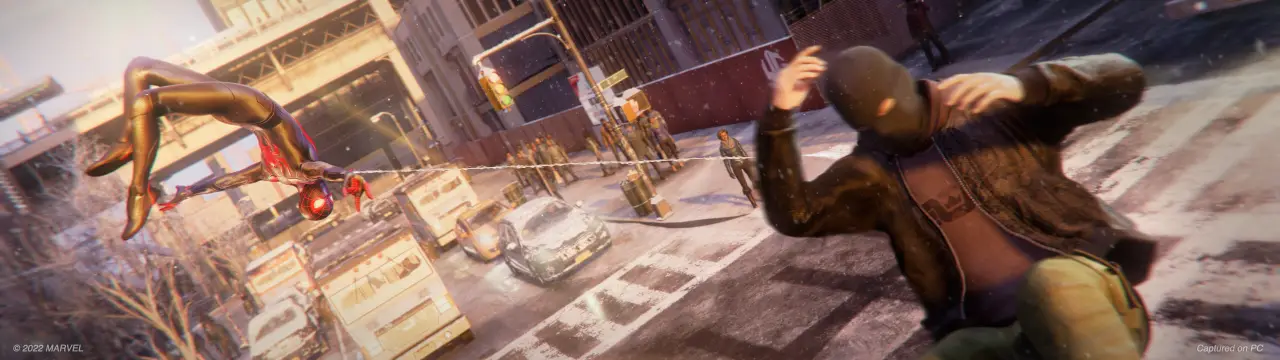
The big thing with Miles is this: he doesn’t just feel like Peter with a different suit. He fights differently. The Venom powers give combat a nastier, faster snap, and honestly, that’s the part that keeps the gameplay from feeling like a smaller rerun of Marvel’s Spider-Man Remastered.
Peter’s combat was already slick. You dodge, launch, juggle, web enemies to walls, bounce between targets, all that good superhero open-world stuff that still feels better than most games trying to do this. But Miles gets this electric punch that can ignore defense, stun a group, and break up those annoying shield-and-armor moments before they slow the fight down. Then you’ve got the dash-style Venom move that closes the gap and sends enemies flying, so instead of dancing around a crowd forever, you can just crack the whole fight open.
That makes melee feel more aggressive. You’re not only reacting. You’re forcing momentum. And because the game is third person, single player, and built around constant movement, that extra punch matters. You’re swinging into a street fight, landing in the middle of ten dudes, and immediately deciding who gets shocked, who gets launched, and who gets webbed to a car door.
The catch is, the game knows this is its main new toy. The skill tree is cut down compared to the first game, and the boss fights don’t have the same number or depth. So yeah, Miles feels amazing in regular fights, but don’t expect a huge pile of new systems stacked on top. The novelty is mostly Venom, camouflage, and the way those tools remix a formula you probably already know.
Camouflage Finally Makes Stealth Feel Like More Than Homework

Here’s where Miles quietly improves one of the weaker parts of the first game: stealth. In Peter’s game, stealth could be fun, but once things went loud, that was usually it. You messed up, now everybody’s yelling, time to beat the room into the floor. Miles’s camouflage changes that in a really simple way: you can vanish for a short time, break line of sight, and actually get back into sneaky mode.
That sounds small, but in play, it’s huge. It means being spotted doesn’t instantly kill the whole plan. You can take out one guard, misjudge a sightline, go invisible, crawl across the ceiling, and reset. Then you pick off the next guy. Then the next. For the first time in this series, silently clearing a whole room one by one feels genuinely viable instead of like you’re fighting the level design.
And compared to the Batman: Arkham games, which still loom over basically every superhero stealth-combat hybrid, Miles Morales earns its place in the conversation by being faster and messier in a good way. Batman is about fear and control. Spider-Man is about improvising while upside down. Miles adds panic buttons that still feel in-character. He can disappear, but he’s not a ghost. He can stun a crowd, but he’s still a teenager figuring this out as the room explodes around him.
The difficulty curve is friendly, too. This isn’t a game trying to crush you. If you’ve played the first Spider-Man, you’ll slide right in. If you haven’t, the basics are readable fast: dodge when the spider-sense flashes, stay airborne when things get crowded, use gadgets and powers before you get boxed in. The game’s challenge is less about brutal punishment and more about looking cool while staying in control.
The Swinging Is Still Elite, Even If Manhattan Feels Too Familiar
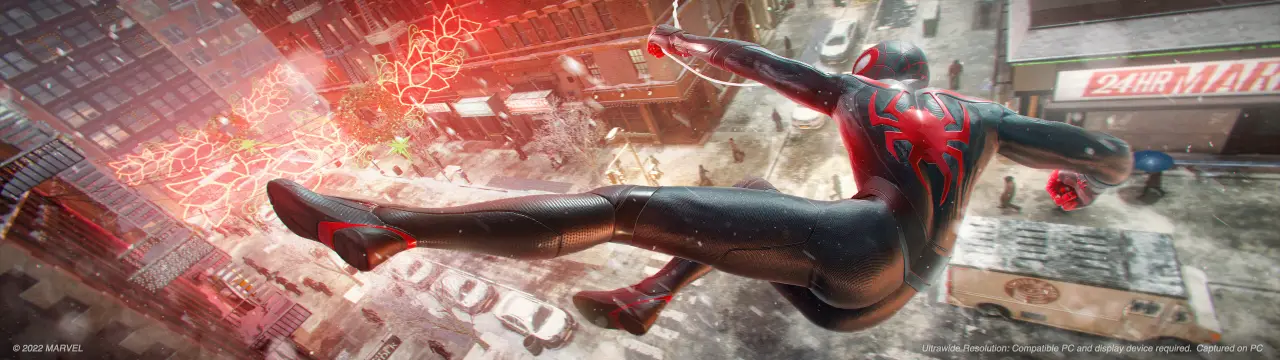
Traversal is still ridiculous in the best way. Swinging through New York remains the reason you sometimes ignore the objective for five straight minutes. You dive, zip, launch, skim over traffic, thread between buildings, and the game just keeps feeding you speed. This series understands something a lot of open-world games don’t: moving through the map has to be fun before the icons even matter.
But let’s be blunt. This is mostly Peter’s Manhattan in winter clothes. It looks good, especially with the PC version handled by Insomniac Games and Nixxes Software, with unlocked frame rates, ray tracing, DLSS 3 support, and even the ability to run on a 6GB GTX 1060. On PC, this is the best way to play it today. But structurally, if you’re coming in expecting a full new city or a massive sequel-sized playground, you’re going to feel the reuse.
The side content is also thinner than the first game. A full clear lands in the mid-teens, and the main story is about eight hours. For a tight, warm superhero story, that works. For somebody expecting a big standalone sequel, it’s light. The game is at its best when you treat it like a concentrated Miles story, not Marvel’s Spider-Man 2 before Marvel’s Spider-Man 2.
There are nice little touches, though. Unlocking Spider-Cat, the cat companion in the Peter-style mask, is exactly the kind of goofy side reward this game needs. It’s not deep. It’s not changing the combat meta. It’s just charming. And that matters, because Miles Morales is strongest when the mechanics and the neighborhood flavor are working together.
Harlem Gives the Action a Reason to Matter
The reason I’d still give this gameplay slice an 8.5 out of 10 is that the combat isn’t just cleaner and flashier. It’s tied to Miles’s identity in a way Peter’s game didn’t quite reach. In Marvel’s Spider-Man Remastered, New York is Peter’s stage. It’s a great stage, but a lot of the city is still backdrop. Here, Harlem feels like home, and that changes how the action lands.
Neighbors know Miles. They call out to him. His mother, Rio Morales, is running a city-council campaign, so the superhero stuff isn’t floating above the neighborhood. It’s rooted in it. When you’re stopping crimes or swinging back through familiar blocks, the game keeps reminding you that Miles isn’t just protecting “the city” in some vague comic-book way. He’s protecting the place that raised him.
That also gives the smaller scale a little more purpose. No, there aren’t as many bosses. No, the skill tree isn’t as full. No, the map doesn’t surprise you if you already played Peter’s game. But the moment-to-moment play has a warmer pulse because Miles belongs to this version of New York in a more personal way. And when Phin Mason, the Tinkerer, pulls the story into more painful territory, those fights hit harder than their mechanics alone would suggest.
So if you wanted a huge new open world with tons of fresh systems, this is not that game. But if you finished the first Spider-Man and wanted a shorter, sharper, more emotional superhero run with better melee tools and smarter stealth, Miles Morales absolutely delivers. It doesn’t reinvent the series. It gives it a jolt.
Content | 6.0/10
Contenuti: 6/10When the Credits Roll, You Realize How Fast This One Goes
My blunt take? This game is way too short to pretend it’s a full meal. The main story lands at about eight hours, and even if you go after everything, you’re still only in the mid-teens. That’s fine if you want a tight little run. It’s not fine if you’re paying standalone money and expecting something with the scale of a proper sequel. It moves fast, it gets to the point, and then it’s gone. Sometimes that feels refreshing. Other times it feels like the game is just starting to warm up when it’s already packing its bags.
And that’s the thing — the pacing is good, but the volume is thin. You don’t get the long, sprawling arc you’d expect from a big Spider-Man release. You get a concentrated story with a clear emotional spine, and then it’s over before it can really breathe. That’s why I’d tell you to come in with the right mindset. If you finished the first game and wanted more Miles specifically, this is a satisfying stretch of time. If you wanted a giant new playground and a whole new era of content, this is not that. It’s a high-protein snack, not dinner.
Fewer Side Jobs, Less Stuff to Chase, Same Old Manhattan
Here’s where the shrinkage really shows: the optional content just isn’t as rich as in the first game. There are fewer side activities, fewer collection bits, and less of that “one more district, one more task” loop that made Peter’s New York so easy to disappear into. You can feel the cutback pretty early. The game gives you things to do, sure, but it doesn’t keep layering on fresh distractions the way the bigger entry did. So if you’re the kind of player who loves living in the open world for dozens of hours, this one starts running out of gas.
And the map doesn’t help. It’s basically the first game’s Manhattan again, just dressed for winter. That sounds prettier than it feels after a while, because once the novelty wears off, traversal starts to blur together. You’re still swinging through the same streets, still hitting the same rhythms, and yes, Miles feels a little different in combat, but the city itself doesn’t reinvent the ride. Compared to Marvel’s Spider-Man Remastered, this is still Peter’s old stage with a new coat of paint. The neighborhood bond is stronger, the emotional angle is better, but the actual world design is more recycled than redesigned. That’s why the game lands closer to an interlude than a full sequel.
A Complete PC Release, Solid Word of Mouth, and a Pretty Good Long Tail
On PC, at least, the package is clean. The standard edition gives you the full game — no separate paid DLC hanging off the side, no weird content trap, just the complete release. That matters more here than usual, because a shorter game needs to justify itself on value, and at least it doesn’t nickel-and-dime you after the fact. And the port itself is strong enough that it helps the game age better than its runtime might suggest. Nixxes brought over DLSS 3, unlocked frame rates, and ray tracing, and it’ll even run on a 6GB GTX 1060. That’s the kind of thing that keeps a game alive on PC after launch day noise fades.
The user response backs that up. Steam sits at 93% positive across 36,622 reviews, which is a lot of people basically saying, “Yeah, this one works.” That doesn’t magically make the campaign longer, and it doesn’t turn the game into a bigger sequel than it is. But it does explain why it keeps its footing over time. People clearly connect with it, especially if they wanted more Miles after the first game and were happy to get a shorter, warmer story instead of a giant reinvention. And that’s really the right lens for it. Compared with Marvel’s Spider-Man 2, this is the bridge, the palate cleanser, the in-between bite — not the main course.





Commenti 0
Ci interessa la tua opinione
Partecipa alla discussione e condividi la tua opinione su questo gioco.
Ancora nessun commento. Dicci cosa pensi di questa recensione.