






















Opening
## Opening
Planet Zoo is what happens when a studio with documentary-grade animal modelling chops and a thousand-piece modular building kit decides to rebuild Zoo Tycoon for the modern PC. Frontier shipped it in 2019 with seventy-something species, four play modes and a Workshop pipeline, then spent the next six years pouring twenty paid packs and a steady drumbeat of free updates on top of that base. By the time you read this it is essentially the genre ceiling for animal park sims — eighty-nine percent positive on Steam across more than seventy-seven thousand reviews, a Metacritic of 80, an OpenCritic "Mighty" stamp, and a Workshop catalogue north of half a million player creations.
What follows is a six-axis breakdown of where the game earns those numbers and where it doesn't. The short version: the animal fidelity, the building toolset and the long-tail content depth are best-in-class; the campaign narrative is a thin tutorial wrapper; the DLC sticker price gets steep; and the simulation rewards patience over reflexes. If you want to know whether you should buy it, which modes to start in, and which packs are worth their money, the next six sections cover all of it.
Story | 5.0/10
Storia: 5/10## Story
The Career Mode Frame
The story spine of Planet Zoo lives entirely inside Career Mode, and it is unapologetically a scaffold for the tutorial rather than a narrative attraction. You play a zoo worker whose former boss has vanished, whose company gets swallowed by an unscrupulous businessman named Dominic Myers, and who is promptly fired by the new owner. From there you go to work for the previous boss's daughter, helping her rebuild a chain of zoos across the world while quietly exposing what Myers has been up to. The whole arc is delivered across thirteen scenarios, each engineered to introduce one mechanical layer — basic construction, habitat needs, staff management, the research tree, the conservation programme, and so on.
Treating that frame as a story to be reviewed misses the point of it. There are no branching choices, no real character writing, no multiple endings, no moral dilemmas, no antagonist beyond a competent voice-acted villain who exists so the campaign has somebody to push against. What Frontier has actually built is a guided onboarding curve disguised as a continent-hopping plot, and on those terms it works: every mission map teaches one new mechanic in roughly an hour of play, the difficulty ramp from "build a starter habitat" to "manage a multi-biome park" is smooth, and the voice acting lends warmth to what would otherwise be dry tooltips. As narrative it is forgettable. As tutorial design it is one of the better examples in the genre.
Where the Real Story Lives — Player Zoos and the Animal Encyclopaedia
The actual narrative weight of the game is carried by two non-traditional sources. The first is the in-game animal encyclopaedia. Every species ships with a real biology sheet — taxonomy, range map, IUCN Red List conservation status, diet, social structure, breeding cycle, enrichment preferences. A non-trivial slice of the roster is genuinely threatened in the wild: Sumatran tigers, Javan rhinos, California condors, snow leopards, Amur leopards. The act of breeding those animals in your park and releasing offspring back into the wild for Conservation Credits is the closest thing the game has to a thesis: zoos as living conservation institutions. Frontier hired wildlife consultants during development and it shows in everything from gait cycles to social behaviour, and the result is an "interactive nature documentary" framing that families and schools have quietly adopted as a learning aid.
The second source is the player's own zoo. The systemic depth of the construction toolset means every save file is effectively an authored long-form story: the original five-acre enclosure that grew into a two-hundred-species flagship park, the orphaned elephant calf that became the marketing mascot, the wetlands wing built specifically to house the first successful Javan rhino breeding pair, the accessibility-first paths added after a player decided their virtual zoo should welcome wheelchair guests. The Steam Workshop and the r/PlanetZoo subreddit are full of these accounts — multi-year save files documented across hundreds of screenshots and "year N of my zoo" video series. That kind of emergent autobiography is what people actually mean when they talk about the story of a Planet Zoo playthrough.
Comparing With Other Sim-Builders
Across the rest of the simulation-builder genre, narrative is usually thin by design. Two Point Hospital uses comedic vignettes between levels but doesn't pretend at a continuous story. Cities: Skylines has no campaign frame at all. Tropico 6 is the genuine outlier in the field with branching political missions and a written El Presidente arc that genuinely changes the play experience between runs. Set against that comparison field, Planet Zoo's Career sits squarely in the middle — better than no-frame games like Cities, considerably lighter than Tropico's authored political vignettes, roughly on par with Two Point Hospital's between-level beats but with a more earnest, animal-welfare-oriented tone instead of the British workplace comedy register.
The Frontier sibling that most closely resembles Planet Zoo's narrative approach is Jurassic World Evolution, and the comparison is instructive: Evolution leans on a major film IP for character weight Planet Zoo simply doesn't have access to, with branded characters, voice cameos and known plot beats that lift the narrative ceiling without changing the underlying tutorial frame. Stripped of that IP scaffolding, Planet Zoo is left writing an original cast against an original premise, and the result is competent rather than memorable. That is a defensible design choice for a game whose audience is queueing up to build, not to read.
The Chinese-Community Read
The Chinese-language community's verdict on Planet Zoo's story is consistent with the international one but more openly indifferent. 3DM's review put it bluntly: "Planet Zoo is not a game you play for the story, it's a game you play to feel the joy of caring for animals." On Bilibili, the dominant Planet Zoo content categories are animal showcases, build tutorials and Workshop tours; almost nobody makes long-form videos about the Career narrative, and the few that do treat it as "how to finish the thirteen tutorial levels as fast as possible" rather than as a story to enjoy. Gamersky and Gcores reviews echo the same priority — the story rating is treated as a side note rather than a deal-breaker, while the build freedom and the animal encyclopaedia are where the column inches go. Several of the most-watched Chinese creators have published guides specifically aimed at speedrunning Career mode so their viewers can "get the tutorial out of the way" and unlock Sandbox or Franchise faster, which is itself a useful signal about how the community values the narrative; forum threads on NGA and S1 consistently rank the campaign well below the encyclopaedia and Workshop tools when discussing the game's strengths. That communal indifference is exactly why a 5.0 story score doesn't dent the game's overall standing — buyers in this genre aren't shopping for narrative, and the rating sheet should weight that accordingly when read by Chinese-speaking buyers.

Audio | 8.0/10
Audio: 8/10## Audio
Score and Musical Direction
Planet Zoo's soundtrack was written by Frontier's in-house audio team and runs to roughly thirty tracks across the base game, expanding modestly with each pack. The musical brief is unmistakable from the first menu screen: warm, light orchestral colour with strings and woodwinds carrying most of the melody, gentle piano and acoustic guitar layered into the calmer building cues, and full orchestral swells reserved for the campaign's emotional beats. The whole thing is designed to live in the background of a multi-hour build session without ever stepping on your concentration, and on that brief it succeeds — long sandbox sessions don't develop the listener fatigue that more aggressive sim soundtracks can cause.
The aesthetic choice itself is the most interesting thing about the score. Frontier's audio team consciously turned away from the cinematic-bombast template that defines most AAA work and from the punchy percussive loops that drive action games, and instead reached for something closer to a Sunday afternoon at a real zoo. That fit between musical tone and game purpose is the OST's real win. It tells you, before you have built anything, that this is a game about quiet attention rather than tension. As a standalone listen the music is modest; as a functional layer that supports the four-hundred-hour build pipeline, it is well-judged.
Animal Vocalisations and Environmental Sound
The hidden gem of the audio mix is the environmental layer, and the centrepiece of that layer is the animal vocalisations. Frontier sourced and authored species-specific calls based on field recordings of real wildlife — the rolling roar of a lion at full chest, the low infrasonic rumble of an elephant herd communicating across an enclosure, the iridescent screech of a peacock in display, the social babble of a penguin rookery, the carrying contact calls of flamingos. Each species is tied to its own bank of vocalisations rather than reusing generic loops, and the volume of every animal is positional, so walking the visitor path through a multi-habitat zoo gives you the same shifting soundscape you would get at a real one.
The supporting environment work is equally careful: distinct wind treatments for savanna versus alpine biomes, water sources broken into waterfalls, streams and pools with separate timbres, crowd murmur that reacts to the density and mood of guests, the mechanical layering of monorail wheels, gondola cables, gift shop tills and animal-keeper trucks. That density is what makes the in-game guest-mode walk-through worthwhile: standing at a capybara pool you can hear the low grunting through the water, and stepping into the primate house you pick up the lemurs trading territorial calls overhead. Spatial fidelity at this level is rare in sim-builders and is one of the reasons people put hundreds of hours into a single park.
Voice Acting and Localisation
The campaign and tutorial layers ship with full English voice acting. The cast is small but competent, with the recurring tutorial mentor and Career antagonist carrying most of the lines, and the performances do useful structural work — they take what would otherwise be a wall of tooltips and make the thirteen-mission curriculum feel like a guided walk rather than a manual read. The overall voice direction is mid-to-upper tier for the sim genre, which is praise the genre rarely earns; voice work in this category is more often phoned-in than not.
Localisation is where Frontier earns real credit with non-English audiences. Simplified Chinese was a day-one official locale, with menu text, the animal encyclopaedia, all tutorial subtitles, and the Workshop browser fully translated — a level of investment most mid-budget Western sim-builders skipped on Asian markets at the time. Traditional Chinese followed, and pack-by-pack updates have stayed translated. The one genuine gap is dub work: there is no Chinese voiceover, so all voiced content lives on subtitles. Chinese-language community feedback on the localisation rates the text quality as solid; the absence of a dub is the only consistent complaint and it is a mild one. Eight out of ten is what you get when the music is purpose-fit, the environmental mix is genuinely excellent, the voice direction punches above the genre, and the only weakness is a missing dub track in one of the world's largest gaming markets.


Visuals | 8.5/10
Grafica: 8.5/10## Graphics
The Cobra Engine and the Animal Models
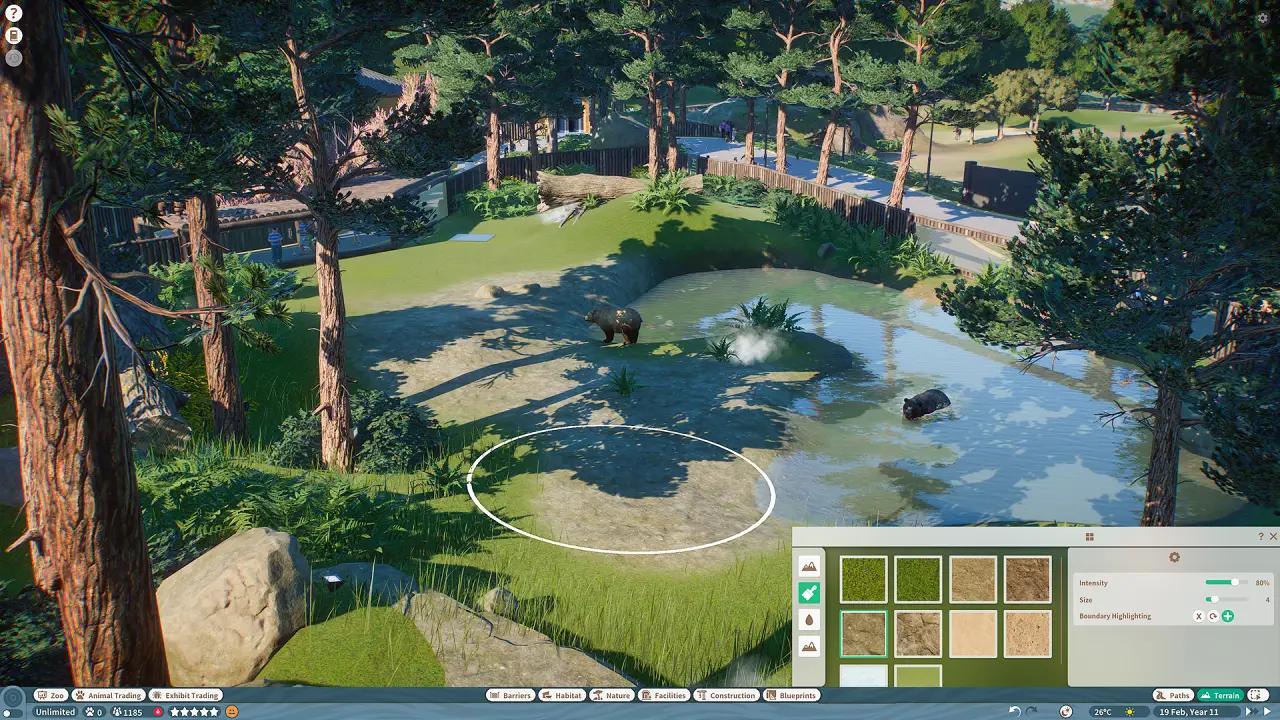
Planet Zoo runs on Frontier's in-house Cobra engine, the same lineage that powered Planet Coaster and Elite Dangerous, tuned here for two specific stress cases: rendering large numbers of high-fidelity animal individuals concurrently, and supporting deep modular construction where every screw, tile and beam is its own placeable. The headline result of that engineering brief is the animal modelling, which is genuinely the best in the genre and remains so years after launch. Across the seventy-plus base species and the hundred-plus pack additions, every creature has its own polygonal model, fur or scale shader, gait animation set and behavioural state machine — the bulk of a polar bear coat, the giraffe's reticulated pattern catching the right light, the textured wrinkles on an elephant's flank, the metallic iridescence of a peacock's tail.
Critics from IGN downwards reached for the same metaphor when reviewing the game in 2019: "you almost forget it's a management sim." The behaviours sit underneath the visuals — elephants drink with their trunks, giraffes lower their long necks to reach water troughs, polar bears roll in fresh snow, penguins porpoise through swimming sections. Each of those actions is a biomechanically reasonable approximation rather than a canned loop, which is why long sessions watching a single habitat never feel mechanical. The base animal fidelity is what locks the visual identity of the entire product line in place, and it is the single biggest reason Planet Zoo has stayed a Workshop juggernaut for so many years.
Art Direction and Biome Variety
The art direction is a deliberate hybrid — photo-real animal models dropped into a slightly stylised, warm, brightly-lit environment. That combination is more thought-through than it looks. Pure photoreal environments would have read as oppressive given the long average session length and the educational/family-friendly tone Frontier wanted; pure stylisation would have undercut the animal modelling, which is the most expensive visual asset in the product. The middle ground lets adult players appreciate the wildlife fidelity while younger players get a palette and lighting that never tips into grim. The same logic explains why the lighting model leans toward soft, mid-altitude sunshine across most biomes.
Biome variety is the second visual win. Builders can drop a park into arctic, tropical rainforest, African savanna, North American forest, Australian outback, or Asian mountain settings, and each biome ships with its own vegetation library, terrain palette and ambient lighting profile. The plant library alone runs into the hundreds of distinct trees, shrubs, flowers and ground covers, all individually modelled, which is what allows the Workshop's most ambitious dioramas to look genuinely site-specific rather than reskins. A wetland boardwalk in the Aquatic Pack reads differently from a tropical bird walk in the Tropical Pack because the entire plant stack and ambient palette underneath them is different — that effort is what supports the genre-leading screenshot density.
Screenshot Mode and the Player Photography Scene
Planet Zoo ships a full photo mode — pause the simulation, free the camera, control focal length, swap in depth-of-field, apply colour grading, and export at up to 4K. The feature is functionally a small virtual cinematography studio, and the playerbase has put it to remarkable use. Steam screenshot sharing for Planet Zoo has consistently sat near the top of the platform's leaderboards, and that volume reflects how much of the audience treats the game as a photography platform first and a management sim second. Frontier designed for it: the default photo-mode profile already enables tasteful DOF and grading, so a player who has never used the mode can produce a desktop-wallpaper-grade shot on the first try.
The Chinese-speaking community has built a noticeably visible piece of this scene — dedicated Bilibili, Banciyuan and Xiaohongshu accounts produce ongoing "Planet Zoo photography" feeds with framing that consciously borrows from National Geographic and BBC nature work. The natural extension is the close-up safari: players will set up shots a meter from an elephant's trunk, beside a lion's mane, or under a peacock's outstretched tail feathers, and at that range the modelling holds up. That kind of stress test on the visual stack is unusual and Planet Zoo's models survive it. The flip side of all that engine headroom is system requirement, which is genuinely mid-range — an RTX 2060-class GPU and a current-gen mid-tier CPU clear it comfortably, and moderate parks (around 200 animals, 50-ish buildings) run fine on the recommended hardware, while five-hundred-animal Workshop mega-parks drop frame rates noticeably on entry-level hardware and integrated graphics should expect to keep ambitions modest. That is the realistic price of the modelling and modular density on offer, and set against Cities: Skylines' lower-poly stylisation, Planet Coaster's cartoonier theme-park look and Two Point Hospital's flat illustrative style, Planet Zoo is straightforwardly the highest-fidelity entry in the category — documentary-grade animal models inside a deeply modular construction engine remain rare in the genre, which is why the 8.5 graphics score is fair: genre-leading on launch in 2019, still genre-leading by 2026, with the visible price of needing real hardware to push the system to its full Workshop ceiling.


Combat | 8.5/10
Gameplay: 8.5/10## Gameplay
The Four Modes and Who Each Is For
Planet Zoo ships four play modes and the surprising thing about them is how cleanly they map to four different player intents. Career mode is the on-ramp: thirteen scripted scenarios that each introduce one mechanical layer — construction, habitats, staff, research, conservation — and that walk a first-time player from "place a fence" to "manage a multi-biome park" without ever feeling like an instruction manual. Franchise mode is the only online layer and the one the long-term metagame lives in: you build multiple parks under a single account, share a global animal market with other players using Conservation Credits, and trade rare or threatened species through the integrated exchange. Challenge mode strips the online layer out and gives single-player veterans the same economic constraints with different starter conditions and difficulty presets. Sandbox unlocks unlimited funds and Conservation Credits and is the canvas the Workshop's most ambitious builds get drafted in.
Where most sim-builders push every player down a single funnel, Planet Zoo's mode design quietly accommodates a tutorial-shaped learner, an online trader, a solo economic optimiser and a pure architect side by side. The same player will rotate through all four across a few hundred hours: Career to onboard, Sandbox to prototype a building or habitat as a free sketch, Franchise or Challenge to run the resulting design under real pressure, and back to Sandbox to refine it. That cycle is one of the structural reasons people stay in the game so long.
Modular Construction From a Single Plank
The modular construction system is the feature reviewers most often single out, and the deeper you go into it the better it gets. The base game ships over a thousand individually placeable pieces — seats, lamps, plants, single planks of wood, glass panels, rock chunks, roof tiles, beams, columns, statues, signs — and every piece can be snapped, rotated, scaled, intersected and freely combined with every other piece. There is no "preset building" you are required to use. You can place a single plank, decide it is the first joist of a roof, and build outwards from there for hours; the engine will let you.
That depth gives the system real range. New players who don't want to fight the toolset can pull complete buildings out of the in-game blueprint library or the Steam Workshop, drop them onto a foundation and only tweak the surface details — a transition cost that is genuinely low. Veteran builders use the alignment grid, the shape-snap tools, the symmetry mirror and the component grouping to push toward architectural-CAD-level precision, and the Workshop's flagship parks routinely exhibit that level of finish. The result is one of the highest construction skill ceilings in any sim-builder, with a floor that doesn't punish new players for not being there yet.
Habitats, Animal Welfare and the Real Skill Test
Habitats are where the simulation depth actually concentrates, and they are the system the game uses to teach animal welfare. Each species carries its own habitat profile, and a viable enclosure has to satisfy a stack of parameters at once: terrain composition (the right ratio of grass, rock, water and substrate), specific plant species in the right counts, ambient temperature and humidity envelopes (an arctic species rejects a tropical habitat), barrier type (glass, mesh, hot wire, wooden — each rated for body size and climb ability), minimum activity area per individual, social structure (solitary, pair-bonded, herd), and enrichment items (toys, scratch posts, climb frames, scent stations).
You cannot bluff this part of the game. A casually fenced field with a single animal in it will see welfare scores collapse, illness rise, escape attempts trigger and visitor reviews crater, and the only correctable lever is reading the species sheet and rebuilding the habitat correctly. That is the system that makes Planet Zoo a genuine simulation rather than a decorating sandbox: animal welfare has economic teeth, and the skill test is biological literacy applied to a virtual space. Players who lean in start to develop genuine working knowledge of real wildlife requirements; players who don't tend to bounce off the management layer in the first ten hours.
Six Staff Roles and the Economic Stack
The management layer underneath the habitats is correspondingly meaty. Six staff roles — keeper, mechanic, janitor, security, vet, researcher — each have their own recruiting market, training tracks, salary curves and morale dynamics, and each is the rate-limiter on a different operational function. Keepers feed and groom animals; mechanics keep rides and infrastructure online; janitors clear the pathways; security manages drunk or unruly guests; vets handle illness and breeding complications; researchers unlock new species and technology tiers. Underpaid or undertrained staff push back through productivity drops and morale collapses, and large parks need genuine HR planning rather than ad-hoc hiring.
The economic ledger has matching depth. Income comes from gate fees, gift shops, food and drink outlets, parking and donations; outflow covers staff salaries, animal feed, habitat maintenance and infrastructure depreciation. The research tree gates new species and habitat technologies behind researcher time, so opening a new continental wing of your zoo means committing to a multi-month research investment first. Conservation tracks health, breeding lineage and family relationships across generations, and successful breeding programmes can release offspring back into the wild for Conservation Credits, which is also the currency that buys rare or endangered species off the Franchise market. It is a system that rewards multi-pass planning, and it is the reason Planet Zoo plays meaningfully different at five hundred animals than at fifty.
The Steam Workshop Multiplier
The Steam Workshop has tipped past five hundred thousand uploads of player-made buildings, habitats, entire parks and blueprint collections, and that volume is what makes the gameplay catalogue effectively unbounded. You can play Planet Zoo for hundreds of hours without ever touching your own construction toolset and still keep encountering new material — the typical Workshop subscriber maintains a rotating subscription list across hundreds of items, and curated collections by trusted creators function as informal expansion packs in their own right.
The Workshop has also developed its own secondary creative economy. Themed blueprint packs — museum-style entrances, Southeast Asian floating-market motifs, Nordic timber-village builds, Art Deco zoo entrance halls, brutalist concrete primate houses — get curated and downloaded in bulk, and a player who installs one only needs to handle animal selection and habitat tuning to ship a finished park. That distribution of construction skill across the community is the underlying reason the 8.5 gameplay score holds up over time. Set against the rest of the 2019 sim-builder shelf — Planet Coaster, Two Point Hospital, Cities: Skylines, Tropico 6 — Planet Zoo's combination of construction freedom and animal simulation depth is the top of the genre, and that lead has not been seriously challenged in the years since launch.


Content | 9.0/10
Contenuti: 9/10## Content
Species Roster and Six Years of Live Operation
The first content number that matters is the animal roster, because in a zoo sim the species count is the literal shelf space. The base game launched with around seventy species; with the full twenty-pack DLC catalogue layered on, the working total now sits past two hundred. That is the genre's standing record for species count in a single product, and it is the metric the buyer should weigh first. Comparable contemporaries each have their own headline number — Two Point Hospital's roughly two hundred illnesses, Cities: Skylines' five hundred-ish building types, Planet Coaster's hundred-plus coaster components — but on the specific lane of "distinct authored animal species" Planet Zoo is alone at the top.
Frontier turned that base into a six-year live-operations programme, shipping more than twenty paid packs across the title's tail: Arctic, South America, Australia, Aquatic, Southeast Asia, Africa, North America, Europe, Wetlands, Conservation, Twilight, Grasslands, Tropical, Arid, Oceania, Eurasia, Barnyard, Zookeeper, Americas, Asia and others. Each pack tends to drop four to eight new species plus a thematically matched library of building modules. Critically, every paid pack has been accompanied by a free update — new mechanics, new pieces, system-level features — so even players who buy nothing keep receiving content. The cadence has been steady enough that the game has read as a live product rather than a "ship and abandon" build for the entire post-launch period.
Main Story Length and Completionist Time
The hour budget bears that scope out. The HowLongToBeat median for Career mode plus a baseline Franchise run lands around fifty hours, and the completionist median — every achievement, every scenario goal, every species and every DLC — runs to roughly two hundred. Those numbers slot in at the top of the sim-builder range: Cities: Skylines lands near forty for a main-line completion, Two Point Hospital around thirty, Planet Coaster around sixty. Fifty-to-two-hundred is the upper bracket of the category.
But the "main story" frame is a slightly misleading way to measure Planet Zoo, because Sandbox makes the campaign optional and the real content total tracks whatever personal objective the player adopts. Chinese-language community playthroughs frequently anchor on bespoke goals — breed every IUCN-Endangered species, assemble a flagship roster representing each continent, build region-accurate biome backdrops for every species. Each of those tracks reliably absorbs dozens of hours by itself. The honest reading of the time budget is that "completion" is a target the player sets, and the game has enough authored material to support most reasonable targets without running dry.
Four Modes, Four Content Lanes
The four-mode structure is itself a multiplier on perceived content. Career delivers the thirteen authored scenarios with their guided progression and voiced cutscenes. Franchise delivers an open-ended online metagame across multiple parks, where Conservation Credits, the global trading market and continuous breeding programmes provide their own progression vocabulary that the campaign never touches. Challenge mode is single-player Franchise — same rules, different starter conditions, presets ranging from beginner-friendly to harsh — and is where economy-focused players who don't want online dependencies live. Sandbox is the unlimited canvas, the mode the Workshop's flagship builders use as a sketchpad before porting finalised designs into Franchise.
Players rotate between modes routinely rather than picking one. The community workflow that surfaces most often is a four-step pipeline: draft a building or habitat in Sandbox under unlimited funds, blueprint the result, port it into Franchise to stress-test the design against real visitor traffic and economic pressure, then refine it back in Sandbox. That cross-mode loop is something the game enables almost by accident, and it is the reason the four-mode structure feels like four overlapping content lanes rather than four separate menu options. Each mode independently has hundreds of hours of content; together they are the reason the total content rating sits at the top of the category.
DLC Cost, Workshop and Chinese-Community Content
The cost question has to be addressed honestly because it is the single largest knock on the package. Fully unlocking the two-hundred-species roster requires the complete twenty-plus pack stack, which retails near $150 — roughly three to four times the base price. Frontier's defence is that the post-launch programme is the reason the title has stayed alive for six years, and Steam's regular DLC bundle discounts (often 70 percent or more) make a complete-edition entry point much cheaper than the rack price suggests. The Chinese community's posture on this has been net-positive but pragmatic: enthusiasm for Frontier's sustained support, balanced against the recognition that a "full package" entry cost is non-trivial. A reasonable buying strategy is to start with the base game and pick packs based on which species and biomes match your personal interest — full-stack purchase is not a prerequisite for a satisfying experience.
The Steam Workshop is the final multiplier. With more than half a million player creations and an active builder community spanning English, German, Japanese, Korean and Chinese forums, the practical content ceiling is whatever the Workshop has uploaded — which is to say, effectively unbounded. Chinese builders have contributed a recognisable subset: "Beijing Zoo recreation", "Shanghai Wild Animal Park recreation", themed packs around native Chinese species and scenes from Chinese mythology. That participation gives Chinese-speaking buyers a genuine sense of being part of a global creative community rather than an audience downloading other people's work. The 9.0 content score reflects all of it — the standing species record, the upper-bracket time budget, the four-mode breadth, the half-million-asset Workshop, the six-year live-operations programme — and it is the single highest dimension in the game's overall rating.





Commenti 0
Ci interessa la tua opinione
Partecipa alla discussione e condividi la tua opinione su questo gioco.
Ancora nessun commento. Dicci cosa pensi di questa recensione.