



















Opening
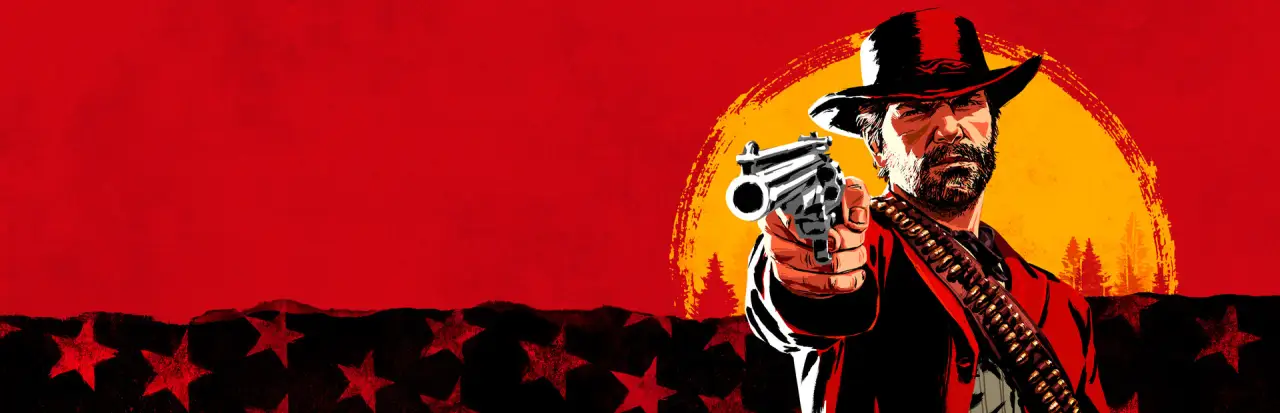
Rockstar built one of the finest open worlds ever shipped, then walked away and left the lights on. Red Dead Online runs on the exact map of Red Dead Redemption 2 — Rocky Mountain snowline down to the steaming plantations of the Deep South — and it inherited every ounce of that craft. What it never inherited was the company's attention. In July 2022 Rockstar announced it was done with major updates and folded its resources into Grand Theft Auto VI. So the thing you buy today is a world-class theme park where nobody is building new rides anymore.
The strange part is that people refuse to leave. The Steam page carries 59,159 reviews at 82 percent positive, the all-time peak hit 19,887 concurrent players, and even now, with only a few hundred online at a time, those few hundred genuinely live out here. They did not come for new content. They came to be cowboys with three friends — to fish, to camp, to watch the stars, and to get blown out of the saddle by a stranger in the brush. For them this stopped being a live-service game years ago; it became a place they keep going home to.
That is the contradiction at the heart of it. The world hit a genre ceiling while the live-service hand let go early; the game sits under an official suspended sentence and stays alive on nothing but player affection. The only question this review needs to answer is whether that frozen, gorgeous, unattended frontier is still worth saddling up for. Six dimensions below, I count the ledger out loud.
Story | 6.0/10
Storia: 6/10The single biggest trade Red Dead Online makes is swapping Arthur Morgan for a cowboy you build yourself. That swap maxes out your freedom and quietly drains the floor out of the storytelling, which is why narrative is the one dimension I had to push down to 6.0.
A custom outlaw buys you freedom and costs you the through-line

The single-player campaign earns its reputation on Arthur Morgan's slow march toward a fixed ending; you are not completing missions so much as watching a man walk toward his own grave. Online tears that line out. You roll your own character — face, gender, temperament, all yours — and the freedom is intoxicating, but the price is that no fixed protagonist carries the emotion for you anymore. Everything you do is technically "your story," yet the game stops telling stories and limits itself to building the stage.
That produces a subtle gap in how the hours land. Stranger missions and the Blood Money arc that arrived in July 2021 still keep the base game's cinematic staging — the camerawork, the score, the cutscene beats are all present, and any single sequence holds up against a full 3A production. String forty hours together, though, and those missions read like a box of jigsaw pieces rather than a spine. Each one is sharp on its own; together they never assemble into a "I have to know how this ends" engine. You remember a tense capture, an ambush in the rain — you struggle to say what your character's story actually was.
It dresses the stage beautifully; it just won't take the mic

Split the dimension open and you find two legs of wildly different length: environmental storytelling and character storytelling. The environmental leg is enormous. Ride through a pine wood at dawn, hear a wolf somewhere past the treeline, watch townsfolk mutter at your notoriety — that wordless ability for the world to narrate itself is still best-in-class. Measured against the base campaign's environmental density, Online barely loses a step.
The character leg is the one that buckles. Because the lead is you, no NPC, however well written, can build the kind of bond the campaign forged when it made you mourn a man. Madam Nazar, Harriet, Gus — the guides on each role's questline have personality, but they remain functional fixtures serving a gameplay loop, not people who move in and stay. The Chinese-language consensus lands on exactly this point: the most upvoted Zhihu verdict calls the scenery untouchable and the parenting negligent — and the first thing a neglectful parent stops doing is writing characters into your heart.
Solo, the thin story leaves you stranded — and the freeze sealed it

A thin narrative is no problem with friends around; you and your posse become the story. Log on alone, with nobody to ride with, and the weakness slams into your face. With no plotline pulling you forward, your only long-term objective collapses into "grind role ranks," and the role grind is dull labor by design. That is the moment you feel it most clearly: the game handed you a flawlessly real West and forgot to hand you a reason you cannot leave.
There is one more thing worth flagging. Ending major updates also strangled what little narrative ambition Online had left. A live game like this could have thickened its world and stood its people up through release after release of story content; once Rockstar shoveled its resources into the next title in 2022, that already-slender thread simply stopped at Blood Money with no follow-up. So you feel a half-finished regret — the studio plainly could have told a fuller online story and chose instead to leave a perfectly dressed stage with nobody to keep writing for it. That regret is the last straw that pins narrative at 6.0. It is not that the writing is bad; it is that the game deliberately set down the campaign's sharpest weapon and never picked it back up. The trade it offers — swapping "tell you a story that breaks your heart" for "give you a world where you write your own" — pays off handsomely for the player with a crew who loves to live in a place, and stings the player who wants a plot to march them forward by the collar. Where you fall on that line all but decides whether you love the entire game.
Audio | 9.0/10
Audio: 9/10Audio is where this game scores its highest mark, a 9.0, for a plain reason: the sound is so strong you only notice it once it goes missing.
The frontier's air is something you hear before you see it

Mute the game for five minutes and the value of this ambient design becomes obvious. With the sound on, wind dragging across the grassland, hooves squelching into rain-soaked mud, the cries of unnamed birds and beasts off in the distance, the layered piano and drunken laughter inside a saloon — none of it is wallpaper. It is the literal air of this frontier. Chinese players keep reaching for the word "untouchable" to describe the immersion, and that is not hyperbole; plenty of them log on not to grind ranks but to spend a little longer inside a wilderness conjured entirely out of sound.
That "only noticed when absent" strength is the hardest strength to engineer. It does not bait you with one explosive theme tune. It weaves hundreds of tiny sounds into a seamless net so your ears, anywhere and at any moment, believe you are genuinely standing in the American West of the 1890s. Critics and players alike grade the audio with near-total agreement, and that consensus is the direct reason I pushed this mark to the top of the card.
The score and Dead Eye both know exactly when to shut up

What shows real craft is the restraint of the music. For most of the runtime it barely plays, ceding the stage entirely to ambience. The instant you slide into a standoff, a chase, or a real firefight, strings tighten without warning, the tempo creeps up, and when the first shot finally cracks the feeling has landed precisely where it needed to. That discipline — silent when it should be silent, surging when it should surge — is far harder than a catchy melody. It is music keeping time with your adrenaline.
The moment Dead Eye triggers is the high point of audio-visual marriage. Time stretches, the world's sound muffles down and narrows to your breath and the chamber click, and then the bullets go out one by one. That feedback magnifies the rush of "I own this standoff" several times over. The whole sonic language — coarse, hollow, dangerous with the occasional streak of romance — locks flush against the series' western register. And the sounds themselves breathe with the scene: ride from a noisy town toward open country and the chatter, carts, and shopfront calls peel away by degrees, replaced by wind and insects, a transition that empties and stills your chest as surely as it empties the soundstage. Camp alone at midnight — fire crackling, a far-off howl, your horse snorting beside you — and the world goes quiet enough to hear yourself breathe. The longer you stay in this world, the less you find it noisy or empty, and that durable listenability is the real worth of the sound design. It is the rare game where you would happily leave the controller down and simply listen, letting the frontier talk to itself while you do nothing at all. Few big-budget productions, for all their money, manage a loneliness this finely tuned.
Visuals | 8.8/10
Grafica: 8.8/10Graphics land at 8.8, and the fraction I docked sits almost entirely in online technical hitches rather than the art itself. The art itself is up against the ceiling.
One map that fits the entire American West inside it

Online shares the base game's single map, which means the moment you log in you are standing on the genre's visual ceiling. From the Rocky Mountain snowline, to the humid swamps, to the muggy fields of southern plantations, an entire fictional West unrolls seamlessly across one map, every region carrying its own climate of vegetation, light, and weather. Ride south from the northern snowfields and you feel the air change, the soil change, even the silhouette of the far mountains change. That scale and texture — a continent packed into a single map — still has almost no peer in open worlds.
Rarer still is the detail system underneath it. Ground turns to mud with the weather, wheel ruts leave tracks, wounds scab and heal on your character, and a dynamic day-night cycle and ecology run on their own. None of these much-praised details are showing off; they exist for one purpose — to make you fully believe this world is real. Set against the same IP's single-player benchmark, Online inherits that foundation almost wholesale, and many players call it the best-looking world they have ever ridden through.
Weather and light do the heavy lifting

The weather and lighting deserve their own paragraph. This West genuinely changes its face: under clear skies the grassland bleaches pale, then storm clouds roll in and the light dims inch by inch, and when the rain truly lands it splashes mud, fogs your sightline, and spooks even your horse. After a downpour, water pooled in the ruts mirrors the sky while distant mist hangs unspent, and the whole land looks freshly washed. Sunrise and sunset are its party trick — golden-red light raking across a ridge, soaking everything in warmth, the layering and gradients of that light still textbook-grade by today's standards. Fog deserves a mention of its own: it pools in low valleys at dawn, thins as the sun climbs, and turns a routine ride into something half-remembered. Snow holds tracks; heat haze shimmers off the desert floor; lightning throws the whole skyline into a second of blue-white relief. It is exactly this weather-and-light engine that lets one map hand you completely different moods at different hours and seasons, so you never tire of it, and so the same trail you have ridden a hundred times can still stop you cold.
A photographer's western, with the occasional stutter

The framing and lighting here carry an authorial intent. Time and again you catch yourself reining in the horse to look twice — dusk staining a whole prairie gold-red, a column of riders pressed against the horizon — and for a beat it stops resembling a game and freezes into a frame from a carefully shot western. That visual persuasion actively rewires your pace, flipping you from "rushing the mission" to "living a life," which is the smartest thing it does.
The weakness is technical, not artistic. The PC standalone can crank its settings high, but loading screens in the online environment and the occasional frame-pacing wobble will yank you out the instant the scenery has pulled you in — especially in the few seconds spent switching sessions or streaming a new region. The hitches are real and they cost you flow; they are not fatal. The scenery's foundation runs deep enough that even after a stutter, once you come to, you still stop to look a moment longer. There is the matter of age, too. This look was born on the last console generation, and viewed today its texture resolution and facial fidelity are no longer the bleeding edge. Yet it shrugs off the hardware's aging through art direction rather than horsepower — composition, lighting, palette, mood do not expire with a graphics card. So even after all these years, the first time you crest a ridge and the gold-red prairie spills out to the horizon, it still makes you catch your breath. I give this dimension 8.8: a sliver off each for technical wobble and age, with the art's weight still parked firmly in the top tier.
Combat | 8.0/10
Gameplay: 8/10Gameplay scores 8.0. Its ceiling is propped sky-high by gunplay feel and the five roles; its floor is dragged down, hard, by PvP imbalance and the fact that the whole thing leans on having friends.
Gunplay and hunting carry over the base game's heavy, deliberate feel

Start with the most reliable part. Dead Eye's bullet time, the recoil and chambering of each weapon, the different feedback for hitting different body parts, the duel of pistols fired from horseback — that gunplay, widely held to be best in class, transfers over wholesale. It is a different species from most fast-twitch online shooters: slow, weighty, built around positioning and cover, every shot landing with mass, closer to performing in a western you can move through than to grinding a kill-death ratio.
The depth of the hunting system is just as scarce among multiplayer peers. Different animals demand a different optimal loadout; bring the wrong kit or hit the wrong spot and the pelt drops a grade. Three-star perfect pelts are hard currency for the Trader and the Naturalist, which forces you to take each hunt seriously. From tracking, to a quiet approach, to a clean one-shot kill, to skinning and hauling, the loop turns hunting into a genuine craft you must learn rather than a button that drops materials.
Five roles turn "who do you want to be" into five growth tracks

The biggest thing separating Online from the single-player game is the five specialist roles: Bounty Hunter, Trader, Collector, Moonshiner, Naturalist. They take the open-world question of "who do you want to be out here" and render it as five upgradeable tracks, each with its own ranks, gear, and gameplay loop. The Bounty Hunter has the strongest combat feel and is the only role whose missions pay out gold bars directly. The Collector is quick to start and a steady earner, broadly held to be the best on-ramp for newcomers. Trader and Moonshiner skew toward management and demand early investment. The Naturalist is the slowest burn, with veterans warning new players to leave it for later.
The genuinely addictive moments tend to come from these activities stacking on top of one another, plus the chemistry of a posse. Camp is your home, up to seven players can form a posse to take jobs, rob, and cover each other, and Free Roam Events spawning all over the map can sweep you into an unplanned brawl at any moment. Almost everyone has the story: you logged on only to sell two wagons of goods, got ambushed by a passing player, turned to chase them, and somehow fought until dawn. You never meant to — you did it all night anyway. That naturally emergent fun is the most magnetic thing the gameplay has.
PvP is the other face, and solo players should think twice
For every bit the cooperative face is magnetic, the competitive face is repellent. The various PvP modes have long been criticized for poor balance and crude matchmaking: veterans run max-rank gear and top-tier horses while newcomers get sniped at the buzzer, often without a chance to fire back. That split drags the gameplay floor down — as much joy as you wring out of co-op, you can sour just as fast in open free-for-alls. And one prerequisite cannot be dodged: whether this is fun hinges heavily on having a steady crew. With a posse, every pleasure listed above holds. Alone, what is left is mostly slow money-grinding and a thin story, and an impatient player will log off after two nights. That "success rides entirely on your squad" design is a plus for the social player and a real barrier for anyone who likes to advance quietly on their own. So the 8.0 is for the player who has friends and loves this feel. The gameplay ceiling — gunplay, hunting, five roles, the chaos that erupts when a posse rides — is genuinely high-mark stuff; the floor is held down hard by PvP imbalance and that heavy social dependency. If you will most likely play solo and run hot on patience, dial that number down a notch in your head before you buy, and save yourself the disappointment.
Content | 6.8/10
Contenuti: 6.8/10Content scores 6.8, and a cold fact pins that number down: major updates ended in July 2022. What you buy today is a thick but frozen back catalogue, not a living service still putting out new content.
The golden-era stockpile is genuinely deep
Start with the upside — the breadth here is not narrow. Five roles, camp management, hunting and exploration, PvP, plus Free Roam Events spawning across the whole map; the horizontal spread is wide, and the spine of long-term progression rests on those five role tracks, each enough to occupy you for a stretch. From the first wave of Frontier Pursuits in September 2019 (Bounty Hunter, Trader, Collector), to Moonshiners in December 2019, to the Naturalist in July 2020, to Blood Money in July 2021, those two years were its content golden age, free role updates landing batch after batch and filling the West fuller and fuller.
Beyond the main courses it also crams in a pile of non-mission daily play as snacks: fishing, gathering herbs, poker and blackjack, horse races and shooting contests, drinking and singing around the campfire with your crew. These scraps look trivial and are exactly what turns "online game" into "a life" — on the days you do not feel like grinding a role, there is always something to do.
How the pieces feed each other
What matters more is that this content interlocks and feeds back rather than sitting as isolated mission lists. The pelts you stockpile from hunting supply the Trader's business; the cash you earn from bounties bankrolls another role's unlocks; the Collector's map-wide wandering keeps bumping you into Free Roam Events. The five roles are not five separate dungeons but one meshed web of living: be a hunter today, a businessman tomorrow, with every bit of effort banked onto the same character. It is precisely this "one West, five ways to live, free to hop between them" structure that keeps it worth returning to even unupdated — you are not clearing a campaign, you are running a life. A slow Tuesday spent fishing quietly pays into the same wallet as a frantic Saturday of legendary bounties; nothing you do is walled off from anything else. For the player willing to "live here," that stockpile is enough to carry dozens or even hundreds of hours; do not feel like advancing a role today, and there is still plenty waiting tomorrow, because the systems were built to reward presence rather than completion.
But the freeze and the grind are two ditches you cannot ride around
The first ditch is the freeze itself. In July 2022 Rockstar announced no more major updates and an all-in pivot to Grand Theft Auto VI, with only "enhancements to existing modes" going forward. That means the content froze long ago — what you see is the whole of it, with no new roles, maps, or modes coming. Worse, the freeze dragged cheater enforcement and server upkeep down with it, further souring PvP. Steam's activity curve records all of this honestly: an all-time peak of 19,887, now only a few hundred online, the heat draining away in plain sight.
The second ditch is the gold-bar economy. The money loop is throttled on purpose; new roles, good horses, good rifles, good clothes hang largely off gold bars, the hard currency, and grinding gold by hand is slow enough to make you question your life choices, and the push-to-pay intent could not be much plainer. This is the single most concentrated complaint among players at home and abroad, and the biggest discount on the durability of that thick stockpile: there is plenty of content, but the road to it is blocked by tollbooths. So 6.8 is folded out of "a deep back catalogue" against "already frozen plus a grind that repels": the player who can accept finished content and wants to live here long-term will find it a steal, while the player who wants an active service and a brisk pace will come away let down. The honest framing is that you are not buying a road that keeps getting longer; you are buying a road that is already built, with a toll booth halfway down it. Decide whether that road goes somewhere you want to live, and the 6.8 will read either as generous or as harsh depending entirely on which player you are.




Commenti 0
Ci interessa la tua opinione
Partecipa alla discussione e condividi la tua opinione su questo gioco.
Ancora nessun commento. Dicci cosa pensi di questa recensione.