


















Opening
Star Wars: Empire at War - Gold Pack is a Star Wars strategy game about running a whole galactic civil war, it absolutely nails that fantasy of fleets above and troops below, and yeah, if that idea hits you, it’s still worth playing.
Here’s the thing: this isn’t the sharpest RTS ever made. If you’re coming in from Command & Conquer: Red Alert 2 wanting tight competitive control, perfect balance, and endless micro battles, you’re gonna feel the limits fast. Space combat is basically flat. The AI can be clueless. And visually, yeah, this is very much a 2006 game wearing its age in public.
But Empire at War gets away with so much because the pitch is just that strong. You’re not just clicking tanks around a map. You’re pushing across planets, building fleets, dropping AT-ATs, throwing Star Destroyers into fights, and watching the galaxy shift because of choices you made.
The Gold Pack also brings in Forces of Corruption, with the Zann Consortium and those dirty underworld mechanics, which gives the whole thing more bite.
And then there’s the mod scene. Nearly 20 years later, people are still keeping this thing alive, with mods like Thrawn’s Revenge turning it into the kind of Star Wars strategy sandbox fans keep begging for. Add Frank Klepacki’s music riding alongside those classic Star Wars themes, and honestly, the atmosphere does a lot of heavy lifting. It’s dated. It’s messy. But for Star Wars fans who want grand strategy flavor without drowning in micro, there’s still nothing else quite like it.
Story | 6.5/10
Storia: 6.5/10The Campaigns Let You Replay the Civil War, But Don’t Expect A Deep Novel

Story-wise, Empire at War is doing a very specific thing: it lets you grab the Galactic Civil War by the map screen and push it around yourself. You’ve got the Empire, you’ve got the Rebellion, and the main campaign structure is basically built around that classic Star Wars tug-of-war. Planets change hands, fleets move across the galaxy, ground forces drop in, and suddenly the war doesn’t feel like a backdrop. It feels like something you’re actively steering.
But here’s the catch: the actual RTS storytelling is pretty light. This is not a character-heavy Star Wars story where every mission is packed with twists, speeches, and emotional payoffs. Most of the narrative comes through objectives, faction flavor, and the fact that you’re fighting with familiar toys. You’re not here because the writing is going to wreck you. You’re here because sending Star Destroyers into orbit while AT-ATs stomp across a battlefield just hits the right part of your brain.
And honestly, that’s enough a lot of the time. Luke and Vader showing up matters because they carry decades of Star Wars weight with them. The game doesn’t need to over-explain why these people matter. It leans on the iconography hard. Sometimes that feels efficient. Sometimes it feels thin. For the story score, that’s why I land around a 6.5 out of 10. It sells the fantasy really well, but as a narrative, it’s more mission framework than gripping drama.
Forces of Corruption Adds A Messier Third Angle, And That Helps

The Gold Pack matters because it includes Forces of Corruption, and that expansion gives the story a much-needed crooked smile. The Zann Consortium comes in as a third faction, and that changes the tone immediately. Instead of just choosing between Rebel idealism and Imperial control, you get this underworld angle. You’re not saving the galaxy. You’re not ruling it in a clean military way either. You’re exploiting it.
That’s the best story addition here, because it gives Empire at War a different flavor without pretending it has suddenly become some massive branching RPG. The corruption mechanics support the vibe. You’re spreading influence, messing with planets, and playing the galaxy like a criminal opportunity map. It’s not morally complicated in a super deep writing sense, but it does give you a grey perspective that the base Empire-versus-Rebellion setup doesn’t really have.
Still, don’t oversell it. The side content and faction flavor are fun, but the game isn’t loaded with dense side stories or richly written optional arcs. It’s strategy-first. The plot is there to push you into battles, not to pause the action for long scenes. If you want Star Wars atmosphere with enough story to give the war shape, it works. If you want layered character drama, this is not that game.
Galactic Conquest Is Where You Start Writing Your Own Star Wars History

The best storytelling in Empire at War doesn’t come from cutscenes or dialogue. It comes from Galactic Conquest, because that mode lets you build your own version of the war. You decide where the fleets go. You decide which planets matter. You decide when to risk a ground invasion and when to hold back in orbit. That’s where the game’s story suddenly feels personal, because the campaign stops being just “the canon war” and starts becoming your messy galaxy-wide disaster.
This is also where the double-layer strategy really pays off. Space battles and land battles aren’t just separate modes sitting next to each other. They feed the fantasy that you’re managing an actual galactic conflict. You might win the orbit, then still have to land troops and finish the job. You might overextend your fleet and get punished later. You might turn one planet into a fortress just because it became important in your run. That kind of player-made narrative is the real juice.
There aren’t major choice-and-consequence story branches in the way some players might expect. The “choice” is strategic, not dramatic. You’re not picking dialogue options. You’re deciding which system burns first. And for this game, that works better anyway. Empire at War is strongest when it gets out of the way and lets Star Wars fans stage their own what-if war, with Frank Klepacki’s music and those John Williams themes doing half the emotional heavy lifting.
Great Star Wars Vibes, Light Storytelling, And That’s The Trade
So if we’re judging the story straight up, I’d call it functional, flavorful, and carried hard by the license. That sounds harsher than I mean it, but it’s true. The writing itself is not the reason Empire at War has a 97% Steam rating across 35592 reviews. People love this game because it makes the Galactic Civil War playable in a way almost nothing else does. You command the map, you launch the fleet, you drop the walkers, and suddenly you’re not watching Star Wars. You’re managing the war machine.
Compared with something like Command & Conquer: Red Alert 2, the actual RTS feel is less sharp and less competitive. Red Alert 2 is snappier if what you care about is pure tactical play. But Empire at War has the stronger fantasy hook, especially if you’re a Star Wars fan who wants strategy without getting buried in extreme micro. It’s broader, more atmospheric, and more about the big picture than perfect unit dancing.
That also explains who this story works for. If you want a cinematic Star Wars strategy sandbox where famous heroes, famous vehicles, and famous factions do a lot of the narrative work, you’re in the right place. If you want deep plotting, tough moral choices, or rich character arcs, you’re going to feel the limits fast. The story is light. The war fantasy is strong. And for this game, that’s the deal.
Audio | 8.5/10
Audio: 8.5/10Frank Klepacki Makes This Old RTS Sound Bigger Than It Looks

The music is doing a ridiculous amount of heavy lifting here, and I mean that as a compliment. Star Wars: Empire at War - Gold Pack is a 2010 Steam package built on a 2006-era strategy game, so yeah, your eyes can tell it’s old. But your ears? Your ears are still buying the fantasy.
Frank Klepacki, the same composer a lot of RTS fans connect with Command & Conquer and Red Alert energy, knows exactly how to make a strategy battle feel like it matters.
The smart move is how the score leans into John Williams’ classic Star Wars themes without turning every fight into a nostalgia jukebox. You get that familiar heroic sweep, but it’s pushed through a more tactical, military-march kind of rhythm. That fits Empire at War perfectly, because this isn’t just “click units until something explodes.” It’s fleets moving over planets, ground forces dropping in, Star Destroyers and AT-ATs becoming pieces in a much bigger galactic civil war.
And that’s why the atmosphere still works. The music understands scale. Space battles feel tense even when the actual combat is flatter than it should be. Ground battles feel more dramatic than their tactical depth really earns. That’s the trick. The soundtrack sells the war in your head, and for a Star Wars strategy game, that matters a lot.
The Voices And Laser Noise Do More Than The Tactics Sometimes Can

Here’s the thing: Empire at War is not the deepest competitive RTS ever made, and if you’re coming from something like Command & Conquer: Red Alert 2 looking for razor-sharp unit control and constant micro battles, this can feel soft. But the sound design helps cover that gap because it keeps pulling you back into the Star Wars fantasy. Unit chatter, weapon reports, ship sounds, and battlefield feedback all work together to make your orders feel like part of a real campaign, not just a board game with lasers.
The voice work is straightforward, but that’s what it needs to be. You click a unit, you give the order, and the response feels instantly readable. It’s not trying to deliver deep character drama. RTS storytelling here is light, and honestly, the game doesn’t have much narrative meat. But the unit voices give battles texture. They make your army feel alive enough without slowing the game down.
The effects are the real glue. When the screen fills with Star Wars-style fire, engines, explosions, and marching metal, the game gets away with a lot. The space combat has no true third dimension, so you’re not pulling off brilliant vertical maneuvers. But when the audio kicks in and the battle sounds huge, you still feel like you’re commanding a fleet instead of babysitting icons.
That 97% Steam Love Makes Sense When You Hear The Atmosphere

A 97% Steam approval rating across 35,592 reviews is not an accident. Players have been forgiving Empire at War’s rough edges for years because the total mood is still that strong. The visuals are dated. The galactic-map AI can be pretty clueless. Three-faction balance gets messy, especially with Forces of Corruption adding the Zann Consortium and its corruption mechanics. But when the game sounds this much like Star Wars strategy should sound, people stick around.
That’s also why the Gold Pack still has legs. The long-running mod scene, with names like Thrawn’s Revenge still keeping the game alive nearly 20 years on, gives players new reasons to come back. But mods don’t work if the foundation feels dead. Empire at War’s audio foundation is still solid: big music, clear unit feedback, punchy effects, and enough Star Wars flavor to make every campaign map feel more important than it mechanically is.
So yeah, for this side of the game, I’m comfortable with an 8.5 out of 10. Not because every sound is perfect, and not because the presentation has aged gracefully across the board. It hasn’t. But because the audio keeps the fantasy intact. If you want to feel like you’re directing a galaxy-wide Star Wars war without drowning in micro, this still hits.
Visuals | 6.0/10
Grafica: 6/10A 2006 Star Wars War Room That Still Knows Its Shapes

Look, visually, Star Wars: Empire at War - Gold Pack is old. Not “retro in a cute way” old. I mean, you boot this thing up today and you can see the 2006 bones immediately. The ground textures are soft, the unit models are chunky, explosions don’t have that modern punch, and the camera is not doing the game any favors when you zoom in too far. This is a 6 out of 10 graphics package now, and honestly, that feels fair.
But here’s where it survives: the art direction knows exactly what it needs to sell. Hoth looks like Hoth. Tatooine reads like Tatooine. The planets, the base layouts, the unit silhouettes — they’re not gorgeous, but they’re recognizable, and in a Star Wars strategy game, that matters a lot. You don’t need photorealism to get that little hit of “yeah, I’m fighting over the galaxy.” You need the right shapes, the right colors, and the right sense of scale.
And the classic hardware still does the heavy lifting. AT-ATs stomping across the battlefield? Still cool. Star Destroyers hanging over a space fight? Still cool. X-wings and TIE fighters buzzing around capital ships? Yeah, still works. The models are dated, absolutely, but the visual fantasy is strong enough that your brain fills in some of the gaps. It’s not a showcase anymore. It’s not even close. But it still understands Star Wars iconography better than a lot of prettier games understand their own worlds.
The Best-Looking Moments Happen When The Camera Stops Pretending This Is Modern

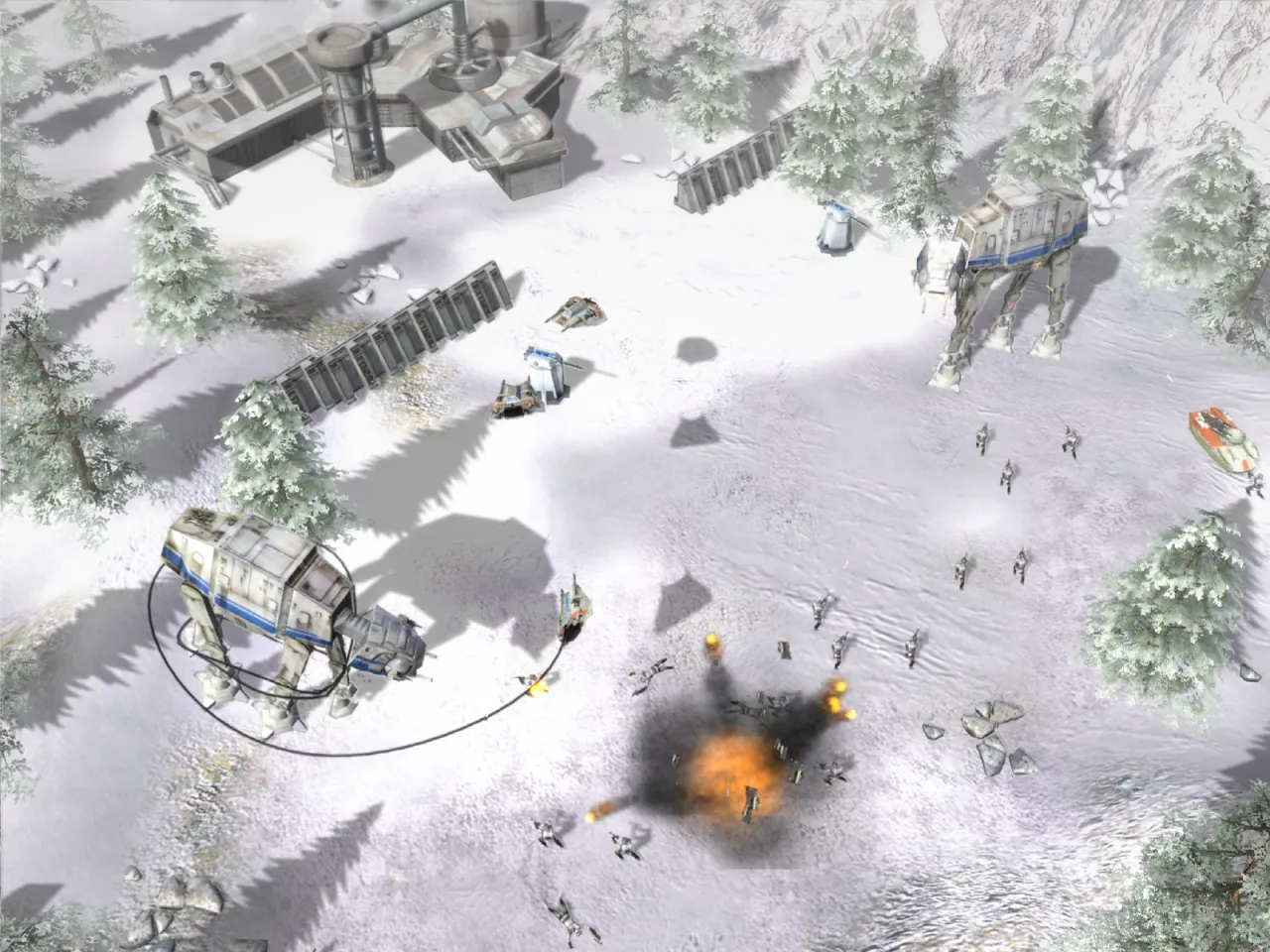
The smartest thing Empire at War does visually is not trying to be a close-up tactics game all the time. It works best from that bird-view, isometric strategy distance, where the rough edges blur a little and the battlefield turns into a moving Star Wars diorama. From up there, the land-and-space split really helps. One minute you’re watching walkers and infantry push across a planet surface, the next you’re jumping into space battles with frigates, fighters, and capital ships trading fire. That back-and-forth gives the whole thing a bigger stage than the raw graphics deserve.
The catch is, space combat is visually flatter than it should be. You’re in space, but you’re not really using space. There’s no real third-dimensional spectacle here, so fleets tend to slide around on a plane instead of feeling like these massive ships are maneuvering through a huge void. That hurts the wow factor, especially now. A stronger fleet often just looks like a stronger fleet grinding you down, not something you’re outplaying through beautiful positioning or dramatic movement.
Still, the presentation has moments. The camera cuts, the scale jumps, the contrast between ground war and orbital combat — that stuff gives battles a cinematic rhythm. And Frank Klepacki’s score, sitting alongside those familiar John Williams Star Wars themes, does a lot of visual work by association. The screen may be showing you an older RTS, but the music and the silhouettes are telling your brain, “No, this is the Galactic Civil War.” That trick works more often than it probably should.
Don’t Come Here Looking For Ray Tracing, Come Here For Readable Chaos

On the tech side, don’t expect miracles. This is not a game with ray tracing, DLSS, fancy modern upscaling, or a renderer built for today’s hardware flex. The Gold Pack hit Steam in 2010, but the visual foundation is still from that mid-2000s PC RTS era. On a modern machine, you can get cleaner output and smoother performance, sure, but you’re not magically turning those assets into a new game. Higher resolution only makes some of the old texture work more obvious.
That said, the game is usually readable, and for this kind of strategy game, readability counts. You can tell what your units are. You can spot the big threats. You can understand the fight without needing esports-level visual parsing. The UI is very much from its time — chunky panels, lots of functional buttons, not exactly elegant — but it does the job. It feels more like a command board than a slick modern interface, and honestly, that fits the fantasy better than it has any right to.
Platform-wise, the important thing is that this is a PC strategy game living through its Steam Gold Pack version now. You’re not comparing a bunch of wildly different console visual modes here. You’re mostly dealing with how well an older PC game scales to newer displays and newer expectations. And that’s the problem: expectations moved on. The game didn’t. So the tech gets exposed fast, especially if you’ve been playing newer strategy games with sharper effects, cleaner UI, and more flexible cameras.
The Community Does A Lot Of The Visual Heavy Lifting Now

Here’s the thing: if we’re talking about Empire at War in the real world, we have to talk about mods. The base game looks dated. No way around it. But the community has been keeping this thing alive for nearly 20 years, and that changes the conversation. Mods like Thrawn’s Revenge don’t just add replay value — they can make the game look and feel much richer, with improved unit models, expanded rosters, and a stronger sense that you’re playing a living Star Wars strategy sandbox instead of a museum piece.
That doesn’t erase the base game’s age. I’m not giving the original visuals credit for every community upgrade under the sun. Out of the box, this is still a 6.0. It has strong silhouettes, decent planet identity, and some great Star Wars spectacle, but it also has flat space battles, old textures, stiff animation, and a UI that feels its age. The community can patch over a lot of that. It can’t fully replace the engine underneath.
But for the right player, that’s enough. If you’re a Star Wars diehard, or you want light strategy with big atmosphere and you don’t care about extreme micro, the look of this game still gets you there. If you’re chasing modern visual fidelity or competitive RTS clarity, yeah, you’re going to bounce off it hard. Compared with Command & Conquer: Red Alert 2, it’s not as clean or sharp as a pure competitive-feeling RTS package, but Empire at War has that galaxy-level Star Wars fantasy Red Alert 2 just doesn’t offer. Visually, it’s worn down. Emotionally, it still lands.
Combat | 8.0/10
Gameplay: 8/10The galaxy map is the trick that still makes this thing work

Here’s the thing Empire at War gets right, and honestly, it’s the reason people are still talking about it after all this time: it doesn’t just give you Star Wars battles. It gives you the war around the battles. You’re not only clicking tanks across a battlefield. You’re managing planets, building up resources, shifting fleets, deciding where to hit next, and trying to make the whole galaxy bend your way. That Galactic Conquest layer is the hook. It makes even a simple fight feel like it matters, because losing a fleet isn’t just “oops, reload.” It can expose a planet. It can open a lane. It can wreck your momentum.
And that double-layer setup is still rare. You fight in space, then you fight on the ground. Up top, it’s Star Destroyers, Rebel fleets, bombers, stations, and big cinematic scraps. Down below, it’s infantry, armor, heroes, walkers, and base pushes. Is either side the deepest RTS system ever made? No. Not even close. But together, they sell the fantasy better than a more technical RTS might. You feel like you’re commanding a whole galactic civil war, not babysitting twelve units and praying your hotkeys are clean.
The Gold Pack matters too, because Forces of Corruption adds the Zann Consortium, and that third faction changes the flavor in a real way. The Empire and Rebellion are already easy to understand: military control versus insurgent pressure. The Consortium comes in with bribery, sabotage, piracy, and corruption mechanics, and suddenly the campaign map has this dirty underworld angle. You’re not just conquering. You’re poisoning the board. That asymmetry is messy, and yeah, balance can get questionable, but it gives the game personality. It makes the Star Wars Underworld playable instead of just background flavor.
Space battles look huge, but don’t expect Homeworld brain games
The space combat is the part everybody remembers first, because come on, watching Star Destroyers crawl into battle still hits. Big ships chew each other apart, fighters swarm around them, hardpoints pop, lasers fill the screen, and Frank Klepacki’s music layered over that familiar Star Wars sound gives the whole thing a proper movie-battle charge. It’s not subtle. It’s not elegant. It’s Star Wars ships punching each other in the face, and for a lot of players, that’s exactly the point.
But I’m not going to pretend the system is secretly super deep. Space combat is flat. There’s no real third dimension to play with, so if you’re coming in hoping to out-position a stronger fleet with clever vertical movement or wild maneuvering, no, that’s not this game. You can target hardpoints, bring the right counters, time reinforcements, and use heroes to swing a fight, but a bigger, better-built fleet is usually going to feel like a bigger, better-built fleet. That’s satisfying in a war-sim fantasy way. It’s less satisfying if you want elite tactical outplays.
Ground combat has a similar tradeoff. It’s approachable, readable, and full of Star Wars toys. AT-ATs feel like walking problems. Tanks and infantry do their jobs. Hero units can absolutely tilt a battle, which adds just enough chaos to keep things from becoming pure math. But again, this is not a hardcore micro machine. The appeal is not perfect stutter-stepping or razor-thin unit control. The appeal is making the big call: where to invade, when to retreat, which planet is worth bleeding for, and when to throw Vader or Han Solo into the mess and let the battlefield get weird.
It’s friendly on purpose, and that’s both the strength and the ceiling
Empire at War is at its best when you meet it on its own terms. This is strategy-first, micro-light Star Wars. That makes it way easier to recommend to fans who want to command fleets and planets without studying build orders like homework. You can be sloppy and still have fun. You can make decisions from the galaxy map, watch them turn into battles, then roll with the consequences. That’s why it works so well for Star Wars diehards and lighter strategy players. It lets you feel clever without demanding that you play like a tournament RTS veteran.
The catch is, if you are that tournament RTS veteran, you’re going to hit the ceiling fast. The AI on the galactic map just isn’t that sharp. It can pressure you, sure, but it doesn’t feel like a brilliant opponent with a long-term plan. It makes moves. It reacts. Sometimes it blunders. And once you understand how the economy, fleets, and invasion flow work, you can start bullying it pretty hard. The three-faction setup from Forces of Corruption is cool, but it also makes balance feel a little loose. Fun loose, not always fair loose.
That’s why the comparison to Command & Conquer: Red Alert 2 is useful. Red Alert 2 has that sharper competitive RTS feel, and you can feel the shared Petroglyph-adjacent DNA in the snappy, readable battlefield design. But Empire at War is chasing a different high. Red Alert 2 is better if you want cleaner RTS combat. Empire at War is better if you want to zoom out and say, “Okay, I’m taking this sector, cutting off that fleet, then dropping troops on the planet.” For Star Wars fans, that extra layer of galactic ownership is huge.
The mods are why the 2006 bones still have legs
Let’s be blunt: this looks old. The visuals are clearly from that mid-2000s RTS era, and the storytelling is thin in the way RTS campaigns often are. Don’t come here expecting deep narrative scenes or modern production values. The official Steam release date for the Gold Pack is 2010-05-26, and you can feel the age even before that when the camera gets close. Units can look chunky. Explosions are charming more than impressive. The interface does the job, but it’s not slick by modern standards.
And yet, the game has a 97% Steam rating across 35,592 reviews for a reason. The reason is not that every system is flawless. It’s that the whole package hits a very specific fantasy better than almost anything else in Star Wars strategy. Single player, multiplayer, bird-view battles, galactic planning, land wars, space wars, heroes, corruption, and that giant sandbox feeling all stack together. It’s easy to forgive rough edges when the game keeps giving you stories: the doomed defense, the surprise counterattack, the hero who saves a planet, the fleet you built for half an hour getting shredded because you got greedy.
And then there’s the mod scene. That’s the secret weapon. Nearly 20 years on, people are still updating and playing major mods like Thrawn’s Revenge, and that gives Empire at War ridiculous replay value. The base game earns an 8.0 out of 10 for gameplay from me: not because it’s the deepest RTS, and not because the AI is brilliant, but because it nails a kind of strategic Star Wars fantasy that barely exists anywhere else. If you want hard, competitive tactical depth, look elsewhere. If you want to run a galactic war and watch Star Wars chaos unfold from orbit to battlefield, this thing still has the juice.
Content | 9.0/10
Contenuti: 9/10The Gold Pack Is The Version You Actually Want
Here’s the thing: if you’re judging Empire at War on content, the Gold Pack is the easy recommendation, because it’s not just the base game sitting there with a shiny label slapped on it. You’re getting the main game plus Forces of Corruption, and that expansion matters. It adds the Zann Consortium as a full third faction, and that changes the campaign layer in a way that feels properly nasty. You’re not just conquering planets. You’re corrupting them. You’re messing with the galaxy instead of politely playing by Rebel-versus-Empire rules.
The pace is the big win. This isn’t a hardcore RTS where every second feels like a keyboard exam. It’s strategy-first, micro-light, and honestly, that’s why it still works. You bounce between the galactic map, space battles, and ground fights, and that rhythm sells the fantasy better than almost any other Star Wars strategy game. One minute you’re pushing fleets across the galaxy. Next, you’re watching Star Destroyers trade fire. Then you’re dropping troops planetside and rolling in with AT-ATs. It’s chunky, readable, and cinematic.
You’ve also got a decent spread of ways to play. Single-player campaigns are the obvious draw, especially if you want that big Galactic Civil War sandbox feel, but there’s also head-to-head play and multiplayer skirmishing if you want to test the factions against another person. I wouldn’t call it a razor-sharp competitive RTS, and if you’re coming from Command & Conquer: Red Alert 2 looking for that tighter, snappier competitive feel, yeah, this is softer. But for Star Wars fans who want command-room drama more than pixel-perfect dancing, this hits way harder.
The Side Content Is Basically The Galaxy Itself
Empire at War’s optional content isn’t “go collect five space trinkets.” The optional content is the map. That’s the hook. You decide where to attack, what to build, which planets to fortify, when to risk your fleet, and when to send a ground force in to finish the job. The campaign structure gives you just enough freedom to tell your own Star Wars war story without turning into a grand strategy spreadsheet nightmare. It’s approachable, but it still gives you that satisfying feeling of moving pieces around a whole galaxy.
That said, don’t come here expecting deep RTS storytelling. The plot delivery is light, and the galactic-map AI can be pretty clueless. Sometimes it makes moves that feel less like a rival commander and more like a toaster with a cape. The three-faction balance also gets messy, especially once the Zann Consortium starts doing its corruption thing. But I’ll take messy ambition over a clean little campaign that forgets what Star Wars feels like. This game understands the fantasy: fleets overhead, troops on the ground, and a galaxy that feels like it’s actually changing hands.
The weak spot is space combat being flat. Literally. You don’t get that full three-dimensional maneuvering fantasy, so if a stronger fleet rolls in, you’re not usually outsmarting it with brilliant vertical positioning. You’re managing hardpoints, reinforcements, and matchups. It’s still fun, but it’s not some tactical chessboard in space. The magic is the combination: the big map, the land battles, the space battles, and Frank Klepacki’s music working with those classic Star Wars themes to make even a simple fight feel like it belongs on a movie screen.
Nearly Two Decades Later, The Mods Are Still Doing Heavy Lifting
The long tail is ridiculous. Most strategy games from this era are museum pieces now. Empire at War is still alive because the mod scene refused to let it die. Thrawn’s Revenge, Awakening of the Rebellion, and plenty more keep stretching the game into new campaigns, new factions, new eras, and new balance philosophies. This is the part that pushes the content score way up for me. The official package is already strong, but the community turns it into something you can reinstall every few years and lose another chunk of your life to.
Steam Workshop support makes that even easier. You’re not digging through ancient forum posts, praying a download link still works, and manually dragging folders around like it’s some forbidden ritual. You subscribe, load it up, and you’re back in the war. That ease matters, because the base game’s 2006-era visuals are absolutely dated now. No getting around it. The models are old, the animations are stiff, and some of the spectacle has aged. But when a game has this much moddable structure underneath, ugly edges stop being a dealbreaker.
And the hardware barrier is basically nothing by modern standards. If your machine can’t run Empire at War smoothly, I’m honestly impressed. That helps the game’s staying power, because it’s easy to recommend to someone with an older PC, a laptop, or a setup that isn’t built for modern strategy games. Between the Gold Pack content, the expansion’s third faction, the single-player and multiplayer options, and a Workshop scene that keeps feeding it new life, this is one of those rare old strategy games where “there’s a lot to play” is underselling it. For Star Wars fans and lighter strategy players, it’s still a 9.0 out of 10 content package.




Commenti 0
Ci interessa la tua opinione
Partecipa alla discussione e condividi la tua opinione su questo gioco.
Ancora nessun commento. Dicci cosa pensi di questa recensione.