
























Opening
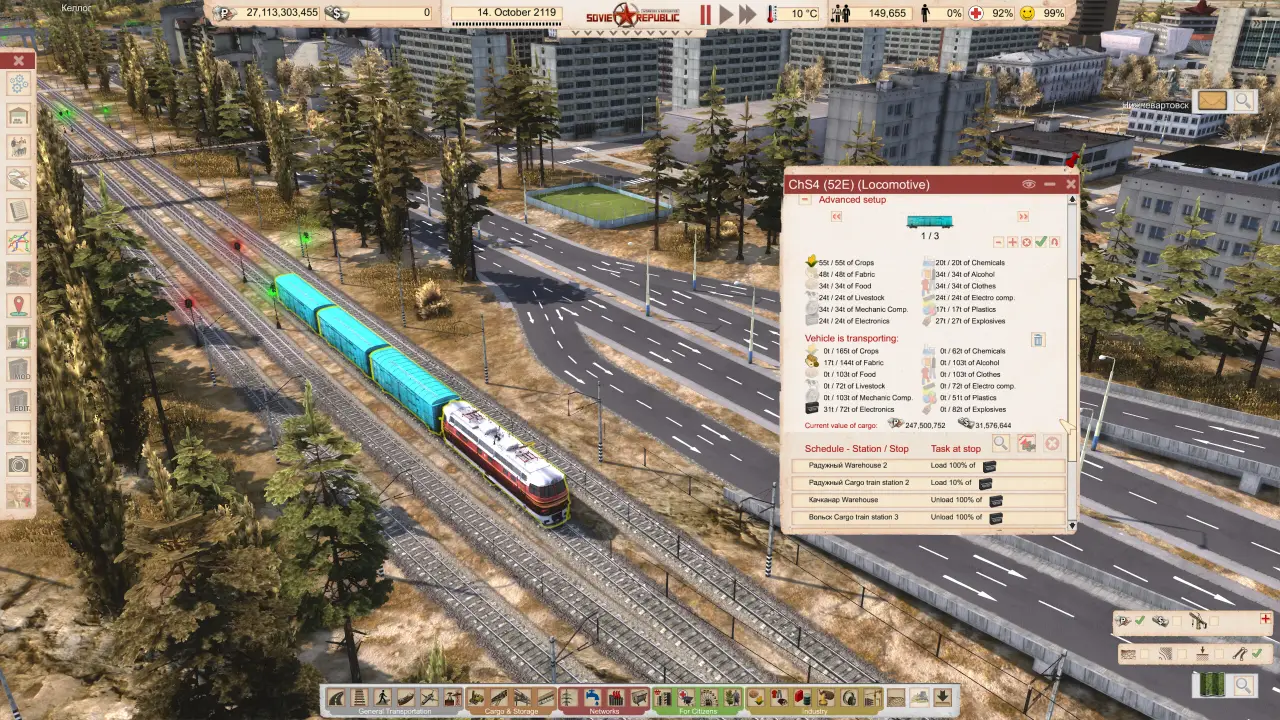
I finally understood this game from inside the cab of a freight train. I had pulled the camera far back, and the train was crawling out of a tiny depot on the edge of town, dozens of cars snaking around a bend, threading through an industrial zone, past blocks of apartments, then disappearing into a tunnel cut through the hills. At the very same moment the transport-management panel was open on screen, a long column of numbers ticking over: where the cargo was bound, what share of capacity it ate, how efficiently it was loaded. That is the instant the whole thing clicks. There is no easy "do I have enough money" conversation here.
Every ton of coal, every wagon of steel, every single bus is a cog in a planned-economy machine. You are not laying out a pretty city; you are running an entire system, and the moment you look away for three minutes the whole apparatus starts to drift toward bankruptcy. That is how this simulation teaches you its rhythm — not with a tutorial pop-up, but by letting the spreadsheet of an entire nation tilt under your feet while you are busy admiring a railway curve.
What follows is a full breakdown across six dimensions: the emergent, story-shaped progression of a sandbox with no written plot; the functional industrial soundscape; the cold-toned, document-film visuals and their notorious wall of interface; the deep, sometimes punishing gameplay loop of resource and logistics planning; the sheer content volume that swallows hundreds of hours; and an overall verdict on who should actually sink their evenings into this thing. Treat the "republic" purely as the game's economic-sandbox backdrop — the interesting part is always the machine, never the flag painted on it.
Story | 7.2/10
Storia: 7.2/10There is no scripted main story here, and nobody steps forward to tell you that you are the chosen savior of anything. You are dropped onto a patch of land, handed a set of buildings, institutions and event names that carry a distinctly mid-century Eastern-European flavor, and then left entirely alone to write the history of your republic yourself. There are no cutscenes, no dialogue, no quest givers. What you get instead is a timeline, and on that timeline two slowly moving curves: population and economy. The story this game tells is the story those two lines draw over forty or eighty hours of play.
History You Author Through Decisions, Not Dialogue
The narrative pressure in this simulation comes entirely from your own choices, and it arrives as consequence rather than as text. One year you decide to cut off all imports and rely purely on domestic industry; the next year a single transport-planning mistake cascades into a nationwide blackout, and you watch factories go dark down the chain. One winter you fail to finish a heating system in time and a whole row of apartment blocks turns into an ice box, citizens quietly draining away. Some economic crisis forces you to sell off the heavy-industry line you had been nurturing just to claw back a little hard currency.
When you later page back through the engineering panels and trace the arc of the city's expansion, those moments stitch themselves into clear historical episodes. The game is not narrating with words; it is using systemic behavior — shifting population structure, recurring economic crises, the relentless spread of infrastructure — to lay down one timeline segment after another. It is, in a strange way, a more honest kind of storytelling than a scripted plot, because the only author is you and the only editor is consequence.
Why Self-Set Goals Are the Engine of Immersion
The structural problem is real: because there is no systematic onboarding quest line, a great many players will get off the train before they ever find a way in. Without something driving you, the early hours feel like doing a stack of cold arithmetic, an accountancy exam presented as a city builder. The emotional payoff only switches on once you give yourself a direction. Decide to build a fully self-sufficient heavy-industry republic that imports nothing. Decide to carve an aviation corridor through a mountain valley. Decide to run an absurdly long cross-border pipeline from a distant field back to your industrial core.
Those self-imposed objectives are the actual quest log this game refuses to print for you. They are what turn the spreadsheet into a saga. Once you are chasing one, every supply chain you stabilize and every line you smooth out reads as a chapter, and the sandbox finally begins to feed your emotions back to you instead of merely taxing your patience. The freedom is total, which is exactly why it is inert until you point it somewhere.
The Odd Responsibility a Save File Earns
There is a particular feeling that arrives after dozens of hours as the nameless chief planner: you suddenly notice that you have started inventing this nation's history in your own head, growing attached to the land inside the save the way you start caring about the people in a long documentary somewhere past the halfway mark. It is not affection the game hands you; it is affection you accidentally generate by maintaining something complex for long enough that its failures hurt.
If what you want is defined characters, spoken lines and a linear push forward, this place will feel far too cold and far too quiet. But if the idea of writing your own history genuinely appeals to you, this systems-emergent narrative rewards you with an oddly real sense of responsibility for one particular stretch of simulated ground — a responsibility no scripted protagonist could have lent you. That is the trade: no plot at all, in exchange for a plot that is entirely, uncomfortably yours. The longer a save survives, the more it accumulates the texture of a real chronicle, and the harder it becomes to abandon it lightly, because walking away now means abandoning a history you spent dozens of hours quietly building line by line.
Audio | 6.5/10
Audio: 6.5/10In this game your ears are mostly assigned a single job: confirming that the machine is still running. The low roar of industry, the drone of vehicles, the grinding scrape of steel as a train passes through — they stack on top of one another so that whenever your gaze drifts across the industrial zone or down a main artery, a busy industrial-city soundscape assembles itself automatically. You do not have to listen on purpose. As long as the city is working, that background hum sits there like the permanent white noise next to a construction site, quietly reassuring you that everything is still moving and nothing has blown up yet.

Functional Soundscape, Not a Soundtrack You Hum
The music itself leans heavily toward the functional. It can hold up a general "I am at work" atmosphere, but it rarely offers a melody or a theme you immediately remember and carry with you. Over long sessions a lot of players simply turn the game volume down and put on their own music or a podcast, letting the layer of industrial and traffic noise retreat to a comfortable place in the background. Voice work is essentially absent, and there is no strong, memorable signature cue reserved for big moments.
The practical effect of all this is telling. Even when a genuine disaster strikes — a blackout, a supply collapse, a frozen district — the emotional punch comes far more from your own frustration at a planning failure than from anything the sound design or the score does to underline it. The audio does not amplify catastrophe; you supply the dread yourself, and the speakers just keep grinding along as if nothing happened, which is somehow exactly right for the restrained, unsentimental tone the whole game is reaching for.
Mixing That Is Serviceable, Not Celebrated
The mix and the options sit firmly at the "good enough" tier. You can adjust the broad volume categories and do some light management of which sounds are allowed to dominate, but in large-scale construction or a dense industrial cluster certain ambient sounds still come across as noisy, especially when you are flicking the camera rapidly between the city and the worksite. Do that for long enough and your ears pick up a faint fatigue, the audio equivalent of working in an open-plan office next to a foundry.
It works like a decent set of overalls. The first few days you notice it is loud; a while later the only instinct left is "as long as there's sound, things are fine — it's the silence that should worry you, because silence means production has stopped." This is not an audio design you can pull out and praise on its own. You will not buy a ticket for it and you will not refund over it, but you can wear it through a long shift without real discomfort — provided you have parked your expectations on systems and gameplay rather than on a symphony.
Visuals | 7.0/10
Grafica: 7/10This game has no intention of stunning you with lighting tricks and particle effects. It looks more like an old-era documentary: cold-toned industrial cities, sprawling sheets of factory infrastructure, distant towns and an airfield nestled between valleys. Viewed from a distance there is a certain austere, archival gravity to the whole frame. When winter arrives and a nuclear plant and a row of conveyor-belt factories line up across the snow, the sheer sense of depth can make you stop the camera just to confirm that yes, you really did assemble all of this one piece at a time.

A Document-Film Look Built on Restraint
The aesthetic choice here is deliberate and, once you accept it, genuinely effective. There is no attempt at visual spectacle, no golden-hour skyboxes engineered to sell screenshots. Instead the art direction commits to a sober, almost engineering-manual palette, and it earns its keep through composition rather than fidelity. The scale reads honestly: a refinery looks like the heavy, expensive, space-hungry thing it is, and a long rail line genuinely feels long. If you think of it in cinematic terms, it is a tightly structured Cold-War-era film shot in plain, unshowy camera language rather than a blockbuster reaching for awe.
That restraint is also its ceiling. People who measure a builder by how pretty its night skyline is, the way they would judge the genre's flashier competitors, will find very little to gawk at. The reward here is slower and quieter: after you have grown familiar with the place, that solid composition starts to convey the enormous physical bulk of the whole planned-economy machine, and it does so without ever raising its voice.
When the Real Pressure Is Information, Not Texture
The actual "graphical pressure" in this game comes from information density, not from textures. The interface is classic old-school PC-simulator design: windows stacked on windows, tables nested inside tables, dozens of buttons crammed into a single cluster. Open the railway transport management and you will see at minimum three or four layers of windows materialize at once — a train roster, line configuration, cargo loading-and-unloading priorities — and anyone meeting it for the first time is liable to be scared off by the waterfall of numbers.
The in-city shop logistics and warehouse management screens behave the same way. The information is genuinely useful, all of it, but the layout looks like engineering software from a decade and a half ago. The upside is that practically every key data point you need can actually be found somewhere, and the steady update cadence has kept the interface functionally competent. The downside is just as obvious: the entry barrier for new players is hoisted brutally high, and even if you are already comfortable with complex simulations you will spend a few hours simply locked in a staring contest with the UI before it stops fighting you.
Performance That Works Without Elegance
Optimization belongs to the "it runs, but it isn't graceful" category. Once your city and your transport network grow past a certain scale, a dropping frame rate is the most ordinary thing in the world, and the demand on a single CPU core is especially noticeable. This is not a game that scales its smoothness with your wallet; it scales its load with your ambition, and a sufficiently sprawling republic will tax the hardware no matter how strong the machine.
To return to the film comparison: this is a rigorously structured, plainly shot mid-century piece rather than a visual marvel. It will not make you gasp, but once you are fluent in it, it uses that grounded composition to lay the colossal volume of an entire planned economy out in front of you — on the strict condition that you survive the opening stretch where you cannot yet read the subtitles, and where the interface is doing its level best to make you give up. The performance ceiling and the interface wall are, in the end, the same kind of friction: both are the cost of a simulation that refuses to hide its own complexity behind a prettier surface, and both reward the players patient enough to push through them rather than punishing them outright.
Combat | 9.0/10
Gameplay: 9/10This game removes roughly half of the "money" that normally drives a city builder and leaves you with two cold figures: rubles and hard currency. What actually decides everything is not cash but materials and people. You dig raw ore out of a mine, ship it to a factory to be processed, and then push the finished goods through road, rail, oil pipeline and the power grid out to the various cities, so that workers have food to eat, housing to live in, and transport to ride. Let any single link in that chain drop, and the result is not "you earn a bit less" — it is factories grinding to a halt, cities losing power, and citizens packing up and leaving, a cascade of consequences that plays out like an economic crisis you personally directed.

Two Currencies and a Full Resource Chain
The decision to remove the comforting single-money abstraction is the spine of the whole design. Because rubles and hard currency behave differently and serve different purposes, you are constantly weighing self-reliance against the convenience of buying your way out of a shortage on the global market. The full resource chain reinforces this: nothing is conjured into existence, every consumer good has a lineage that traces back to a quarry, a coal seam, a steel mill, a chemical plant. You are not managing an economy in the abstract; you are managing the physical movement of matter across a map, and the map does not forgive sloppiness.
That is what makes the loop addictive rather than merely difficult. When a supply chain you laboriously assembled finally runs stable — ore in one end, finished goods and contented citizens out the other — the satisfaction lands with a weight that lighter builders simply cannot reach, because you understand every join in the thing you built. There is no hidden machinery doing the hard part for you; the abstraction layer that other games use to keep things friendly has been peeled away, and what remains is a direct, slightly intimidating accountability for every flow of matter on the map.
Transport Is the Soul and the Poison
The transport system is the soul of this game and also its most toxic part. Roads, railways, trams, buses, tanker trucks, pipelines, the electrical grid — all of it is yours to plan personally, by hand. Laying a railway is not the trivial matter of dragging two lines across the terrain. You have to reckon with gradient, with turning radius, with locomotive power, and on top of that you have to consider whether your new line is going to jam up some other trunk route you depend on. A rail network here is a genuine engineering puzzle, and it punishes the lazy solution every time.
Bus lines are no kinder. You cannot just loop them around at random; every stop's coverage of residential, work, commercial and public-service areas has to be threaded together into a coherent web, and if your scheduling is unbalanced you get the magnificent social spectacle of buses packed to bursting while the factories stand empty for lack of anyone who could actually get to work. The systems are interlocking enough that a clever fix in one corner quietly creates a new problem two districts over, and learning to anticipate that ripple is most of what mastery means here.
A Brutal Curve With a Real Reward
The learning curve is, frankly, steep. In the first twenty hours you will most likely live through several full "national collapses": supply lines severed, finances overdrawn, population draining away, your save reduced by your own hand to a field of ruins. The aggravating part is that the game offers almost no systematic onboarding quest line and no gentle, graduated tutorial. You learn far more by groping forward on your own, by reading the data, and by studying your own failures than by anything the game hands you.
That is precisely why it is both maddening and addictive. Once you push through that barrier and start running a region steadily, watching a complex logistics network flow in front of your eyes, the feeling that "I built this whole apparatus with my own hands" stacks several layers higher than an ordinary city builder ever delivers. Compared with the genre's marquee transit-and-zoning simulators, where the central problem is usually traffic congestion, here you are handling the entire chain from resource extraction to citizens' daily survival, and the real question is never "is the road blocked" but "can this nation even stay alive." It is fun, and it is exhausting, and the two are not separable.
Content | 8.8/10
Contenuti: 8.8/10This is the kind of game where you think you have played a great deal, then glance at the progress bar and realize you have not even reached the threshold. You can fix your eyes on a single plain and build outward from a quarry, a coal mine and a steel mill all the way through chemicals, machinery and consumer goods, then casually run a railway off to a distant port and dump your surplus capacity onto the global market. Or you can do the exact opposite, starting from a stretch of farmland, raising grain, building up livestock and light industry, and feeding the entire republic that way. The map does not prescribe a path; it offers a continent of them.

Two Opposite Ways to Build a Nation
The breadth of viable strategies is one of the game's quiet strengths. The heavy-industry route and the agricultural-and-light-industry route are not cosmetic variations on the same loop; they demand different layouts, different transport priorities, and different relationships with the outside market. One republic might survive on exporting machined goods and importing food; another might aim for total self-sufficiency and treat any import as a small defeat. Because the underlying simulation is consistent, these divergent ambitions all remain legitimate, and a single map can be replayed with a completely different economic personality each time.
That replay value compounds with the self-set goals the game leans on so heavily. Deciding to build a self-sufficient heavy-industry republic, or to carve an aviation corridor through a valley, reshapes which buildings matter and which supply lines you obsess over, so the "content" is as much a function of your imagination as of the asset list. Two players can spend a hundred hours each on the identical map and come away describing what are, in practice, two entirely different games, because the simulation rewards intent and the map never pushes you toward one canonical solution.
A City Is Data, Not Just More Buildings
City content here is not simply "place more buildings." Education, healthcare, fire service, culture and entertainment each correspond to their own set of structures and their own data, and the population structure shifts in response — where the young go to study, where they work after graduating, where the old live, whether children have a nursery. All of it gradually assembles, through a heap of stiff-looking numbers, into a city's "personality." When you open the panel for a polytechnic university and watch the curves for students and staff climb slowly, it becomes very hard not to treat the whole thing as a living social project rather than a row of icons.
Crucially, this is the textbook "long-term management" simulation. Sinking tens or even hundreds of hours into a single save is entirely unremarkable, because the moment you have your first city and industrial zone running stably, you are immediately tempted to spin up a second industrial cluster, or open a new mining district on the far side of the mountains, or run an absurdly long cross-border oil pipeline. The community keeps feeding in a steady stream of updates, new systems and new buildings, and on top of that a healthy mod ecosystem stretches an already large toy box another notch wider.
The Cost of All That Depth
The price of this depth is equally clear: this is not a title suited to "hopping on for half an hour." Every time you reload, you have to spend a few minutes remembering exactly where you left your planning; every new system means reading screen after screen of data and adjusting line after line of routing. If all you want is to relax as a "click-and-build mayor," this density of content will feel a little suffocating, an obligation rather than a pastime.
But if you lean toward the sort of simulator that can keep you company for months, something you slowly turn over in your mind across many evenings, then this is a bottomless pit in the best sense. The content does not run out; you run out of free time first. That asymmetry — far more game than any reasonable schedule can consume — is exactly what its intended audience is looking for, and exactly what makes it a poor fit for everyone else. The mod ecosystem and the steady drip of community-driven systems only deepen the well further, so even a veteran who has wrung dry every base mechanic can find fresh reasons to start one more save and chase one more ambitious layout.






Commenti 0
Ci interessa la tua opinione
Partecipa alla discussione e condividi la tua opinione su questo gioco.
Ancora nessun commento. Dicci cosa pensi di questa recensione.