Notizia
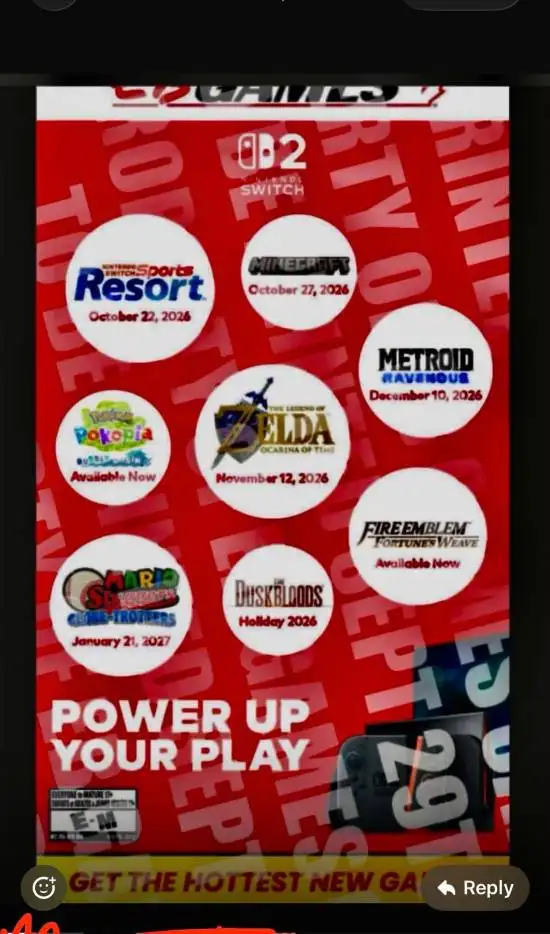
EB Games Leak Reveals Ocarina of Time Remake Release Date
A Reddit user claims an EB Games poster leaked several Switch 2 release dates, though the listing remains unverified. Ni















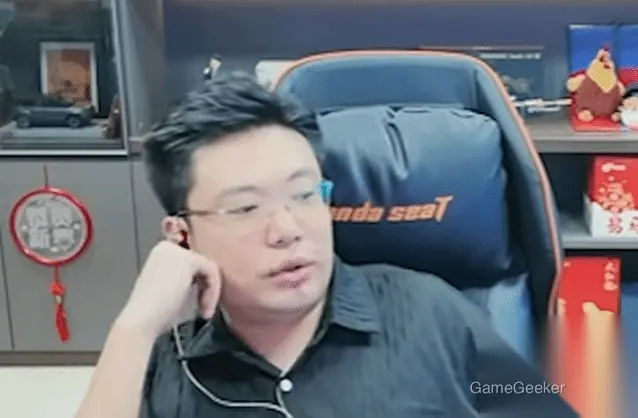
Whether a livestream tournament can succeed has never fundamentally depended on how big the prize pool is, but on whether viewers can understand the key to victory within a few dozen seconds. Recently, Dashima’s Delta Force “Delta Bounty Tournament” sparked controversy, and the debate isn’t actually that complicated: many viewers felt the event was clearly lacking in entertainment value, and its showmanship fell short of expectations. For someone like me, a hardcore strategy player, this feels like an endgame puzzle: it’s not that the rules lack depth, but if the state of play can’t be quickly understood by spectators, then even the most brilliant mind games turn into informational noise.
From a systems design perspective, the problem likely goes beyond the streamers’ form. It may be that “Warfare Zone,” the mode in Delta Force, simply isn’t well suited to being directly turned into a high-density livestream competition. Many netizens have already pointed out that this mode comes across as relatively flat on stream, with neither the pacing nor the highlights concentrated enough; to put it more bluntly, some viewers even said they “couldn’t tell what was going on.” When viewers have to spend a great deal of attention just identifying objectives, routes, and rewards, the immediacy of livestream feedback gets weakened, and that information barrier directly drives up viewer drop-off.
In terms of strategic depth, a game being fun to play and a tournament being fun to watch are inherently two different evaluation systems. Many mechanically complex modes feel fascinating when you’re the one making resource trade-offs, but that doesn’t necessarily hold up from the sidelines, because spectators can’t see the decision chain or feel the risk-reward exchange. Compared with Dashima’s past PUBG and Goose Goose Duck content, this event was widely seen as lacking clear pacing beats; it had neither a steady stream of hype moments nor memorable scenes that were easy to spread, so the livestream felt like watching a chess game that only the player moving the pieces could understand, while everyone else just found it dragging.

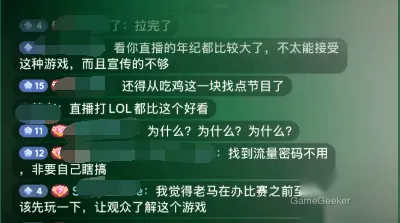
But the issue is that this controversy also exposed an even more critical layer: whether the streamer’s content actually matches the audience profile. Some netizens put it very directly—people came to watch Lao Ma himself play, but instead spent much of the time watching others, so naturally the experience became boring. Others argued that the event felt somewhat like a “forced launch” riding on the game’s popularity, yet popularity does not equal compatibility; if the tone of the content isn’t aligned, traffic conversion easily turns into wasted exposure.
Against this backdrop, Dashima’s livestream popularity on Douyin also saw obvious fluctuations. According to netizens, the stream’s popularity at one point dropped from around 100,000 to roughly 40,000. While platform metrics of this kind are naturally influenced by subject matter and timeslot, the fact that public controversy and declining popularity appeared at the same time at least shows that audience feedback had already begun affecting outcomes. In the livestreaming space, the biggest fear isn’t controversy—it’s viewers neither understanding what they’re watching nor feeling any desire to keep watching.

If we’re only talking about the trend, my judgment is very clear: extraction-style gameplay and search-fight-extract content may not be impossible to turn into esports events, but three issues must be solved first—information visualization, objective clarity, and the presence of star players. Otherwise, the game itself may be reasonably fun to play, yet lose much of its appeal once converted into a livestream program, and this disconnect will keep resurfacing. For streamers and platforms alike, running a tournament is not as simple as bringing a popular game into the livestream room and expecting to win. It is more like designing a game of strategic contest, and whether viewers can quickly read the situation is the first move that determines success or failure.




Commenti 0
Ci interessa la tua opinione
Benvenuto! Raccontaci cosa pensi di questo gioco: chi arriva per primo potrebbe avere una sorpresa.
Ancora nessun commento. Scrivi il primo.