
Notizia
Bunny Garden 2 Adds Twin-Tail Lolita Roro in New Update
Bunny Garden 2's new 10-second trailer shows a twin-tailed lolita character in a sweet-yet-cutting promo. With six heroi
















Compared with typical esports coverage that only reports match schedules, this VCT CN Hangzhou event for VALORANT feels more like a dual-track information feed of “tournament + hardware.” On the competition side, it continues the journey as the second stop following the Guangzhou Kickoff event; on the hardware side, AMD continues to provide full performance support, effectively putting the professional stage and players’ PC-buying needs on the same table.
VCT CN Hangzhou, officially the regular season of Stage 1 of the 2026 VALORANT Champions Tour CN League, is currently being held at Hangzhou West Lake Sports Center. Over the course of three weeks, 12 of China’s top professional teams will face off continuously, with the final showdown set for April 19. Unlike many esports titles that like to market the “offline atmosphere” as a selling point, highly competitive FPS games like VALORANT place greater emphasis on stable frame rates, low latency, and consistency, which makes the tournament platform configuration itself especially worth paying attention to for players.
The designated tournament platform processor for this event is the Ryzen 7 9800X3D, while AMD’s Ryzen 9000HX series mobile processors are responsible for performance and data support throughout the event. Looking at it from another angle, desktop tournament machines focus on pure high-frame-rate output, while mobile platforms emphasize multi-scenario coverage—they need to handle training matches while also supporting data processing, livestream assistance, and work on the go. In terms of product positioning, this combination is somewhat like the difference between fixed console configurations and freely customizable PCs: the former pursues a unified standard, while the latter aims for a more flexible upper limit.
If compared with what players actually buy, the focus of several Ryzen 9955HX series gaming laptops is quite clear. The Lenovo Legion R9000P AI Yuanqi goes after all-around specs, with a Ryzen 9 9955HX3D plus RTX 5080, 275W total system performance release, and a 2.5K 240Hz OLED display, making it feel more like an “all-in-one machine for training, streaming, and content creation.” The ASUS TUF Gaming 6 Pro Ryzen Edition, by contrast, feels more like the mainstream sweet spot, with up to RTX 5070, a 16-inch 2.5K 165Hz IPS display, and a chassis as thin as 1.79cm and about 2.25kg, making it clearly more suitable than some heavy flagship models for carrying between the dorm and commuting.

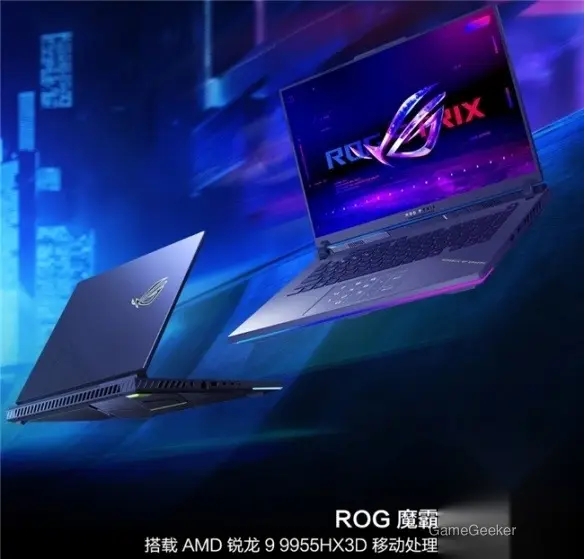
By comparison, the top-spec ROG Strix SCAR 9 and the MECHREVO Canglong 16 Ultra lean more toward performance enthusiasts. The former pairs a Ryzen 9 9955HX3D with an RTX 5070 Ti, delivers 215W total system output in manual mode, and comes with a 16-inch 2.5K 240Hz high-refresh display, making it clearly better suited to esports games like VALORANT; the latter goes even further by bringing in an RTX 5090 with 24GB GDDR7 VRAM, 280W combined stress-test performance, plus a 300Hz MiniLED display—this kind of configuration is no longer just for playing VALORANT, but more like bundling AAA gaming and productivity together as well.
Looking further up, the 18-inch camp also offers two different approaches. The MECHREVO Canglong 18 Pro emphasizes a large screen and a relatively quiet experience, with noise as low as 40dB in silent turbo mode under 205W performance release; meanwhile, the MSI Titan 18 Pro Ryzen Edition is the flagship of flagships, featuring 4K MiniLED, HDR1000, 100% DCI-P3, and up to an optional RTX 5090, with the recommended configuration being RTX 5080 and 260W combined stress-test output. These kinds of machines are like folding a desktop PC experience into a laptop, making them better suited to fixed usage scenarios rather than truly being something you “carry around.”
From the perspective of players across all platforms, the hardware demands of a competitive FPS like VALORANT follow a completely different logic from AAA single-player blockbusters. It does not require you to endlessly pile on image quality; instead, high refresh rate, stable frame pacing, and low response time come first. So if your main game is VALORANT, prioritizing a 240Hz display and a stronger CPU is often more practical than blindly chasing a top-tier GPU. If your budget is sufficient, combinations like the Legion R9000P AI Yuanqi and ROG Strix SCAR 9, with high refresh rates and strong CPUs, are the safer choice; if you also care about portability and price, the TUF Gaming 6 Pro Ryzen Edition is more balanced than a flagship that simply piles on specs.
From the trend in tournament partnerships, manufacturers are no longer just lending their names to competitions; they are now treating the professional stage as a real showcase window. Compared with the past, when promotion focused mainly on GPU specifications, this wave puts more emphasis on processors, whole-system tuning, and multi-scenario coordination. That also shows that competition in esports laptops has moved from single-point performance to platform-level experience comparisons. For players, this is a good thing, because what you see is no longer just ad copy—the professional environment has already tested the answer for you once.





Commenti 0
Ci interessa la tua opinione
Partecipa alla discussione e condividi la tua opinione su questo gioco.
Ancora nessun commento. Scrivi il primo.