









The Top 3 in 30 Seconds: Start with The Room 4: Old Sins for interconnected mechanical puzzles inside an attic dollhouse. Choose Escape Simulator for first-person rooms, movable objects, optional online co-op, and community-made rooms. Boxes: Lost Fragments is the choice for focused puzzle boxes rather than broad room exploration.
Why These Made the List #
These picks cover several kinds of solo puzzle play: interconnected mechanical devices, rooms to search, compact dioramas, and investigations shaped by story or atmosphere. All are playable solo and focus on escape-room, mechanical, or investigation-based puzzles. The order reflects how distinctive and coherent each game’s puzzle structure is, along with how well its setting supports that design. Optional co-op offers another way to play, but none of these games requires it.
Top Picks #
1. The Room 4: Old Sins #
An attic dollhouse holds the mystery of a missing engineer and his wife, but the rooms do more than provide a backdrop: they connect the devices you inspect into one coherent puzzle space. That makes The Room 4: Old Sins the strongest fit here. It’s a focused choice for anyone who enjoys studying intricate mechanisms and seeing how small details fit together.
 Steam$2.24$8.99-75%価格を見る →
| Aspect | Explanation |
|---|---|
| Why It's Ranked Here | The interconnected attic dollhouse gives close mechanical inspection a clear spatial identity, linking separate rooms into one coherent object. |
| Who It's For | Best for players who enjoy examining small mechanical details and solving devices through close observation. |
| Key Selling Points | It combines an attic dollhouse with interconnected rooms, intricate mechanisms, a focused single-player structure, and a mystery about a missing engineer and his wife. |
2. Escape Simulator #
In Escape Simulator, you search first-person rooms and handle movable objects and furniture. Solo play is available, while online co-op remains optional. A room editor and Steam Workshop add a broad range of community-created spaces, though their quality and requirements can vary. It takes second place because hands-on room interaction is central to the experience, with plenty of scenarios to explore or create.

 GAMIVO$7.68Steam $7.68価格を見る →
| Aspect | Explanation |
|---|---|
| Why It's Ranked Here | Movable objects put physical interaction at the heart of its rooms, while the editor and Steam Workshop extend the available puzzle spaces. Community rooms vary in quality and requirements, so their breadth also calls for some discretion. |
| Who It's For | A strong fit for players who want standalone rooms, object handling, optional online co-op, and community-created content. |
| Key Selling Points | It offers first-person rooms with movable objects and furniture, solo play and optional online co-op, a room editor, and Steam Workshop support. |
3. Boxes: Lost Fragments #
A thief trapped in a mansion sets up Boxes: Lost Fragments, but the puzzle boxes are the real attraction. Each one is an object to investigate, making this a compact alternative to games built around navigating large rooms. It earns third place through that focused mechanical identity and works especially well for players who would rather inspect intricate objects than roam a broad environment.

 Kinguin$0.83-95%Steam $0.83価格を見る →
| Aspect | Explanation |
|---|---|
| Why It's Ranked Here | Its elaborate puzzle boxes offer a clear alternative to room-navigation games, though players looking for broad environmental exploration may prefer another pick. |
| Who It's For | A good choice for players who want compact mechanical objects rather than large spaces to navigate. |
| Key Selling Points | It centers a single-player progression on elaborate puzzle boxes, with a mansion setting and a trapped thief. |
4. The House of Da Vinci 3 #
Renaissance inventions and time travel shape The House of Da Vinci 3, the final chapter of a continuing story about Giacomo, Leonardo’s apprentice. Its setting gives the mechanical puzzles strong narrative context, which puts it in fourth place. Since it concludes a trilogy, though, it makes more sense for returning players than for someone looking for a first story entry.

 GOG$6.73-50%Steam $6.73価格を見る →
| Aspect | Explanation |
|---|---|
| Why It's Ranked Here | Its mechanical inventions sit within a distinctive Renaissance setting and a continuing story, though the trilogy finale is a less natural starting point for new players. |
| Who It's For | Best for players already interested in the series who want a continuing adventure alongside mechanical puzzles. |
| Key Selling Points | It is the trilogy’s final chapter, with Giacomo, Leonardo’s apprentice, mechanical inventions, a Renaissance setting, and time travel. |
5. Escape From Mystwood Mansion #
Five main puzzle rooms and hidden subareas give Escape From Mystwood Mansion a recognizable mansion-escape structure. You can examine 3D items, use dynamic hints, and reach multiple endings. It ranks fifth for combining room exploration with useful hints. Steam lists English, so check the store page if you need another language for text-based puzzles.
 Kinguin$0.50-97%Steam $0.50価格を見る →
| Aspect | Explanation |
|---|---|
| Why It's Ranked Here | Its room-by-room structure rewards environmental examination, while dynamic hints can make the investigation more approachable. The Steam listing gives English as the available language. |
| Who It's For | A fit for players looking for a mansion escape who can read English. |
| Key Selling Points | It features first-person mansion exploration, five main puzzle rooms with hidden subareas, examinable 3D items, dynamic hints, and multiple endings. |
6. Machinika: Museum #
As a museum technician in Machinika: Museum, you investigate and repair alien devices. Observation and logic drive this contained science-fiction mystery instead of exploration across a large escape-room environment. It takes sixth place by giving mechanical puzzles a distinct setting, especially for players more interested in unfamiliar devices than room navigation.
 Kinguin$0.53-94%Steam $0.53価格を見る →
| Aspect | Explanation |
|---|---|
| Why It's Ranked Here | Its contained mechanisms have a clear science-fiction identity, and the investigation stays focused on understanding devices rather than navigating large spaces. |
| Who It's For | A strong match for players who prefer science fiction, observation, logic puzzles, and contained mechanisms. |
| Key Selling Points | It is a single-player mystery about a museum technician investigating and repairing alien devices through observation and logic. |
7. Escape Academy #
A school for escapists gives Escape Academy a natural way to organize its puzzle-room scenarios. You can play alone or with one other person in local or online co-op, and some rooms are timed. That puts it seventh: the game offers a clear sequence of challenges, but the timer suits players who enjoy pressure more than those who prefer a relaxed pace. Steam lists English, French, German, and Spanish.
 Steam$1.99$19.99-90%価格を見る →
| Aspect | Explanation |
|---|---|
| Why It's Ranked Here | Its scenario-based structure provides a clear route through different escape-room challenges and supports both solo and paired play. Timed rooms favor players who enjoy pressure. |
| Who It's For | Best for players who enjoy timed challenges and can read English, French, German, or Spanish. |
| Key Selling Points | It features a school for escapists, structured puzzle-room scenarios, solo play, two-player local and online co-op, and timed room challenges. |
8. Doors: Paradox #
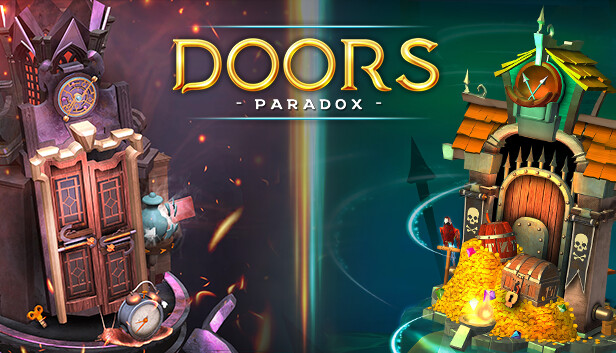
Each puzzle in Doors: Paradox takes place in a rotatable 3D diorama. Find objects and clues in the scene, then use them to open a door. Across 13 realms, the game contains 58 dioramas, each a self-contained puzzle space rather than part of a continuous room layout. It ranks eighth for its compact structure and relaxed presentation, making it a natural fit for players who prefer one contained scene at a time.
 Kinguin$0.40-98%Steam $0.40価格を見る →
| Aspect | Explanation |
|---|---|
| Why It's Ranked Here | Its compact dioramas make each scene’s boundaries and progress easy to understand, but the format is less like navigating continuous rooms. |
| Who It's For | A good fit for players who prefer one compact scene at a time and a relaxed presentation. |
| Key Selling Points | It offers 58 rotatable 3D dioramas across 13 realms, where players find objects and clues to open doors in a single-player structure. |
9. Tested on Humans: Escape Room #
A research center gives Tested on Humans: Escape Room a darker frame for familiar escape-room tasks such as decoding codes and finding hidden objects and clues. It ranks ninth because atmosphere is its clearest point of distinction. Choose it for that sinister setting; players who want a lighter mood may prefer another pick.
 Steam$1.99$9.99-80%価格を見る →
| Aspect | Explanation |
|---|---|
| Why It's Ranked Here | Its research-center premise gives familiar code-breaking and hidden-object investigation an unsettling context. |
| Who It's For | A fit for players comfortable with dark environments alongside logic puzzles. |
| Key Selling Points | It combines a single-player escape-room investigation with code decoding, hidden objects and clues, and a dark research-center setting. |
10. Escape First Alchemist #
In Escape First Alchemist, apprentices explore an alchemist workshop, find ingredients and recipes, and craft potions. You can play alone or in co-op with up to four players. It ranks tenth for adding a fantasy crafting layer to room-based escape puzzles, while its Steam listing gives English as the available language. The alchemy premise makes it a natural choice for players who can read English and want that extra crafting angle.
 Kinguin$0.47-96%Steam $0.47価格を見る →
| Aspect | Explanation |
|---|---|
| Why It's Ranked Here | Potion crafting gives its room-based puzzles a distinct fantasy angle, and co-op broadens the format. The Steam listing gives English as the available language. |
| Who It's For | A good choice for players who want fantasy crafting puzzles and optional co-op, and can read English. |
| Key Selling Points | It features an alchemist workshop, ingredients and potion recipes to discover, potion crafting, solo play, co-op for up to four players, and a voiced master. |
Comparison Table #
| Game | Genre | Why It's Ranked | Play Structure |
|---|---|---|---|
| The Room 4: Old Sins | Single-player mechanical puzzle adventure | Interconnected dollhouse rooms give close mechanical inspection a strong spatial identity. | A self-contained single-player investigation built around connected mechanical spaces. |
| Escape Simulator | First-person escape-room puzzle game | Movable objects put room interaction at the center, and creation tools extend the available scenarios. | Room-based scenarios for solo or online co-op play, with community content and creation tools. |
| Boxes: Lost Fragments | Single-player mechanical puzzle adventure | Elaborate puzzle boxes make for a focused alternative to large spaces. | A single-player progression through a sequence of puzzle boxes. |
| The House of Da Vinci 3 | Single-player historical mechanical puzzle adventure | Mechanical inventions are tied to a continuing Renaissance story, though this is the trilogy finale. | A story-led single-player campaign through a continuing adventure. |
| Escape From Mystwood Mansion | First-person mansion escape-room puzzle game | Mansion exploration, examinable objects, and dynamic hints support a recognizable escape-room structure. | A room-by-room escape with hidden subareas, hints, and multiple endings. |
| Machinika: Museum | Single-player science-fiction mechanical puzzle adventure | Alien devices give its contained observation and repair puzzles a science-fiction identity. | A single-player investigation organized around examining and repairing devices. |
| Escape Academy | Timed escape-room puzzle game | Structured scenarios support solo or paired play, with a timed format for added pressure. | Timed room challenges playable alone or with one co-op partner locally or online. |
| Doors: Paradox | Single-player diorama puzzle game | Self-contained scenes provide a compact alternative to continuous room layouts. | A sequence of rotatable dioramas where clues and objects lead to opened doors. |
| Tested on Humans: Escape Room | Dark single-player escape-room puzzle game | Its sinister research-center atmosphere distinguishes familiar escape-room tasks. | A single-player investigation using codes, hidden objects, and clues. |
| Escape First Alchemist | Fantasy escape-room crafting puzzle game | Potion crafting adds a fantasy variation to room-based escape puzzles. | A workshop escape where players explore, gather ingredients, follow recipes, and craft potions alone or with co-op partners. |
How to Pick the Right One #
| Preference | Recommended Games |
|---|---|
| Choose by puzzle shape → | The Room 4: Old Sins, Boxes: Lost Fragments, Machinika: Museum, and Doors: Paradox |
| Choose by room exploration → | Escape Simulator, Escape From Mystwood Mansion, Escape Academy, Tested on Humans: Escape Room, and Escape First Alchemist |
| Choose by story and atmosphere → | The House of Da Vinci 3, Machinika: Museum, Tested on Humans: Escape Room, and Escape First Alchemist |
FAQ #
Which games are suitable for solo play, and which require co-op? #
Every pick supports single-player play, so none requires co-op. Escape Simulator, Escape Academy, and Escape First Alchemist also offer it as an option. Escape Academy supports two-player local or online co-op, while Escape First Alchemist supports up to four players.
Which games focus on mechanical boxes rather than navigating rooms? #
The Room 4: Old Sins emphasizes intricate mechanisms inside an interconnected attic dollhouse, while Boxes: Lost Fragments focuses on elaborate puzzle boxes. Machinika: Museum centers on investigating and repairing alien devices. Doors: Paradox uses small, self-contained 3D dioramas instead of a continuous room layout.
What language limitations should players know about? #
The Steam listing for Escape From Mystwood Mansion gives English as the available language and does not list Chinese. The language table for Escape Academy lists English, French, German, and Spanish, but not Chinese. The Steam listing for Escape First Alchemist gives English as the available language and does not list Chinese. If Chinese support matters, check the current store language information before choosing one of these games.
Which games are best for players choosing by atmosphere? #
The House of Da Vinci 3 offers a Renaissance setting, mechanical inventions, time travel, and a continuing trilogy story. Machinika: Museum builds a science-fiction mystery around unfamiliar alien devices. Tested on Humans: Escape Room uses a dark research-center atmosphere, while Escape First Alchemist places its puzzles in a fantasy alchemist workshop with potion crafting.
How should a new player choose a starting game? #
Start with The Room 4: Old Sins for a focused introduction to interconnected mechanical devices. Choose Escape Simulator for first-person room navigation, movable objects, optional online co-op, and community rooms. Doors: Paradox works well if you prefer relaxed, self-contained scenes. Choose The House of Da Vinci 3 if you are already interested in its continuing trilogy story, since it is the finale rather than the best first story entry. Before choosing Escape From Mystwood Mansion, Escape Academy, or Escape First Alchemist, check whether the listed language options suit you.





コメント 0
ご意見をお聞かせください
このゲームについての感想や評価をお寄せください。
コメントはまだありません。最初の一件をどうぞ。